


Key takeaways
- Most trading companies don’t lose profit because demand is weak. They lose it because critical decisions get made on fragmented information — and the cost shows up in small leaks across sales, procurement, inventory, and finance simultaneously.
- The math is unforgiving: if Sales, Warehouse, Logistics and Finance each operate at 95% accuracy in isolation, the combined perfect-order rate is only ~81%.[1]
- €1.84 trillion of excess working capital is trapped globally, with DSO rising from 47 → 50 days between 2015–2024.[2]
- 43% of B2B credit sales are now overdue[3]; 70–75% of Letter-of-Credit documents are rejected on first submission[4]; 20–40% of shipments are delayed by documentation errors.[5]
- The fix isn’t software for its own sake. It’s integrated operational control across the entire order-to-cash and procure-to-pay cycle.
Overview
A salesperson promises a delivery date without knowing actual stock availability. Procurement places an urgent purchase order because inventory records are outdated. Finance discovers a customer exceeded their credit limit only after another order has been approved. Warehouse teams spend hours reconciling stock discrepancies that should never have existed.
These aren’t isolated incidents. They’re symptoms of disconnected business processes.
In a typical trading operation, every transaction passes through multiple departments. A customer inquiry becomes a quotation, the quotation becomes a purchase order (PO), the PO triggers procurement, logistics, inventory movements, invoicing, collections, and supplier payments. When these activities operate in separate spreadsheets, email chains, WhatsApp threads, and disconnected systems, visibility disappears — and operational friction follows:
- Sales teams can’t see credit exposure
- Procurement can’t accurately forecast demand
- Warehouse teams can’t trust stock records
- Finance spends most of its time reconciling instead of analysing
McKinsey’s supply-chain research is direct on the point: “Companies can manage supply chains only when they have a clear picture of each link.”[6] For trading businesses, that means controlling the entire order-to-cash and procure-to-pay cycle — not just individual transactions.
This article is the pillar that maps the full landscape. Each section introduces a major sub-topic and links to the deep-dive blog where it’s covered in detail.
What you’ll learn:
- How the trading process actually works end-to-end
- The 5 most common control failures — and where each one breaks
- What those failures really cost the business
- The 7 operational controls high-performing trading companies use
- How integrated ERP turns those controls into the default path of work
How Customer Orders Move Through Sales, Procurement, Inventory and Finance
Many operational problems become hard to solve because companies focus on departments instead of workflows. The customer, however, experiences only one process — from inquiry through delivery and payment.
The 12 Steps Every Trading Order Goes Through
| # | Stage | Department |
|---|---|---|
| 1 | Customer submits an RFQ (Request for Quotation) | Sales |
| 2 | Sales prepares a quotation | Sales |
| 3 | Internal teams validate pricing, availability, lead time, credit | Sales + Procurement + Finance + Inventory |
| 4 | Customer issues a PO | Sales |
| 5 | Procurement sources products from suppliers | Procurement |
| 6 | Logistics arranges shipment | Logistics |
| 7 | Inventory received, allocated, or dispatched | Warehouse |
| 8 | Delivery documents completed | Logistics |
| 9 | Customer invoice issued | Finance |
| 10 | Payment collected | Finance |
| 11 | Supplier payments settled | Finance |
| 12 | Profitability measured | Finance + Management |
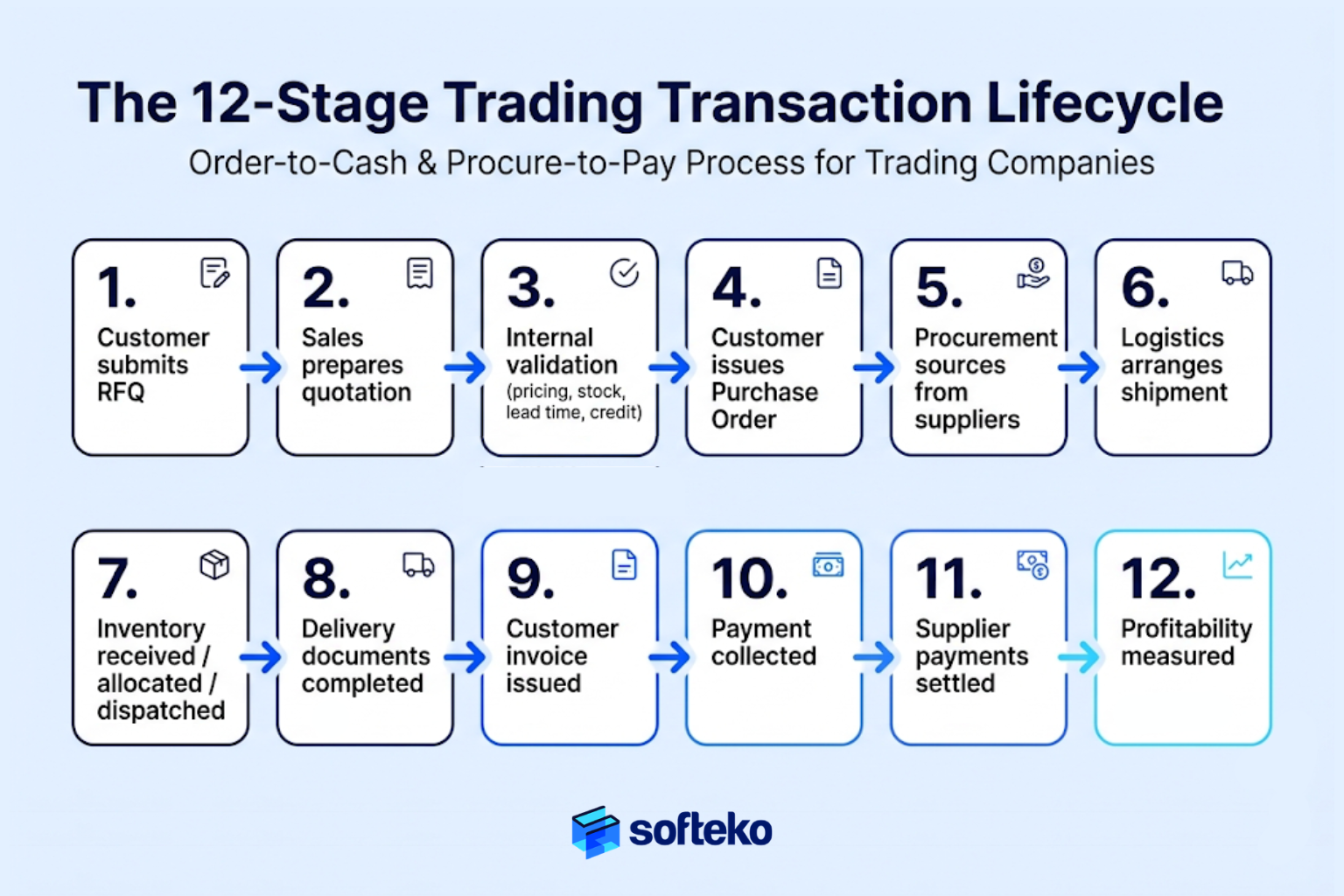
Every stage carries financial risk: a quotation creates pricing risk, a PO creates supply risk, inventory creates working-capital risk, credit terms create collection risk, shipment execution creates fulfilment risk. The objective of operational controls is not to add more approvals — it is to ensure the right information is available before financial commitments are made.
Why Trading Operations Become Harder to Control as They Grow
A single trading business may simultaneously execute direct supplier-to-customer shipments, warehouse-based fulfilment, intercompany transfers, local sales from stock, bulk cargo shipments, containerised shipments, bagging operations, and cross-border transactions. Each model introduces lead-time, customs, freight, allocation, and payment variables. Mature trading organisations rely heavily on operational controls because every transaction carries this risk — not because of bureaucracy.
5 Problems That Cause Delays, Stock Errors and Margin Loss
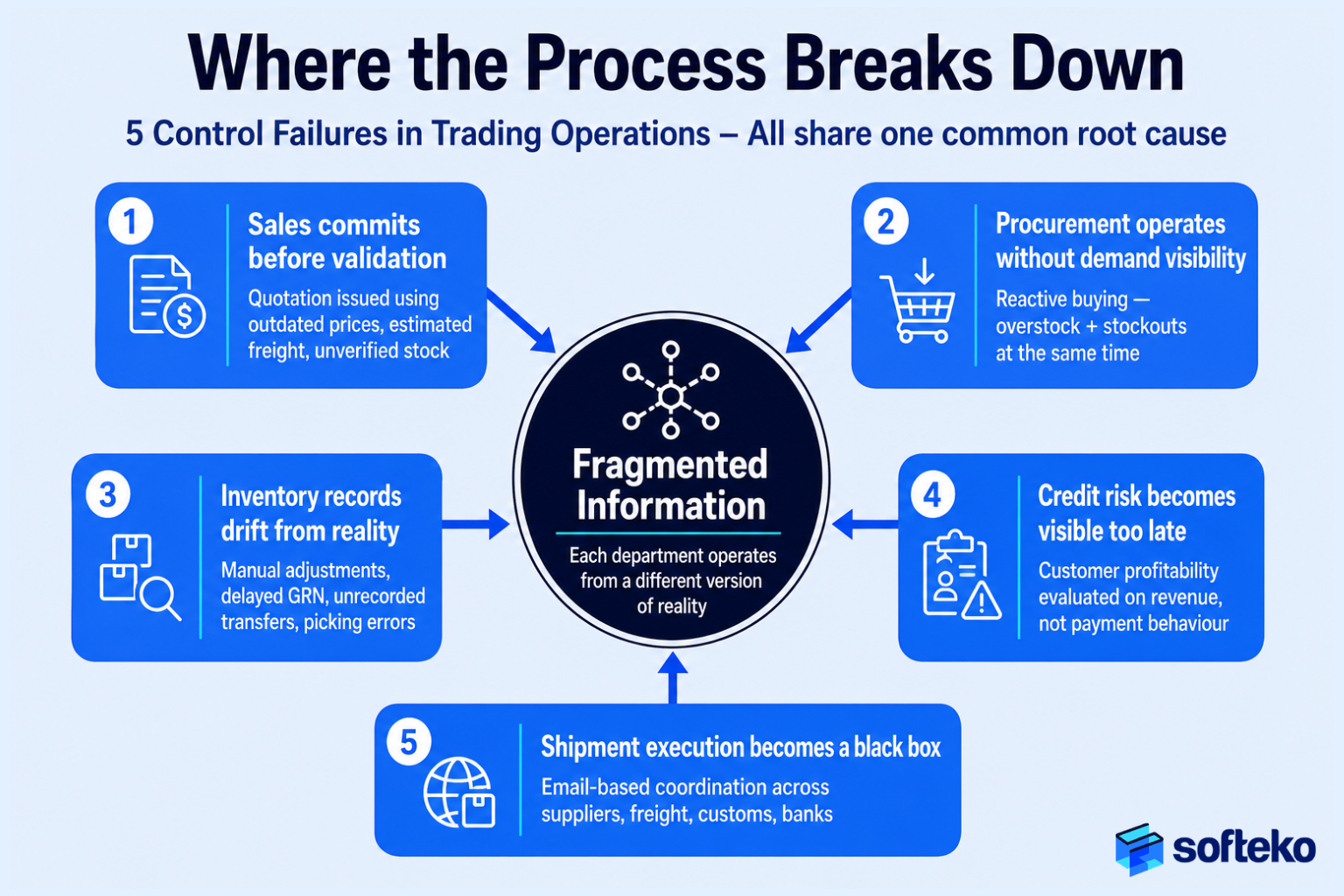
Most trading companies don’t suffer from a lack of effort. Employees work harder, managers chase updates, teams hold more meetings. Yet deliveries slip, inventory grows, and margins decline. The reason: operational failures rarely originate inside a single department — they occur between departments, at handoff points where information is lost and decisions are made on incomplete data.
| # | Failure | Where it originates | Read the deep dive |
|---|---|---|---|
| 1 | Sales commits before validation | Quotation issued using outdated supplier prices, estimated freight, unverified stock | (Pre-sales validation controls — covered in the section below) |
| 2 | Procurement operates without demand visibility | Reactive buying — overstock + stockouts simultaneously | Why Inventory Keeps Growing While Cash Flow Gets Worse |
| 3 | Inventory records drift from reality | Manual adjustments, delayed GRN posting, unrecorded transfers, picking errors | How Trading Businesses Achieve 99% Inventory Accuracy |
| 4 | Credit risk becomes visible too late | Customer profitability evaluated on revenue, not payment behaviour | Mastering Credit Control |
| 5 | Shipment execution becomes a black box | Email-based coordination across suppliers, freight, customs, banks | Streamlining LC, Shipping & Trade Documentation Workflows |
What Industry Data Says About Inventory, Credit and Shipment Risk
- Inventory accuracy is a leading predictor of fulfilment performance: a 1-point increase (98% → 99%) measurably improves on-time delivery.[7] Without it, every department compensates with buffers, assumptions, and emergency actions.
- Credit risk: 43% of B2B credit-based sales are overdue,[3] mostly from customer cash-flow pressure — not disputes. Days Sales Outstanding (DSO) has been rising for the past decade.[2]
- Shipment execution: ~70–75% of LC document presentations are rejected on first submission[4] for minor wording, timing, or UCP 600 misalignment; 20–40% of shipment delays trace back to documentation errors.[5]
All 5 Problems Start With Disconnected Information
At first glance these look like separate departmental issues. They’re not. The root cause is fragmented information: each department operating from a different version of reality, and management trying to decide across all of them. As transaction volume grows, the gaps between datasets grow with it — producing more reconciliation work, more emergency decisions, more firefighting, more margin leakage.
How These Problems Reduce Profit, Cash Flow and Customer Retention
Operational failures rarely appear as a single line on a P&L. No accounting report contains a category called “poor visibility.” Instead, the cost shows up across many areas simultaneously — and the compound effect is what most businesses miss.
| Cost layer | What it looks like | Why it stays invisible |
|---|---|---|
| Margin leakage | Quoted at 12% margin, realised at 8% — repeated across hundreds of transactions | Spread across many SKUs and customers; only surfaces in quarterly reviews |
| Inventory cash trap | Stock sitting 6+ months, working capital tied up before generating revenue | Inventory is shown as an asset, not as a cash commitment |
| Working capital pressure | Overdue invoices grow faster than collections; borrowing rises | Treated as a financing problem, not a receivables-discipline problem |
| Customer trust erosion | Late deliveries, partial shipments, doc errors → repeat-order frequency drops | Impact arrives months after the failure |
| Executive attention drain | Management resolving exceptions instead of strategising | Hours never logged as “cost of fragmentation” |
| Compound effect | A bad quotation → urgent procurement → expedited freight → late delivery → late collection → stretched supplier payments | Each item looks minor; the chain reaction doesn’t |
Zilliant’s analysis of industrial margin erosion reaches the same conclusion: margin erosion in trading and distribution is rarely a strategy problem — it’s a pricing-execution and cost-allocation problem.[8] Headline gross margin can stay stable while contribution margin quietly deteriorates because post-invoice adjustments aren’t visible in early reporting.
Why 95% Accuracy Still Creates Order Errors
Industry benchmarks consider a 96–98% order accuracy rate as “good” and 99.5%+ as high-performance.[9] That sounds healthy until you do the composite math.
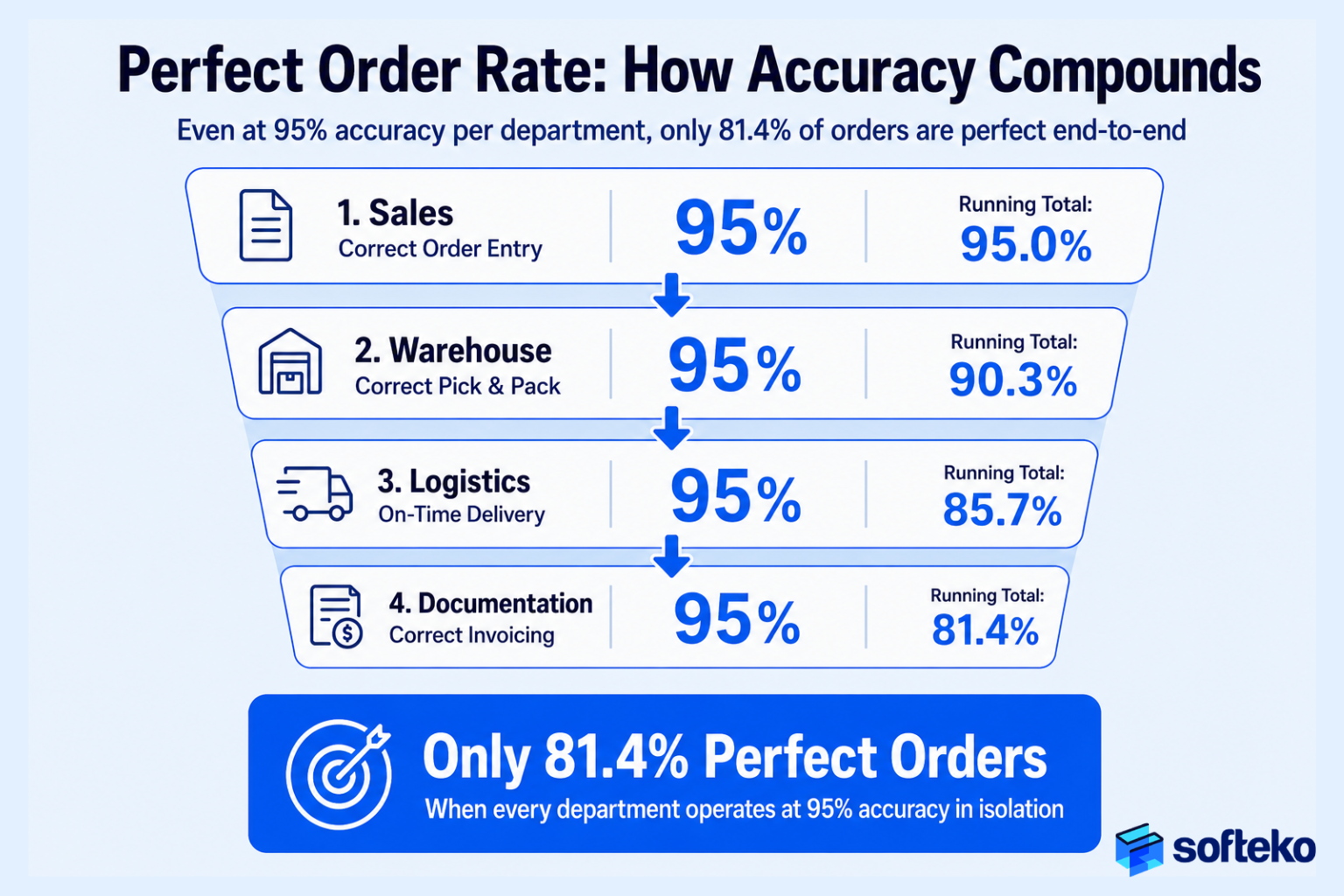
Why 95% Accuracy Produces Only 81% Perfect Orders
| Department | Accuracy | Running total |
|---|---|---|
| Sales (correct order entry) | 95% | 95.0% |
| Warehouse (correct pick/pack) | 95% | 90.3% |
| Logistics (on-time delivery) | 95% | 85.7% |
| Documentation (correct invoicing) | 95% | 81.4% |
If each department operates at 95% accuracy in isolation, fewer than 82 in every 100 orders are perfect end-to-end.[1] Hitting 95%+ end-to-end requires all four departments to operate well above 98% — which is impossible without a shared system.
This is why warehouse-only accuracy initiatives stall at ~90%. The deeper fix is covered in How Trading Businesses Improve Order Accuracy and Prevent Fulfillment Errors.
7 Controls That Prevent Delays, Stock Errors and Margin Loss
The difference between businesses that consistently protect margins and the rest is not perfection — it’s predictability. They build controls that surface risks before they become losses. Each control below has a dedicated deep dive in the cluster.
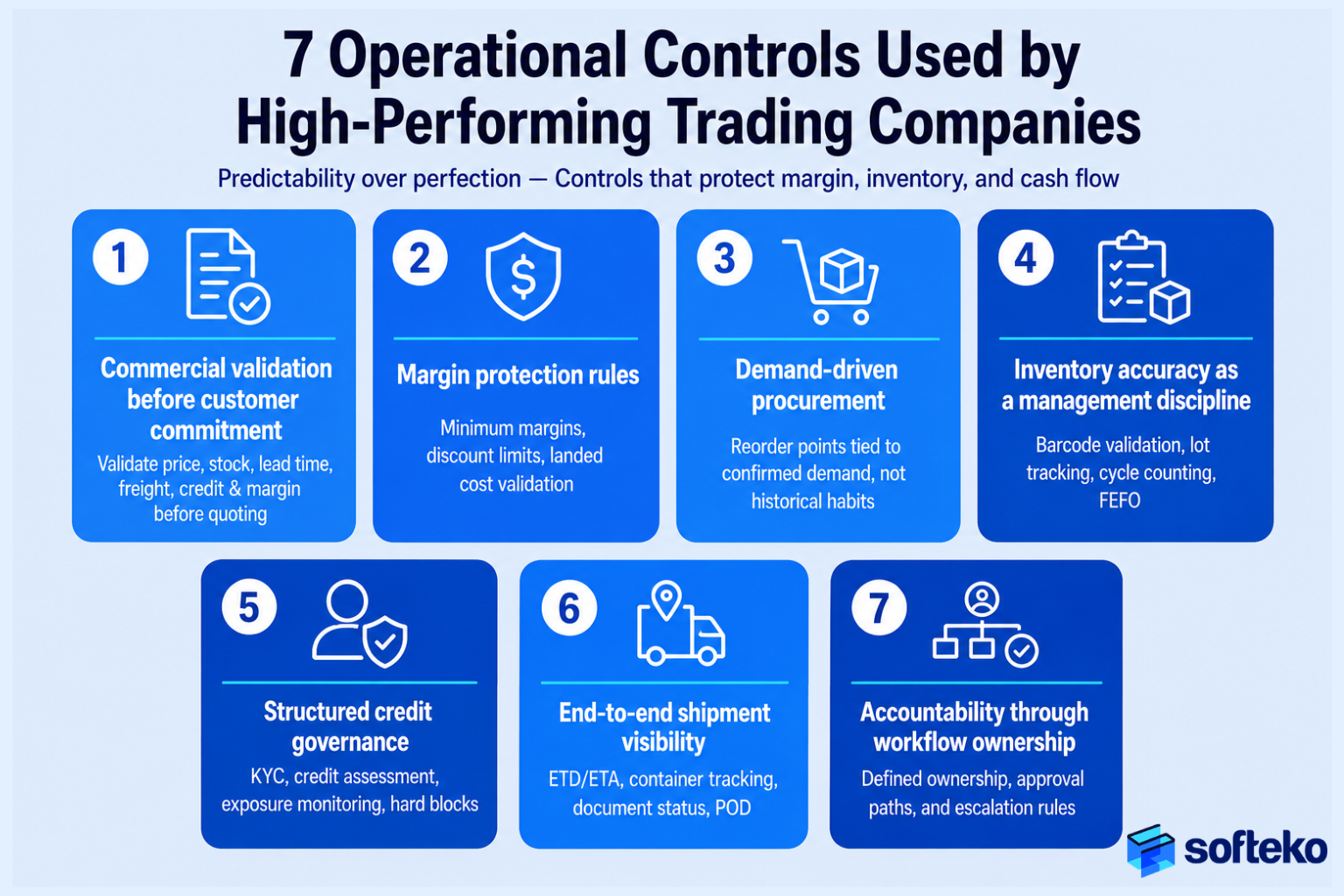
| # | Control | Purpose | Deep dive |
|---|---|---|---|
| 1 | Commercial validation before customer commitment | Treat quotations as financial commitments — validate supplier price, stock, lead time, freight, credit, margin before the customer sees a price | Landed Cost: The Hidden Expense Killing Your Profit Margins |
| 2 | Margin protection rules | Minimum margins, discount approval limits, landed-cost validation, exception tracking | Landed Cost + Import Cost Tracking |
| 3 | Demand-driven procurement | Reorder points and safety stock tied to confirmed demand, not historical habit | Why Inventory Keeps Growing While Cash Flow Gets Worse |
| 4 | Inventory accuracy as a management discipline | Receiving validation, lot/batch, FEFO, cycle counting — barcode-validated workflows deliver “traceability by design”[10] | How Trading Businesses Achieve 99% Inventory Accuracy |
| 5 | Structured credit governance | KYC, credit assessment, customer grading, exposure monitoring, hard blocks on overrides | Mastering Credit Control |
| 6 | End-to-end shipment visibility | ETD/ETA monitoring, container tracking, doc status, customs clearance, signed POD | Streamlining LC, Shipping & Trade Documentation Workflows |
| 7 | Accountability through workflow ownership | Every transaction has defined ownership, approval paths, escalation rules | All spoke blogs reinforce this |
What all 7 controls share
They all depend on information. Margin controls need cost visibility. Inventory controls need stock visibility. Credit controls need financial visibility. Without reliable, shared information, controls become manual — and manual controls break as transaction volume grows. That’s where ERP moves from “administrative software” to “operational control system.”
How ERP Enforces These Controls
ERP doesn’t improve trading performance by automating transactions. It improves performance by removing the information fragmentation that breaks every one of the 7 controls above.
| Without integrated ERP | With integrated ERP |
|---|---|
| Sales quotes from supplier price; landed cost unknown | Sales quotes from estimated landed cost; margin visible at quote |
| Procurement buys from spreadsheet; can’t see other warehouses | Procurement sees consolidated stock + reservations + incoming + aging |
| Warehouse trusts memory; discrepancies surface in cycle counts | Every movement scan-validated; cycle counting catches issues in days, not months |
| Credit limits live in finance system; sales doesn’t see them | Credit exposure visible at order entry; hard blocks on overrides |
| Shipment status scattered across freight portals & email | One operational view from quotation to POD |
| Finance reconciles at month-end; surprises arrive late | Variance visible as actual invoices arrive |
| “Where is X?” → multi-day investigation | “What’s at risk today?” → dashboard answer |
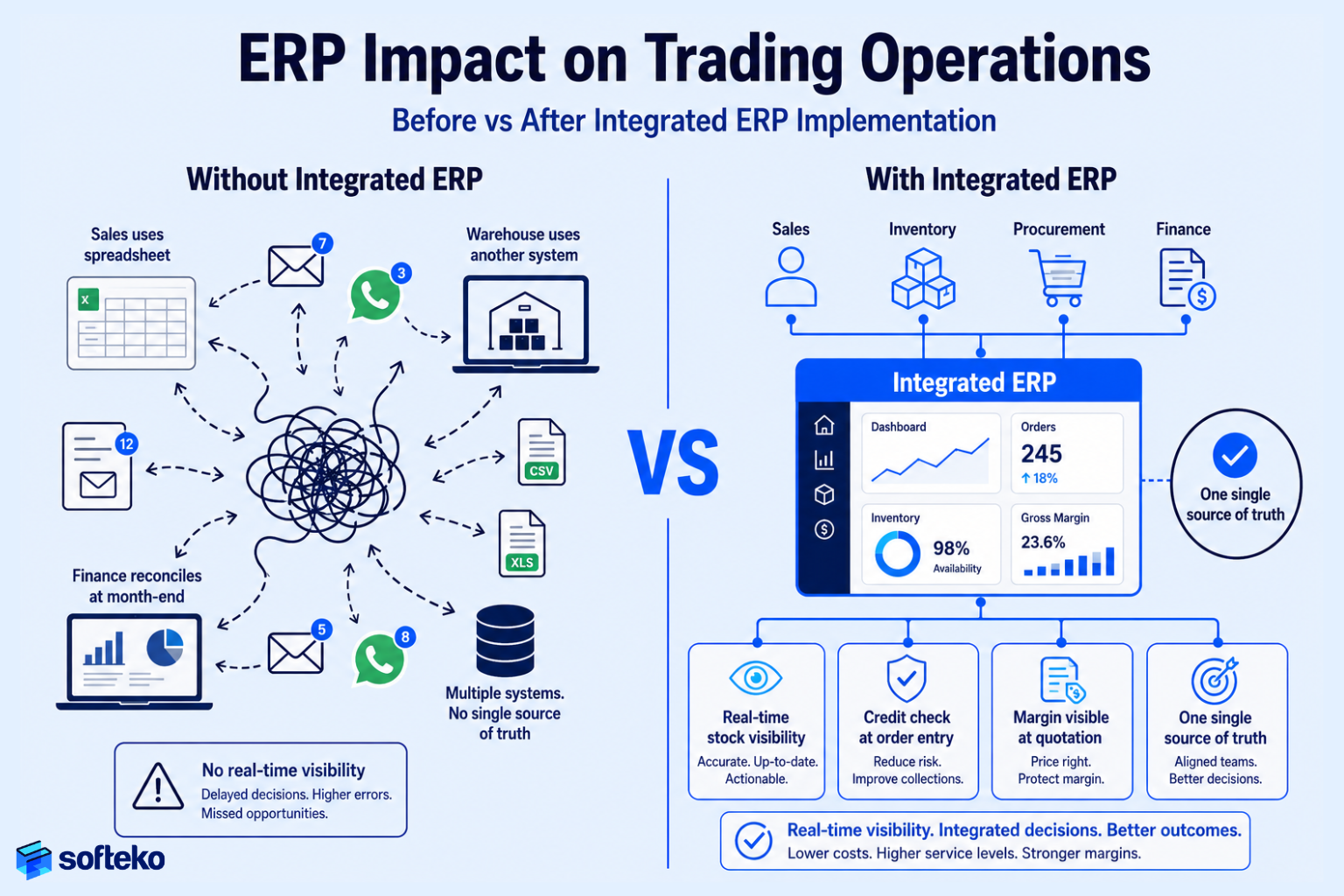
Oracle NetSuite’s analysis of ERP traceability frames this clearly: ERP advances traceability by creating a centralised platform where all stakeholders (Sales, Warehouse, Suppliers) input data into the same record — enabling tracking of granular details like batch and serial numbers, quality records, and approval history.[11]
ERP Cannot Fix Broken Processes
The implementations that consistently reduce margin leakage fix process discipline first, then deploy the system to enforce what already works. Automating broken processes just scales them. This is why mature trading-ERP projects don’t begin with “which modules?” — they begin with “what controls do we want enforced consistently?”
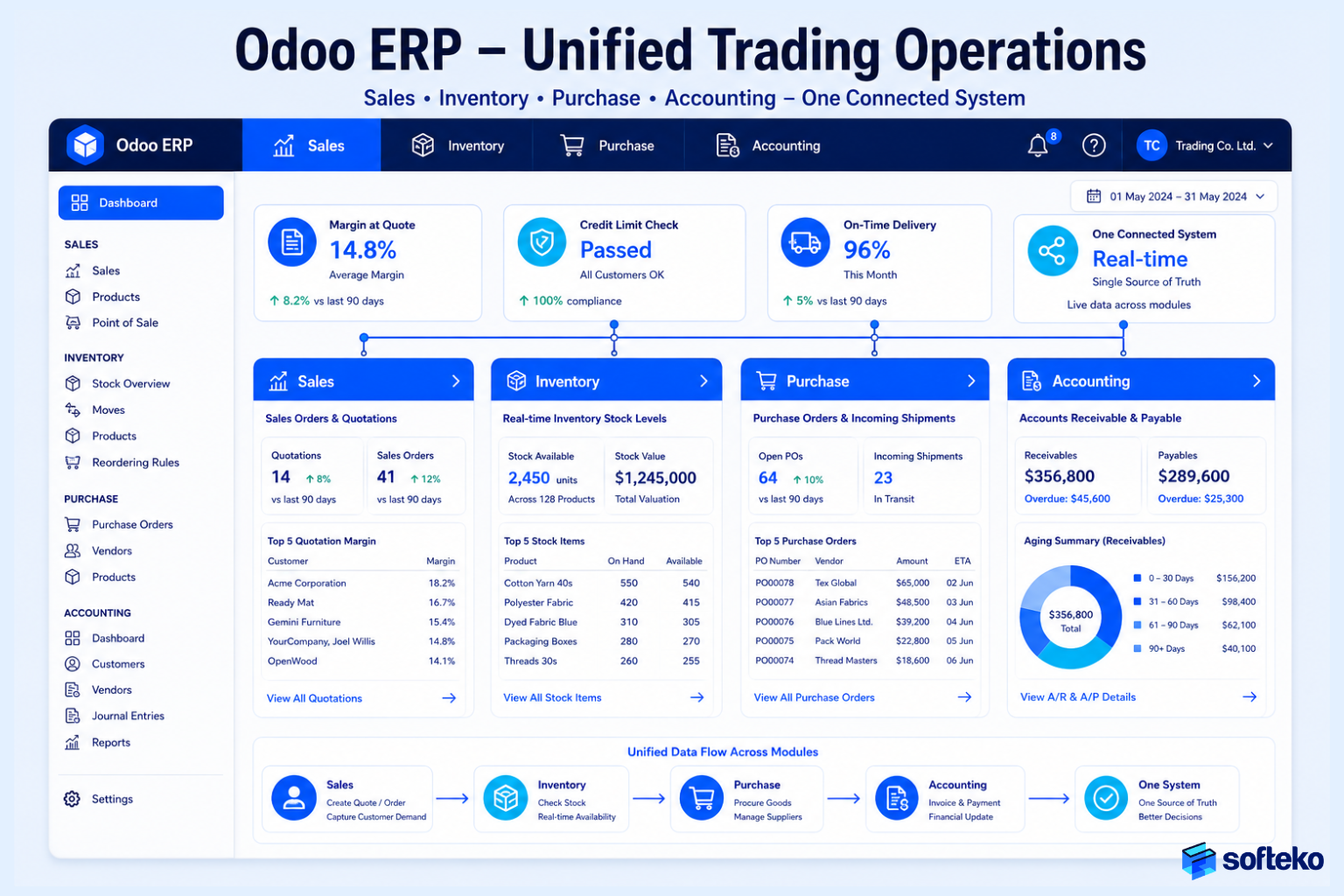
For trading businesses specifically, Odoo is particularly relevant because Sales, Inventory, Purchase, Accounting, Documents, and Approvals operate on a connected workflow rather than siloed modules — which is what these 7 controls require to function.
Why ERP Fails When You Ignore Standard Procedures
Some businesses see major improvements after ERP go-live. Others see almost none. The software is often identical. The difference is whether the 7 controls existed as enforced processes before the system went in.
If quotations are still issued by email outside the system, if approvals still happen verbally, if cycle counts are still postponed — ERP just digitises the same problems. The most successful implementations across the trading sector share five characteristics:
- Clear operational objectives (turnover, DSO, fill rate, margin variance — not “go-live date”)
- Strong executive sponsorship across Sales, Operations, and Finance
- Accurate master data before configuration begins
- Defined ownership and accountability at every workflow stage
- Continuous performance measurement after go-live
Fix Approval Rules and Workflows Before Implementing ERP
Most trading businesses already have the people, the products, and the customers they need to be profitable. What they often don’t have is the operational visibility to keep margin from leaking, inventory from growing, cash from tightening, and customer trust from eroding — all at the same time.
At Softeko, we help trading, wholesale, distribution and import-export businesses map their order-to-cash and procure-to-pay workflows, identify where margin and visibility break down, and implement Odoo ERP as the enforcement layer for the 7 operational controls above.
The objective isn’t to deploy software. It’s to build a trading operation where every commercial decision is made on complete information — before the financial consequence shows up.
FAQ
Why do profitable trading companies still run into cash and margin problems?
Because revenue, profit, and cash are three different things on three different timelines. As PwC’s 2025/26 working-capital data shows, DSO has risen 5.7% and DIO has risen 13.6% over the past decade — meaning cash is trapped longer in receivables and inventory even when sales are healthy.[2] Visibility into the chain of operational decisions matters more than the underlying P&L.
Is this a finance problem or an operations problem?
Both — and that’s the point. Operational decisions made in Sales, Procurement, Warehouse, and Logistics drive financial outcomes. Finance just records the consequences. Treating it as a finance-only problem produces collections improvements that don’t last because the upstream causes aren’t fixed.
What’s the highest-impact starting point?
Almost always the quotation-to-commitment stage — because most downstream margin leakage gets baked in at the quote. Pre-sales validation (supplier price, stock, lead time, freight estimate, credit exposure) before any commercial commitment prevents the largest share of failures.
Will ERP automatically fix these issues?
No. ERP enforces discipline — it doesn’t create it. The implementations that work define the operational controls first, then configure the system to enforce them consistently across volume.
Where does Odoo fit specifically?
Odoo connects Sales, Inventory, Purchase, Accounting, Approvals, and Documents in one operational record. For trading businesses, this matters because the 7 controls described above all require the same underlying capability — a shared transaction view across departments. The blogs linked above each cover the specific Odoo modules and capabilities in detail.
References
- Benchmarking Success — The Perfect Order KPI — https://www.benchmarkingsuccess.com/the-perfect-order-kpi-is-it-the-best-metric-ever/
- PwC Working Capital Study 25/26 — https://www.pwc.co.uk/services/business-restructuring/insights/working-capital.html
- Atradius — B2B Payment Practices Trends in North America 2025 — https://group.atradius.com/knowledge-and-research/reports/b2b-payment-practices-trends-in-north-america-2025
- Forbes / ICC — How Blockchain Is Redefining Letter of Credit Documentation in Global Trade Finance — https://www.forbes.com/councils/forbesfinancecouncil/2026/02/03/how-blockchain-is-redefining-letter-of-credit-documentation-in-global-trade-finance/
- BCG — The Hidden Power of Customs Management in Global Trade (2025) — https://www.bcg.com/publications/2025/hidden-power-customs-management-global-trade
- McKinsey & Company — Taking the Pulse of Shifting Supply Chains — https://www.mckinsey.com/capabilities/operations/our-insights/taking-the-pulse-of-shifting-supply-chains
- Logistics Viewpoints / APQC — The High Cost of Inventory Accuracy — https://logisticsviewpoints.com/2019/03/12/high-cost-inventory-accuracy/
- Zilliant — Why Profit Margins Are Declining in Industrial Manufacturing — https://zilliant.com/blog/why-profit-margins-are-declining-in-industrial-manufacturing-where-theyre-really-going
- Omniful — The True Cost of Poor Order Accuracy — https://www.omniful.ai/blog/the-true-cost-of-poor-order-accuracy
- Clarus WMS — The Importance of Barcodes in Warehouses — https://claruswms.co.uk/the-importance-of-barcodes-in-warehouses/
- Oracle NetSuite — Supply Chain Traceability — https://www.netsuite.com/portal/resource/articles/erp/supply-chain-traceability.shtml