


Key takeaways
- Fulfillment errors are usually blamed on the warehouse, but the warehouse only exposes problems that started earlier — in requirement capture, order changes, or inventory records.
- The median company achieves only a ~90% perfect-order rate, meaning roughly 1 in 10 orders has some defect.[1] Even if every department hits 95% accuracy individually, the combined rate falls to ~81%.
- A foundational study found 65% of inventory records were inaccurate across ~370,000 records[2] — well before anyone touches a picking slip.
- Barcode-validated workflows lift inventory accuracy from ~63% (manual) to 99.9%[3] — but only when the upstream process is sound. Bad process automated faster is still bad process.
- A single mis-shipment costs $10–$250 in direct rework alone[4] — before lost customers, returns, or trust erosion are counted.
- The fix isn’t a better warehouse. It’s validation at every handoff: requirement → inventory → pick → pack → dispatch → POD. ERP makes those controls enforceable at scale.
Overview
Fulfillment errors are often blamed on warehouse execution. In reality, the warehouse usually exposes problems that originated earlier in the order-to-delivery process.
Customer requirements move through sales, inventory validation, picking, packing, dispatch, delivery, and proof of delivery. Accuracy depends on information remaining accurate at every stage. When order updates are missed, inventory records are unreliable, or departments work from different versions of information, fulfillment risk increases long before a product is picked.
This explains why businesses can report strong performance in individual functions yet still struggle with perfect-order performance. Customers evaluate the entire process as a single experience, not as separate departmental activities. A breakdown anywhere in the workflow becomes a fulfillment failure from the customer’s perspective.
This article examines:
- Where order accuracy actually breaks down
- What those failures cost
- Which operational controls reduce risk
- How ERP supports a controlled order-to-delivery workflow
How Order to Delivery Works in a Trading Business
Order accuracy is not a warehouse KPI. It is the result of a workflow that starts when a customer communicates a requirement and ends when that customer confirms receipt of the correct product, quantity, documentation, and delivery.
7 Steps from Customer Order to Delivery
| Stage | What Happens | Key Risk |
|---|---|---|
| 1. Requirement Capture | Sales captures product specs, quantities, pricing, delivery requirements, commercial terms | Incomplete or inconsistent information |
| 2. Quotation → Sales Order | Approved quotation becomes the foundation for downstream activities | Order modifications not tracked |
| 3. Inventory Validation | Confirm stock availability in correct quantities and locations | Phantom inventory, stale data |
| 4. Picking | Warehouse selects items based on order instructions | Wrong product, wrong quantity, wrong location |
| 5. Packing | Verify correct products, quantities, labels, shipping documents | Missing items, incorrect labels |
| 6. Dispatch | Manage transportation and verify shipment details | Wrong address, wrong carrier |
| 7. Proof of Delivery | Customer confirms receipt; transaction closes operationally | No confirmation record, disputes unresolved |
Notice what ties every stage together: information.
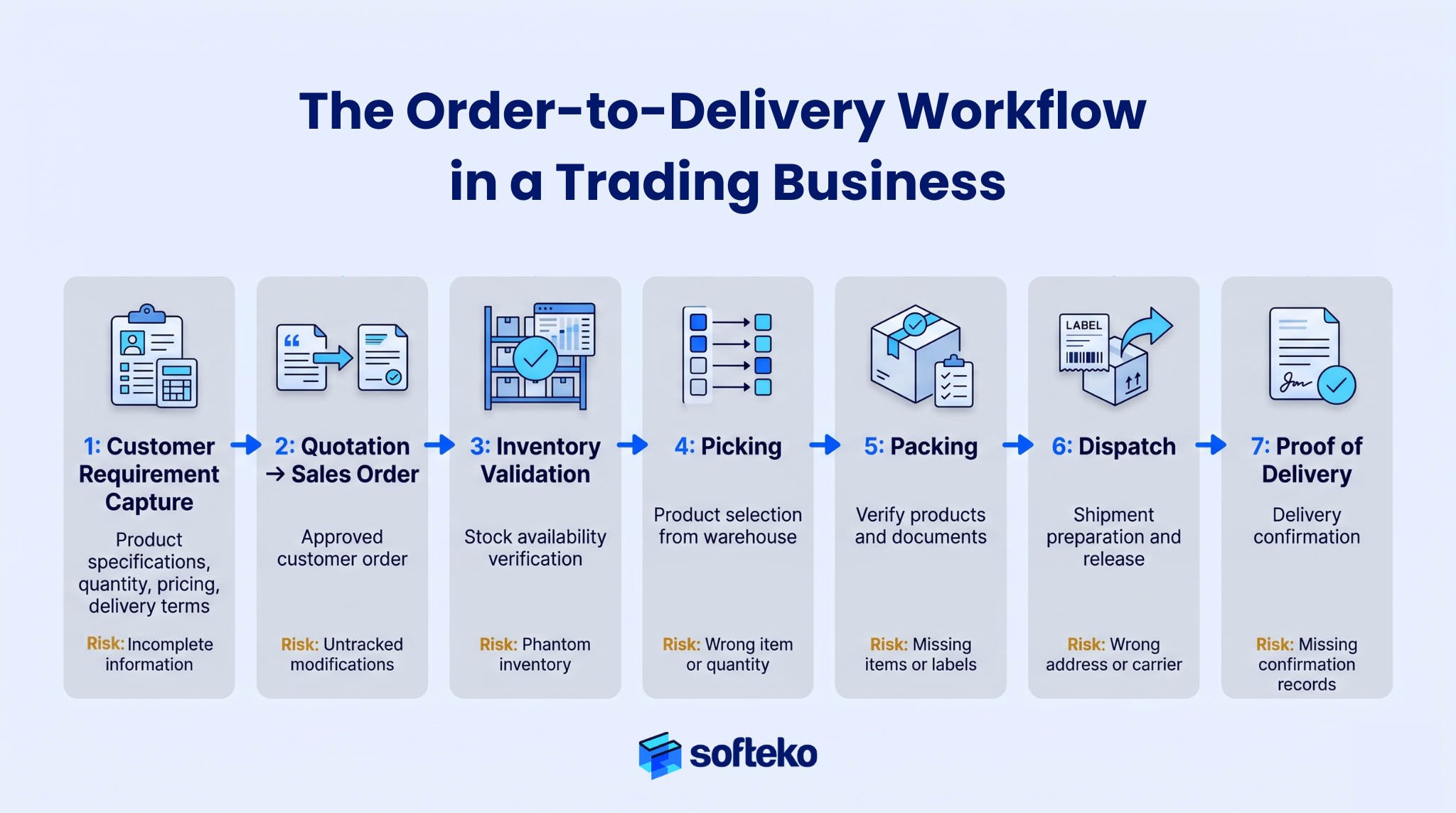
Products move physically through the warehouse, but order accuracy depends on information moving accurately between sales, inventory, warehouse, logistics, and customer-facing teams. Every handoff transfers both responsibility and risk.
This is why fulfillment accuracy should be viewed as an order-to-delivery process rather than a warehouse activity. The warehouse executes the order, but the quality of execution depends on the quality of information received from the stages before it.
Why Customers Receive Wrong Products, Quantities, or Deliveries
Most businesses discover fulfillment problems when a customer reports:
- Wrong item
- Incorrect quantity
- Missing product
- Delivery discrepancy
The visible error appears during fulfillment. The actual cause often exists much earlier in the workflow.
7 Common Causes of Order and Delivery Mistakes
| Breakdown Point | What Goes Wrong | Why It Matters |
|---|---|---|
| 1. Requirement Capture | Customer specs, substitute requests, delivery instructions recorded incompletely | Every downstream team works from inaccurate information |
| 2. Order Modifications | Changes to quantities, dates, products, shipping not communicated across teams | Warehouse continues using outdated instructions |
| 3. Inventory Visibility | System shows available stock; physical inventory disagrees | Forces last-minute substitutions, partial shipments, emergency procurement |
| 4. Picking Errors | Similar descriptions, high SKU counts, poor location management, paper-based processes | Probability of wrong item increases with complexity |
| 5. Packing Mistakes | Correctly picked order leaves with wrong quantities, missing items, incorrect labels | Errors remain undetected until delivery |
| 6. Dispatch Failures | Shipment details not verified against original order | Accurate warehouse work becomes inaccurate delivery |
| 7. Proof of Delivery | No confirmation records | Disputes over missing items, quantity discrepancies, damage claims become unresolvable |
Why the Same Mistakes Keep Happening
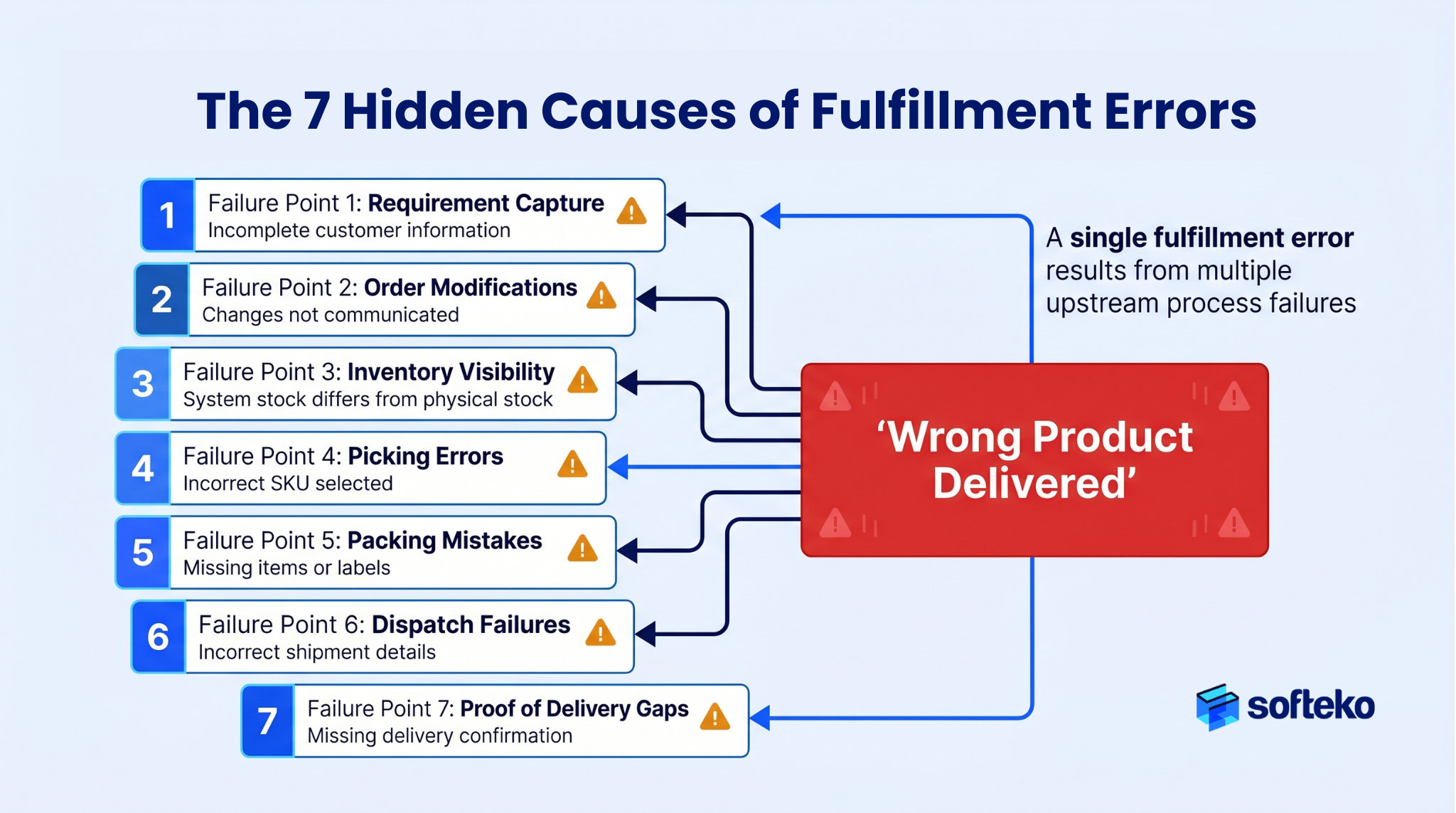
Across all these breakdowns, one pattern emerges:
The issue is rarely a single warehouse mistake. Most fulfillment failures originate from disconnected information flow, manual handoffs, weak validation controls, and limited visibility between departments.
The warehouse simply becomes the stage where those upstream problems become visible.
What Research Says About Order and Delivery Mistakes
How Small Mistakes Turn Into Customer Problems
Order accuracy benchmarks reveal an important reality: strong individual metrics do not automatically produce strong customer outcomes.
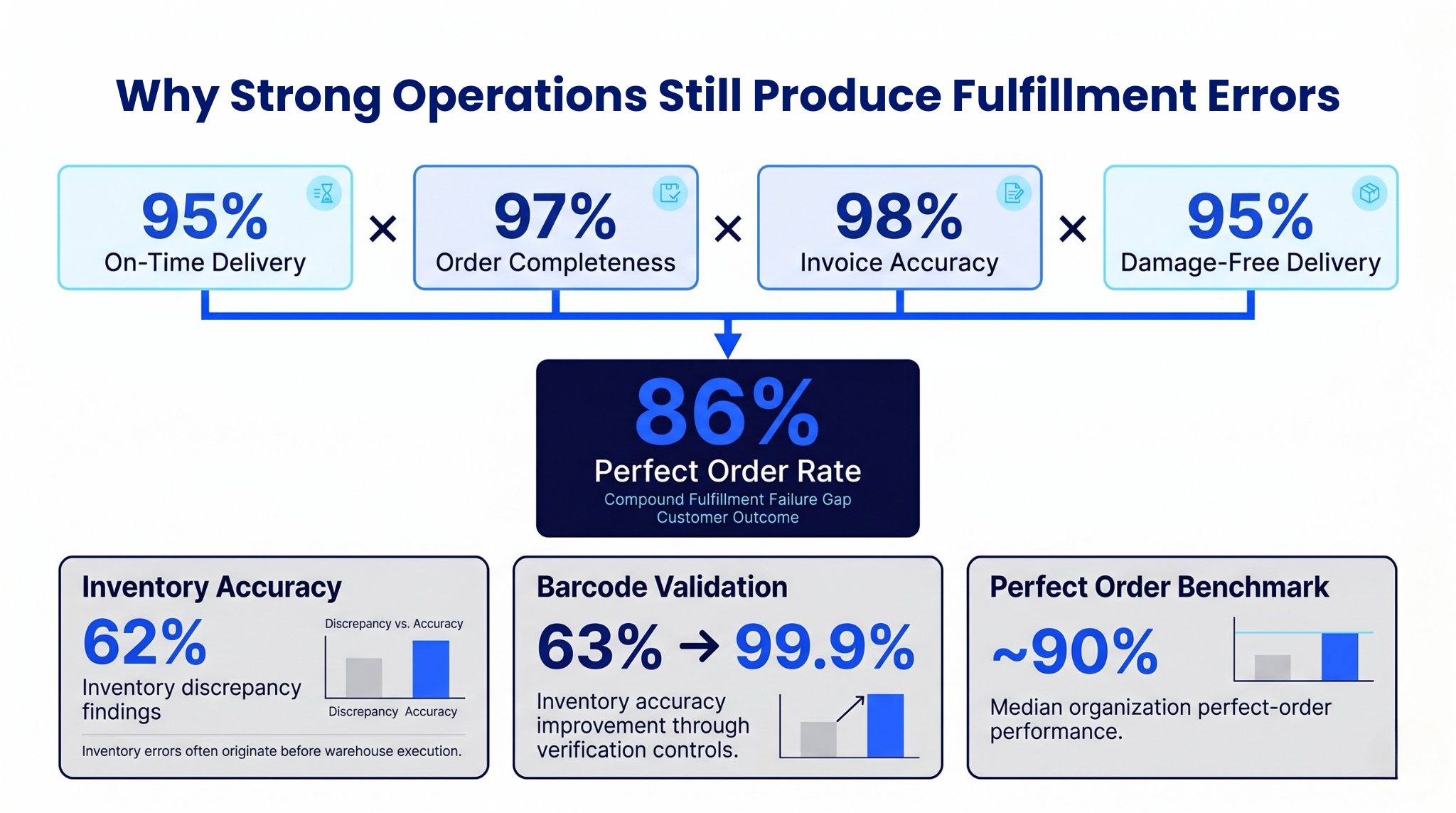
Warehouse performance studies suggest that leading operations target order accuracy rates between 99.5% and 99.9%.[5] At first glance, those numbers appear exceptionally high. The problem is that customers experience the entire order lifecycle, not individual activities.
A business can achieve 99% performance across multiple functions and still generate a surprisingly low perfect-order rate because errors compound across the workflow.
Consider this example from Benchmarking Success:
| Metric | Performance |
|---|---|
| On-time delivery | 95% |
| Order completeness | 97% |
| Invoicing accuracy | 98% |
| Damage-free delivery | 95% |
| Combined perfect-order rate | ~86% |
Individually, each metric appears healthy. Combined, however, the perfect-order rate falls to approximately 86%. In practical terms, nearly 1 in every 7 orders still fails somewhere in the process.
Why Other Companies Make Order Errors
Research on fulfillment performance shows that the median organization operates at roughly a 90% perfect-order rate.[1] That means 1 out of every 10 orders experiences some form of failure—whether through quantity discrepancies, delivery issues, documentation errors, inventory problems, or fulfillment mistakes.
Why Inventory Errors Lead to Delivery Problems
Inventory accuracy emerges repeatedly as one of the strongest predictors of fulfillment performance.
Studies examining order management processes found inventory discrepancies in 62% of analyzed records, with root causes linked to:
- Poor data validation
- Communication failures
- Manual processes
- System gaps
Rather than warehouse execution itself.[6]
This supports a recurring operational observation: fulfillment errors often originate before warehouse activity begins.
What Happens When Inventory Records Are Wrong
The relationship between inventory accuracy and fulfillment performance becomes even clearer when examining cost impact:
- Research cited by Mecalux (citing University of Twente) found that unresolved inventory discrepancies can increase operational costs by more than 95%.[7]
- When inventory records cannot be trusted, businesses experience:
- Stockouts
- Emergency purchasing
- Shipment delays
- Manual investigations
- Avoidable customer service activity
Why Validation Checks Prevent Delivery Mistakes
Research on barcode-enabled warehouse operations shows inventory accuracy improving from manual levels near 63% to as high as 99.9% when verification occurs during receiving, storage, picking, and shipping activities.[3]
The finding is significant because it demonstrates that many fulfillment errors are not caused by physical inventory movement but by weak validation processes surrounding that movement.
Customer Impact
Academic studies found that:
- Order discrepancies have a strong negative effect on customer trust (β = 0.559, p < 0.001)
- Order accuracy directly influences customer satisfaction (β = 0.287, p < 0.001)
- Customer satisfaction drives long-term loyalty (β = 0.345, p < 0.001)[8]
For trading businesses that depend on repeat purchasing relationships, fulfillment performance is not simply an operational metric — it is a customer retention metric.
What Successful Trading Businesses Do Differently
Taken together, the evidence points toward a consistent conclusion:
Businesses rarely suffer from a single warehouse problem. They suffer from multiple small process failures that accumulate across order capture, inventory management, fulfillment execution, and delivery.
The organizations that achieve high order accuracy are typically the ones that control information flow, validation, and accountability across the entire order-to-delivery process.
What Order and Delivery Mistakes Are Really Costing Your Business
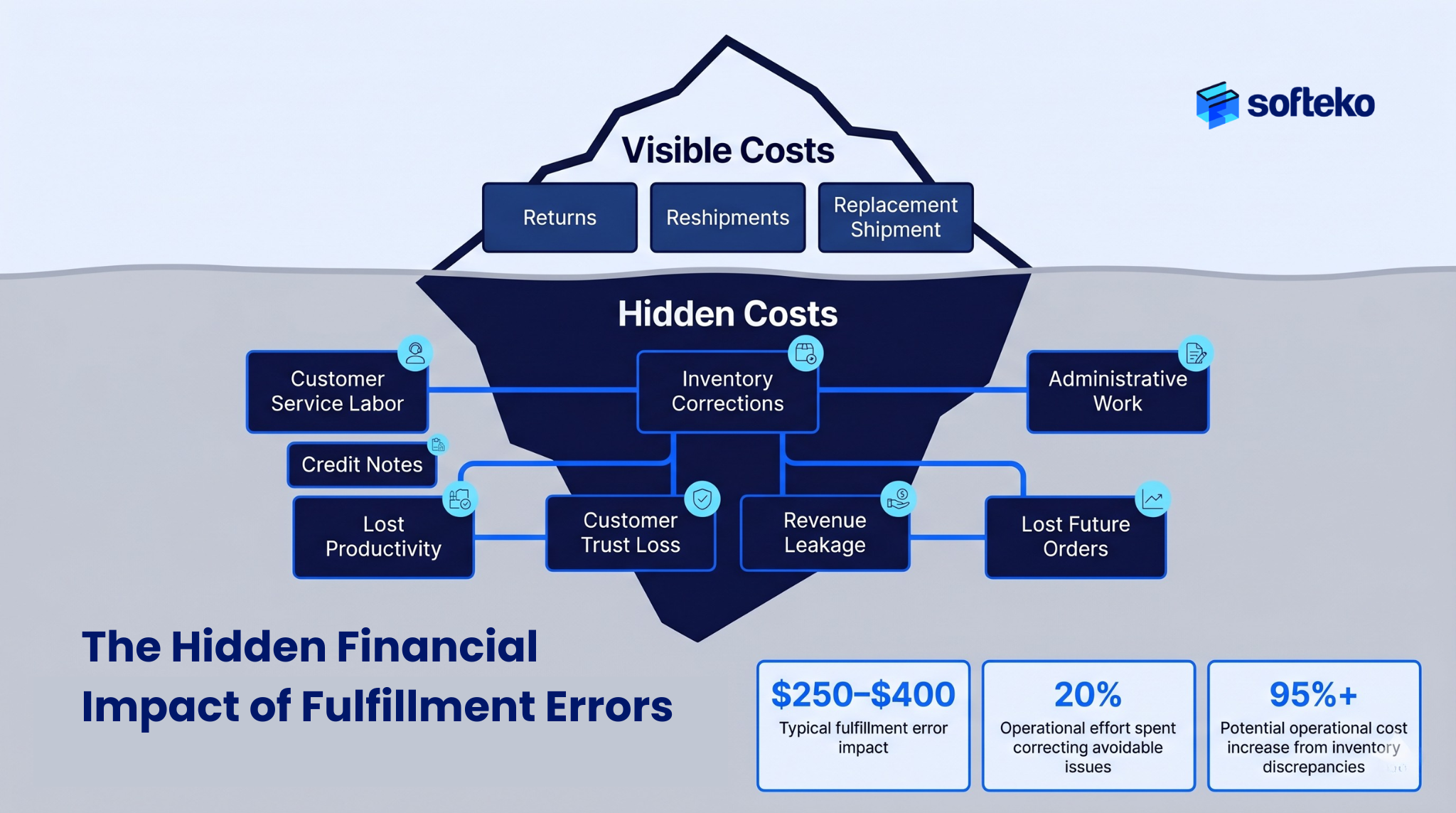
Most businesses calculate the direct cost of a fulfillment error. Far fewer calculate the total operational cost.
How One Delivery Mistake Creates Multiple Costs
A wrong shipment does not end with a return. The process often triggers:
- Customer service involvement
- Return authorization
- Replacement picking
- Repacking
- Reshipping
- Inventory adjustments
- Credit notes
- Invoice corrections
- Additional administrative work
What appears to be a single mistake becomes multiple unplanned activities across several departments.
Cost Per Error
| Cost Category | Typical Range |
|---|---|
| Direct cost per fulfillment mistake | $250 – $400 |
| Returns and reshipments (upper bound) | Up to $300 |
| Operational cost spiral | +25% |
| Cost as percentage of order value | Up to 30% |
| Processing cost per returned item | $20 – $30 |
Sources: Alexander Jarvis[9], Finale Inventory.[3]
How Delivery Mistakes Waste Employee Time
Teams spend time:
- Investigating discrepancies
- Reconciling inventory records
- Responding to customer complaints
- Coordinating replacement shipments
- Correcting documents
Research indicates that organizations can devote up to 20% of operational effort to correcting avoidable fulfillment issues.[9]
Every hour spent fixing preventable mistakes is an hour not spent serving customers or improving operations.
Why Inventory Errors Increase Costs
When inventory records are unreliable, businesses:
- Purchase products they already own
- Hold excess safety stock
- Expedite shipments to recover missed orders
- Lose sales due to perceived stockouts
Studies have linked inventory discrepancies to operational cost increases exceeding 95% in certain environments.[7]
Customer Retention Risk
Academic research shows a strong relationship between order fulfillment quality, customer satisfaction, trust, and long-term loyalty.[8]
- 32% of shoppers are ready to abandon a brand after one negative experience.[9]
- A customer may tolerate occasional delays, but repeated fulfillment failures gradually undermine confidence
This matters particularly in trading businesses where customer relationships often generate revenue over many years.
Losing a customer rarely means losing a single order. It means losing:
- Future orders
- Recurring revenue
- Referral opportunities
- Market reputation
Why Delivery Mistakes Become More Expensive as You Grow
| Order Volume | Error Impact |
|---|---|
| 50 orders/month | Occasional errors absorbable through manual intervention |
| 5,000 orders/month | Small process weaknesses become significant financial liabilities |
Small process weaknesses that appear manageable at low volume become significant financial liabilities as transaction volume grows.
The Business Impact of Order and Delivery Mistakes
Fulfillment errors are not simply warehouse mistakes. They create:
- Revenue leakage
- Increased operating costs
- Consumed management attention
- Reduced customer confidence
- Pressure on margins
The financial impact extends far beyond the cost of replacing an incorrect shipment.
7 Controls That Prevent Order and Delivery Mistakes
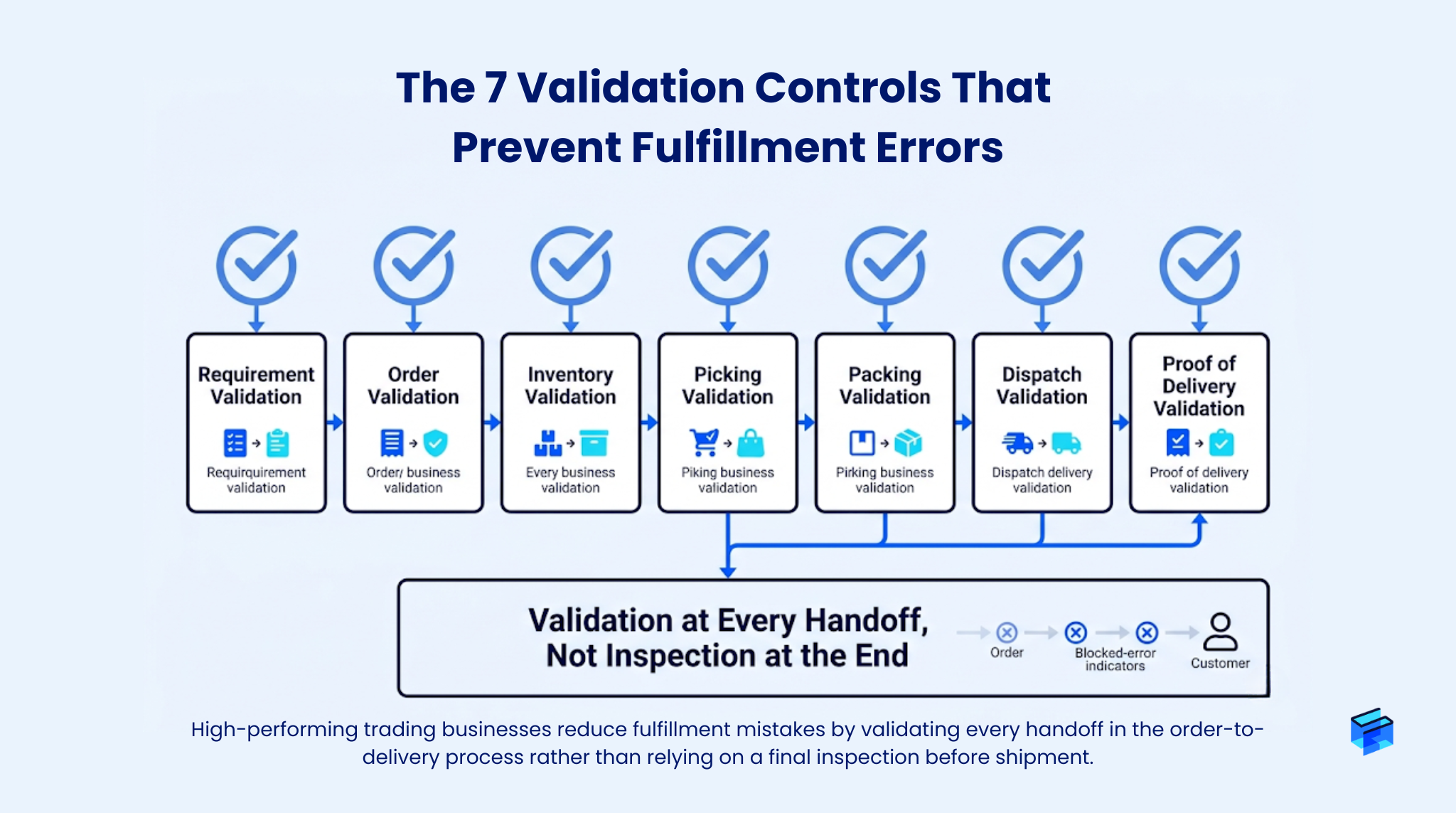
Businesses that consistently achieve high order accuracy rarely depend on individual effort alone. They build controls into the workflow so that errors are detected before they reach the customer.
The Seven Validation Controls
| Control | Purpose | What It Prevents |
|---|---|---|
| 1. Requirement Validation | Verify product specs, quantities, delivery instructions, pricing, commercial terms before order finalization | Downstream correction work |
| 2. Order Validation | Ensure changes to quantities, products, dates, shipping are visible to all fulfillment teams | Warehouse executing outdated instructions |
| 3. Inventory Validation | Confirm system records accurately reflect physical stock before committing to customer | Fill-rate failures, stockouts, emergency purchasing |
| 4. Picking Validation | Verify correct product, quantity, and location using system checks — not memory or paper | Wrong item, wrong quantity, wrong location |
| 5. Packing Validation | Confirm picked items match original order; quantities correct; documentation complete | Errors before transportation costs are incurred |
| 6. Dispatch Validation | Verify shipping info, delivery addresses, carrier instructions, transport docs align with order | Accurate warehouse work → inaccurate delivery |
| 7. Proof-of-Delivery Validation | Confirm what was delivered, when, and who received it | Disputes unresolved, accountability gaps |
Key Insight
None of these controls depend on technology alone. They are process controls first.
Technology becomes valuable because it helps enforce these controls consistently across:
- Departments
- Transactions
- Warehouses
- Growing order volumes
Organizations that improve fulfillment performance typically strengthen validation at every handoff rather than focusing on a single warehouse activity. They reduce opportunities for bad information to move through the process unchecked.
How ERP Improves Order-to-Delivery Visibility
The operational controls discussed earlier become increasingly difficult to maintain as:
- Order volumes grow
- SKU counts expand
- Warehouses multiply
- Customer segments diversify
- Departments specialize
The challenge is no longer knowing what the controls should be. The challenge is enforcing them consistently.
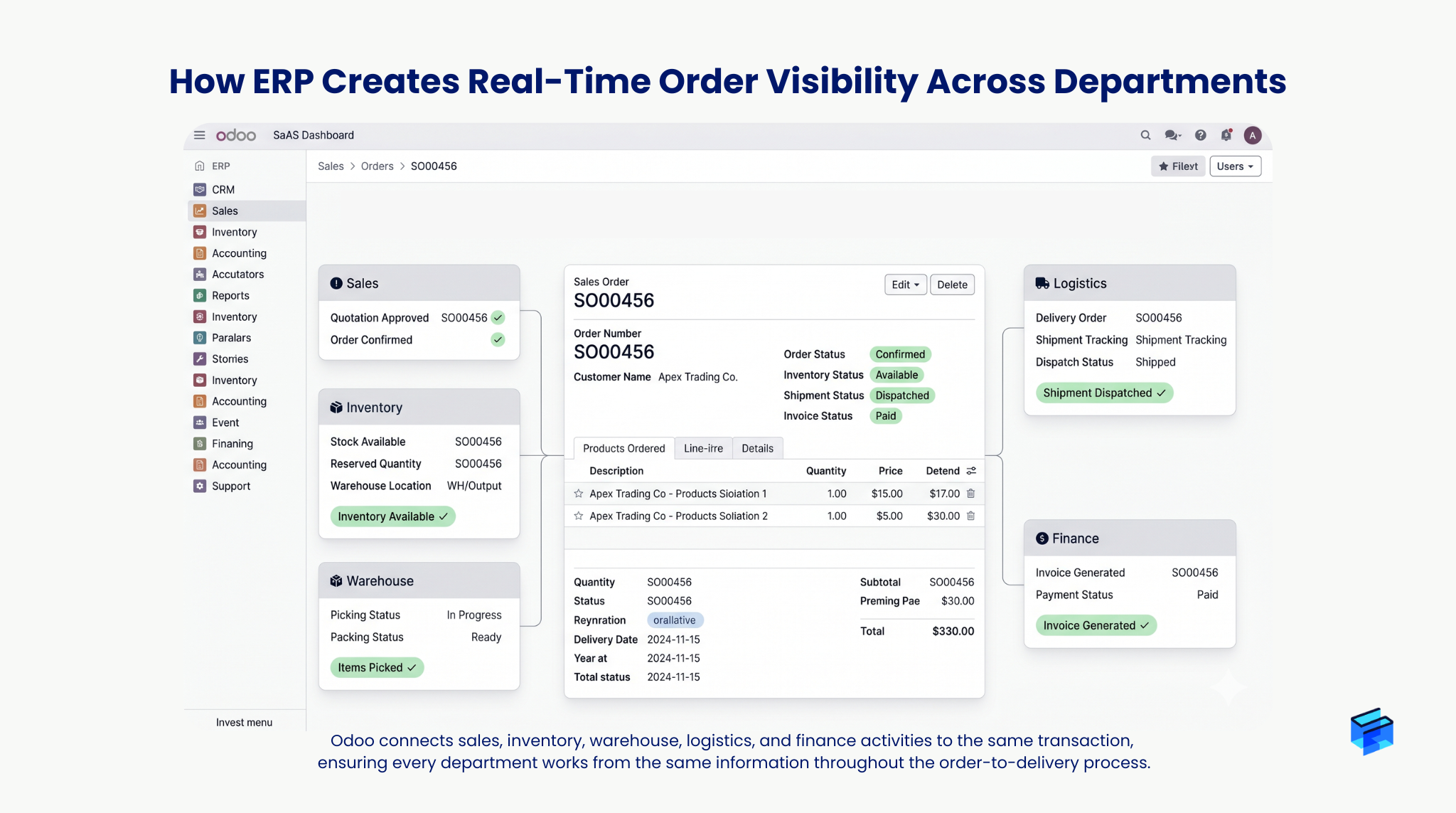
This is where ERP functions as a visibility and accountability system.
How ERP Replaces Spreadsheets, Emails, and Manual Tracking
| Before ERP | After ERP |
|---|---|
| Sales, inventory, warehouse, logistics, finance maintain separate records | Shared operational view of the order across all teams |
| Order changes exist in emails, spreadsheets, phone calls | Changes become visible to all teams in real time |
| Inventory decisions based on spreadsheets, emails, manual checks | Decisions based on current, synchronized inventory data |
| Discrepancies discovered by customer complaint | Root causes identified proactively |
| Validation happens inconsistently or not at all | Systematic checkpoints at every workflow stage |
How ERP Prevents Order and Delivery Mistakes
1. Order Visibility
When sales updates an order, the change becomes visible to the teams responsible for:
- Inventory allocation
- Fulfillment
- Delivery
This reduces the risk of departments working from different versions of the same transaction.
2. Inventory Synchronization
Inventory movements, receipts, allocations, transfers, and deliveries update a common inventory record. Decisions are based on current information rather than spreadsheets, emails, or manual status checks.
3. Traceability
Businesses can track how an order moved from:
- Quotation → Sales order
- Inventory allocation → Picking
- Packing → Dispatch
- Delivery → Customer confirmation
When discrepancies occur, root causes can be identified instead of guessed.
4. Systematic Validation
Barcode verification, inventory checks, order confirmations, shipping validation, and delivery records create checkpoints throughout the workflow.
Research shows that organizations implementing barcode-based validation can achieve substantial improvements in inventory accuracy and picking performance because system records remain aligned with physical operations.[3]
5. Cross-Department Accountability
When information is shared across functions:
- Sales can see inventory constraints
- Warehouse teams can see order updates
- Operations can identify bottlenecks
- Management gains visibility into where errors originate instead of only seeing customer complaints after delivery
Why ERP Reduces Order and Delivery Mistakes
ERP does not improve order accuracy because it is software. It improves order accuracy because it reduces information fragmentation, strengthens validation controls, and creates visibility across the entire order-to-delivery process.
How Odoo Improves Fulfillment Accuracy Across Departments
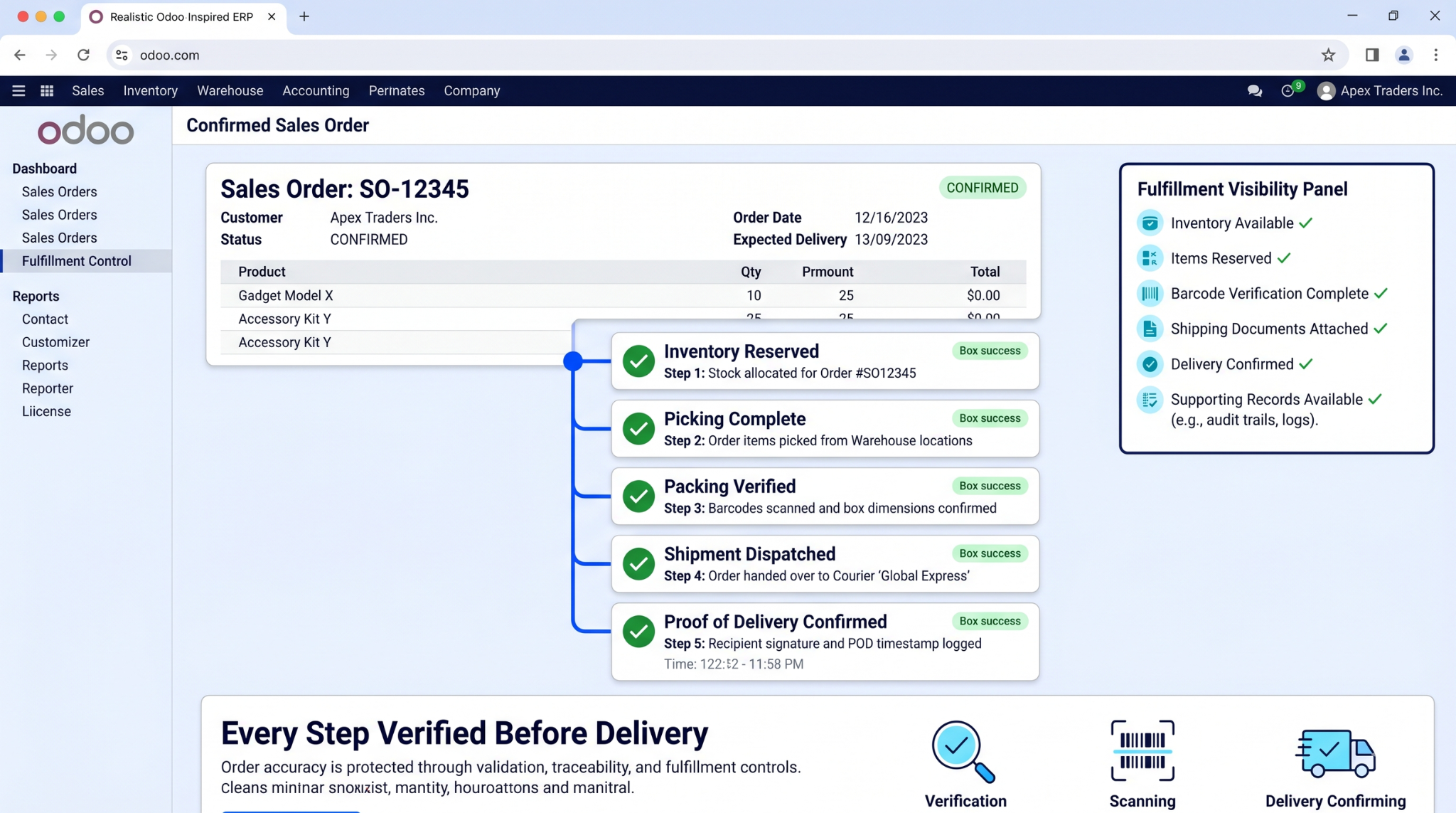
Order accuracy improves when every department works from the same operational record. Odoo supports this by connecting sales, inventory, warehouse, delivery, and documentation activities within a single workflow.
How Each Department Benefits from Odoo
| Department | Odoo Capability | Accuracy Benefit |
|---|---|---|
| Sales | Customer requirements captured in quotation/order flow become the same information used throughout fulfillment | Reduces risk of warehouse teams working from outdated emails, spreadsheets, or manually re-entered documents |
| Inventory | Availability, reservations, receipts, transfers, deliveries connected to the same transaction | Teams see whether stock is available before making commitments to customers |
| Warehouse | Barcode-supported workflows for receiving, transfers, picking, shipping | Fewer opportunities for incorrect inventory movements and mis-picks |
| Delivery | Dispatch activities, delivery orders, shipment status, customer deliveries linked to original order | Traceability for missing items, delays, quantity discrepancies |
| Documentation | Shipping docs, customer instructions, delivery records, supporting files associated with transaction | Reduces information loss during departmental handoffs |
| Proof of Delivery | Delivery confirmations, signed acknowledgments, supporting records | Evidence of fulfillment completion; faster dispute resolution |
The Outcome
The outcome is stronger process control, not just better system organization.
Sales, inventory, warehouse, logistics, and management teams operate from the same information source, making it easier to detect issues before they become customer-facing fulfillment errors.
8 Mistakes That Cause Order and Delivery Problems During ERP Implementations
One of the most common misconceptions is that fulfillment errors are warehouse problems. During ERP implementations, businesses often focus on picking and shipping activities only to discover that the majority of accuracy issues originate earlier in the workflow.
The Eight Common Patterns
| # | Mistake | What It Looks Like | Why It Happens |
|---|---|---|---|
| 1 | Weak requirement capture | Sales records customer requirements differently; inconsistent product descriptions; information maintained outside the primary process | No standardized data entry process |
| 2 | Uncontrolled order modifications | Quantities, delivery dates, products, shipping instructions updated, but changes don’t reach inventory/warehouse/logistics | No formal change management process |
| 3 | Inventory discipline gaps | Attempting to improve fulfillment while operating with unreliable inventory records | Belief that warehouse efficiency can compensate for bad data |
| 4 | Reliance on individual knowledge | Certain employees become the unofficial control system | Process works until those individuals are unavailable, overloaded, or leave |
| 5 | Weak validation controls | Orders move between stages without structured verification | Assumption that each department will catch previous department’s mistakes |
| 6 | Parallel system adoption | ERP implemented, but teams maintain spreadsheets, manual trackers, unofficial records | Resistance to change; lack of training; poor change management |
| 7 | Technology-first, process-second | ERP automates existing broken processes rather than redesigning them | Failure to standardize before digitizing |
| 8 | Ignoring the upstream problem | Blaming warehouse for errors caused by sales, inventory, or system gaps | Visibility limited to where the error becomes visible (warehouse) |
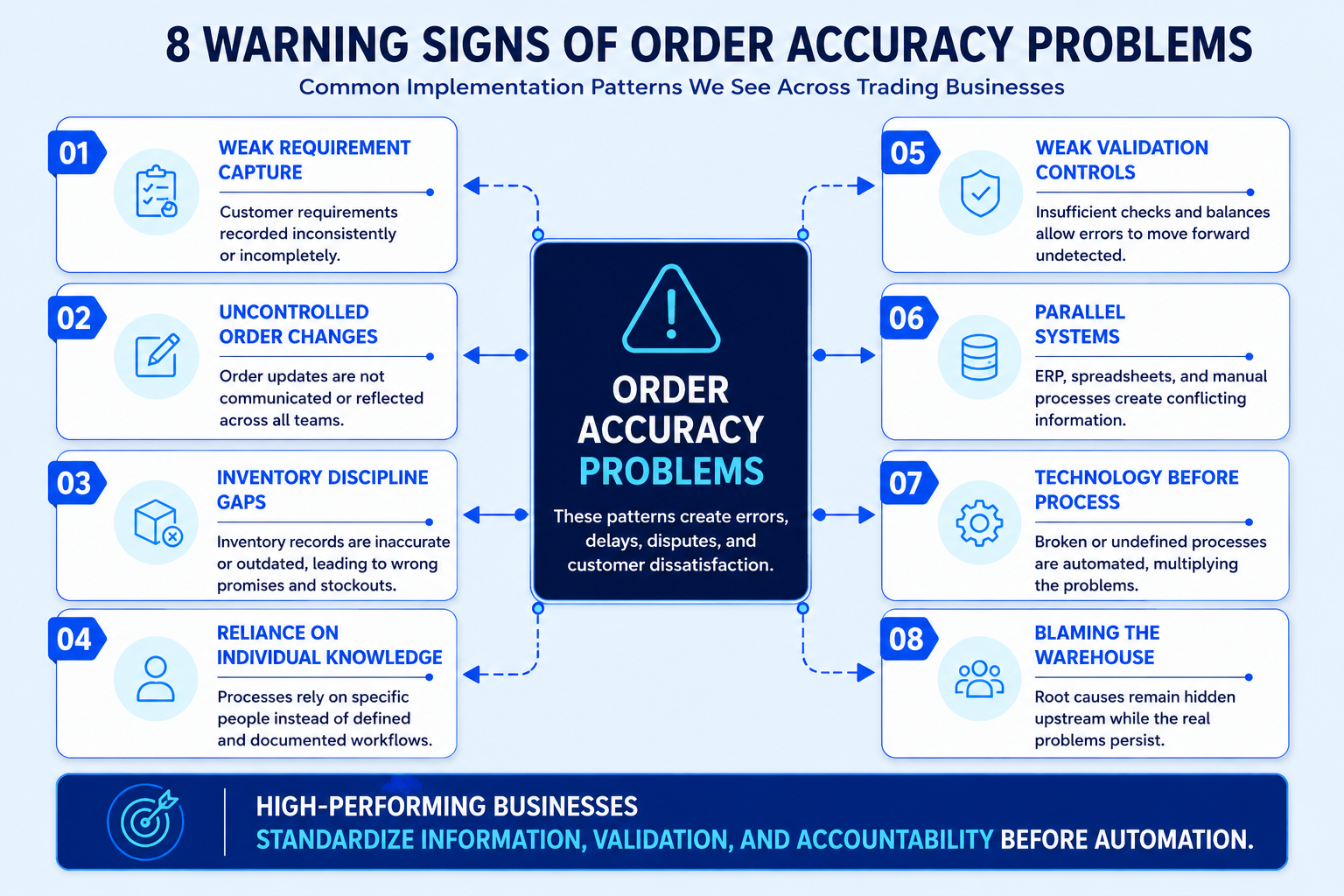
Across trading businesses, the most successful implementations share a common characteristic:
They do not simply automate existing processes. They standardize how information is captured, validated, shared, and tracked across departments.
Technology supports the process, but process discipline remains the foundation of fulfillment accuracy.
Improve Order Accuracy Before Errors Reach Your Customers
If your team is spending time on:
- Correcting shipment mistakes
- Resolving delivery disputes
- Investigating inventory discrepancies
- Managing avoidable returns
The problem may not be warehouse execution. It may be the lack of visibility and control across the order-to-delivery process.
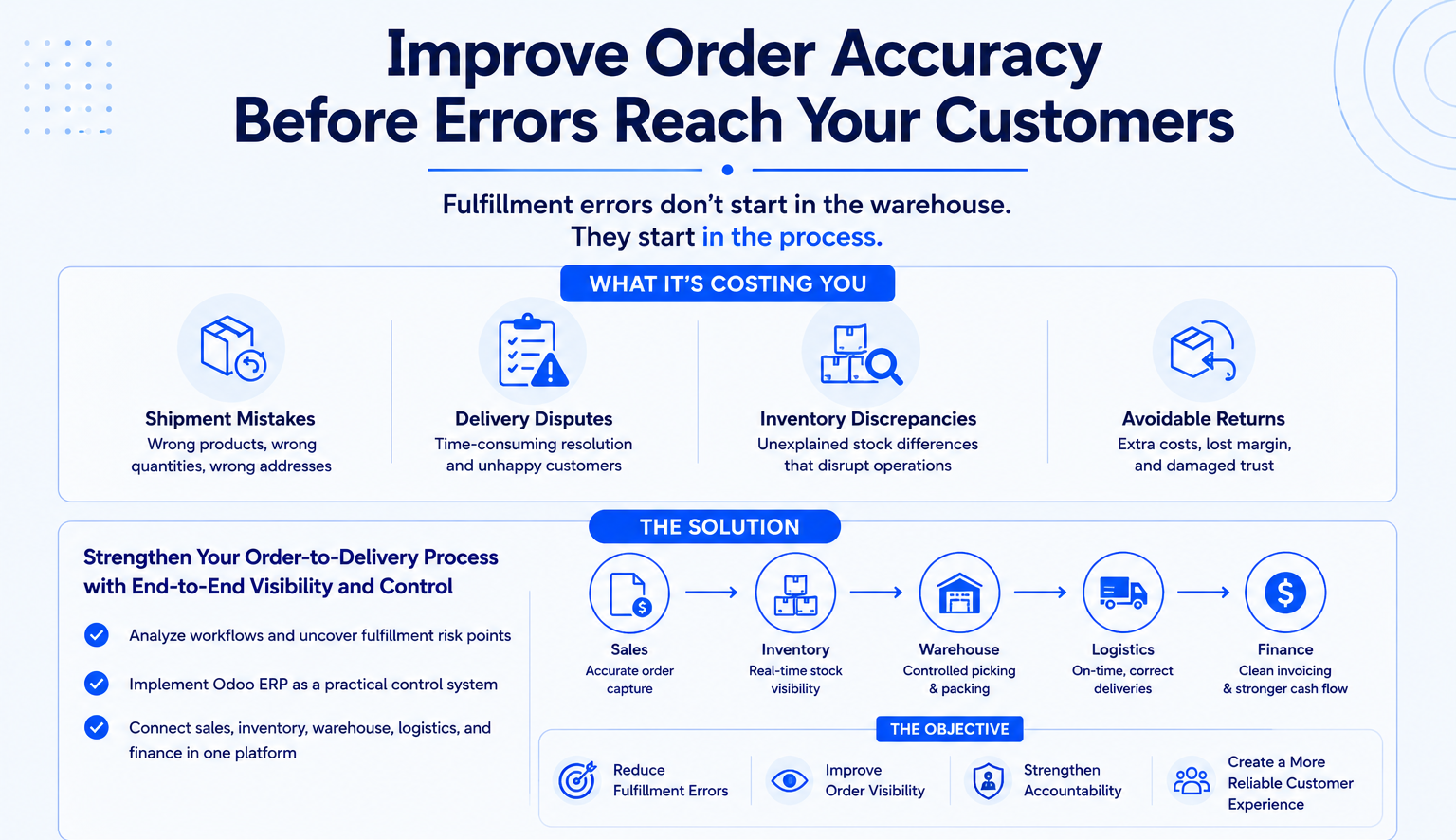
At Softeko, we help trading businesses:
- Analyze operational workflows
- Identify fulfillment risk points
- Implement Odoo ERP as a practical control system for sales, inventory, warehouse, logistics, and finance operations
The Objective
- Reduce fulfillment errors
- Improve order visibility
- Create a more reliable customer experience
- Strengthen accountability
with our team to evaluate how your current order-to-delivery process performs and where operational controls can be strengthened.
FAQ
How does Odoo help reduce stockouts in a trading business?
Odoo continuously monitors inventory levels and can trigger replenishment requests before stock reaches critical levels. This helps businesses avoid lost sales caused by product shortages while maintaining healthier inventory levels.
Can Odoo manage inventory across multiple warehouses?
Yes. Odoo provides real-time visibility of stock across multiple warehouses, branches, and locations. Teams can quickly see where products are available and transfer stock between locations when needed.
How does Odoo calculate product profitability?
Odoo combines purchase costs, freight charges, customs duties, warehousing expenses, and other landed costs to calculate the true profit margin of every product and transaction.
How can Odoo speed up the order-to-delivery process?
Once a sales order is confirmed, Odoo automatically creates warehouse operations, delivery orders, and invoicing workflows. This reduces manual coordination and helps shipments move faster.
Can Odoo track sales performance in real time?
Yes. Sales teams and management can monitor quotations, sales orders, revenue, margins, and customer performance through live dashboards and reports.
Does Odoo automate purchase orders?
Yes. Odoo can generate purchase orders automatically based on minimum stock levels, demand forecasts, or confirmed sales orders. This reduces manual purchasing work and prevents delays in replenishment.
Can Odoo handle international trading operations?
Yes. Odoo supports multiple currencies, multiple companies, Incoterms, international shipping workflows, and trade documentation requirements, making it suitable for import-export businesses.
What trading documents can be managed in Odoo?
Odoo can manage quotations, proforma invoices, purchase orders, commercial invoices, packing lists, certificates, delivery documents, and customer records from a single platform.
How does Odoo help control pricing and margins?
Businesses can define approval rules for discounts and low-margin sales. If a quotation falls below the required profit threshold, management approval can be required before the deal proceeds.
Can Odoo improve supply chain visibility?
Yes. Odoo provides end-to-end visibility from customer inquiry to procurement, shipment tracking, inventory movement, delivery, invoicing, and payment collection. This helps teams identify delays before they become costly problems.
Is Odoo suitable for growing trading companies?
Yes. Odoo is highly scalable. Companies can start with core modules such as Sales, Inventory, Purchase, and Accounting, then add Warehouse, CRM, HR, Quality, or Manufacturing modules as operations expand.
How does Odoo improve cash flow management?
Odoo helps businesses track receivables, payables, inventory value, and profitability in real time. Faster invoicing and better payment visibility allow management to make quicker financial decisions.
Can Odoo track every step of a customer order?
Yes. Odoo creates a complete audit trail from inquiry to quotation, sales order, procurement, shipment, delivery, invoicing, and payment collection, ensuring full transaction visibility.
How long does it take to implement Odoo for a trading business?
Implementation time depends on business complexity, number of users, business processes, and required customizations. Most trading companies begin seeing operational improvements during the early implementation phases.
What is the biggest benefit of Odoo for trading companies?
The biggest benefit is operational control. Instead of managing sales, inventory, procurement, logistics, and finance through spreadsheets and disconnected systems, Odoo centralizes everything into one platform, providing real-time visibility and faster decision-making.
Is Odoo better than using Excel for inventory and trading operations?
For small datasets, Excel may work temporarily. However, as order volume grows, spreadsheets often create inventory inaccuracies, duplicate data entry, delayed reporting, and limited visibility. Odoo automates these processes and provides real-time information across departments, reducing operational risk.
Can Odoo help reduce manual work in trading operations?
Yes. Odoo automates repetitive tasks such as quotation creation, purchase order generation, inventory updates, invoice processing, and approval workflows. This allows employees to focus on higher-value activities instead of manual data entry.
How does Odoo help trading businesses make faster decisions?
Odoo provides live dashboards for sales, inventory, procurement, finance, and logistics. Managers can access accurate data instantly instead of waiting for manually prepared reports, enabling quicker and more informed decisions.
References
- APQC — Metric of the Month: Perfect Order Performance (also covers median 90% perfect-order rate via DCL Corp) — https://www.sdcexec.com/warehousing/article/12193325/apqc-metric-of-the-month-perfect-order-performance · https://dclcorp.com/blog/fulfillment/perfect-order-rate/
- DeHoratius & Raman — Inventory Record Inaccuracy: An Empirical Analysis, Management Science — https://pubsonline.informs.org/doi/10.1287/mnsc.1070.0789
- Finale Inventory — Benefits of a Barcode Inventory System & Barcode System ROI — https://www.finaleinventory.com/barcode-inventory-system/benefits-of-barcode-inventory-system · https://www.finaleinventory.com/blog/guides/barcode-inventory-system-roi/ · https://www.finaleinventory.com/blog/warehouse-management/top-5-kpis-for-warehouse-performance/
- Productiv — Order Fulfillment Challenges (Honeywell mispick-cost data) — https://getproductiv.com/blog/challenges-in-order-fulfillment
- WSI — Tracking Warehouse KPIs That Matter — https://www.wsinc.com/blog/tracking-warehouse-kpis-that-matter/
- LUT Master’s Thesis (Seredyuk, V.) — Inventory discrepancy root-cause analysis — https://lutpub.lut.fi/bitstream/handle/10024/168685/Mastersthesis_Seredyuk_Victoria.pdf
- Mecalux — Inventory Record Accuracy (citing University of Twente) — https://www.mecalux.com/blog/inventory-record-accuracy
- Growing Science / Uncertain Supply Chain Management — Order accuracy → customer trust → loyalty (Almuani et al., 2024); supporting study via IOCSPublisher — https://www.growingscience.com/uscm/Vol12/uscm_2024_80.pdf · https://enrichment.iocspublisher.org/index.php/enrichment/article/download/259/189/
- Alexander Jarvis — What Is Order Accuracy Rate in eCommerce (cost-per-error and 32%-abandonment data) — https://www.alexanderjarvis.com/what-is-order-accuracy-rate-in-ecommerce/