

Overview
Your trading business did not become complicated on purpose. It became complicated because it grew. One warehouse became three. One product line became forty. A handful of customers became a rolling order book. A single accountant became a Finance team with three closing cycles running in parallel. Somewhere in that growth, the tools stopped keeping up.
In practice, the first sign is small. A Sales Executive quotes a price the Warehouse Supervisor cannot confirm. Procurement raises a PO for stock that already arrived. Finance closes the month five days late because two spreadsheets disagreed. None of these are disasters on their own. Together, they are the early evidence that manual operations have quietly become the bottleneck.
Notably, this is not a failure. It is a business evolution. Spreadsheets, email approvals, WhatsApp confirmations, and disconnected accounting software carried your business further than they were designed to. They stopped scaling the moment your operation exceeded what a small team could hold in memory. That is when the conversation about a real operating system for the business begins.
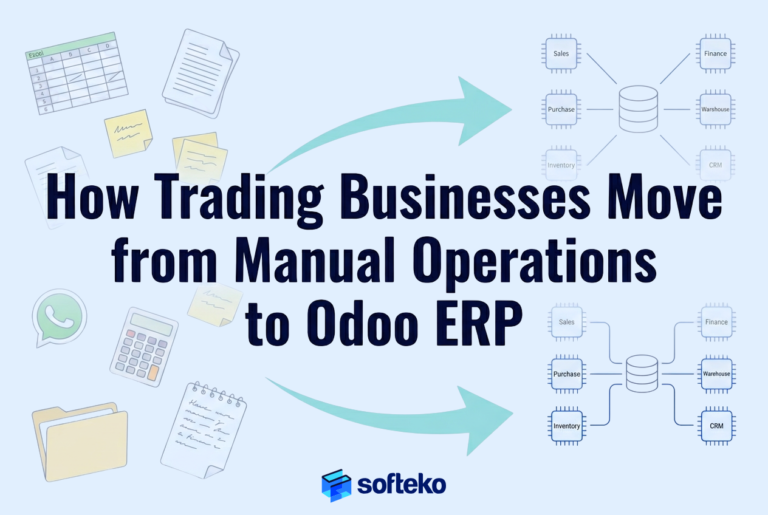
This guide is the last article in the Trading ERP Authority Series. It does not explain ERP selection, comparison, migration, implementation, or cost — those are already covered in the earlier articles. Instead, it answers the one question that remains once you have finished the buying process: what will your business genuinely look like after moving from manual operations to Odoo ERP? Every section walks through a specific change — in workflows, in decisions, in accountability, in visibility — and shows what the future operating model of your trading business should look like.
Why Manual Systems Stop Supporting Trading Business Growth
Manual systems do not fail suddenly. They fail gradually — and then all at once. For most trading businesses, the failure begins with spreadsheets, extends into disconnected applications, and ends with departments that cannot agree on the same numbers.
Peer-reviewed research from Dartmouth’s Tuck School of Business found that operational spreadsheets contain errors in 0.9%–1.8% of all formula cells, and between one-third and one-half of all business spreadsheets contain material defects.[1] Industry analysis extends this — over 90% of business spreadsheets have errors that go unnoticed in financial reporting, and roughly half of models used by mid-sized companies contain material defects.[2] For a trading business with 10,000+ cells tracking inventory, prices, and receivables, that means 90–180 statistically inevitable errors sitting inside the numbers your leadership team already trusts.
Furthermore, poor data quality has a measurable revenue cost. Research from Validity found that 44% of businesses estimate they lose more than 10% of annual revenue because of poor data quality, most of it created by manual entry, reconciliation, and cleanup.[2] For a trading business with USD 10 million in revenue, that translates to more than USD 1 million absorbed every year by preventable data errors.
5 Signs Your Trading Business Has Outgrown Spreadsheets
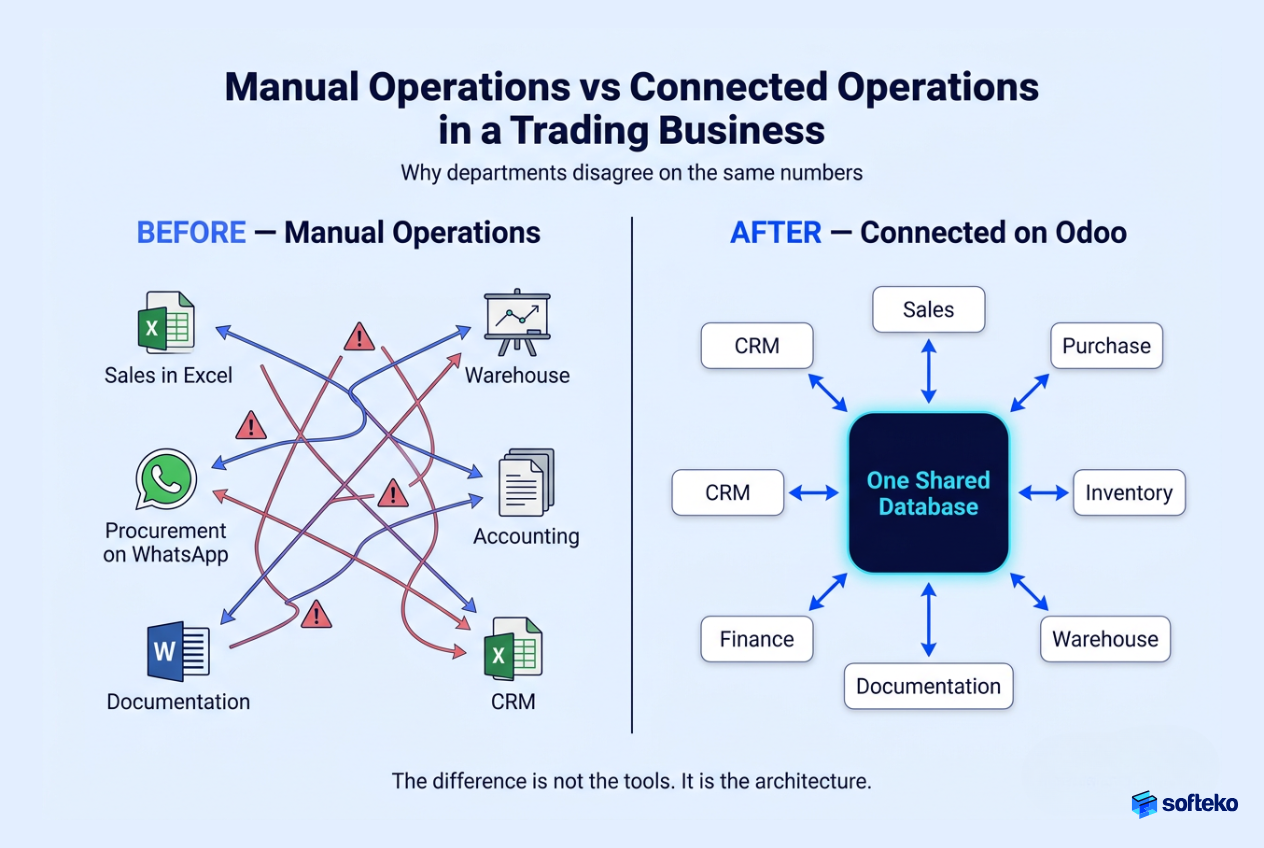
Independent research across business environments points to five consistent signs that a business has outgrown manual systems.[2] For trading operations specifically, they present as follows.
| Sign | What it looks like in a trading business |
|---|---|
| Operational complexity exceeds spreadsheet capacity | Multi-warehouse stock, multi-currency pricing, and landed cost cannot be tracked reliably in Excel. |
| Administrative work grows faster than revenue | Each new customer or supplier adds hours of manual reconciliation, not minutes. |
| Manual updates create errors that erode trust | Sales quotes stock that Warehouse cannot ship. Finance closes on numbers Operations already knows are wrong. |
| Lack of visibility slows every decision | Managers wait for weekly or monthly reports to see what already happened. |
| Manual operations cannot support automation | Every process needs a person, an email, or a WhatsApp message to move forward. |
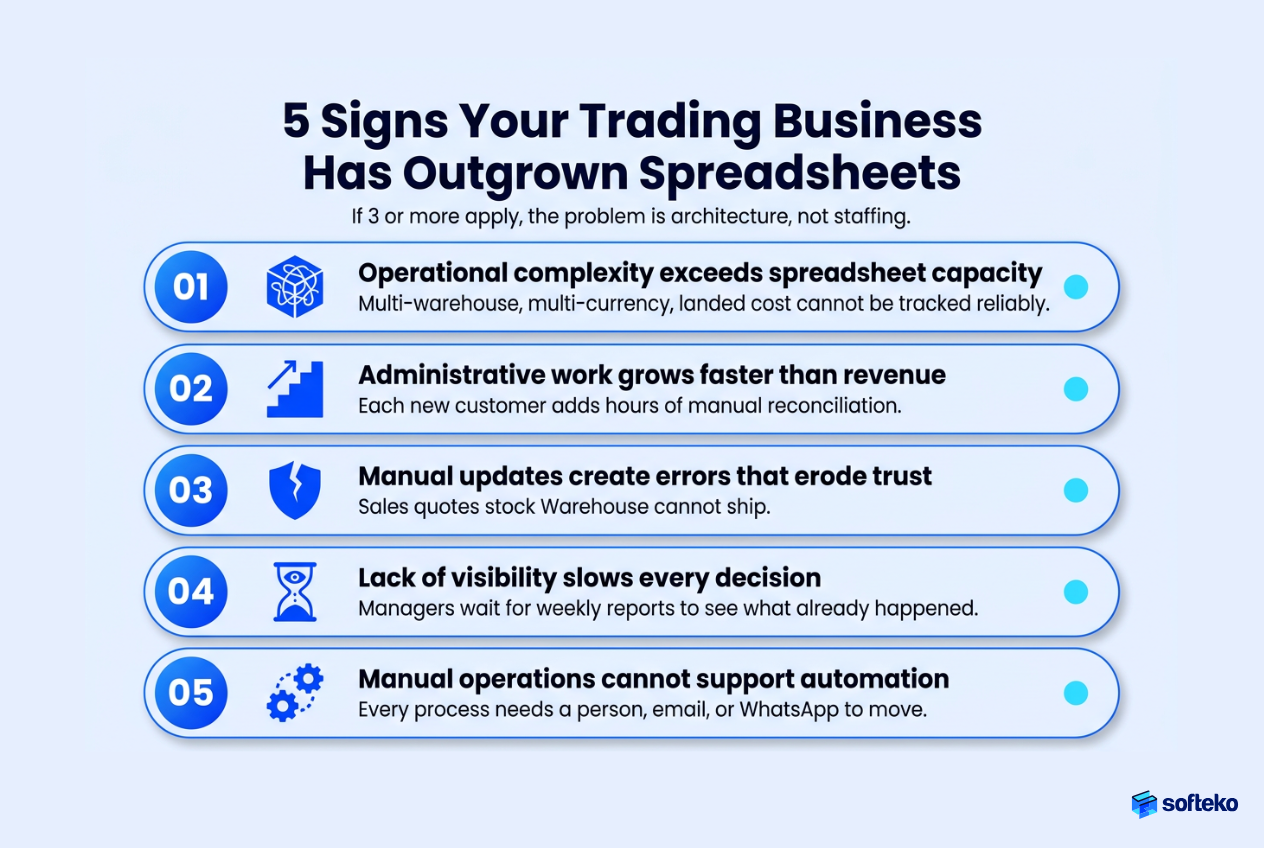
If your business shows three or more of these signs simultaneously, the underlying problem is not staffing or discipline. It is architecture. Manual systems were never designed for the operational complexity your business now carries.
How Manual Operations Slow Business Growth
Importantly, the deeper issue is not that manual operations are slow. It is that they cap how large your business can safely grow. Every new customer adds reconciliation work, new warehouse adds inventory blind spots, new supplier adds documentation, new country adds compliance risk. Because none of this scales linearly, the operating overhead compounds. At some point, adding revenue starts adding proportionally more risk than profit — and growth stalls.
This is the business reality that eventually forces the conversation. Not “we need better software” but “we can no longer grow safely on this operating model.”
Where Manual Trading Operations Break Down
Every trading business breaks down in the same four places first — and in the same order. Recognising this pattern helps you understand what a connected operating model needs to fix.
1. Order-to-Cash Processes Break Down First
In practice, the first breakdown appears in the order-to-cash cycle. Sales Executives create quotes in Excel using price lists that are frequently out of date. Customer POs arrive by email, get entered manually into accounting software, and then reappear as delivery instructions on WhatsApp. Somewhere between the quote and the invoice, at least one number changes — a discount not recorded, a shipment split without notification, a credit limit exceeded because Finance was not in the loop. The result is disputes, delayed collections, and margin leakage that no one can trace cleanly.
2. Procurement-to-Pay Processes Become Disconnected
Secondly, procurement breaks down when volume grows beyond what a single Procurement Officer can hold in memory. Purchase requests are approved on WhatsApp. Supplier POs are raised without checking existing stock. Landed costs are calculated after the shipment lands, not before. Payment terms are honoured inconsistently, damaging supplier relationships that took years to build.
3. Inventory Records Drift from Warehouse Reality
Thirdly, inventory reality drifts from inventory records. The Warehouse Supervisor knows what is on the shelf. The system knows what should be there. Nobody knows the gap until a stock-take reveals it — usually months late. In the meantime, Sales promises stock that has already been sold, and Procurement reorders material that is quietly sitting in a different warehouse.
4. Finance Teams Spend More Time Just Matching Accounts
Finally, Finance absorbs the accumulated cost of everything upstream. The AR Controller chases invoices that were issued incorrectly. The Finance Officer reconciles bank transactions manually. Month-end closes stretch from three days to eight because sub-ledgers do not agree. Reports arrive too late to change any decision.
Notably, the pattern is consistent. Each breakdown is caused by the same underlying condition — departments operating in isolation, using separate tools, on separate copies of the same data. No amount of individual effort fixes it, because it is not a people problem. It is a system architecture problem.
How Connected Departments Improve Daily Operations
A connected operating model changes the fundamental question your business answers every day. In manual operations, the daily question is “What happened yesterday?” In connected operations, the question becomes “What should we do next, right now?” That shift is the point of the transition.
Panorama Consulting Group’s 2024 ERP Report — based on responses from organisations across industries — found that 95% of companies saw improved business processes after moving to a connected operating platform, 77% eliminated data silos, and 66% improved operational efficiency.[3] Independent research from ZipDo further indicates that connected systems reduce business decision-making time by roughly 36%, mainly because managers stop waiting for reports and start acting on live data.[7]
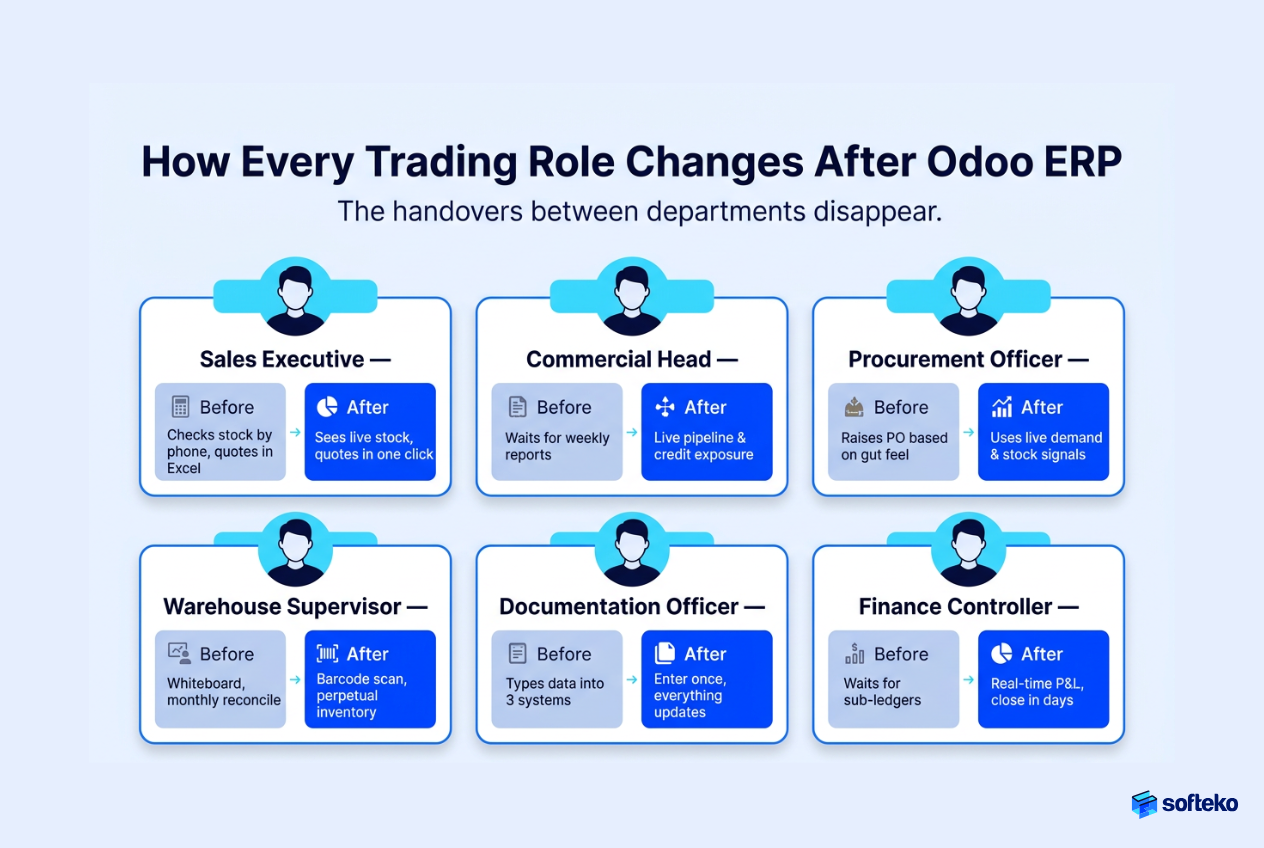
How Every Department Changes
The transition is easiest to see when you walk through it role by role.
| Role | Before (manual operations) | After (connected operations on Odoo) |
|---|---|---|
| Sales Executive | Checks stock by phone. Quotes in Excel. Emails PO to Ops. | Sees live stock and prices. Generates quotes in one click. PO flows into the system automatically. |
| Commercial Head | Waits for weekly sales report. Approves credit informally. | Sees live sales pipeline, margin, and credit exposure. Approves against defined limits. |
| Procurement Officer | Raises PO based on gut. Emails supplier. Chases delivery. | Sees stock, sales forecast, and open POs together. Raises PO with approved terms. Tracks delivery in-system. |
| Warehouse Supervisor | Manages stock on a whiteboard. Reconciles monthly. | Scans in/out on a mobile device. Perpetual inventory updates with every move. |
| Documentation Officer | Types the same shipment data into three systems. | Enters shipment once. Documents, invoice, and inventory update together. |
| Finance Controller | Waits for sub-ledgers to be finalised. Closes month manually. | Sees real-time P&L, cash position, AR ageing. Closes in days, not weeks. |
Consequently, the effect is not that each person works faster in isolation. It is that the handovers between them disappear. Sales does not wait for stock confirmation. Procurement does not wait for sales forecasts. Finance does not wait for month-end. The business starts operating in real time instead of in batches.
Teams Stop Entering the Same Data Multiple Times
Furthermore, the single biggest efficiency gain is one most people underestimate. In a manual operating model, the same information is entered into three, four, sometimes five different systems — the CRM, the accounting software, the inventory spreadsheet, the customs documentation, the shipment tracker. Each re-entry is an opportunity for error, delay, and disagreement between systems.
In a connected operating model, that information is entered once. Every downstream system reads from the same source. Panorama’s finding that 77% of organisations eliminated data silos points to exactly this shift.[3] It is not glamorous. It changes the shape of every operational conversation.
Teams Get Real-Time Business Visibility
In addition, Panorama’s research shows 65.9% of organisations realised their expected benefits from real-time data after moving to a connected platform.[3] Real-time visibility changes what a Commercial Head or Finance Controller can even ask. Instead of asking “What did we sell last week?”, the question becomes “What is our current margin on this customer, and should we accept this new order at these terms?” The decision moves from retrospective to prospective.
How Odoo ERP Changes Management Decisions
Once operations become connected, the decision-making rhythm of the entire business changes. Managers stop reacting to what already happened and start managing what is about to happen. This is where the operational shift starts producing measurable business impact.
Managers Act on Real-Time Information
In practice, in a manual operating model, most decisions are made in weekly management meetings after everyone has caught up on last week’s numbers. In a connected operating model, most operational decisions are made continuously against live signals — a stock level crossing a reorder point, a customer approaching a credit limit, a shipment delayed at customs, a cash position dipping below a threshold. Weekly meetings still happen, but they focus on strategy, not on reconciling numbers.
Business Rules Replace Manual Approvals
Secondly, in a manual environment, most decisions rely on individual judgment — the Purchase Manager decides which supplier gets the PO, the Commercial Head decides when to release credit, the Finance Officer decides which payment gets processed today. That judgment is valuable but inconsistent, and it disappears when the person is on leave.
In a connected operating model, standard workflows enforce the “how” while leaving the “whether” to the manager. The system routes purchase requests to the right approver based on value, blocks a sales order that would breach a credit limit, flags an overdue invoice before it becomes a bad debt. The judgment is still human. The consistency is systemic.
Managers Make Decisions with Real-Time Data
Thirdly, this is the change most business owners feel first. Manual operations force leaders to make decisions on partial information — the last inventory count, the last month’s P&L, the last customer complaint. Connected operations replace assumptions with evidence.
For example, instead of assuming your best-selling product is your most profitable, you can see the actual gross margin after landed cost, discounts, and freight — across every warehouse — in seconds. Instead of assuming your top customer is your most valuable, you can see the net contribution after collection days and returns. Instead of assuming Procurement is negotiating well, you can see supplier price movement across two years. These are not new questions. They are the questions leadership has always wanted to answer — but manual operations could not answer them fast enough to matter.
Finance Teams Solve Problems Earlier
Finally, financial decisions change as much as operational ones. In a manual operating model, the CFO learns about a cash flow problem after it happens. In a connected operating model, the CFO sees the cash position, the AR ageing, the AP schedule, and the open POs together — and can adjust before the problem arrives. This is the operational meaning of “financial visibility.” It is not a nicer dashboard. It is the ability to act before the number becomes a problem.
Operational Improvements You Can Expect After Moving to Odoo ERP
In fairness, it is important to be honest about what improvements a trading business can and cannot expect from moving to a connected operating model. The research is consistent, but expectations need to be calibrated to trading realities.
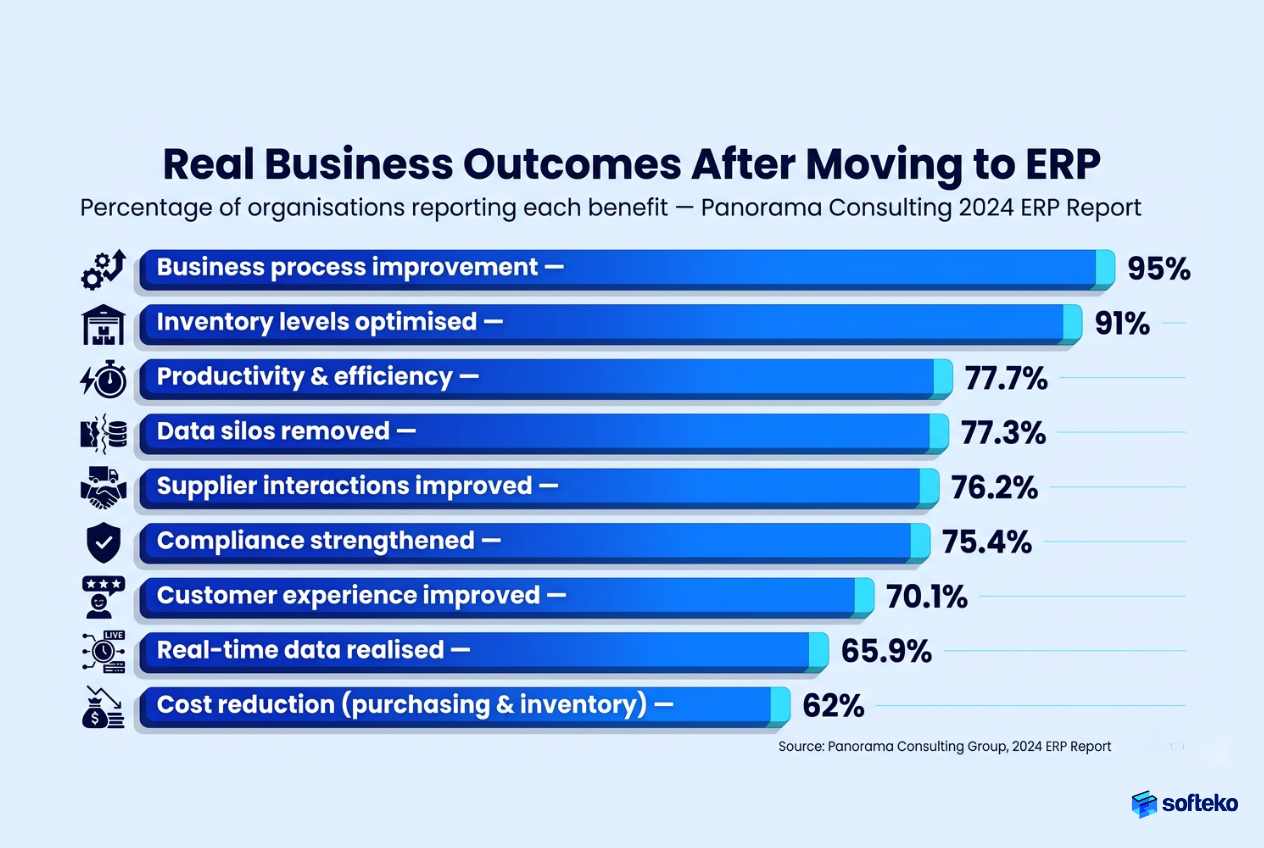
Panorama Consulting’s 2024 ERP Report shows that across industries, organisations that completed the transition reported the following outcomes.[3]
| Business area | Organisations reporting expected benefit |
|---|---|
| Inventory levels optimised | 91% |
| Business process improvement | 95% |
| Productivity & efficiency | 77.7% |
| Removing data silos | 77.3% |
| Supplier interactions | 76.2% |
| Compliance | 75.4% |
| Customer experience | 70.1% |
| Real-time data | 65.9% |
| Cost reduction (particularly purchasing & inventory) | 62% |
Independent research from Nucleus Research puts the average ERP payback period at 16 months, with organisations typically achieving 200%+ ROI when the transition is treated as an operational change rather than a software installation.[4] The same research finds that cloud deployments deliver roughly four times the ROI of on-premise systems — a factor worth weighing for trading businesses evaluating deployment options.[4]
Expected Business Improvements
In practice, trading businesses moving from manual to connected operations should expect improvements along four dimensions.
Inventory accuracy. Most trading businesses running on spreadsheets operate with 85–90% inventory accuracy. After transition, accuracy typically moves to 97–99%, provided the Warehouse team uses barcode scanning and cycle counting consistently.
Order-to-cash cycle time. Manual quote-to-invoice cycles frequently take 5–10 working days. Connected cycles shorten to 1–3 days, mainly because handovers disappear.
Financial close. Manual month-end closes commonly take 8–12 working days for a multi-warehouse trading business. Connected closes shorten to 3–5 days as sub-ledgers reconcile continuously instead of at month-end.
Working capital. Better inventory accuracy plus faster collections plus tighter AP scheduling typically frees 8–15% of working capital that was previously locked up in overstock, disputes, or slow reconciliation.
What Odoo ERP Will Not Change
Importantly, some outcomes are commonly promised but rarely delivered. A connected operating model does not, on its own, increase revenue. It does not eliminate headcount, fix a broken pricing strategy or a weak sales team. It does not remove the need for human judgment. What it does is remove the operational drag that has been quietly limiting how well your existing team can execute. The revenue upside is real — but it comes from the decisions your leadership team makes with better information, not from the software itself.
How to Measure Business Performance with Odoo ERP
One of the most important discoveries in the ERP research literature is uncomfortable: most organisations measure the wrong thing. They measure the go-live date, the budget hit, the number of modules deployed. Panorama’s research found that only 33% of organisations track user adoption, and on average only 26% of employees actively use their company’s ERP.[3] That is why so many implementations report technical success and operational disappointment.
If your business measures the transition properly, three categories of KPI matter.
1. Track Daily Operational KPIs
These are the metrics that tell you the connected operating model is doing what it was supposed to do.
- Inventory accuracy (target: 97%+)
- Order fill rate / OTIF (on-time in-full)
- Order-to-cash cycle time
- Quote-to-order conversion rate
- Supplier on-time delivery
- Warehouse pick accuracy
2. Track Financial Performance KPIs
These convert operational improvements into money.
- Days Sales Outstanding (DSO)
- Days Inventory Outstanding (DIO)
- Days Payable Outstanding (DPO)
- Gross margin per product line and per customer
- Working capital as % of revenue
- Month-end close cycle time
3. Track User Adoption KPIs
These predict whether the other two categories will improve at all.
- Active user rate by department
- Transactions processed inside the system vs outside it
- Manual override rate
- Support tickets per department per month
- Training completion rate
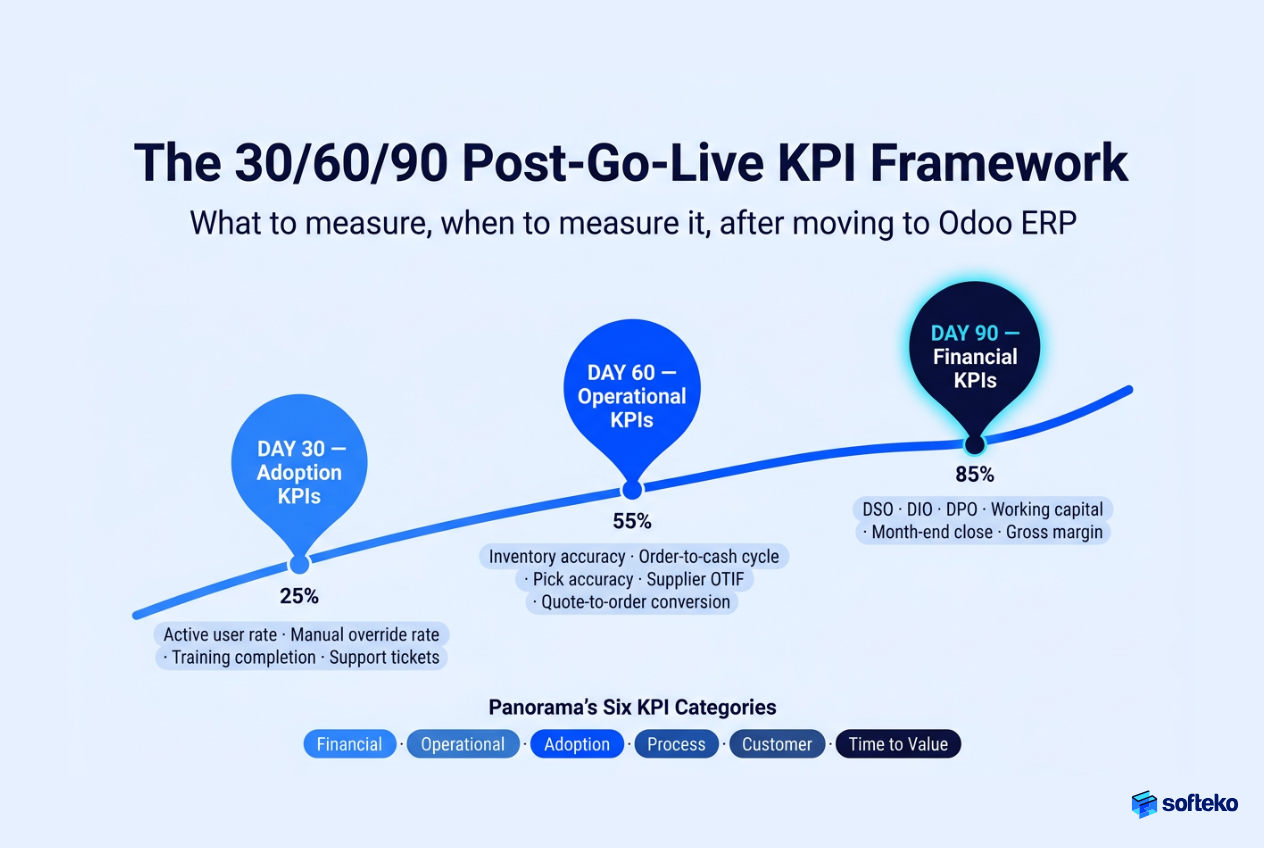
Measure Progress After 30, 60, and 90 Days
In practice, setting explicit targets for each of these KPIs at 30, 60, and 90 days after go-live is the single most useful discipline for measuring the transition. At 30 days, adoption dominates — is every trading role using the system as intended? then 60 days, operational KPIs stabilise — are inventory accuracy and order cycles moving in the right direction? At 90 days, financial KPIs start to move — is DSO shortening, is working capital freeing up, is the month-end close accelerating?
Panorama’s research suggests six KPI categories to track post-go-live: Financial Performance, Operational Efficiency, Employee Productivity & Adoption, Business Process Improvement, Customer Experience, and Time to Value.[3] For a trading business, all six map cleanly onto the KPIs above.
How Odoo ERP Supports Continuous Improvement
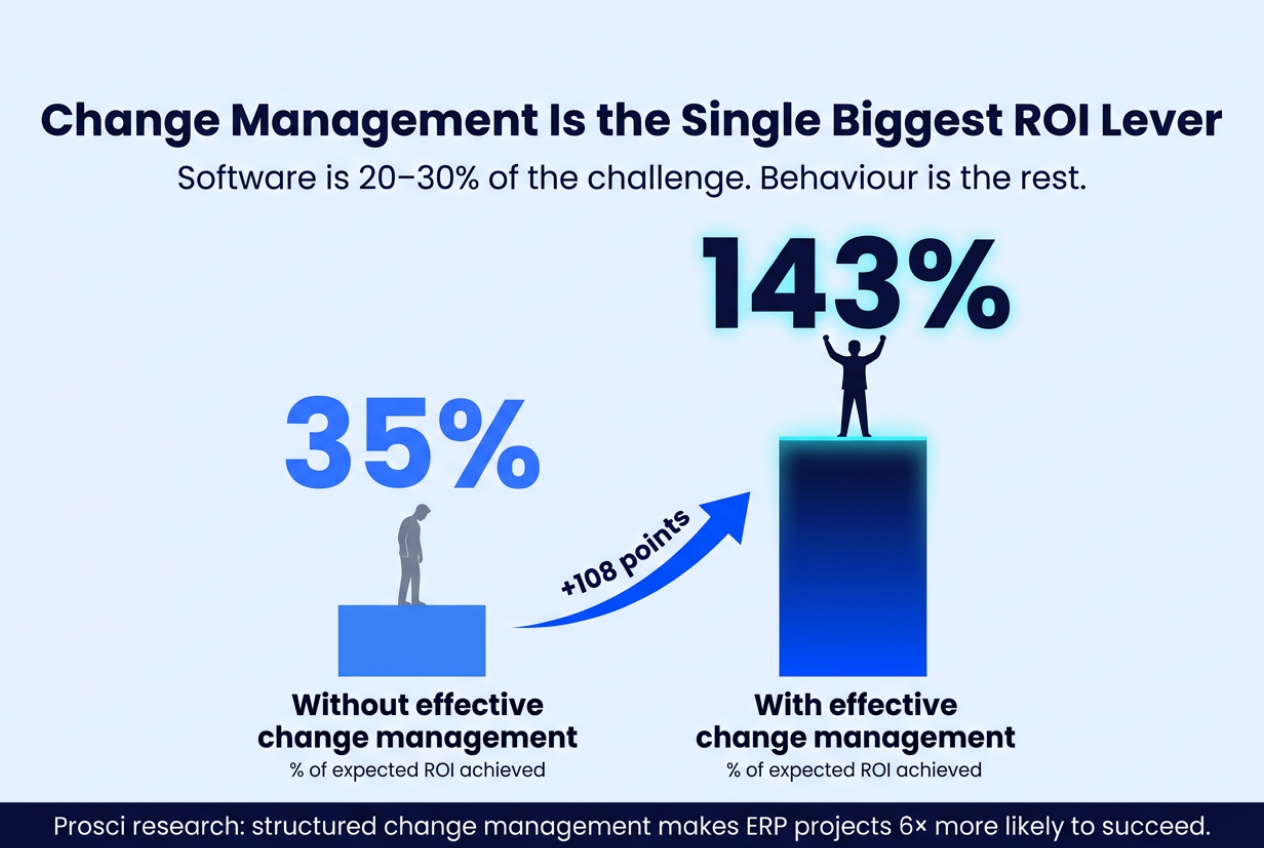
Notably, the largest misconception about ERP is that go-live is the finish line. In reality, go-live is the starting line. The connected operating model creates the visibility, the data, and the process discipline that make continuous improvement possible for the first time. Whether your business capitalises on that opportunity is a separate decision — and it is the one that separates trading businesses that get 35% of their expected ROI from trading businesses that get 143%.
That gap is well documented. McKinsey research on organisational change found that companies with effective change management programs achieve 143% of expected ROI, while organisations with little or no change management achieve only 35%.[5] Prosci’s independent change-management research corroborates this — programmes with structured organisational change management are six times more likely to achieve their goals.[9] The point is not that software drives ROI. Behaviour drives ROI. Software makes better behaviour possible.
Improve Business Processes After Go-Live
In practice, the first 90 days after go-live are about stabilisation — fixing configuration gaps, closing training gaps, and getting adoption above 80%. The next 6–12 months are about optimisation. This is where the connected operating model starts paying back.
Optimisation looks like this. Finance identifies that DSO has stopped improving at day 90; a review shows Sales is still granting informal payment extensions, and a workflow update tightens it. Procurement notices supplier lead-time variance is destroying safety-stock planning; a scorecard is introduced and lead times tighten within a quarter. The Warehouse team sees that one product family drives 40% of pick errors; a slotting change halves the error rate. None of this was possible in the manual world because none of the data existed in a form anyone could analyse.
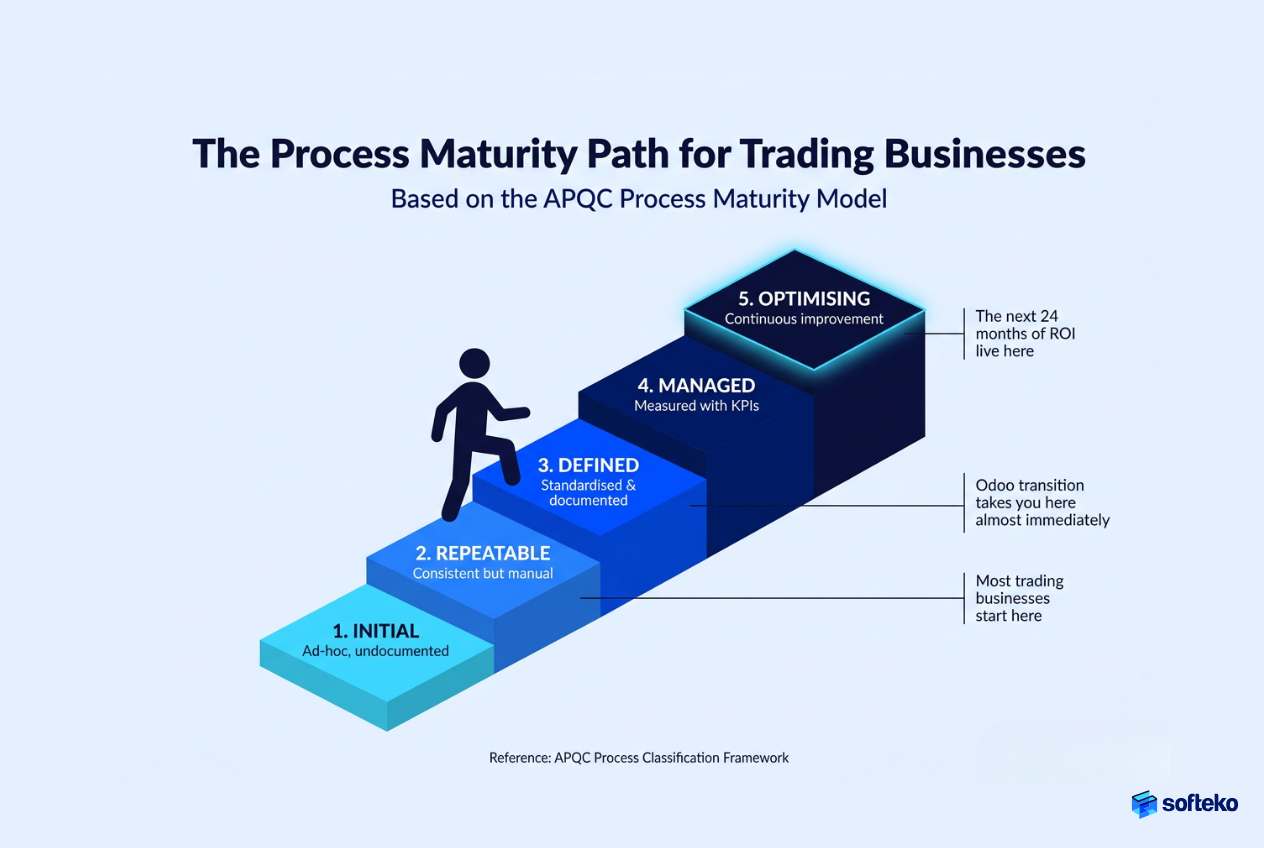
Use the APQC Process Maturity Model
For structured improvement, the APQC Process Classification Framework and its associated maturity model give trading businesses a widely used reference for how to evolve from ad-hoc processes to optimised ones.[8] The model describes five stages — Initial, Repeatable, Defined, Managed, and Optimising — and most trading businesses moving off manual operations begin somewhere between Initial and Repeatable. The transition to a connected operating platform moves them to Defined almost automatically. Moving from Defined to Managed and Optimising is the work of the following 24 months — and it is where the biggest ROI usually appears.
Why Business Improvement Slows Down
In fairness, not every business capitalises on the continuous improvement opportunity. The most common reason is leadership — once go-live is behind them, the executive team disengages, KPI reviews stop, and the connected operating model quietly degrades back into ad-hoc practices. Software cannot prevent this. Only leadership can.
How Odoo Supports Modern Trading Operations
By now the operational case is clear. The remaining question is how a specific platform enables it. Odoo is one of several practical choices, and it fits trading businesses well for reasons that are architectural rather than promotional.
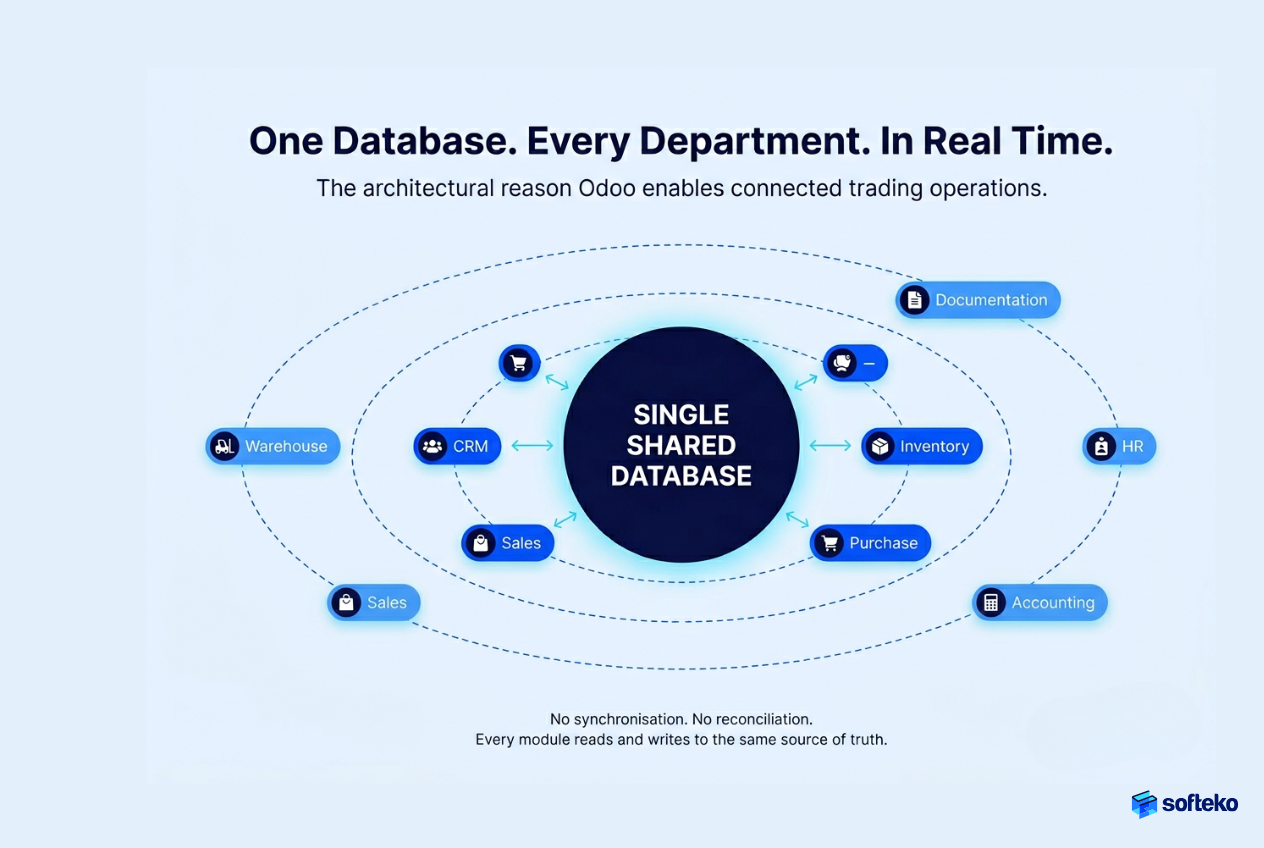
One Database Connects Every Department
Odoo is built on a single relational database that all modules share. When a Sales Executive confirms an order, the same transaction reserves stock, triggers a procurement request if needed, generates the delivery order, produces the invoice, and posts the accounting entry. There is no synchronisation between modules because there is nothing to synchronise — every module reads and writes to the same tables. For a trading business, this is the operational meaning of “connected.”
Automate Business Workflows and Approvals
Odoo’s automation rules replace manual approval chains — email approvals, WhatsApp confirmations, hand-carried forms — with routed workflows.[Odoo documentation: Automation Rules] For example, a purchase request above a threshold routes to the Purchase Manager. A sales order exceeding a customer credit limit hard-blocks until Finance approves. A shipment awaiting documentation flags the Documentation Officer. In every case, the workflow is defined once and enforced everywhere.
Give Every Department Real-Time Reports
For Finance Controllers and business owners, Odoo’s Accounting application provides real-time Profit & Loss, Cash Flow Statement, Executive Summary, Aged Receivables, Aged Payables, Partner Ledger, Product Margin, and Analytic Reports — refreshed as transactions post, not as spreadsheets are updated.[Odoo documentation: Accounting] The bank synchronisation feature reduces reconciliation from days of manual work to hours of exception handling.
Support Complex Trading Operations
For trading businesses specifically, Odoo handles the operational patterns that break spreadsheets — multi-warehouse inventory with transfers, multi-currency pricing with automated FX, landed cost calculation on inbound shipments, LC-based supplier payment workflows, dropshipping, kitting, three-way match on invoicing, and country-specific VAT/tax logic. None of these are unique to Odoo. What matters is that they exist as configured workflows rather than as customisations, which is why trading businesses with disciplined implementations keep their Odoo ERP total ownership cost predictable.
What Moving to Odoo ERP Means for Your Business
Notably, moving from manual operations to Odoo ERP is not simply changing software. It is changing how your entire business operates, collaborates, and grows.
In practice, that is why the earlier articles in this series matter. Selecting the right ERP, comparing Odoo against traditional systems, migrating your data cleanly, running a disciplined implementation, budgeting realistically, and avoiding the well-documented implementation mistakes — those decisions all lead to this final one. The transition itself is where the value gets created or lost.
In our experience, the trading businesses that make this transition well share a small set of habits. Their leadership team owns the outcome, not just the budget, department heads standardise processes before they configure anything, master data has named owners before day one, change management starts at project kickoff, not the week before go-live, and success is measured against operational KPIs, not against a go-live date. And above all, they treat go-live as the beginning of continuous improvement, not the end of an implementation.
If your business is preparing for this transition, the honest starting question is not “When can we go live?” It is “What kind of operating model do we want to run 24 months from now — and what decisions do we need to make today to get there?” That single question reframes the move from a technology project into a business decision, which is what moving from manual to Odoo ERP genuinely is.
At Softeko, we help trading businesses run structured Odoo ERP transitions — from readiness assessment through connected go-live and 90-day performance review — with executive alignment, master data governance, and change management built into every phase.
Frequently Asked Questions
How long does it take to move from manual operations to Odoo ERP?
For a typical single-country trading business, a disciplined transition takes 4–7 months from kickoff to go-live, plus 60–90 days of hypercare. Multi-country or multi-entity trading businesses typically need 8–12 months. Anyone quoting significantly less is usually cutting change management, data migration, or testing — which is why Panorama’s research shows 55–75% of ERP projects fail to meet objectives.[6]
What is the biggest operational change we should expect?
The biggest change is not any single new capability. It is that departments stop operating in isolation. Sales sees live stock. Procurement sees live sales forecasts. Finance sees live operations. In Panorama’s research, 77% of organisations eliminated data silos after the transition, and this is what business owners tend to notice first.[3]
Will Odoo replace our accounting software, inventory software, and CRM?
Yes — that is the operational point. Running Sales, Purchase, Inventory, Accounting, and CRM in one system removes the reconciliation work that manual operations force on every team. Panorama’s 2024 ERP Report shows 95% of organisations saw business process improvement after consolidating onto a connected operating platform.[3]
How much productivity improvement should we realistically expect?
Independent research shows 77.7% of organisations report productivity and efficiency benefits after moving to a connected operating platform, and roughly 62% see cost reductions in purchasing and inventory.[3] For a trading business, most of the gain comes from removing duplicate data entry, faster order-to-cash cycles, and shorter financial close cycles.
What is the fastest way to fail at this transition?
Treating it as a software installation instead of an operational change. McKinsey research shows organisations with weak change management achieve only 35% of expected ROI, while organisations with strong change management achieve 143%.[5] Prosci’s research adds that structured change management makes projects 6× more likely to succeed.[9] Software is roughly 20–30% of the challenge. Behaviour is the rest.
How do we know when our trading business is ready to move off manual operations?
You are ready when three conditions are true. First, your leadership team agrees on measurable outcomes — inventory accuracy, order cycle time, financial close, DSO. Second, you have named owners for master data (customers, suppliers, products) and for each process area (order-to-cash, procure-to-pay, warehouse, finance). Third, you accept that the transition is an operational change, not an IT project. If any of these three are missing, the transition will struggle regardless of how good the software is.
Do we need to fix our processes before moving to Odoo, or will Odoo fix them?
Both, in sequence. A connected operating platform will not fix a broken process — it will digitise the mess and make it faster. Before configuration, standardise the core flows (order-to-cash, procure-to-pay, warehouse, finance) at the level of “who does what, when, and against which rules.” Then configure Odoo against that standardised flow. Businesses that skip the standardisation step almost always end up over-customising the system and inflating ownership cost.
What should we measure in the first 90 days after go-live?
Measure adoption first, operations second, finance third. In the first 30 days, active user rate by department and manual override rate matter most. By day 60, operational KPIs — inventory accuracy, order cycle time, pick accuracy — should be moving in the right direction. By day 90, financial KPIs — DSO, month-end close, working capital — should start improving. Panorama’s six-category KPI framework (Financial, Operational, Adoption, Process, Customer, Time to Value) is a widely used reference for this.[3]
References
- Powell, Baker, Lawson (Dartmouth College, Tuck School of Business) — Errors in Operational Spreadsheets — https://mba.tuck.dartmouth.edu/spreadsheet/product_pubs_files/errors.pdf
- Validity / Nexus360 — Growing Businesses Outgrow Spreadsheets (data quality and revenue impact) — https://nexus360.digital/growing-businesses-outgrow-spreadsheets/
- Panorama Consulting Group — The 2024 ERP Report — https://www.panorama-consulting.com/resource-center/erp-industry-reports/the-2024-erp-report/
- Nucleus Research — ERP Pays for Itself — Fast (16-month average payback, 200%+ ROI) — https://nucleusresearch.com/research/single/erp-pays-for-itself-fast/
- McKinsey & Company — Unlocking Success in Digital Transformations — https://www.mckinsey.com/capabilities/people-and-organizational-performance/our-insights/unlocking-success-in-digital-transformations
- Gartner — Latest Enterprise Resource Planning (ERP) Insights — https://www.gartner.com/en/information-technology/topics/enterprise-resource-planning
- ECI Solutions / ZipDo — 2024 ERP Guide: Essential Insights for SMB Executives (36% decision-time reduction) — https://www.ecisolutions.com/blog/39-erp-statistics-smb-2024/
- APQC (American Productivity & Quality Center) — Process Classification Framework and Process Maturity Model — https://www.apqc.org/resource-library/resource-listing/apqcs-process-maturity-model
- Prosci — Your ERP Adoption Rate Guide (structured change management is 6× more likely to succeed) — https://www.prosci.com/blog/your-erp-adoption-rate-guide