


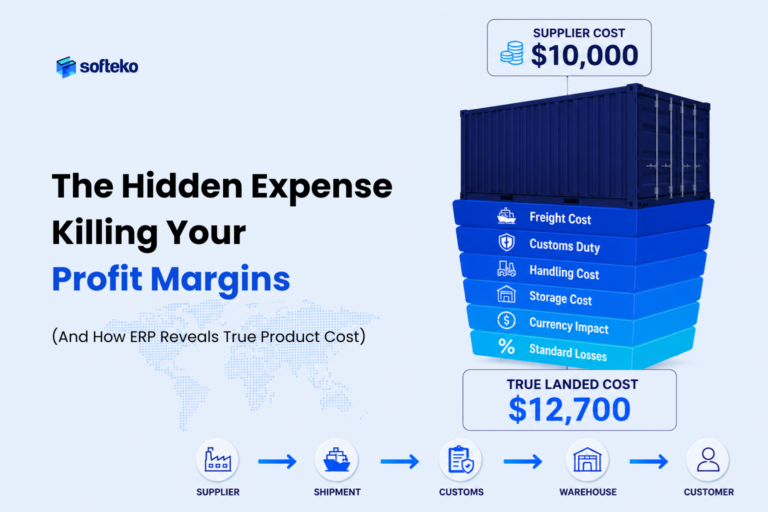
Key takeaways
- Landed cost routinely adds 20–40%+ to supplier price; in some import scenarios the landed cost is 54% higher than the FOB price.[1][2]
- For many importers and distributors, landed cost components make up 10–30% of total company expenses — yet they’re booked as overhead, not as product cost.[3]
- Margin erosion in trading is rarely a strategy problem. It’s a pricing-execution and cost-allocation problem.[4]
- ERP with landed-cost management consistently delivers ~30% purchasing & inventory savings within two years and a median ROI of ~52%.[5]
- The fix isn’t more reporting. It’s connecting procurement, freight, customs, warehouse and finance to the same product cost — before pricing decisions are made.
Overview
Most trading businesses know their supplier price. Far fewer know their true product cost.
A procurement team negotiates a favourable rate. Sales builds a quotation off that rate. The customer accepts, the shipment moves, revenue arrives, and several months later finance discovers the margin was much lower than expected. Nothing went wrong operationally. The cost picture was simply incomplete.
In trading, the supplier invoice is the starting point of cost, not the answer. Freight, customs duties, port handling, inland transport, inspection, storage, currency movement and physical losses all stack on top before the product becomes saleable. When those costs live in separate systems and arrive at different times, pricing decisions get made on a number that doesn’t exist.
This article covers:
- What landed cost really includes — the seven-layer Hidden Cost Stack
- Why supplier price ≠ product cost — and how the gap creates margin leakage
- The seven hidden costs that erode profitability before finance sees them
- What research actually says about freight volatility, inventory valuation and ERP cost visibility
- The seven operational controls that protect margin
- How Odoo automates landed cost tracking step-by-step
- FAQ + a starting diagnostic for your last 10 transactions
What is landed cost?
Landed cost is the total cost incurred to procure, transport, clear, receive and make a product available for sale.
Supplier cost + all acquisition costs = Landed cost
The challenge is that those acquisition costs are rarely captured in a single place. Procurement negotiates the supplier price. Logistics books freight. A customs broker handles clearance. The warehouse receives the inventory. Finance records duties and miscellaneous charges. Each function sees a slice of the cost; management needs the whole picture.
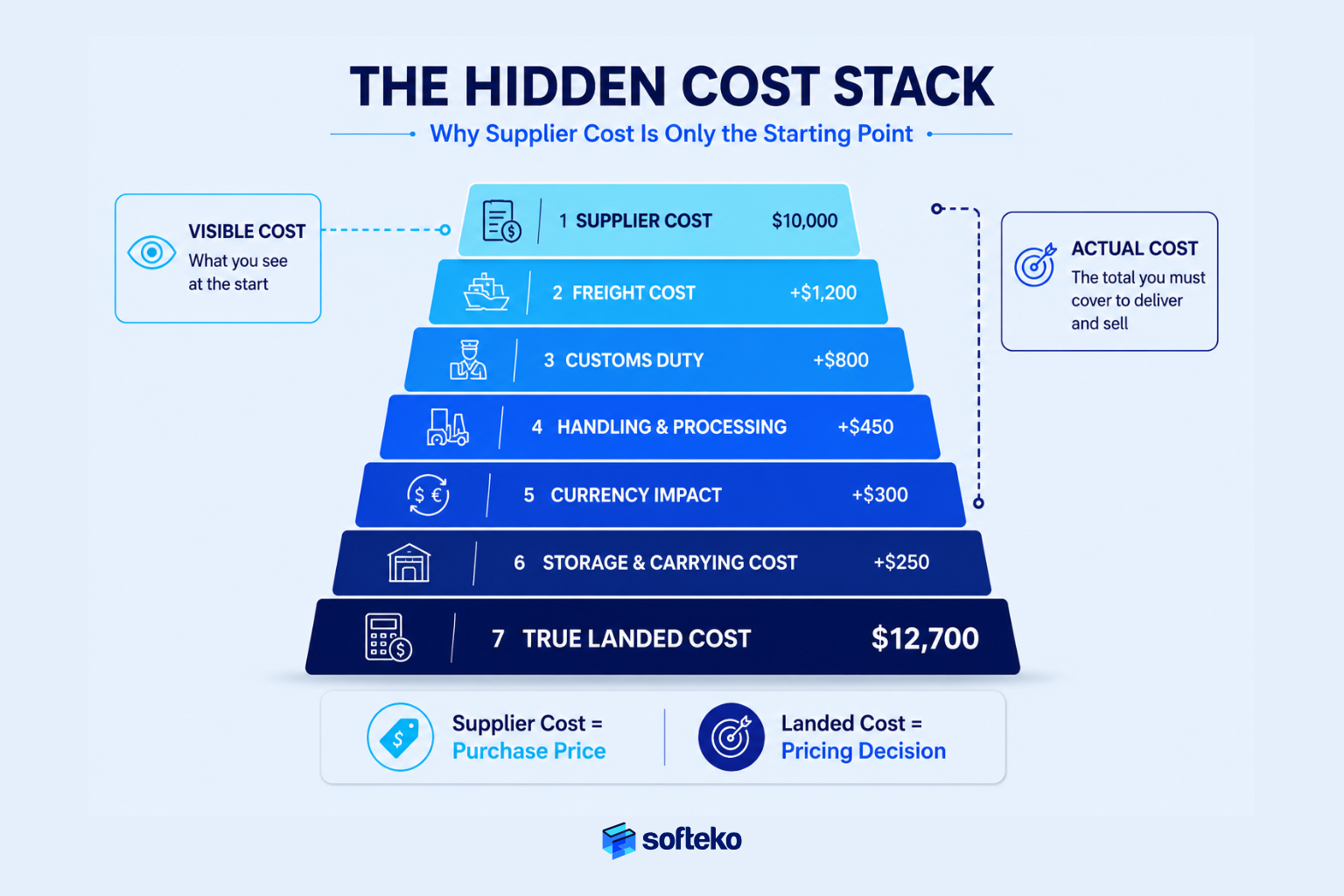
The Hidden Cost Stack — 7 layers from supplier to saleable
| # | Layer | What it covers | Why it gets missed |
|---|---|---|---|
| 1 | Supplier cost | Invoice value from vendor | Treated as “the” product cost |
| 2 | Freight | Ocean, air, trucking, container, fuel surcharges, detention | Invoice arrives after pricing |
| 3 | Customs & duties | Import duty, processing fees, inspection, port authority charges | Recorded post-arrival |
| 4 | Handling & processing | Port handling, unloading, warehouse receiving, internal transport, bagging, repackaging, QC | Booked as opex, not COGS |
| 5 | Currency impact | FX movement between PO and payment | Becomes visible only at settlement |
| 6 | Storage & carrying | Warehouse rent, insurance, financing, working-capital cost | Treated as overhead |
| 7 | True landed cost | The sum of layers 1–6 | What should drive pricing |
CohnReznick’s analysis of NetSuite landed-cost management makes the same point in accounting terms: landed costs increase the asset value of inventory and directly affect COGS, so missing layers distort both valuation and profitability.[6]
Example of Landed Cost Calculation
| Cost component | Amount |
|---|---|
| Supplier cost | $10,000 |
| Ocean freight | $1,200 |
| Customs duty | $800 |
| Port & clearance | $300 |
| Inland transport | $250 |
| Warehouse handling | $150 |
| Total landed cost | $12,700 |
If sales prices are based on supplier cost only, the pricing model is built on a number that’s 27% lower than reality. The product can hit sales targets and still disappoint on margin every month.
Why Businesses Don’t Know Their True Product Cost
A procurement team can reduce supplier pricing by 3% while freight rises 8%, duties tighten, storage costs rise (because inventory turns more slowly), and FX moves the wrong way. The negotiated savings disappear before the product reaches the customer.
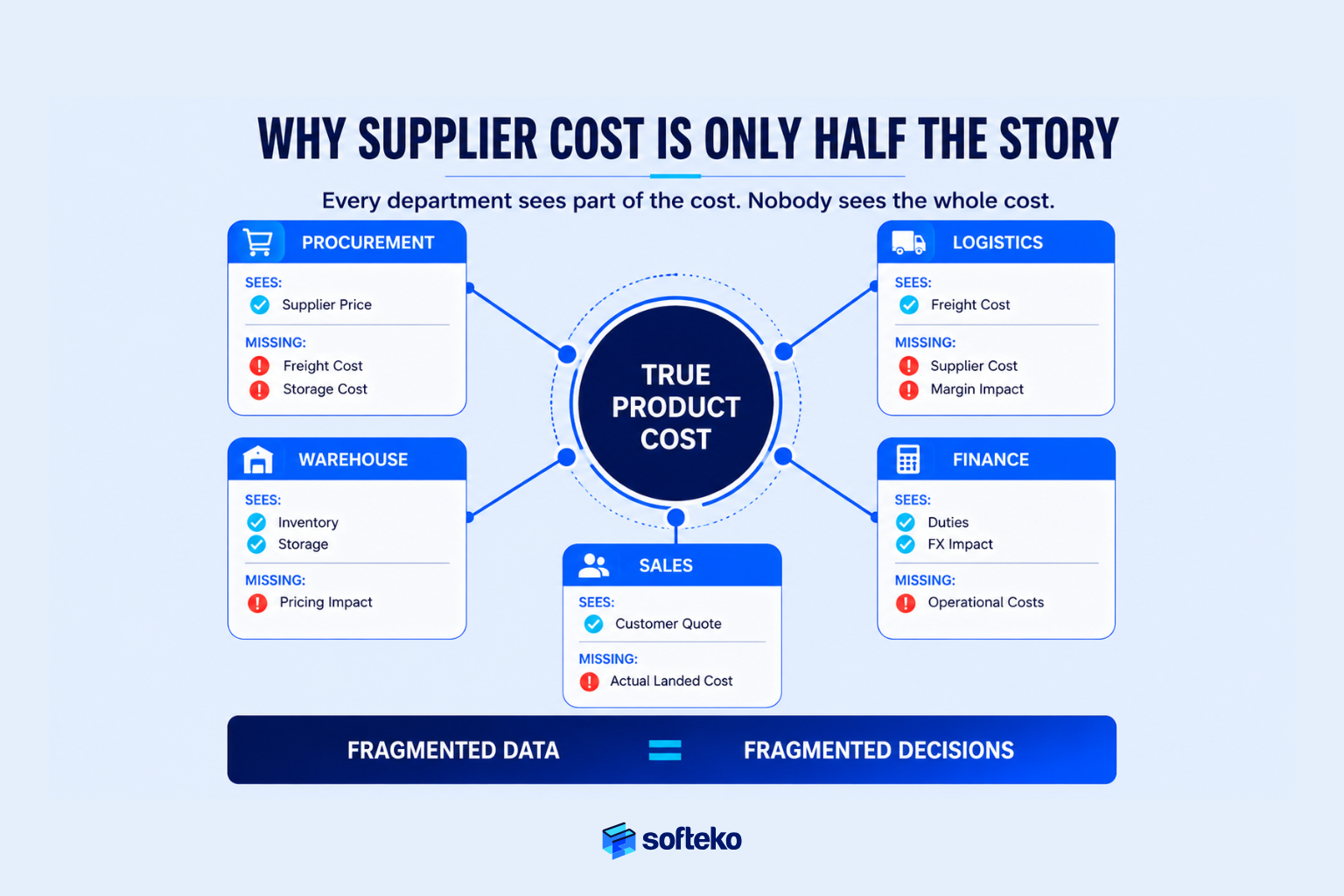
How cost visibility breaks across departments
| Function | What they see | What they don’t see |
|---|---|---|
| Procurement | Supplier price, terms, and payment | Final freight, duty, handling |
| Logistics | Freight bookings, shipment status | Final supplier costs, customs invoices |
| Warehouse | Goods receipt, storage, handling | Pricing implications |
| Finance | Duties, vendor invoices, FX | Operational losses, real-time freight |
| Sales | Quotation, customer terms | Total landed cost at quote time |
Each team is doing its job. The cost information is just fragmented, and fragmented data produces fragmented decisions.
Zilliant’s research on industrial-manufacturing margin decline reaches a striking conclusion: margin erosion is rarely a pricing-strategy failure. It’s a pricing-execution problem — inconsistent cost pass-through, unchecked discounting, contract lag, post-invoice adjustments.[4] The same dynamic plays out in trading: the strategy is sound; the cost base is incomplete.
Why Lower Supplier Prices Don’t Always Increase Profit
Suppose a buyer negotiates $20/MT off a supplier. Procurement KPI: win.
Then the supplier ships late → emergency freight is needed → inventory arrives after demand peaks → warehousing costs accumulate → eventual margin: loss.
Stokly’s landed-cost analysis for distributors frames this exact pattern as the reason high-performing distributors evaluate suppliers on total cost of ownership, not unit price[7]. The lowest quotation rarely produces the highest profit.
How Incomplete Costs Lead to Wrong Pricing
Incomplete costing produces two opposite failure modes:
| Failure mode | Cause | Result |
|---|---|---|
| Underpricing | Sales quotes from the supplier cost only | Revenue grows, margin quietly deteriorates |
| Overpricing | Sales add excessive buffers for uncertainty | Lost deals, lost competitiveness |
In both cases, the root cause is the same: the business lacks confidence in the actual product cost.
7 Hidden Costs That Reduce Your Profit Margin
Margin leakage rarely comes from one big mistake. It comes from dozens of small costs that never get connected to the product being sold.
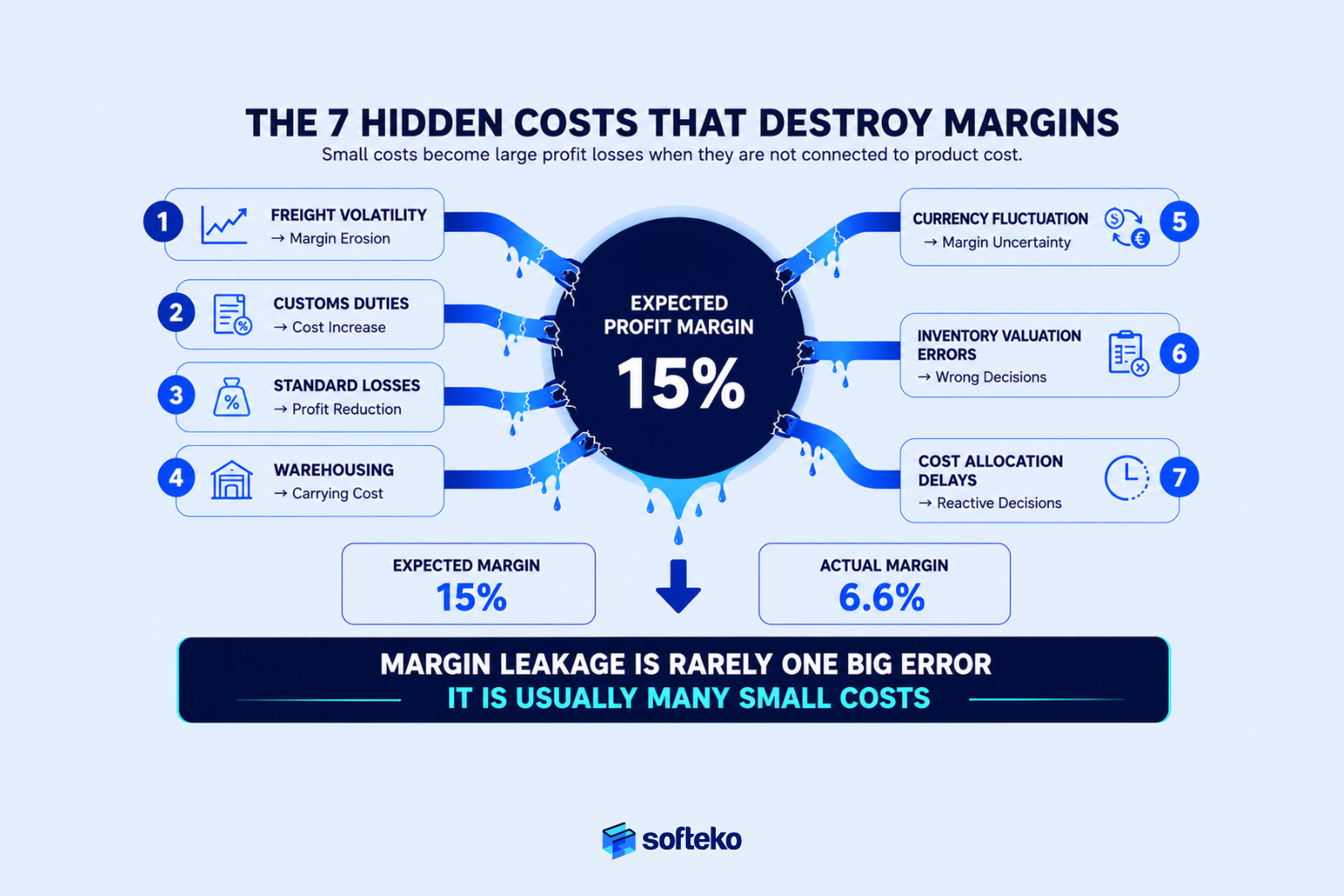
| # | Hidden cost | Typical business impact |
|---|---|---|
| 1 | Freight volatility | Reduced gross margin between quote and shipment |
| 2 | Customs duties & regulatory charges | Understated product cost (added post-arrival) |
| 3 | Standard losses (handling, moisture, bagging, QC) | Lower realised profitability per MT |
| 4 | Warehousing & storage | Carrying cost rises with days in stock |
| 5 | Currency fluctuation | Margin unpredictability between PO and payment |
| 6 | Inventory valuation errors | Misleading profitability reports |
| 7 | Cost allocation delays | Reactive decisions instead of proactive |
A few examples deserve a closer look:
- Freight volatility is now a structural risk, not a temporary anomaly. As FlexFulfillment notes on shipping-cost volatility, pricing decisions made on outdated freight assumptions cause systemic under- or over-pricing across entire quarters.[8]
- Standard losses are routine in bulk and commodity trading — handling, moisture, bagging and QC rejections typically run 0.3–0.5% for bulk operations. Recorded operationally, often not financially.
- Inventory valuation errors are arguably the most expensive because they cascade: wrong inventory value → wrong COGS → wrong gross margin → wrong product profitability ranking → wrong strategic decisions. CohnReznick highlights that this is precisely why “Actual vs. Estimated” landed-cost methods matter — estimated methods let inventory valuation update before all invoices arrive.[6]
Individually, each of these looks like a rounding error. Across hundreds of transactions and thousands of MT, they become a structural P&L problem.
What the research says on Landed Cost, Inventory Valuation, and Profit Margins
Freight Costs Change More Than Most Businesses Expect
Ocean and trucking rates fluctuate enough that supplier pricing alone no longer provides a reliable basis for profitability planning [8]. For commodity trading, freight can move profitability by several margin points within a single quarter.
How Much Does Landed Cost Add?
For many importers, landed cost components run 10–30% of total company expenses, and 40%+ of the cost of each imported freight item. Treating them as overhead instead of product cost misstates gross margin systematically.
Why Profit Margins Keep Shrinking
Zilliant’s 2024 analysis shows that organisations can maintain stable headline gross margin while contribution margin and net profit quietly deteriorate — because post-invoice adjustments (freight, rebates, allowances) reduce realised profitability but aren’t visible in early reporting.[4]
Why Inventory Valuation Matters
CohnReznick’s NetSuite landed-cost guidance and Oracle’s own NetSuite landed-cost documentation both make the same point: inaccurate inventory valuation distorts COGS, gross margin and product profitability simultaneously.[6][9]
How Better Product Costing Improves Pricing
An academic study from Theseus / Aalto finds that manufacturers implementing advanced product costing techniques report improved pricing accuracy and better identification of low-margin products — implying traditional costing systematically misses the layers that matter most[10]. DataIntelo’s market analysis supports the same conclusion at the market level.[11]
How ERP Improves Cost Visibility
Parsimony’s ERP statistics 2025 reports:
- ~30% average purchasing & inventory savings within 2 years of ERP go-live
- Median ERP ROI of ~52%, with payback in 2–3 years
- Forecasting accuracy improvements of ~35% with AI-augmented modules [5].
The takeaway across all of this is consistent: profitability problems in trading usually originate from incomplete cost visibility, not poor sales performance.
7 Controls That Keep Product Costs Accurate
| # | Control | What it enforces |
|---|---|---|
| 1 | Capture every cost at the source | No acquisition cost exists without a link to inventory |
| 2 | Define freight allocation rules (weight / volume / qty / value / container-fill) | Consistent distribution across SKUs in a shipment |
| 3 | Allocate duties & clearance to inventory immediately | Inventory valuation reflects acquisition cost from day one |
| 4 | Standardise loss management (handling, moisture, bagging, QC) | Physical losses become part of product cost, not overhead |
| 5 | Connect inventory valuation to actual costs | Inventory value updates as costs arrive |
| 6 | Monitor cost variance (estimated vs actual per cost line) | Costing assumptions improve over time |
| 7 | Pricing governance (margin check before quote release) | Sales never quotes on incomplete cost |
None of these controls depends on hindsight. Each exists to improve decisions before revenue is generated.
How Odoo automates landed cost tracking
The reason most spreadsheet-driven landed-cost processes break isn’t calculation — it’s control. Capturing supplier prices is easy. Capturing freight, duties, warehouse costs, standard losses and handling expenses consistently across hundreds of transactions is much harder.
Odoo connects purchasing, inventory, logistics and accounting in one workflow so landed cost gets built up from actual operational events instead of assumptions.
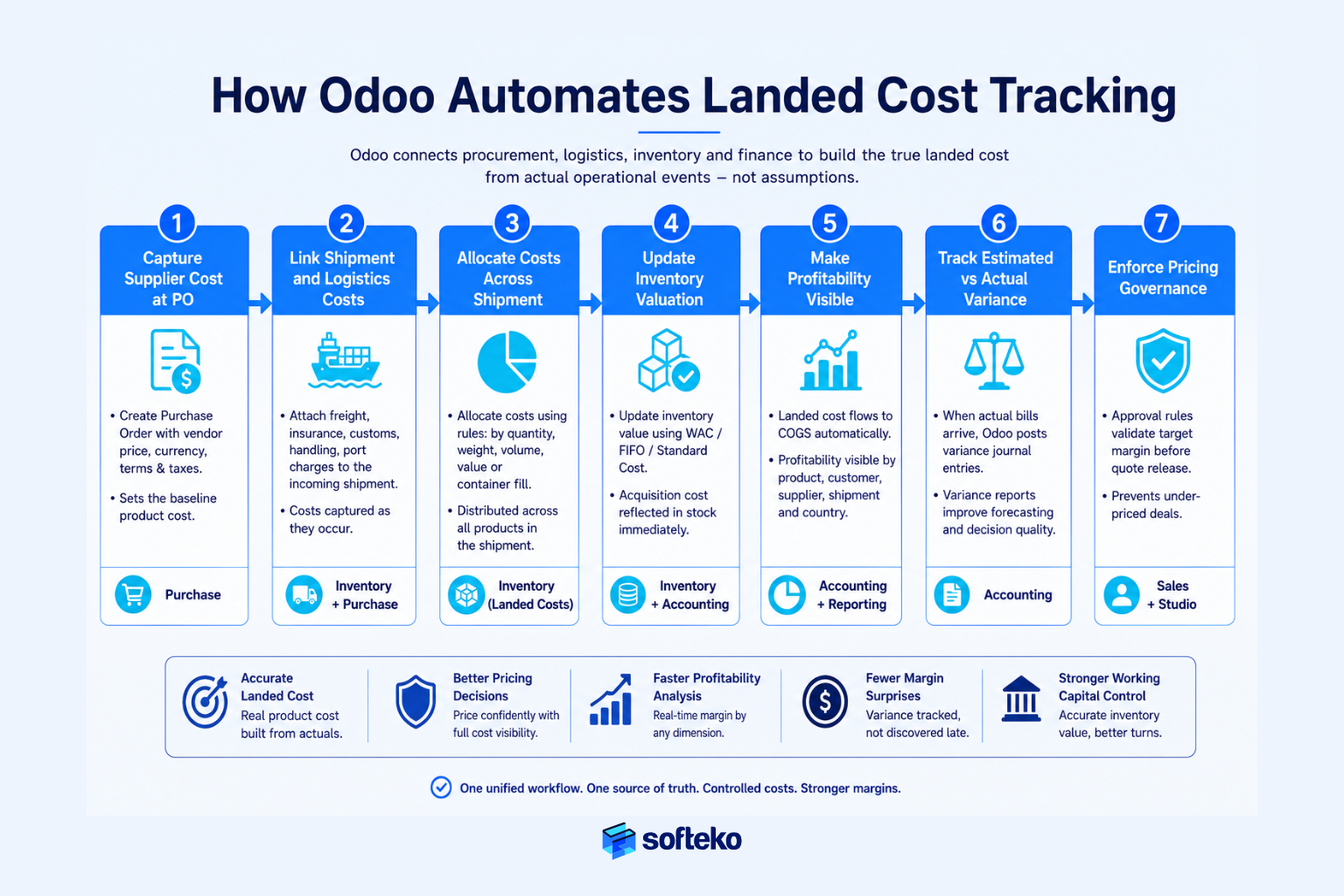
How Odoo Tracks Landed Costs Step by Step
| # | Step | What Odoo does | Module |
|---|---|---|---|
| 1 | Capture supplier cost at PO | Sets baseline product cost on the PO | Purchase |
| 2 | Link shipment & logistics costs | Freight, customs, port handling, and insurance are attached to the receipt | Inventory + Purchase |
| 3 | Allocate costs across the shipment | Quantity/weight / volume / value-based methods, applied automatically | Inventory (Landed Costs) |
| 4 | Update inventory valuation | WAC / FIFO / standard cost recalculated to reflect acquisition cost | Inventory + Accounting |
| 5 | Make profitability visible | Margin reportable by product, customer, supplier, shipment, and country | Accounting + Reporting |
| 6 | Track variance (estimated vs actual) | Bills posted later create variance journal entries automatically | Accounting |
| 7 | Pricing governance | Approval rules can block quotes that fall below the target margin | Sales + Studio |
Before and After Using Odoo for Landed Cost
| Before | After |
|---|---|
| Procurement negotiates the supplier price | Procurement understands the total acquisition cost |
| Sales quotes from the supplier cost | Sales prices from the landed cost |
| Finance discovers margin issues later | Finance validates profitability pre-close |
| Variance is invisible | Variance is reportable and trended |
| Inventory carries supplier cost only | Inventory carries the actual acquisition cost |
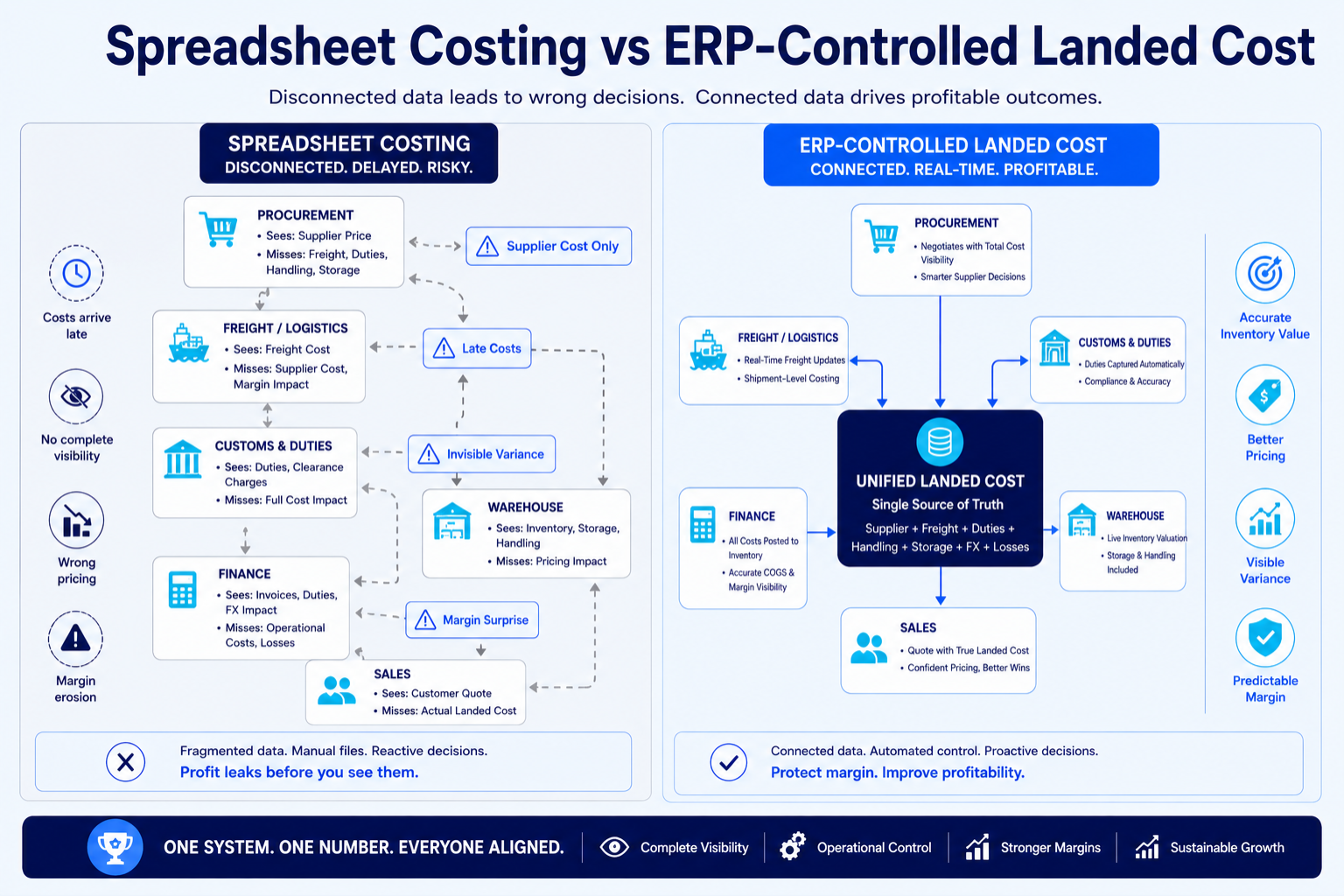
Example of Estimated vs Actual Cost:
| Cost category | Estimated | Actual | Variance |
|---|---|---|---|
| Freight | $2,000 | $2,450 | +$450 |
| Customs | $1,200 | $1,350 | +$150 |
| Handling | $300 | $325 | +$25 |
| Total | $3,500 | $4,125 | +$625 |
Over a year, captured variance becomes a feedback loop that improves supplier selection, freight planning, budgeting, pricing accuracy and margin forecasting.
How Daily Operations Change with Odoo
The value of Odoo’s landed-cost functionality isn’t the calculation — spreadsheets can calculate. It’s the discipline: freight, customs duties, handling charges, warehouse costs and standard losses become part of the product cost conversation before management evaluates profitability.
Result:
- More accurate inventory valuation
- Better pricing decisions
- Faster profitability analysis
- Fewer margin surprises
- Stronger working-capital control
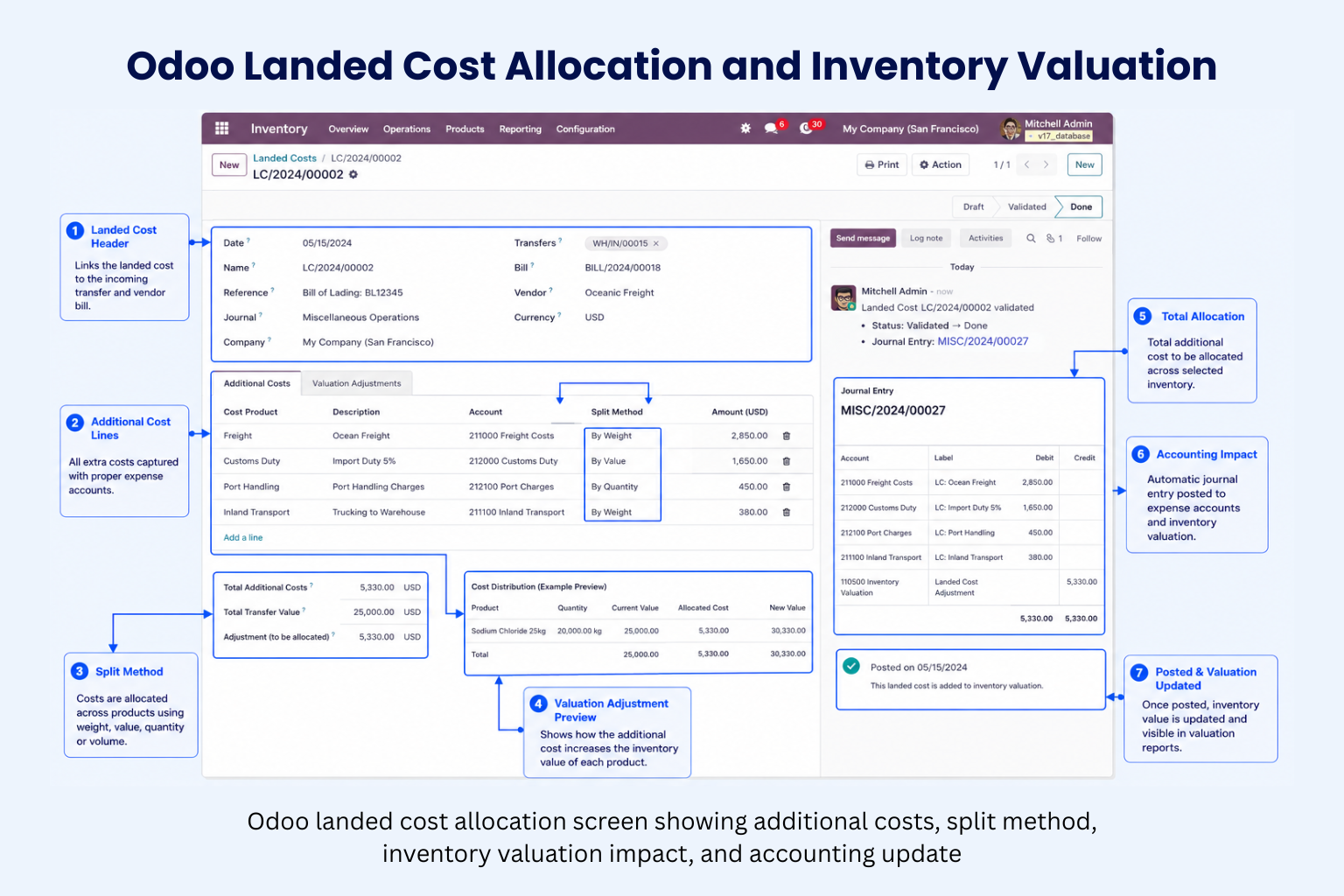
Why Cost Visibility Is More Important Than Reports
Reporting tells you what happened. Operational controls influence what happens next. By the time finance identifies shrinking margins, the supplier is paid, the shipment is delivered, the inventory is sold, and the customer has already received the product. The window to protect margin has closed.
That’s why landed cost should be treated as an operational control mechanism, not an accounting deliverable. When procurement, logistics, warehouse and finance work from different cost numbers, leakage is structural. When they work from the same landed-cost data, margin becomes predictable.
FAQ
How much does landed cost typically add to the supplier price?
Industry analysis puts landed cost at 40%+ of total imported freight item cost, and Ecosire’s worked example shows a 54% gap between FOB and landed cost in a representative import.[1]
Why does landed cost matter for profitability?
Because pricing built on supplier cost alone systematically under-states real cost. The result is margin leakage that only becomes visible after the sale.[4]
What’s the difference between actual and estimated landed cost?
Estimated landed cost lets inventory valuation update before every invoice arrives; actual lands when bills are reconciled. Estimated methods enable real-time decision-making; actual methods close the variance loop.[6]
Which costs are most frequently missed?
Freight surcharges, customs processing fees, inland transport, warehouse handling, currency impact, and physical losses (handling, moisture, bagging) — all routinely booked as overhead rather than COGS.
How does Odoo handle landed cost specifically?
Odoo’s Inventory module allocates freight, duties, handling and insurance directly to inventory receipts using configurable rules (quantity/weight/volume/value), then updates WAC/FIFO valuation and posts variance journals when actual bills arrive.
A simple starting diagnostic
Before changing anything, run this on your last 10 completed shipments:
| Metric | Source |
|---|---|
| Supplier cost | PO |
| Estimated landed cost (at quote) | Sales quote model |
| Actual landed cost (post-shipment) | Finance reconciliation |
| Expected margin | Quote |
| Actual margin | P&L by transaction |
If the gap between expected and actual margin is meaningful and consistent, the issue is not pricing or sales. It’s cost visibility. And cost-visibility problems are usually fixable long before they become profitability problems.
Protect the margin before it leaks
The businesses that consistently protect margin in trading are not the ones with the cheapest suppliers. They’re the ones who know what their product actually costs before they commit to a deal.
At Softeko, we work with trading, wholesale, distribution and import-export businesses to analyse how costs move through their operations and to implement Odoo ERP as a practical control system across procurement, landed-cost calculation, inventory valuation, margin approval, quotation governance and supply-chain visibility.
Our objective isn’t to deploy software. It’s to create operational controls that reduce margin leakage and improve decision-making across procurement, finance, sales and supply chain.
References
[1] Drip Capital — Landed Cost Guide
https://www.dripcapital.com/en-us/resources/blog/landed-cost
[2] Ecosire — Landed Cost vs FOB Example
https://ecosire.com/blog/landed-cost-calculation-import-duties
[3] Go-ERP — Understanding Landed Cost
https://go-erp.eu/the-impact-of-landed-costs/
[4] Zilliant — Why Profit Margins Are Declining in Industrial Manufacturing
https://zilliant.com/resources/why-are-profit-margins-declining/
[5] Parsimony — ERP Statistics 2025
https://parsimony.com/erp-statistics/
[6] CohnReznick — Optimize Inventory Tracking with NetSuite Landed Costs
https://www.cohnreznick.com/insights/optimize-inventory-tracking-with-netsuite-landed-costs
[7] FlexFulfillment — Shipping Cost Volatility
https://flexfulfillment.com/blog/shipping-cost-volatility/
[8] Oracle NetSuite — Landed Cost Documentation
https://docs.oracle.com/en/cloud/saas/netsuite/
[9] Theseus Repository — Advanced Product Costing in Manufacturing
https://www.theseus.fi/
[10] DataIntelo — Manufacturing Costing Software Market Report
https://dataintelo.com/report/manufacturing-costing-software-market
[11] Stokly — Understanding Landed Costs and Their Impact on Profit
https://www.stokly.com/blog/understanding-landed-costs