


Key takeaways
- About 70–75% of Letter of Credit document presentations are rejected on first submission — almost always for minor wording, timing or UCP 600 / ISBP misalignment issues (Forbes Finance Council, 2026; ICC Banking Commission, via Universal Commerce Protocol).
- Preventable classification and documentation errors cause an estimated 20–40% of shipment delays (BCG, 2025).
- Demurrage runs $75–$300 per container per day; a 10-day delay costs $1,000–$3,000 per TEU (FreightAmigo) — and the full business impact is typically 5–7× the visible port charge once rework, lost sales and working-capital cost are added.
- 67% of companies plan to improve supply-chain visibility, but only 30% have completed implementation in the last 12 months (SCMR).
- Document workflow automation delivers 50–94% faster processing and ~70% fewer manual errors (HelloRoketto; PDF.ai).
Overview
International trade rarely breaks down because cargo is unavailable. The goods are usually ready. The vessel booking is confirmed. The customer is waiting.
What’s missing is an approval. Or the latest commercial invoice. Or confirmation that the Certificate of Origin was submitted. The delay isn’t in the cargo — it’s in the workflow.
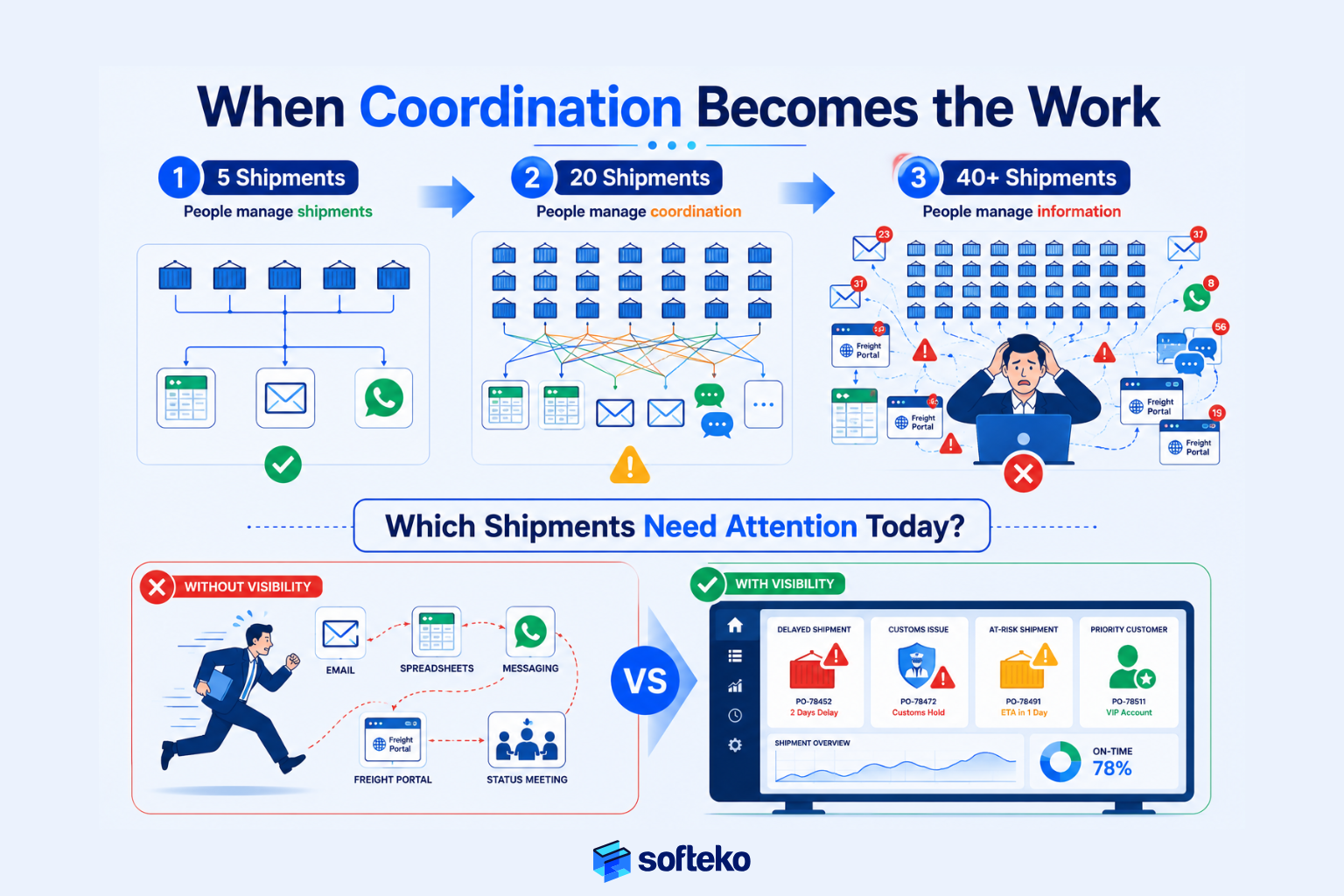
This becomes more painful as trading businesses grow. Five shipments a month can run on email, spreadsheets, phone calls and individual follow-up. Fifty shipments across multiple suppliers, freight forwarders, banks and customs authorities exposes a different reality: coordination becomes harder than transportation.
This article covers:
- The full 8-stage LC-to-shipment workflow and where it breaks
- The 8 most common causes of trade delays (with sourced data)
- What documentation errors actually cost (the 5–7× multiplier)
- The Trade Visibility Chain Framework — 6 layers that have to stay intact
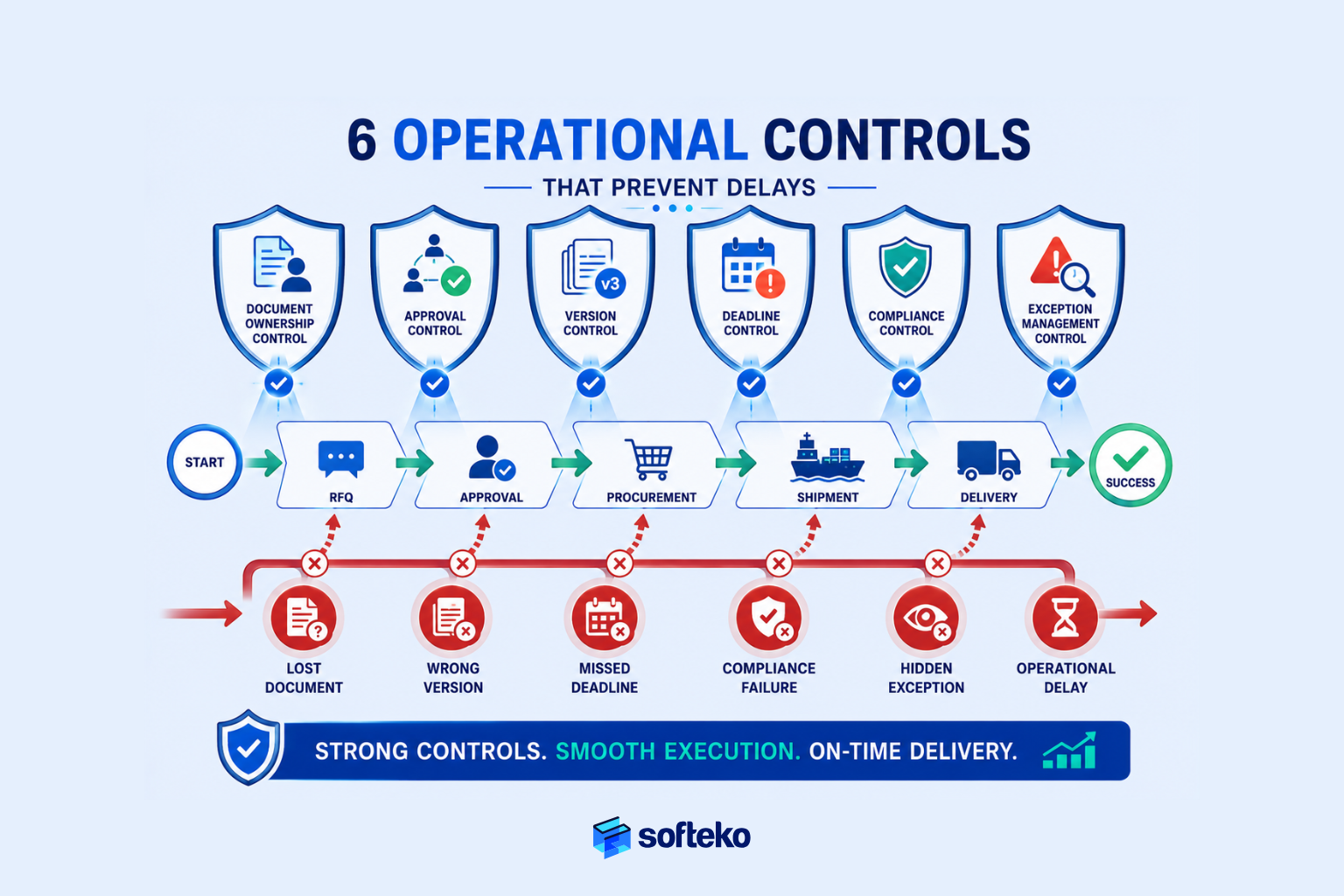
- The 6 operational controls that prevent delays
- How Odoo turns those controls into the default path of work
- FAQ + a starting audit
8 Stages of an LC-to-Shipment Workflow
An import transaction is not one process — it’s a chain. A customs hold may originate from an invoice prepared weeks earlier. An LC discrepancy may trace back to a quotation detail agreed months ago. To see where workflows break, view the process as a chain rather than isolated tasks.
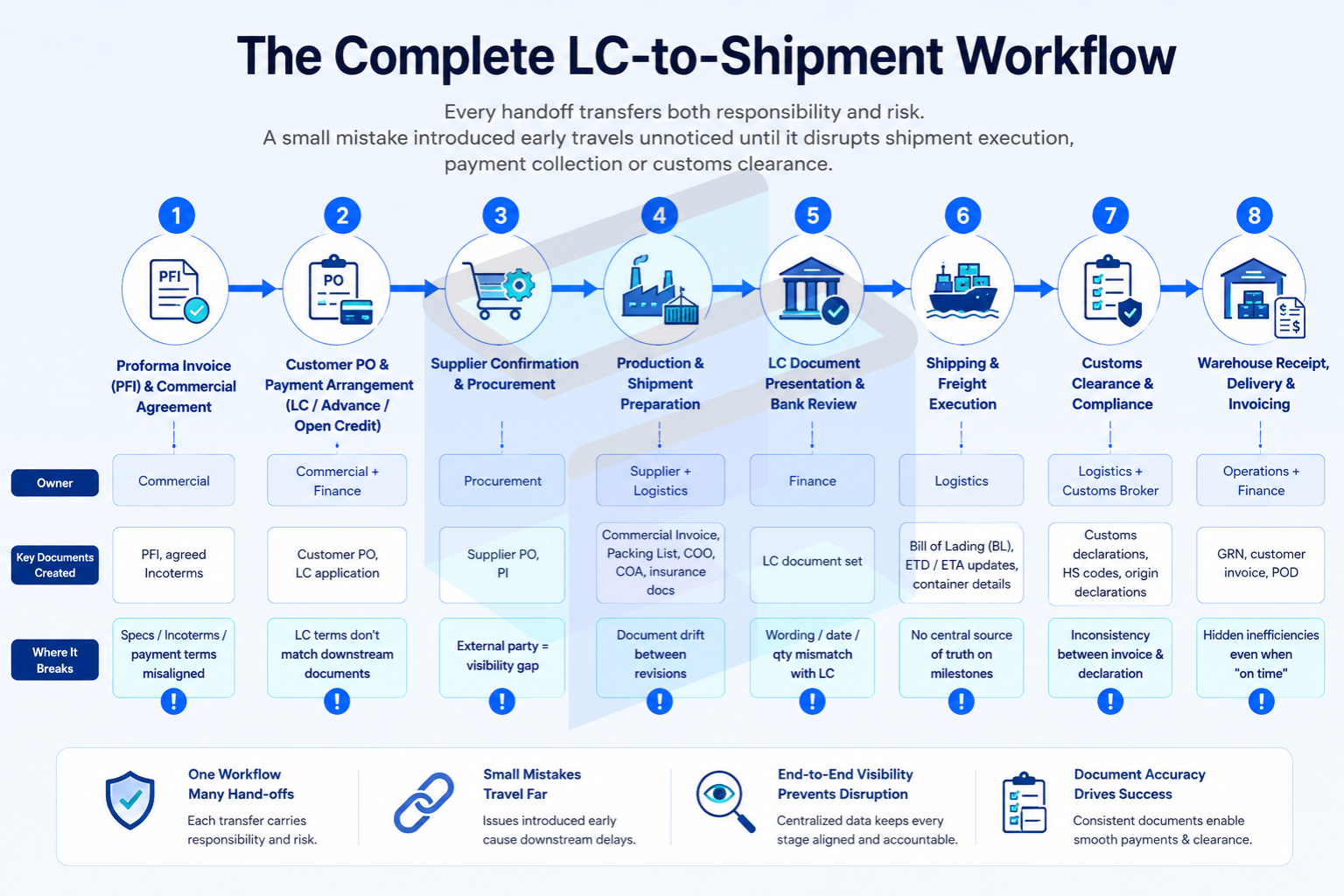
| # | Stage | Owner | Key documents created | Where it breaks |
|---|---|---|---|---|
| 1 | Proforma Invoice (PFI) & commercial agreement | Commercial | PFI, agreed Incoterms | Specs / Incoterms / payment terms misaligned |
| 2 | Customer PO & payment arrangement (LC / advance / open credit) | Commercial + Finance | Customer PO, LC application | LC terms don’t match downstream documents |
| 3 | Supplier confirmation & procurement | Procurement | Supplier PO, PI | External party = visibility gap |
| 4 | Production & shipment preparation | Supplier + Logistics | Commercial Invoice, Packing List, Certificate of Origin (COO), Certificate of Analysis (COA), insurance docs | Document drift between revisions |
| 5 | LC document presentation & bank review | Finance | LC document set | Wording/date/qty mismatch with LC |
| 6 | Shipping & freight execution | Logistics | Bill of Lading (BL), ETD/ETA updates, container details | No central source of truth on milestones |
| 7 | Customs clearance & compliance | Logistics + Customs broker | Customs declarations, HS codes, origin declarations | Inconsistency between invoice & declaration |
| 8 | Warehouse receipt, delivery & invoicing | Operations + Finance | GRN, customer invoice, POD | Hidden inefficiencies even when “on time” |
Every handoff transfers both responsibility and risk. A small mistake introduced early travels unnoticed until it disrupts shipment execution, payment collection or customs clearance.
8 Common Causes of Trade Delays
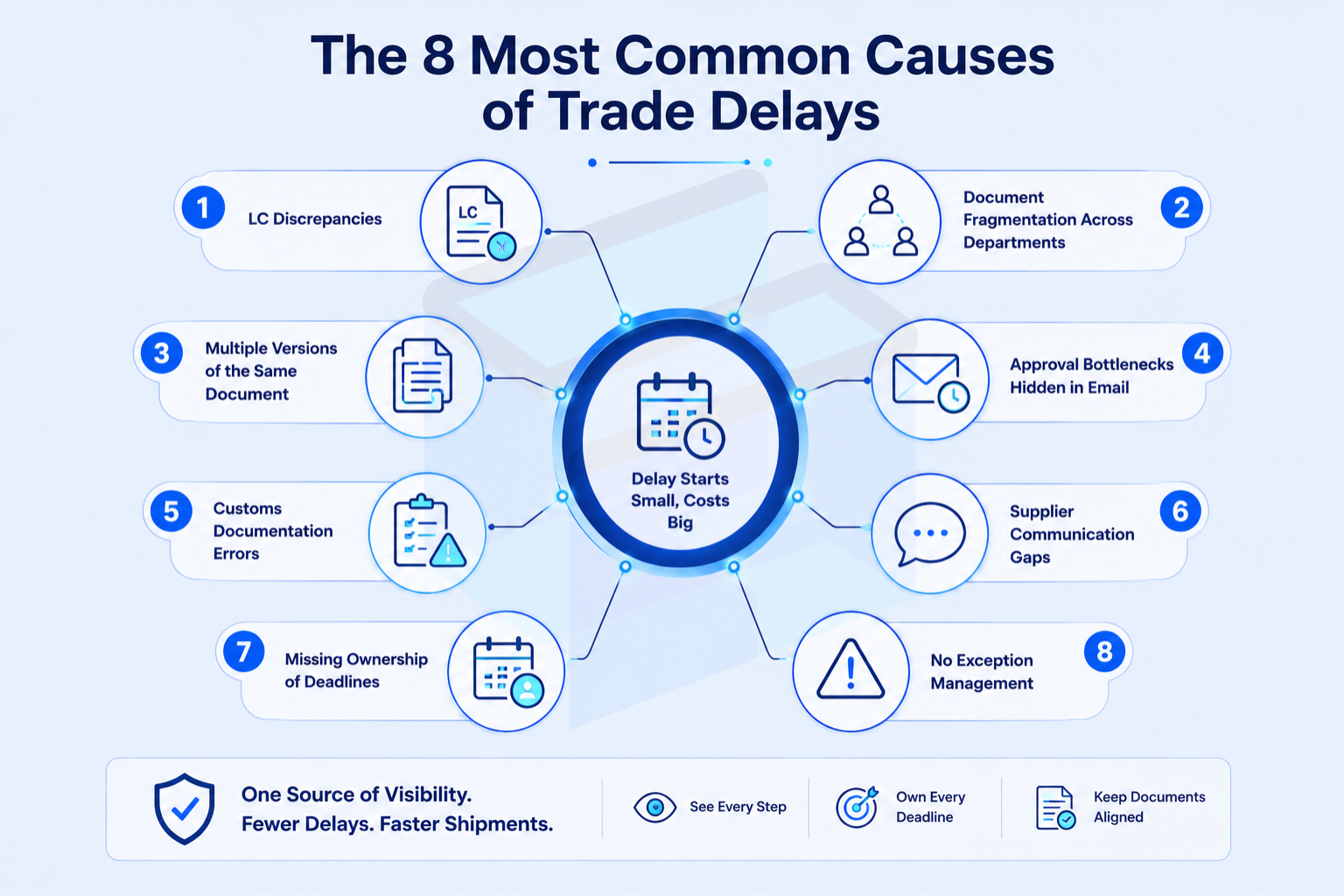
| # | Cause | What goes wrong | Source |
|---|---|---|---|
| 1 | LC discrepancies | ~70–75% of first presentations rejected — wording, qty, dates, missing docs, UCP 600 / ISBP mis-match | Forbes / ICC |
| 2 | Document fragmentation across departments | Commercial holds quotations, Finance holds LC correspondence, Logistics holds shipping docs — no single trade file | — |
| 3 | Multiple versions of the same document | Revised packing list, updated invoice, LC amendment — older versions keep circulating | — |
| 4 | Approval bottlenecks hidden in email | Quotation, PFI, exception, margin approvals stuck in someone’s inbox; nobody knows where | — |
| 5 | Customs documentation errors | Wrong HS code, invoice inconsistency, missing origin declaration, missing certificates → 20–40% of delays | BCG, 2025; StarUSA on customs execution |
| 6 | Supplier communication gaps | Updates come via email/WhatsApp/phone — never reach every stakeholder | — |
| 7 | Missing ownership of deadlines | LC expiry, shipment cut-off, customs filing, payment milestones tracked manually | LinkedIn — Vibin Sethu on LC submission timing |
| 8 | No exception management | Problems get noticed after delay starts, not before | LinkedIn — Alaa Elshalaby on shipment delays |
A quick note on LC discrepancies: the ICC Banking Commission Trade Register has consistently shown a 65–80% discrepancy rate on first presentation for decades (analysis here). Almost all of it is operational: wording mismatches, date typos, missing documents, or misalignment with UCP 600 and ISBP — not legitimate compliance failures.
Why These 8 Trade Delays Have the Same Root Cause
At first glance these are unrelated — banks, customs, suppliers, internal teams. They all stem from one underlying issue: visibility. The organisation can’t act on information it can’t see. Documents exist, but status is unclear. Approvals exist, but ownership is unclear. Deadlines exist, but accountability is unclear.
How Documentation Delays Increase Costs
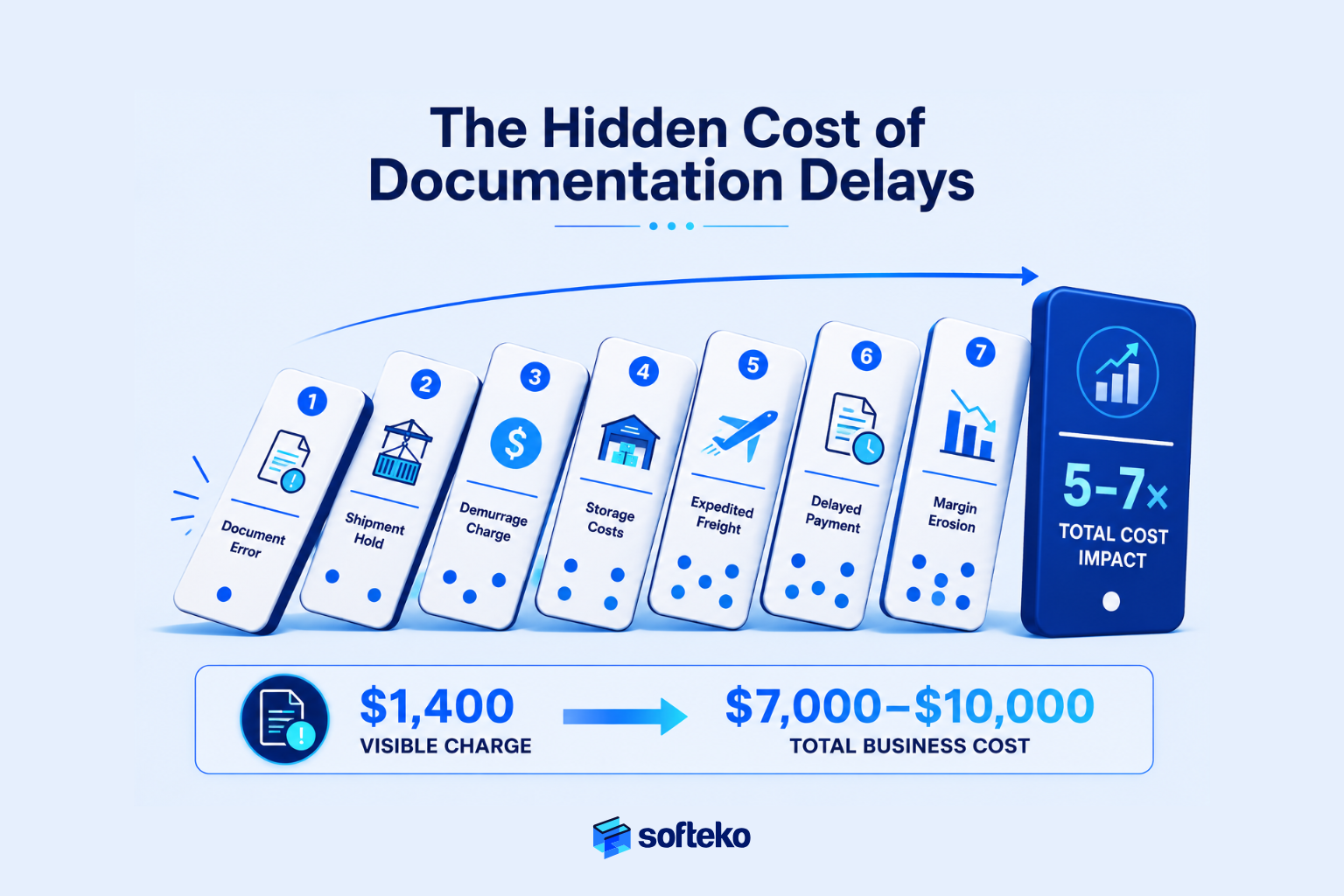
Most businesses calculate only the visible expense — the demurrage invoice. The real cost is 5–7× larger because every delay triggers a cascade.
What Demurrage and Detention Really Cost
| Metric | Value | Source |
|---|---|---|
| Demurrage per container per day | $75–$300 | FreightAmigo |
| Cost of a 10-day delay per TEU | $1,000–$3,000 | FreightAmigo |
| Demurrage & detention as % of shipping cost | 10–25% | FreightAmigo impact analysis |
| Margin erosion from multi-container delays | 5–10% | FreightAmigo |
| Perishables price penalty for time-sensitive goods | 20–30% | University of Auckland study (see note below) |
Why a Small Documentation Error Can Cost 5–7× More
A widely cited University of Auckland analysis estimates the total business cost of a documentation-driven delay is 5–7× the visible port charge. A $1,400 demurrage charge typically becomes a $7,000–$10,000 problem once you add:
| Hidden cost layer | Example impact |
|---|---|
| Additional storage / warehousing | Per-day fees during hold |
| Expedited transport recovery | Air freight vs. ocean differential |
| Administrative rework | Document corrections, re-filings |
| Supplier coordination cost | Re-issuance, amendments |
| Customer service effort | Status updates, claims handling |
| Lost sales opportunities | Slot lost to a competitor |
| Delayed cash collection | LC payment release deferred |
A small document error becomes a profitability issue.
How Documentation Errors Delay Cash Collection
For LC transactions specifically, the shipment may already be delivered while payment remains unavailable because document discrepancies delayed bank processing. The transaction is operationally complete but financially unfinished — a pattern that compounds across volume.
6 Layers of Trade Visibility
Trade execution becomes predictable only when every stakeholder can see the information required to complete the next action. The chain has six links — when any one breaks, risk accumulates and eventually shows up as a delay.
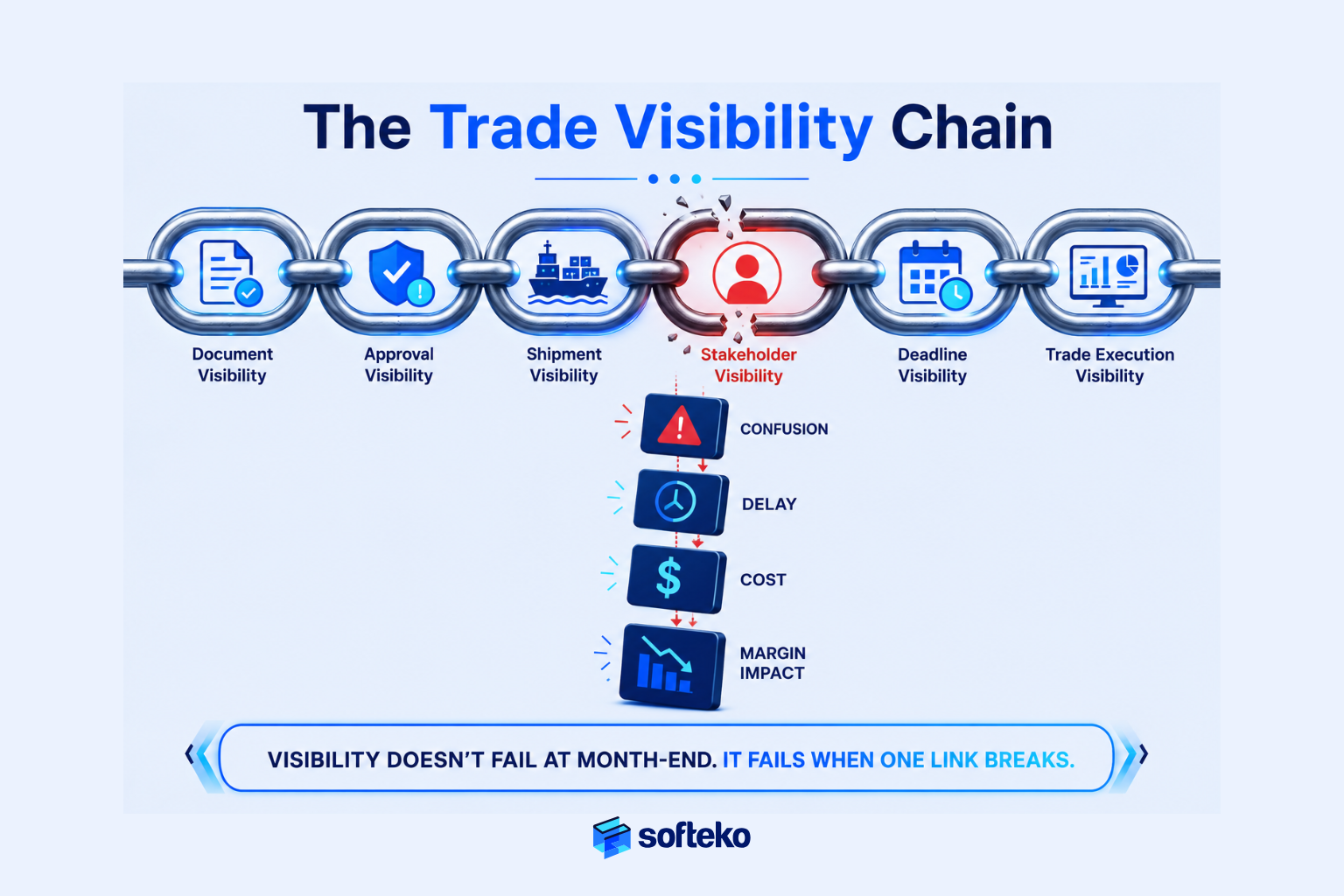
| # | Layer | The question it answers | What “broken” looks like |
|---|---|---|---|
| 1 | Document visibility | Has the right version of the document been received? | Multiple revisions in circulation; nobody knows which is “final” |
| 2 | Approval visibility | Where is approval currently stuck? | Approval in someone’s inbox; team chases by email |
| 3 | Shipment visibility | Is the transaction progressing — not just where the container is | Container tracked, but production/booking/clearance status unknown |
| 4 | Stakeholder visibility | Who owns the next action? | Everyone assumes someone else is handling it |
| 5 | Deadline visibility | Which deadline needs attention before it becomes urgent? | LC expiry / customs filing missed |
| 6 | Trade execution visibility | “Which transactions are at risk right now?” — answered instantly | Answered only at month-end |
McKinsey’s supply-chain research reaches the same conclusion at scale: most organisations still struggle to achieve meaningful visibility beyond their first-tier suppliers, even after years of investment. The principle from McKinsey’s pulse-of-supply-chains research is stark: “Companies can manage supply chains only when they have a clear picture of each link.”
Why Manual Trade Coordination Stops Working as You Grow
Manual coordination works at low volume. The cracks appear as volume grows.
| Volume | What it feels like |
|---|---|
| 5 shipments/month | Spreadsheets + email + WhatsApp. Everyone knows everything. |
| 20 shipments/month | Spreadsheets get out of date by lunch. Coordination becomes a job. |
| 40+ shipments/month | Workload is no longer logistics — it’s information management. Updates live in 50 inboxes and 5 freight portals. |
Common tools and what they actually deliver:
| Tool | Strength | Weakness |
|---|---|---|
| Communication | Information stays inside one inbox | |
| Spreadsheets | Reporting | Reflects only the last manual update |
| WhatsApp / messaging | Speed | No traceability; updates lost in scrollback |
| Individual experience | Domain knowledge | Single point of failure |
Once the organisation starts asking “which shipments need attention today?” and the answer requires multiple status meetings, the coordination model has already failed. These are visibility questions, not workflow questions.
6 Controls That Prevent Trade Delays
The Visibility Chain explains what needs to be visible. These six controls describe how you make it visible at scale.
| # | Control | Purpose |
|---|---|---|
| 1 | Document ownership control | Every critical document has a defined owner, status, next action and history |
| 2 | Approval control | Approvals become trackable workflow events, not email conversations |
| 3 | Version control | Only the latest approved version is active; history retained for audit |
| 4 | Deadline control | System highlights approaching risk before it becomes urgent |
| 5 | Compliance control | Verification moves earlier in the workflow (pre-execution, not post-failure) |
| 6 | Exception management control | Deviations from plan become visible to the people who can resolve them |
A reality check: SCMR’s analysis shows 67% of companies plan to improve visibility, but only 30% have completed implementation in the last year. The gap between intent and execution is exactly where these six controls sit.
How Odoo supports trade documentation management
Odoo supports the six controls by connecting Commercial, Procurement, Logistics, Finance and Management in one operational record — rather than as separate systems that must be reconciled by email.
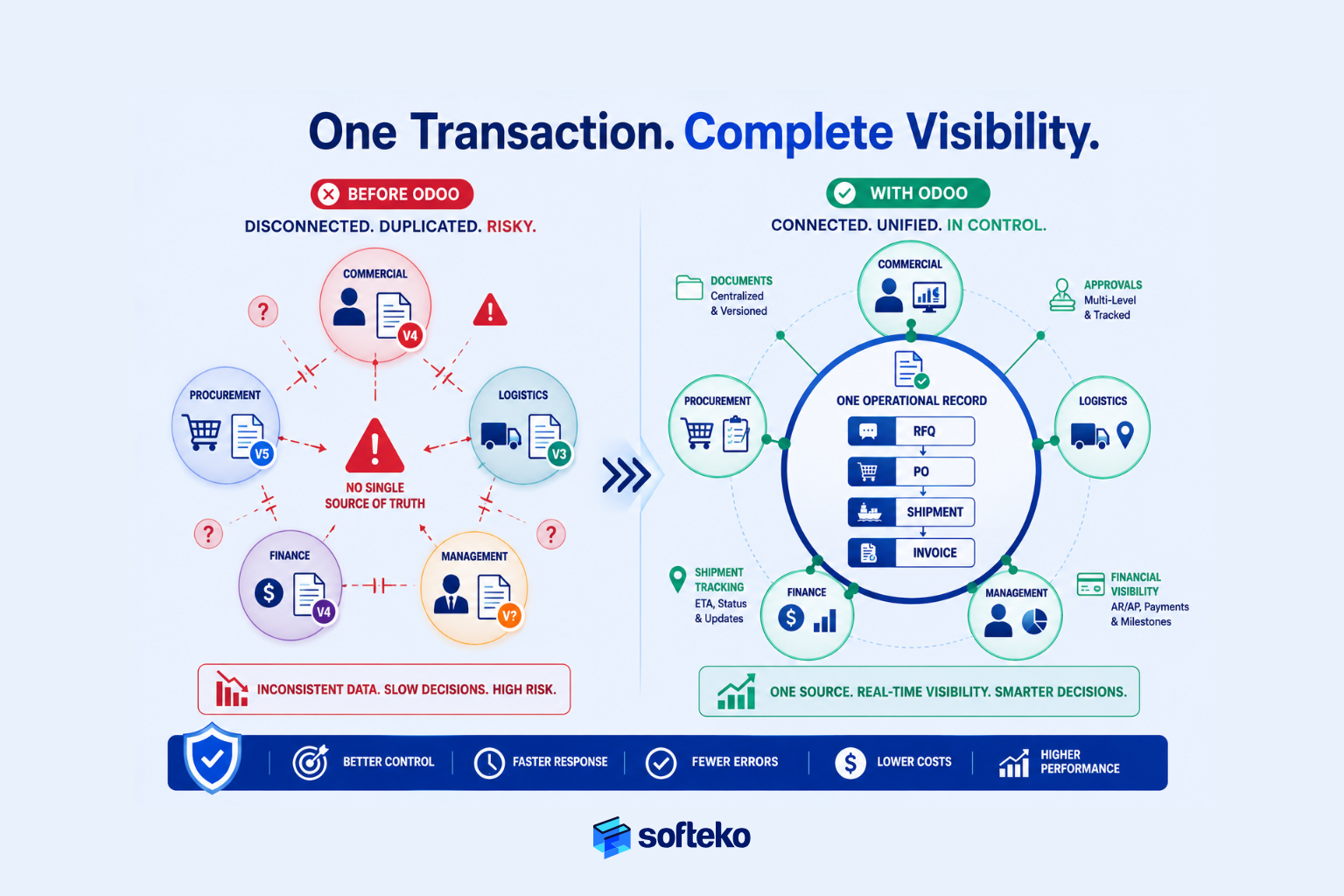
| Visibility layer → control | Odoo capability | Module |
|---|---|---|
| Document visibility | Centralised document repository linked to the transaction (PO/SO/Shipment) | Documents |
| Approval visibility | Multi-step approval routing with status, owner, history | Approvals + Studio |
| Version control | Document versioning with approved/draft states | Documents |
| Stakeholder visibility | Shared transaction view across Sales / Purchase / Inventory / Accounting | All modules |
| Procurement & supplier coordination | Customer demand → PO → supplier PO → shipment, all linked | Sales + Purchase |
| Shipment visibility | Inventory operations + carrier integration + ETA tracking | Inventory + Inventory Connectors |
| Financial visibility | Transaction-linked AR/AP, LC payment milestones, working-capital reporting | Accounting |
| Deadline & exception visibility | Activities + scheduled actions + exception filters | Activities (across all modules) |
The objective isn’t faster document storage — it’s operational alignment. Commercial, Procurement, Logistics, Finance and Management all start working from the same information.
How Daily Work Changes After ERP
| Before | After |
|---|---|
| “Where is the document?” | “What risk requires attention today?” |
| “Who approved this?” | “Which shipment needs intervention?” |
| “Which version is correct?” | “Which deadline is approaching?” |
| “What’s the status of this shipment?” | “Which exception needs escalation?” |
What Workflow Automation Improves
Workflow automation isn’t a substitute for control — it’s the mechanism that enforces control consistently at scale. The numbers are consistent across recent studies:
| Metric | Improvement | Source |
|---|---|---|
| Document processing time reduction | 50–94% | HelloRoketto |
| Manual error reduction | ~70% | PDF.ai |
| Processing speed vs manual | 4× faster with intelligent document processing | SenseTask 2025 |
| Cost saved per document | $8–$12 | SenseTask |
| Overall workflow cost savings | ~30% | SenseTask |
| Operational efficiency gain | 3× | HelloRoketto |
And on the ERP side specifically, vendor case-study data reports ~40% reduction in stock discrepancies, ~30% fewer stockouts, and ~25% faster order-to-cash post-implementation. Treat vendor data as directional rather than definitive, but the direction is consistent.
ERP Works Best with Strong Processes
Some businesses see major improvement after ERP go-live. Others see almost none. Same software, different outcomes. The difference is whether the 6 controls existed first.
If document ownership is still ambiguous, if approvals still happen by email outside the system, if deadlines still depend on individual memory — ERP just digitises the same problems faster. The implementations that consistently reduce delays fix the process first, then deploy the system to enforce it.
Frequently Asked Questions About LC and Trade Workflows
Why are LC documents rejected so often?
~70–75% of first presentations get rejected for minor operational issues — wording mismatches, date typos, missing docs, or non-compliance with UCP 600 / ISBP — not real compliance failures (Forbes / ICC).
What percentage of shipment delays come from documentation?
20–40%, per BCG’s 2025 analysis — almost all preventable. The biggest categories: commercial invoice errors, wrong HS codes, and origin declaration mistakes.
What does a single shipment delay actually cost?
Visible cost: $75–$300 per container per day in demurrage (FreightAmigo). Total business cost: 5–7× the demurrage charge once rework, lost sales and working-capital impact are added.
What is UCP 600 and why does it matter?
UCP 600 is the International Chamber of Commerce’s Uniform Customs and Practice for Documentary Credits — the global rulebook banks use to evaluate LC documents. ISBP (International Standard Banking Practice) is the companion document. Discrepancies almost always trace back to misalignment with one of these two.
Will Odoo eliminate LC discrepancies?
Not by itself. It will eliminate the coordination causes — version control, ownership, approval status, deadline awareness — which is where most discrepancies originate. The actual UCP 600 / ISBP compliance still depends on human review.
How quickly does workflow automation pay back?
Recent industry data puts savings at $8–$12 per document plus ~30% overall cost reduction, with 4× faster processing. For a business processing hundreds of trade documents a month, that’s typically a sub-12-month payback.
Do we need ERP at low shipment volume?
Probably not. At 5 shipments/month, manual coordination works. The threshold typically appears between 20 and 40 simultaneous shipments — when coordination overhead starts exceeding execution work.
What’s the single highest-impact control to implement first?
Deadline + exception visibility. A system that surfaces approaching LC expiries, customs filings and shipment cut-offs before they become urgent prevents the largest cost category (demurrage + LC payment delays) without rebuilding any other process.
5 Questions to Check Your Trade Workflow
Before changing anything, answer these five questions about your last 10 international shipments:
| Question | Where to find it |
|---|---|
| What % of LC presentations were accepted on first submission? | Bank correspondence |
| What % of customs entries cleared without query? | Broker reports |
| What was the average days-of-demurrage per shipment? | Carrier invoices |
| For every delayed shipment, can you name the document, approval or deadline that caused it? | Internal records (or memory) |
| Can your management team identify at-risk shipments today without a status meeting? | Real-time test |
If any of these answers are uncomfortable, the problem isn’t logistics. It’s visibility.
Reduce Trade Delays with Better Workflow Visibility
International trade rarely fails because of cargo. It fails because of coordination — and coordination only scales when documents, approvals, deadlines and stakeholders are visible in one place.
At Softeko, we help trading businesses analyse their LC-to-shipment workflows, identify where visibility breaks down, and implement Odoo ERP as a single source of truth across Commercial, Procurement, Logistics, Finance and Operations.
Our objective isn’t to deploy software — it’s to build the operational controls that prevent delays before customers feel them.