

Overview
Your trading business did not become complex overnight. It grew one customer, one warehouse, and one shipment at a time. Somewhere along that path — usually when a second warehouse opens, a new country enters the picture, or Finance stops trusting the inventory report — leadership starts asking a bigger question: what actually happens during an ERP implementation?
Most business owners assume implementation begins when consultants start configuring software. In reality, that is only 5% of the work. Odoo’s own methodology allocates approximately 80% of project time to iterative analysis, configuration, validation, and training cycles — with only 5% for go-live itself.[3] The remaining effort is business change: leadership alignment, process standardisation, master data preparation, cross-department workshops, and employee readiness.
The stakes are high. Independent research from Panorama Consulting shows that inadequate change management drives 42% of ERP failures, poor data migration accounts for 38%, and lack of executive sponsorship contributes to 31%.[1] Gartner predicts that by 2027, more than 70% of ERP initiatives will fail to meet their original business goals, with 25% failing catastrophically — and that 75% of ERP strategies are not strongly aligned with overall business strategy.[2]
This guide walks you through a realistic Odoo implementation for a trading business — from planning and phases through governance, rollout choices, risks, go-live, and the first 90 days. By the end, you should understand why implementation success depends far more on leadership, governance, and operational discipline than on the software itself.
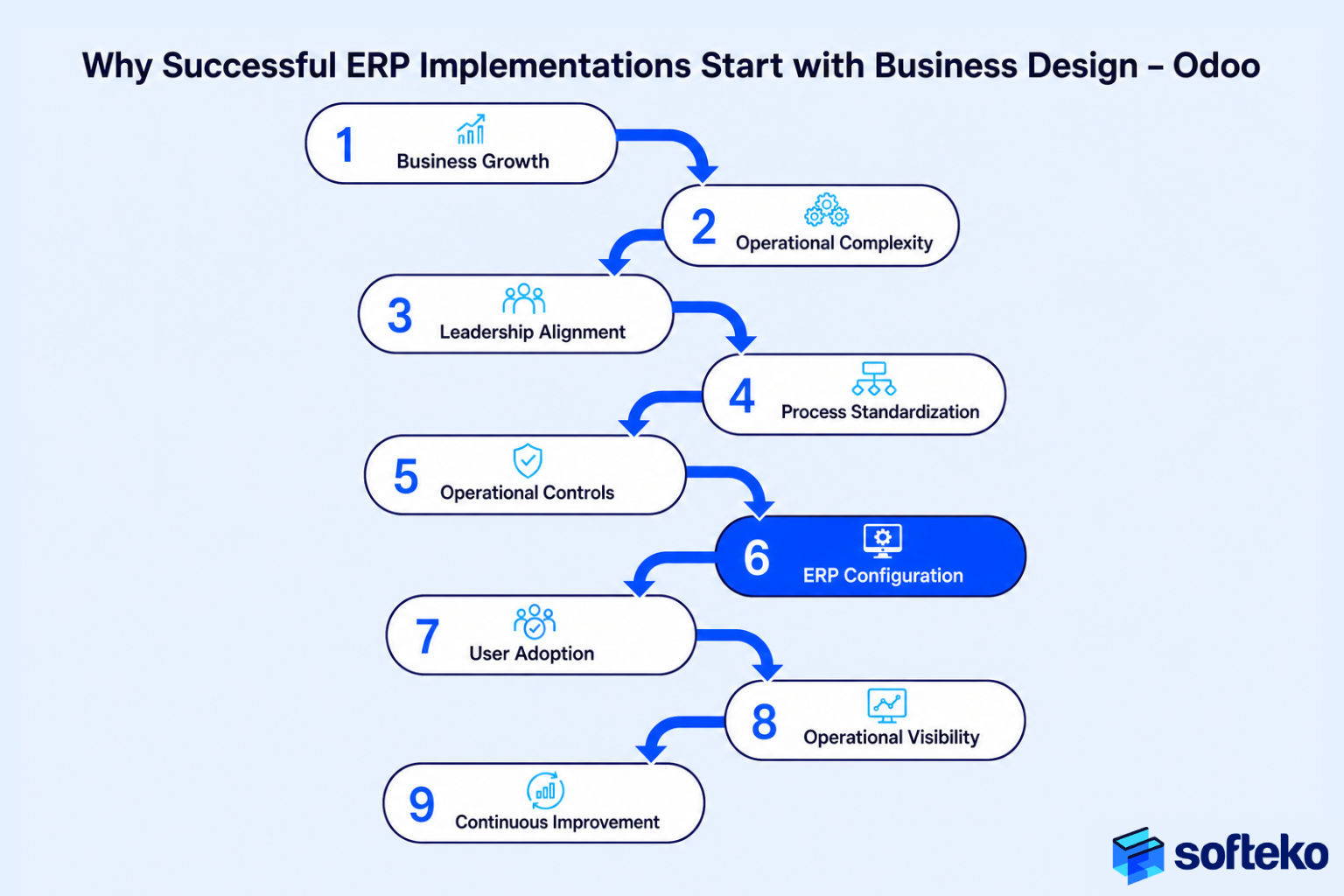
Why ERP Implementation Is a Business Transformation—Not Just an IT Project
An ERP reshapes how your business operates. It replaces email approvals with workflows, separate customer databases with one master, and month-end reconciliation with daily visibility. Because it changes operations, most of the effort — and most of the cost — lies in the change, not the software.
Every successful implementation begins by answering questions such as: how should orders move through the business? Who approves purchases? When should inventory be replenished? Which department owns customer master data? Which operational controls can never be bypassed? Only after these questions have clear answers does software configuration become useful.
Businesses that treat ERP as an IT project focus on installing software quickly. Businesses that treat ERP as an operational improvement project focus on designing better ways of working first. That difference decides whether your employees embrace the system or work around it.
Standardise Decisions Before You Configure Them
A well-designed ERP implementation establishes rules about how transactions should happen — not just how they are recorded.
| Business activity | Manual environment | ERP-controlled environment |
|---|---|---|
| Customer onboarding | Sales creates records independently | Standard approval workflow before activation |
| Purchase approval | Email approval from a manager | Defined hierarchy based on value or margin |
| Inventory allocation | First employee to update the spreadsheet wins | System allocates according to business rules |
| Shipment release | Warehouse decides manually | Released only when required conditions are met |
| Vendor payment | Finance checks multiple files | Payment follows a predefined validation path |
The improvement is not faster data entry. It is consistent decision-making at scale. This is where the APQC Process Classification Framework, a globally used taxonomy of more than 1,000 standardised business processes, becomes useful — it gives your team a common reference for mapping workflows before automating them.[4]
What Happens Before an ERP Implementation Officially Begins?
The most successful ERP implementations begin weeks — sometimes months — before anyone configures the system. This preparation phase decides whether implementation becomes a controlled business improvement project or a series of expensive corrections after go-live.
Executive Alignment Comes Before Project Planning
Every ERP project starts with a business question: why are we implementing an ERP? Different departments answer differently. Sales wants faster quotations. Procurement wants supplier visibility. Warehouse wants accurate inventory. Finance wants cash flow visibility.
None of these objectives are wrong. However, when each department assumes its own priorities define the implementation, the project drifts. Before planning starts, your leadership team must agree on shared success criteria — typically some combination of standardised operations, improved order-to-cash visibility, reduced manual work, better inventory accuracy, and reliable financial reporting from operational data.
Map Processes and Identify Where They Break
Documenting current workflows is only half the exercise. The more valuable discussion identifies where delays, errors, and uncertainty occur — quotations waiting on pricing approval, emergency purchasing because forecasts are unavailable, inventory discrepancies from manual stock adjustments, delayed landed cost calculation, revenue recognition waiting for operational confirmation.
These operational gaps become implementation priorities. Rather than asking “How should Odoo work?”, the sharper question is: “Which operational problems should the ERP eliminate first?”
Define Business Rules Before System Rules
Instead of asking “Should the ERP require approval for purchase orders over $50,000?”, leadership should first ask “Which purchases require management oversight, and why?” The policy comes first. The ERP simply enforces it.
The same principle applies to credit limits, margin thresholds, inventory allocation, supplier selection, and shipment release. When business rules are consistent, the ERP becomes consistent.
Clean Master Data Before Migrating It
ERP implementation depends on trusted data: customer records, supplier records, product catalogs, units of measure, warehouse locations, pricing structures, payment terms. Trading businesses routinely discover duplicate customers, obsolete products, and inventory balances that never matched physical stock. Migrating that data simply transfers old problems into a new environment.
Establish Project Governance Early
Every implementation needs an Executive Sponsor (removes obstacles, makes strategic decisions), a Project Manager (coordinates timeline and communication), Department Process Owners (validate workflows), an ERP Implementation Partner (advises and configures), and Key Users (test workflows and support adoption). Ownership stays inside the business. Consultants provide expertise. Employees provide operational knowledge. Independent research shows that organisations with structured governance boost on-time completion rates by up to 90%, and 67% see operational improvements within the first year.[7]
The Complete Odoo ERP Implementation Journey
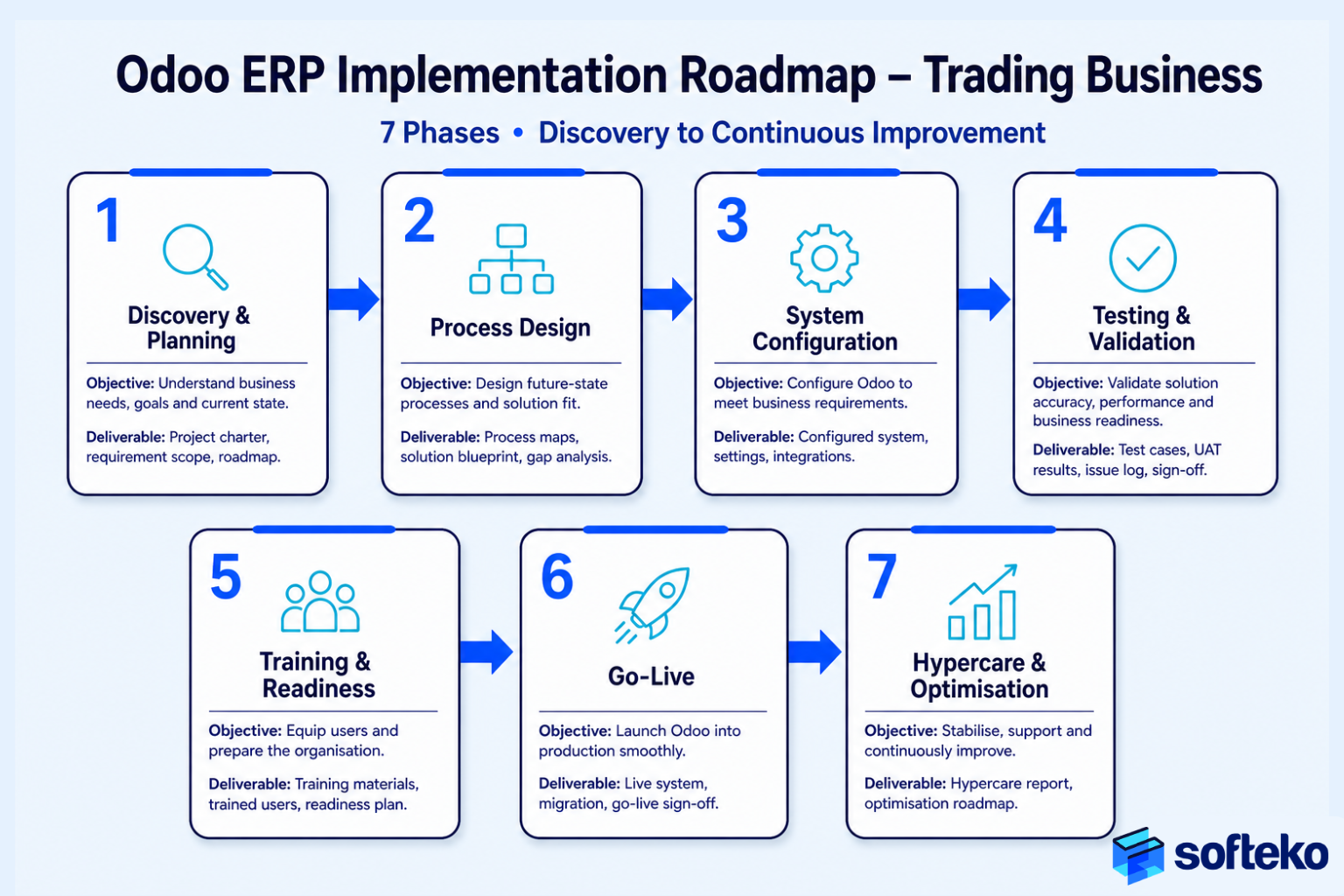
An Odoo implementation follows seven business milestones, each building on the previous one. Odoo’s own methodology allocates roughly 80% of project time to iterative implementation cycles (analysis, configuration, validation, training) and only 5% to go-live itself.[3]
| Phase | Business objective | Key deliverable |
|---|---|---|
| 1. Discovery & Planning | Understand the business | Approved implementation scope |
| 2. Business Process Design | Standardise operations | Future-state process maps |
| 3. System Configuration | Translate business rules into workflows | Configured ERP environment |
| 4. Testing & Validation | Verify real business scenarios | Approved end-to-end test results |
| 5. Training & Change Readiness | Prepare employees | Confident users |
| 6. Go-Live | Transition daily operations | ERP becomes the operational system |
| 7. Hypercare & Optimisation | Stabilise and improve | Continuous operational refinement |
Discovery Learns the Business Before Anyone Touches Software
The implementation team spends time understanding how customers place orders, how quotations become confirmed sales, how procurement works, how inventory moves, how shipments are executed, and where operational delays occur. A wholesaler may discover that purchase approvals differ between product categories. A distributor may find each warehouse follows different receiving procedures. An importer may realise landed cost calculations vary depending on who prepares the shipment. These findings shape every later decision.
Process Design Simplifies Instead of Digitising Existing Habits
Instead of “Sales emails Procurement, Procurement emails Warehouse, Warehouse confirms by phone,” the future workflow becomes: Sales confirms the order → inventory availability is verified through the ERP → required approvals follow predefined rules → Procurement receives approved demand automatically → Warehouse prepares fulfilment from the same record. The improvement is not faster communication. It is fewer opportunities for miscommunication.
Testing Verifies the Business, Not Just the Software
Effective testing follows complete operational scenarios. Instead of “Does this button work?”, users ask “Can we complete a customer order exactly as our business expects?” Cross-department testing matters most — Sales quotation → Procurement PO → Warehouse receipt → shipment → invoicing → collection. Only when these complete journeys succeed should implementation move toward production.
Realistic Timelines Beat Optimistic Ones
Panorama Consulting benchmarks show midsize companies (roughly $100M–$250M in revenue) complete ERP implementations in an average of 6.7 months, while very large companies average around 12 months.[8] Given that 74% of ERP projects overrun their timelines by more than 50%,[6] trading businesses should plan for realistic durations rather than optimistic sales estimates.
Who Is Responsible for ERP Implementation Success?
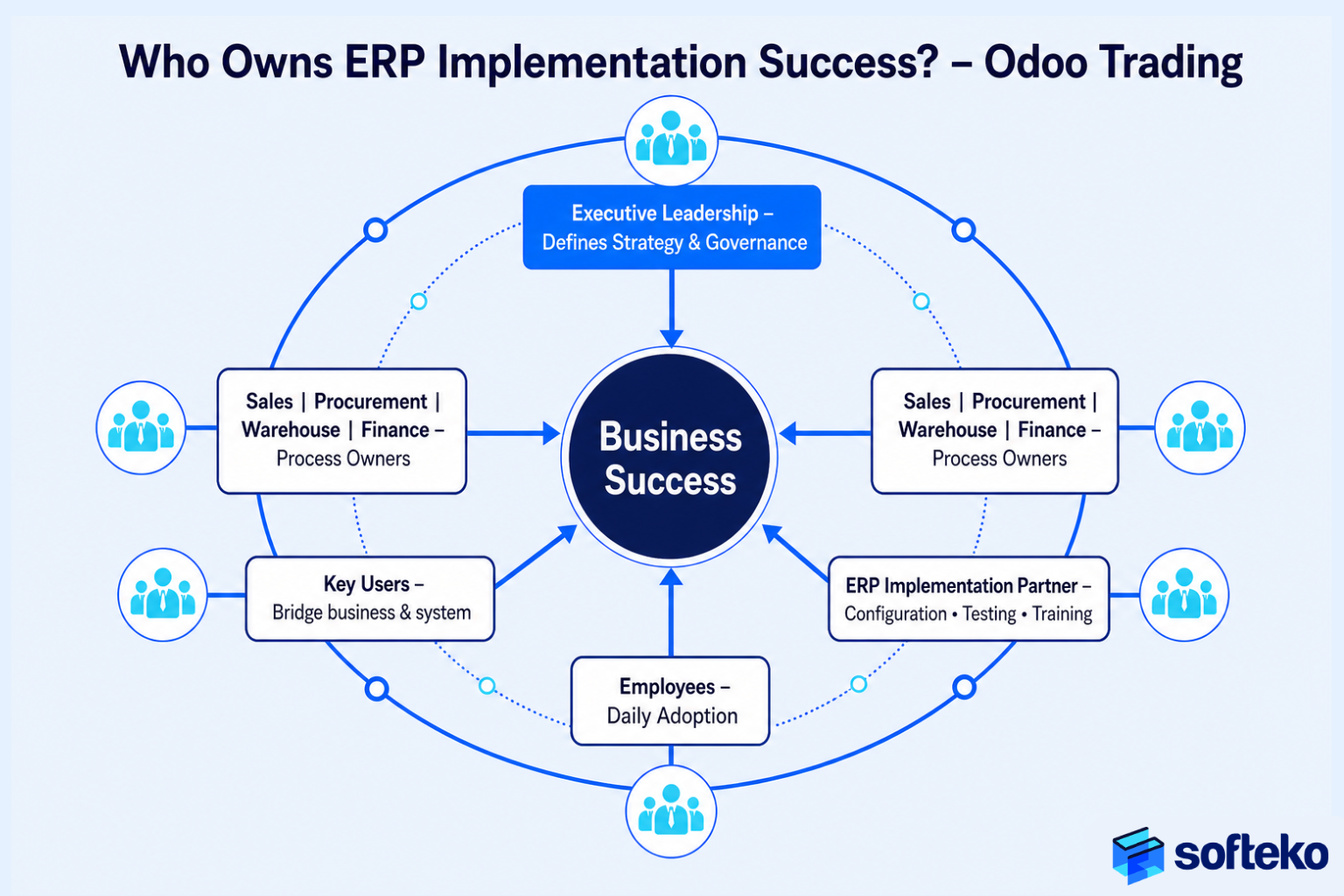
An ERP implementation succeeds when three groups collaborate: Executive Leadership (strategy and governance), Business Teams (operational knowledge), and the Implementation Partner (methodology and configuration). Each has responsibilities that cannot be delegated.
Executive sponsorship is not optional. Independent research shows 31% of ERP failures trace directly to lack of executive sponsorship, and 78% of organisations report insufficient sponsorship on their ERP projects.[1] Leadership defines why the ERP is being implemented, sets measurable objectives, approves operational policies, resolves cross-department conflicts, allocates budget, and communicates the importance of change. None of these responsibilities involve configuring software.
Department managers become process owners — the Sales Manager confirms quotation approvals and pricing governance; the Procurement Manager defines supplier selection and purchase approval hierarchy; the Warehouse Manager validates receiving, storage, and dispatch controls; the Finance Manager approves credit policies, revenue recognition triggers, and reporting requirements. Key users — experienced employees who bridge business and system knowledge — participate in workshops, review workflows, test scenarios, and support colleagues after go-live.
Odoo’s own methodology reflects the responsibility split explicitly. The Project Leader (from the partner) owns scope decisions and development approval. The customer’s Single Point of Contact (SPoC) owns final testing sign-off, end-user training organisation, and user-manual creation.[3]
Responsibility Matrix
| Activity | Executive Leadership | Department Managers | Key Users | ERP Partner |
|---|---|---|---|---|
| Define business objectives | ✔ | |||
| Document current processes | ✔ | ✔ | ✔ | |
| Design future workflows | ✔ | ✔ | ✔ | ✔ |
| Configure ERP | ✔ | |||
| Validate business processes | ✔ | ✔ | ✔ | |
| User Acceptance Testing | ✔ | ✔ | Support | |
| Employee training | Sponsor | ✔ | ✔ | Deliver & support |
| Go-live approval | ✔ | ✔ | Recommend | |
| Continuous improvement | ✔ | ✔ | ✔ | Advisory |
The pattern is consistent: the ERP partner owns the methodology. The business owns the outcome.
Why Change Management Determines ERP Implementation Success
Many ERP implementations fail for reasons that have nothing to do with the software. Workflows are configured correctly. Testing is completed. Training is delivered. Yet after go-live, employees return to spreadsheets, keep approving via WhatsApp, and maintain personal records outside the ERP.
The system works. The organisation does not.
Independent research reinforces this — 60% of ERP projects fail due to poor change management, and 70% of failures cite employee resistance as the primary reason.[6] Prosci research shows human factors matter roughly 6× more than technical factors in ERP success, and organisations that integrate change management with project management see about half of their projects meet or exceed objectives.[5]
Employees Support Change When They Understand the Business Reason
Employees rarely resist software. They resist uncertainty. If leadership does not explain why the business is changing early, employees create their own assumptions — and that uncertainty slows adoption long before go-live.
Instead of “We’re implementing Odoo,” effective communication connects the change to a real operational problem: “Today our warehouse spends time resolving stock discrepancies because inventory updates are delayed. The new process records movements immediately, so Sales and Procurement work from the same information.” The second explanation makes the change worth adopting.
The ADKAR Framework Turns Change into a Repeatable Structure
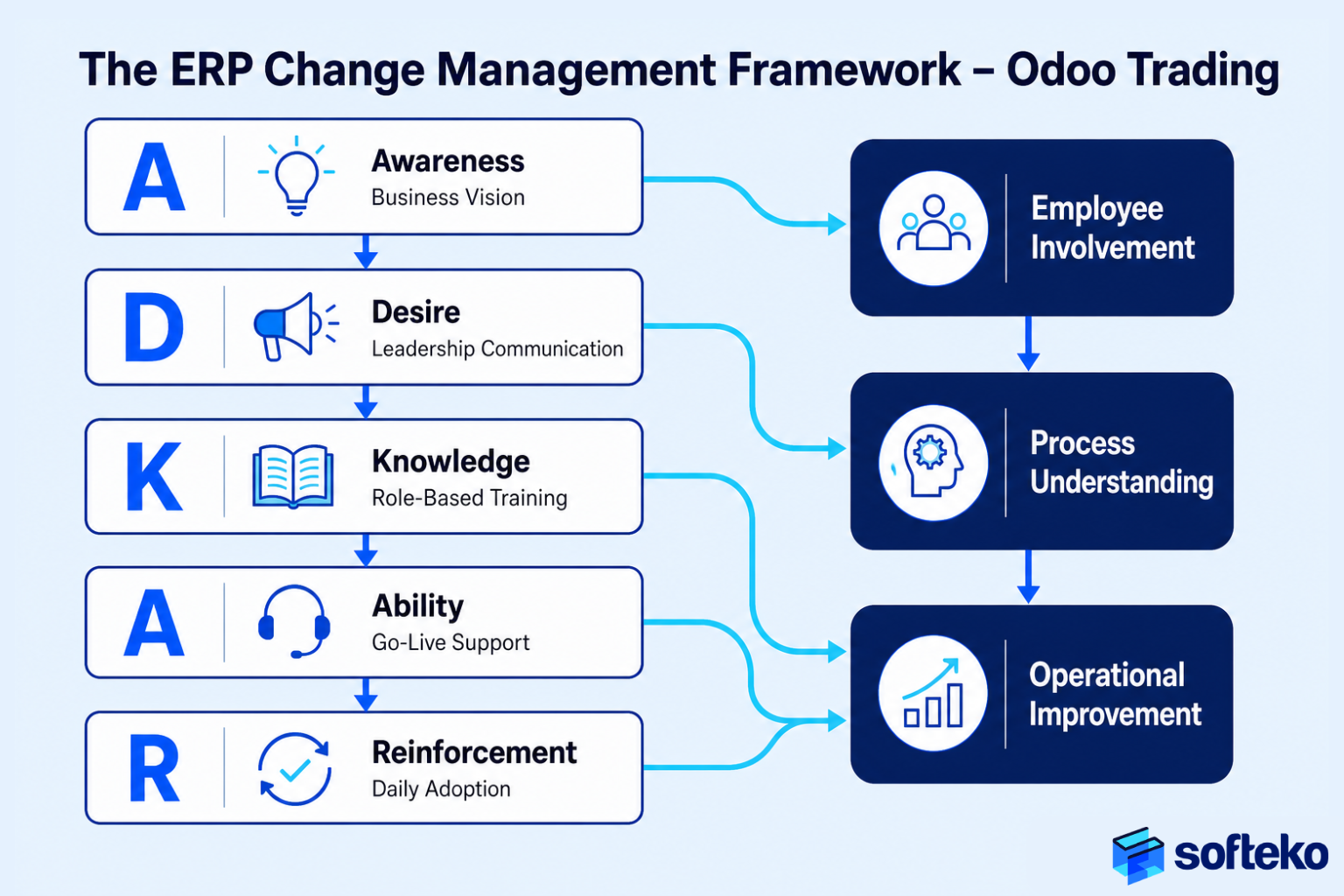
Prosci’s ADKAR model — Awareness, Desire, Knowledge, Ability, Reinforcement — is widely used by ERP implementation teams. In one documented case, an international company applied ADKAR across a multi-year ERP lifecycle and recorded an 86% improvement in project success.[5]
For a trading business, ADKAR translates practically: build Awareness of why the business is changing, Desire by showing what each department gains, Knowledge through role-based training, Ability through hands-on practice with real scenarios, and Reinforcement through hypercare and daily manager behaviour.
Managers shape adoption more than training sessions. If department heads use ERP reports during meetings and stop asking for spreadsheet updates after go-live, employees follow. If managers keep asking for the parallel spreadsheet, employees quickly conclude the ERP is optional. Leadership behaviour becomes organisational behaviour.
Should Your Trading Business Choose an All-at-Once or a Phased ERP Rollout?
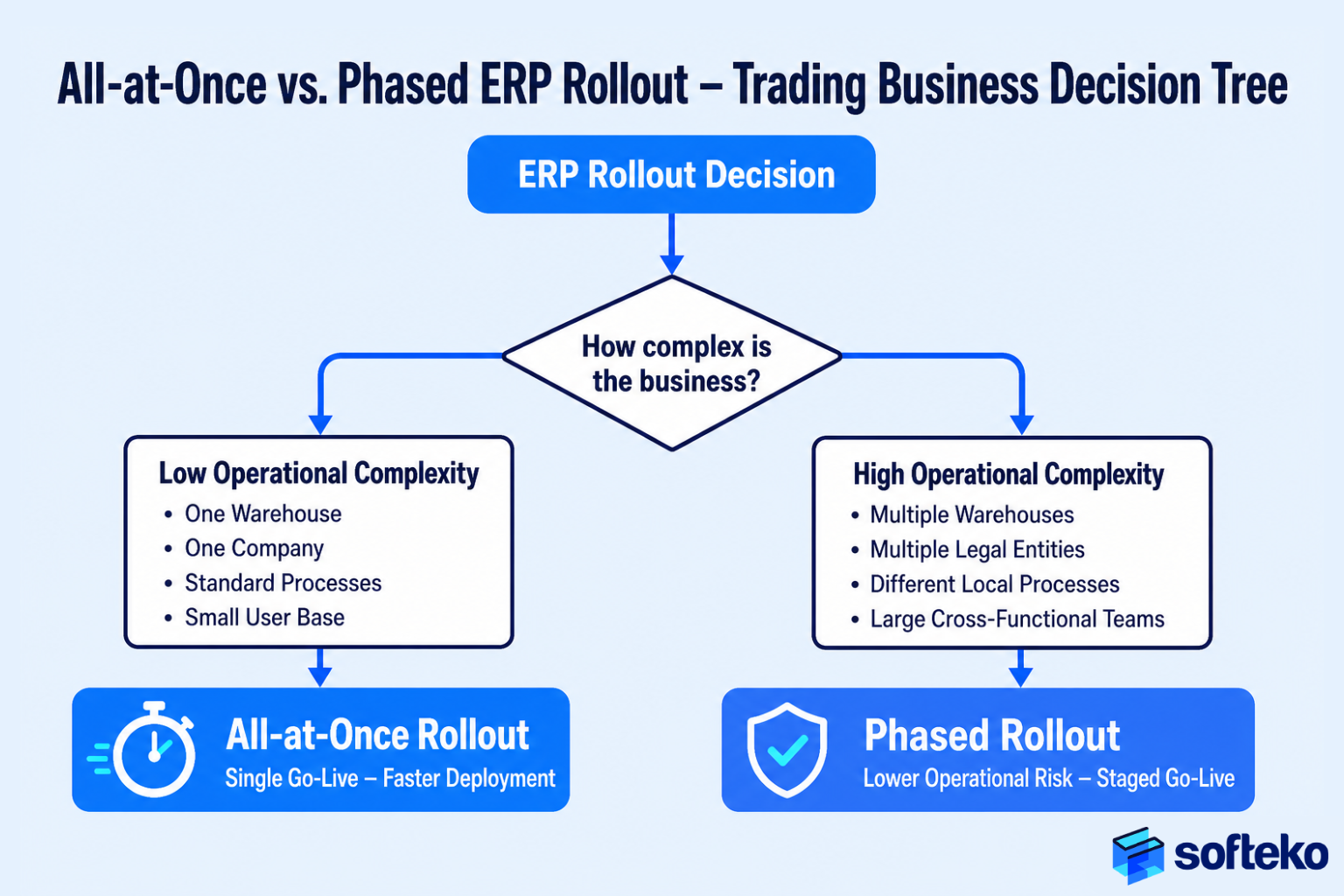
A All-at-Once Rollout implementation switches from legacy to Odoo on a single agreed date. Every department transitions together. A Phased implementation introduces the ERP gradually — by department, warehouse, country, or business process — with each phase stabilising before the next begins.
Neither approach is universally better. Academic research from Cambridge University Press analysing 45 organisations found 89% used All-at-Once, phased, or hybrid — with an 88% overall success rate when the strategy matched organisational readiness.[9] The right choice depends on your business complexity, not on the ERP itself.
| Evaluation factor | All-at-Once Rollout | Phased Rollout |
|---|---|---|
| Implementation speed | Faster | Slower |
| Initial business disruption | Higher | Lower |
| Project duration | Shorter | Longer |
| Training complexity | Higher | More manageable |
| Risk of widespread issues | Higher | Lower |
| Resource requirements at go-live | Concentrated | Distributed |
| Suitable for | Single location, standardised processes | Multi-warehouse, multi-country, multi-entity |
Choose All-at-Once Rollout When the Business Is Ready
A All-at-Once rollout works when your business operates from one primary location, has standardised processes, clean master data, completed testing, trained employees, available executive leadership through go-live, and can tolerate short operational disruption. A single-warehouse distributor with 25 employees and one legal entity often falls into this category.
Choose Phased When Complexity Is High
A phased rollout is safer when you have multiple warehouses, multiple countries, several legal entities, complex import/export operations, thousands of SKUs, or significant operational differences between locations. A trading company operating in UAE, Saudi Arabia, and Oman typically implements Finance and Procurement at headquarters first, then rolls out warehouse operations country by country. Lessons from each phase improve the next.
Panorama Consulting’s analysis reaches the same conclusion: All-at-Once Rollout delivers faster, lower-cost rollout at higher risk, while Phased offers lower risk and better user adoption but requires maintaining dual systems and extended project management.[10] Confidence comes from preparation, not from speed.
How Can Trading Businesses Reduce ERP Implementation Risks?
Most ERP problems begin long before go-live. Leadership hasn’t agreed on business priorities, departments follow different procedures, master data contains duplicates, employees receive minimal training, and business processes are approved without adequate testing. By the time these issues appear during go-live, correcting them is significantly more expensive.
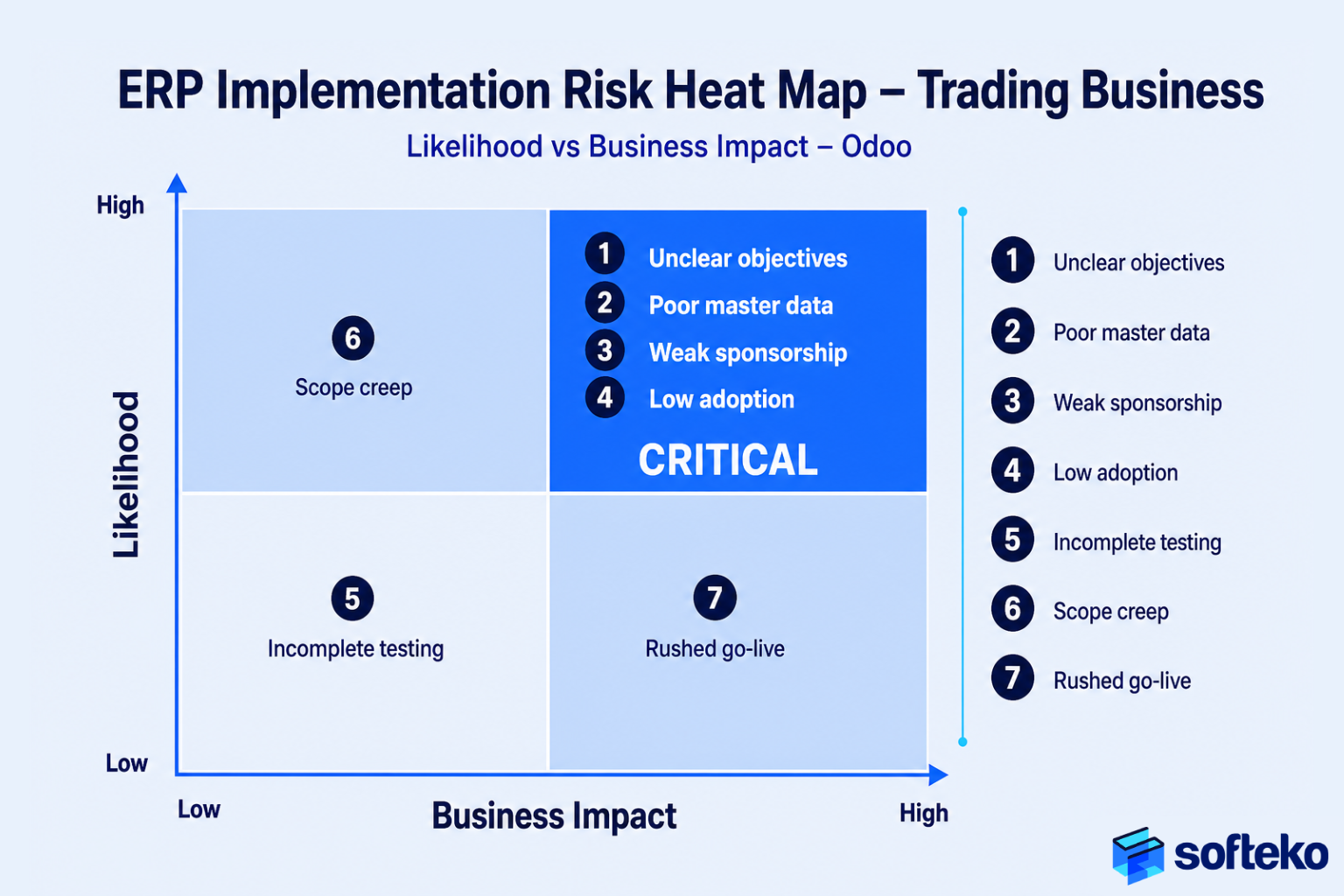
Panorama Consulting’s study of 2,400+ implementations ranks the top eight failure drivers: (1) inadequate change management (42%), (2) poor data migration (38%), (3) inexperienced implementation teams (35%), (4) lack of executive sponsorship (31%), (5) insufficient end-user training (29%), (6) scope creep (26%), (7) over-customisation (23%), (8) vendor selection errors (19%).[1] The top three alone account for more than 75% of all failures.
The Seven Most Common Risks — and What Controls Them
| Risk | Recommended mitigation |
|---|---|
| Unclear business objectives | Define measurable success criteria before project kickoff |
| Poor master data quality | Treat data preparation as an independent workstream with named ownership |
| Weak executive involvement | Executive steering committee with scheduled reviews |
| Inadequate user adoption | Continuous communication, role-based training, structured hypercare |
| Incomplete end-to-end testing | Cross-functional business scenario testing before go-live |
| Scope creep | Formal change request process; separate essential from optimisation |
| Rushing go-live | Readiness review before production approval; delay if not ready |
Watch for Early Warning Signs
Most implementation failures develop gradually rather than suddenly. Watch for major business decisions remaining unresolved; steering committee meetings postponed; department priorities frequently changing; workshops ending without agreement; training attendance declining; employees continuing to request spreadsheet templates; master data validation remaining incomplete; recurring test issues that should already have been resolved.
Identifying these signs early lets you correct course before operations are affected. A delayed go-live is usually far less expensive than a poorly prepared one.
What Happens During Go-Live and the First 90 Days?
Go-live is often celebrated as the end of an ERP implementation. From a business perspective, it marks the beginning. Every quotation, purchase order, inventory movement, shipment, invoice, and payment now affects real customers, suppliers, and cash flow. The ERP is no longer a project. It is your operating system.
Go-Live Is a Controlled Transition, Not a Single Event
Before the system becomes operational, the implementation team confirms that final master data has been validated, opening inventory balances are accurate, outstanding customer orders have been reviewed, supplier commitments have been verified, financial opening balances have been approved, users can access the system, and support teams are available. Only then should live operations begin.
The first week is the busiest period of the entire implementation. Employees encounter real situations that training exercises could never fully replicate — an urgent customer quotation revision, a shipment arriving earlier than expected, inventory that must move between warehouses, an unexpected supplier invoice charge. These situations rarely indicate the ERP has failed. They indicate real business operations are now testing the agreed processes.
Hypercare Focuses on Stability, Not New Features
The period immediately following go-live is called hypercare. The project team closely monitors business operations, answers user questions, resolves issues, and validates that critical workflows operate as expected. The focus shifts from building the ERP to helping employees use it confidently. The objective is operational stability — not feature expansion.
Measure Business KPIs, Not Just Support Tickets
Panorama Consulting recommends six strategic KPI categories for measuring ERP implementation success: Financial Performance, Operational Efficiency, Employee Productivity & Adoption, Business Process Improvement, Customer Experience, and Time to Value (TTV).[11] Time to Value is the most overlooked metric — how long after go-live before ERP delivers noticeable benefits. Setting explicit TTV targets creates accountability.
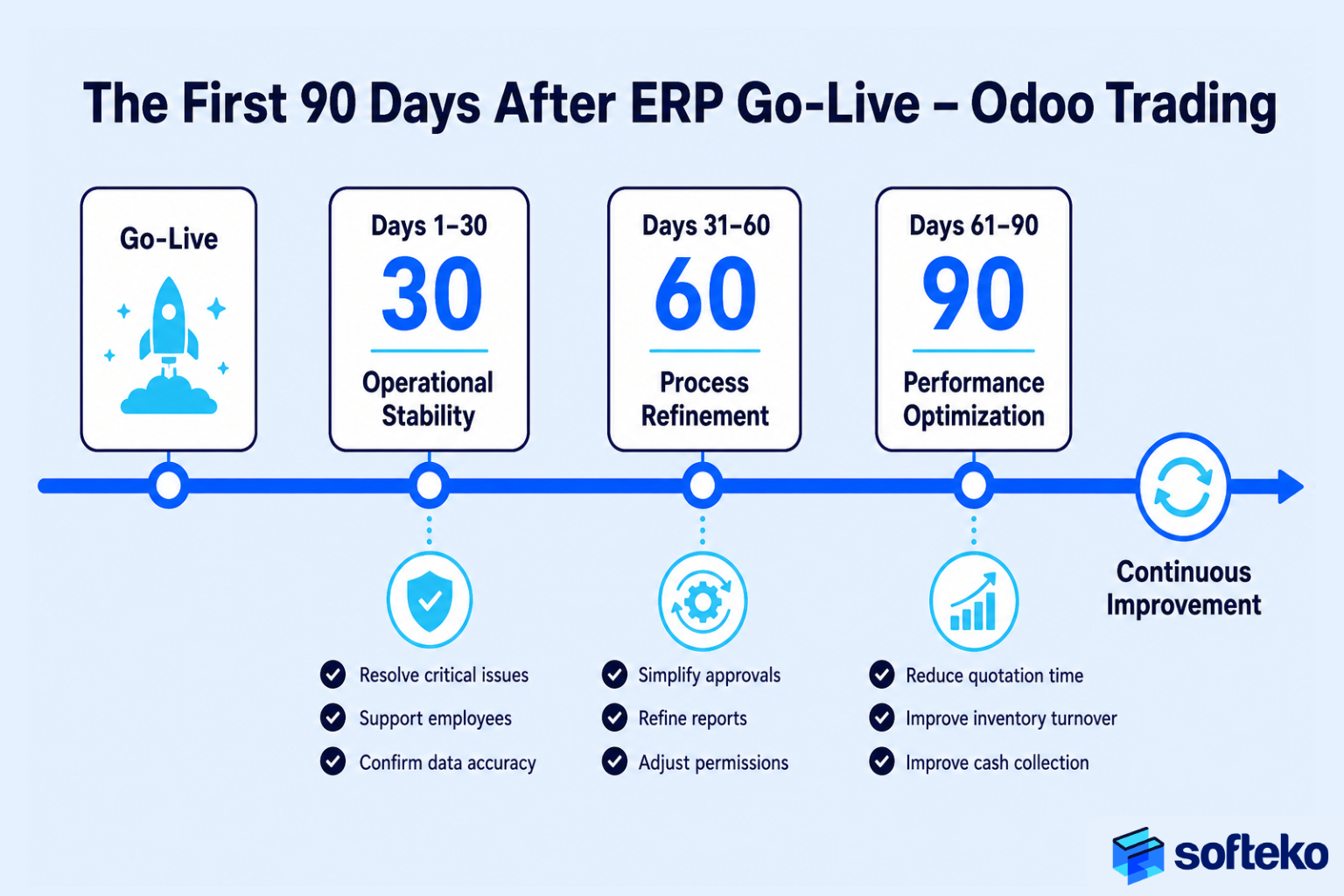
| First 30 days | Days 31–60 | Days 61–90 |
|---|---|---|
| Operational stability | Process refinement | Performance optimisation |
| Resolve critical issues | Simplify approval workflows | Reduce quotation approval time |
| Support employees | Refine operational reports | Improve inventory turnover |
| Confirm data accuracy | Improve dashboard visibility | Reduce purchasing lead times |
| Reinforce standardised procedures | Adjust user permissions | Improve cash collection |
By the third month, attention shifts from “Can employees complete the workflow?” to “How can we improve the workflow?” At that point, the ERP has become part of normal operations, and continuous improvement becomes the primary objective.
How Odoo Supports a Structured ERP Implementation in a Trading Business
By this point, one conclusion should be clear. A successful ERP implementation is built around business processes, operational governance, leadership commitment, and employee adoption. Only after those elements are in place does the software matter.
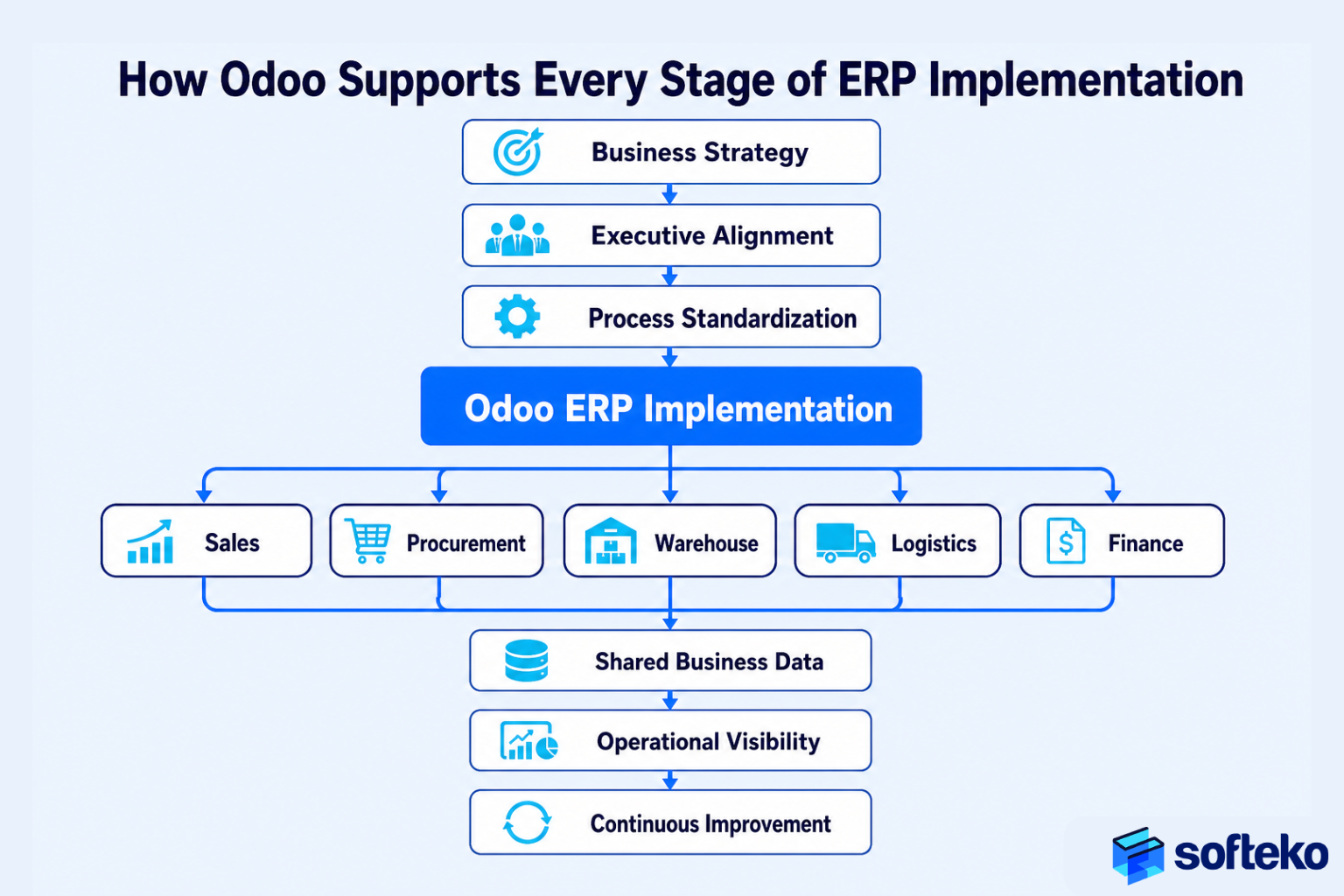
Odoo does not replace implementation methodology — it supports it. The platform provides one operational database where Sales, Procurement, Inventory, Warehouse, Logistics, and Finance all work from the same information. Instead of asking “Has Procurement received this order?” or “Which spreadsheet has today’s stock?”, every department reads the same operational record.
For a trading business, this shared visibility replaces the coordination overhead that consumes senior time in disconnected environments. A confirmed customer order automatically influences inventory reservation, procurement planning, and shipment scheduling. Warehouse movements update inventory, valuation, and purchasing records together. Finance sees operational activity during the month, not after it closes.
Odoo’s implementation philosophy reinforces this. Its official documentation is explicit that “the more you cut the amount of development, the better” — configuration should always be tried before customisation.[3] Business policies (approval thresholds, credit limits, supplier validation, margin governance, document controls) are configured as workflows rather than built as custom code. That discipline reduces implementation risk, simplifies future upgrades, and lowers long-term ownership cost.
Odoo also supports scalability. As your trading business adds warehouses, opens new country entities, or expands product ranges, the ERP grows through configuration rather than requiring another major implementation project. That is the practical outcome of a structured implementation done well — the ERP becomes the foundation for future growth, not a fixed system your business eventually outgrows.
ERP Implementation Readiness Checklist
Before approving your ERP implementation, ask a more important question: “Is our business ready — not just our software?”
Executive readiness
- ☐ Measurable business objectives defined
- ☐ Executive Sponsor appointed
- ☐ Department heads support implementation goals
- ☐ Formal governance structure for major decisions
Business process readiness
- ☐ Current workflows documented
- ☐ Operational bottlenecks identified
- ☐ Future-state workflows approved
- ☐ Approval policies standardised
- ☐ Department responsibilities clearly defined
Master data readiness
- ☐ Duplicate customer records removed
- ☐ Supplier records validated
- ☐ Product master complete and standardised
- ☐ Units of measure reviewed
- ☐ Pricing rules and payment terms accurate
- ☐ Opening balances verified
User readiness
- ☐ Key users assigned
- ☐ Role-based training completed
- ☐ Users practised real business scenarios
- ☐ Employees know where to request support
- ☐ Change communication reached every department
Go-live readiness
- ☐ Cutover plan approved
- ☐ Opening inventory balances confirmed
- ☐ Open customer and supplier transactions reviewed
- ☐ Hypercare team available
- ☐ Executive approval given for production
If several items remain incomplete, delaying go-live is almost always less expensive than correcting operational problems after production.
Start Your ERP Implementation the Right Way
Implementing an ERP is not the moment your business installs new software. It is the moment your business decides to operate differently.
Successful trading businesses do not adopt ERP because their spreadsheets stop working overnight. They adopt it because operational complexity eventually exceeds what disconnected systems and manual coordination can reliably support. That is why implementation begins with leadership, not configuration — with agreeing on objectives, standardising processes, preparing master data, and helping employees understand new ways of working.
Odoo supports that operating model. It does not create it. Leadership defines the workflows; the ERP enforces them consistently across Sales, Procurement, Warehouse, Logistics, and Finance.
If you are preparing for an ERP implementation, resist the temptation to start with feature comparisons or configuration discussions. Start with your business: are your processes clearly defined? Do departments agree on how work should flow? Is your master data ready? Have you prepared employees for change? Can leadership guide the business through implementation?
Organisations that answer these questions before go-live rarely view ERP as a software project. They view it as the foundation for consistent operations and sustainable growth.
At Softeko, we help trading businesses design and execute structured Odoo ERP implementations — from executive alignment and process design through configuration, testing, training, go-live, and hypercare.
Frequently Asked Questions
How long does an Odoo ERP implementation take for a trading business?
Timelines depend on complexity, not size. A single-warehouse business with standardised processes may complete implementation in a few months. Multi-country trading organisations usually require a phased approach spanning 9–15 months. Industry benchmarks show midsize companies average 6.7 months; very large companies average around 12.[8]
What is the biggest reason ERP implementations fail?
Business factors, not technology. Panorama Consulting’s research on 2,400+ implementations shows the top three failure drivers — inadequate change management (42%), poor data migration (38%), and inexperienced implementation teams (35%) — account for more than 75% of all failures.[1]
Should a trading business customise Odoo during implementation?
Only when a genuine competitive process cannot be supported through standard configuration. Odoo’s official methodology is explicit: “The more you cut the amount of development, the better.”[3] Excessive customisation increases implementation complexity, testing effort, upgrade costs, and long-term maintenance.
What departments should participate in an ERP implementation?
Every department that contributes to order-to-cash and procure-to-pay — Sales, Procurement, Warehouse, Logistics, Finance, Operations, and Executive Management. Cross-functional participation ensures workflows reflect how the business actually operates, not how individual departments prefer to work.
Is an All-at-Once or phased ERP rollout better?
Neither is universally better. All-at-Once works for standardised single-location businesses. Phased rollout is safer for multi-warehouse, multi-entity, or multi-country trading operations because it reduces operational risk. Academic research on 45 organisations found 88% success across both approaches — when the strategy matched organisational readiness.[9]
What should management monitor after ERP go-live?
Business performance rather than technical metrics alone. Panorama Consulting recommends six KPI categories: Financial Performance, Operational Efficiency, Employee Productivity & Adoption, Business Process Improvement, Customer Experience, and Time to Value.[11] Time to Value is the most overlooked — setting 30-, 60-, and 90-day targets creates accountability.
References
- Panorama Consulting Group via Godlan — ERP Implementation Failure Statistics 2026 Research — https://godlan.com/erp-implementation-failure-statistics/
- Gartner — Latest Enterprise Resource Planning (ERP) Insights — https://www.gartner.com/en/information-technology/topics/enterprise-resource-planning
- Odoo SA — Official Implementation Methodology — https://www.odoo.com/web/content/27370198
- APQC — Process Classification Framework (PCF) — https://www.apqc.org/process-frameworks
- Prosci — ERP Change Management Research and ADKAR Case Study — https://www.prosci.com/blog/erp-change-management
- Gitnux — ERP Implementation Failure Statistics 2026 — https://gitnux.org/erp-implementation-failure-statistics/
- Astra Canyon — 10 ERP Implementation Best Practices for a Successful Rollout in 2026 — https://www.astracanyon.com/blog/10-erp-implementation-best-practices-for-a-successful-rollout
- Panorama Consulting via 4acc — ERP Stats, Facts, and Trends — https://4acc.com/article/erp-stats-facts-and-trends/
- O’Leary via Cambridge University Press — Implementing ERP Systems: All-at-Once Rollout versus Phased — Enterprise Resource Planning Systems chapter
- Panorama Consulting Group — A All-at-Once Rollout Implementation Vs A Phased ERP Implementation — https://www.panorama-consulting.com/big-bang-implementation/
- Panorama Consulting Group — The ROI of ERP: How to Measure Success Beyond Go-Live — https://www.panorama-consulting.com/the-roi-of-erp-how-to-measure-success-beyond-go-live/