

Growing trading businesses rarely struggle because they lack demand. More often, you struggle because the systems that once supported your business can no longer support the business you have become.
A company that started with a handful of employees, one warehouse, and a few dozen customers may now manage multiple warehouses, hundreds of suppliers, international shipments, multiple currencies, and thousands of monthly transactions. Your Sales team needs faster quotations. Procurement needs accurate demand forecasts. Warehouse managers need real-time inventory visibility. Finance needs to understand profitability before the month ends rather than after it.
As operations expand, information becomes scattered across spreadsheets, emails, accounting software, warehouse applications, and individual employees’ knowledge. Every department develops its own way of working. The business continues to grow, but coordination becomes increasingly difficult.
This is a normal stage in the growth of many trading businesses. It does not necessarily indicate poor management. Rather, it reflects the increasing operational complexity that comes with serving more customers, managing more products, and operating across more locations.
At this point, most business owners recognise that they need an ERP system. The more difficult question is choosing the right type of ERP.
So, should you invest in a traditional ERP platform that has been serving large enterprises for decades? Or should you choose a modern ERP platform designed around flexibility, faster implementation, and continuous improvement?
The answer is rarely found in a software demonstration. A polished interface or a long feature list does not reveal how well an ERP system will support your daily operations five years from now. Instead, the decision should be based on operational fit, implementation approach, scalability, long-term ownership costs, and the ability to adapt as your business changes.
This guide explains how to evaluate modern ERP vs traditional ERP from a trading business perspective. Rather than comparing products, it provides a practical framework for comparing ERP philosophies, understanding their operational impact, and making a more informed investment decision.
Key takeaways
- Gartner predicts that by 2027, more than 70% of recently implemented ERP initiatives will fail to meet their original business goals, with 25% failing catastrophically.[1] Your ERP selection is a high-stakes trading operations decision, not a software purchase.
- The global ERP market has already decided the architecture question. Cloud ERP now accounts for 70% of the market and is growing at 14.5% annually while on-premise grows at only 2%.[2]
- Legacy ERP systems suffer a usability crisis: only 26–27% of employees actively use them, while total cost of ownership can run 5× higher than modern cloud alternatives.[3]
- 60% of traditional ERP users struggle with real-time data access due to integration limits.[4] For your trading business, that means Sales, Procurement, Warehouse, and Finance make decisions on stale information.
- The fix is not the ERP with the longest feature list. Rather, it is the ERP that supports how your business needs to operate today, adapts as it grows tomorrow, and remains affordable to own for the next decade.
Why Growing Trading Businesses Outgrow Traditional ERP Systems
Your growing trading business often outgrows traditional ERP systems because operational complexity increases faster than the system can adapt. What worked well for a smaller organisation becomes difficult to modify, integrate, and maintain as products, warehouses, suppliers, customers, and regulatory requirements expand.
You are not alone in this experience. IDC research found that 35.4% of SMBs identify legacy applications and custom code as top barriers to revenue growth, and roughly 40% of business leaders name legacy systems as a major obstacle to digital transformation.[5]
Growth creates new operational requirements, not just higher transaction volumes. Each new warehouse introduces additional inventory movements. Every international supplier adds documentation, customs, and landed cost considerations. Each sales region may require different pricing policies, currencies, tax rules, and approval processes. Without an ERP that can evolve alongside these changes, operational controls become fragmented. Your employees begin creating manual workarounds, duplicate data, and offline approval processes simply to keep the business moving.
Business Growth Creates Operational Complexity That Legacy Systems Struggle to Manage
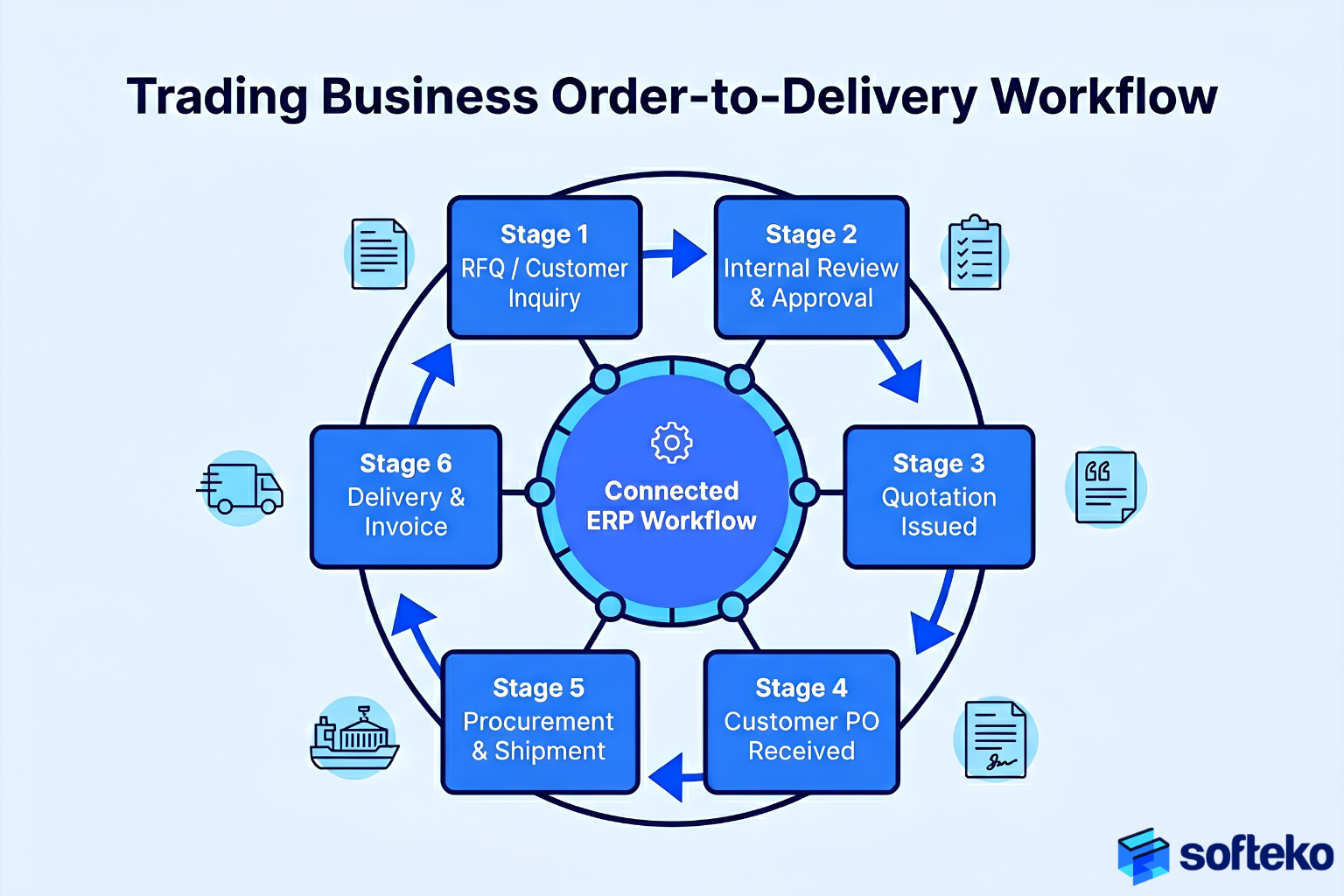
Your trading business may begin with a straightforward process:
Customer inquiry → quotation → purchase → delivery → invoice.
As you expand, however, that same process becomes significantly more complex. Instead of sourcing from one supplier, your Procurement team compares quotations from multiple international vendors. Inventory may be distributed across several warehouses. Products may require different packaging formats, landed cost allocations, and regulatory documents before shipment.
Additionally, even customer relationships become more sophisticated. Some buyers purchase on advance payment terms, while others operate under approved credit limits. Corporate accounts may follow different approval paths than new customers. These operational differences require consistent controls rather than isolated software functions.
For example, consider your quotation process. A growing trading business should not issue quotations based solely on available stock. Before pricing is finalised, Procurement may need to verify supplier pricing, Logistics may confirm shipping feasibility, Finance may validate customer credit exposure, and commercial management may review margin thresholds.
In a well-designed trading workflow, a structured Pre-Sales Review (PSR) process validates commercial, procurement, logistics, and financial inputs before a quotation can proceed.
This illustrates an important principle: as businesses grow, success depends less on individual employee knowledge and more on standardised operational controls.
Business example
A regional chemical distributor operating in three GCC countries adds a second warehouse and begins importing products from Europe and Asia.
Previously:
- One Sales Executive prepared quotations
- Procurement negotiated directly with two suppliers
- Finance approved invoices at month-end
After expansion:
- Multiple suppliers quote different lead times
- Inventory exists in two warehouses
- Landed costs vary by shipment
- Different customers receive different payment terms
- Logistics coordinates multiple shipping routes
- Management wants real-time gross margin visibility before approving large deals
The operational challenge is no longer processing more orders. It is coordinating more decisions across more departments without losing control.
Why Legacy ERP Becomes Harder to Adapt
Many traditional ERP systems were designed during a period when business processes changed less frequently than they do today. Their primary objective was stability.
Large organisations invested heavily in designing standardised workflows that remained unchanged for years. Extensive customisation during implementation was considered acceptable because major process changes were relatively infrequent. That approach can become restrictive for your growing trading business.
Notably, market conditions change quickly. New distribution channels emerge. Regulatory requirements evolve. You expand into new countries, add warehouses, introduce new product categories, or acquire other companies. Each operational change may require modifications to workflows, approval rules, reporting structures, or integrations.
If every adjustment depends on complex custom development, your ERP gradually becomes more expensive and more difficult to maintain. The result is often slower business adaptation rather than better operational control.
In contrast, modern ERP platforms generally take a different approach by emphasising configuration before customisation. Business rules, approval paths, user permissions, workflows, and reports can often be adjusted through system configuration rather than modifying the underlying application. This distinction becomes increasingly important as your operational requirements continue to evolve.
The Hidden Cost of Maintaining Old ERP Systems
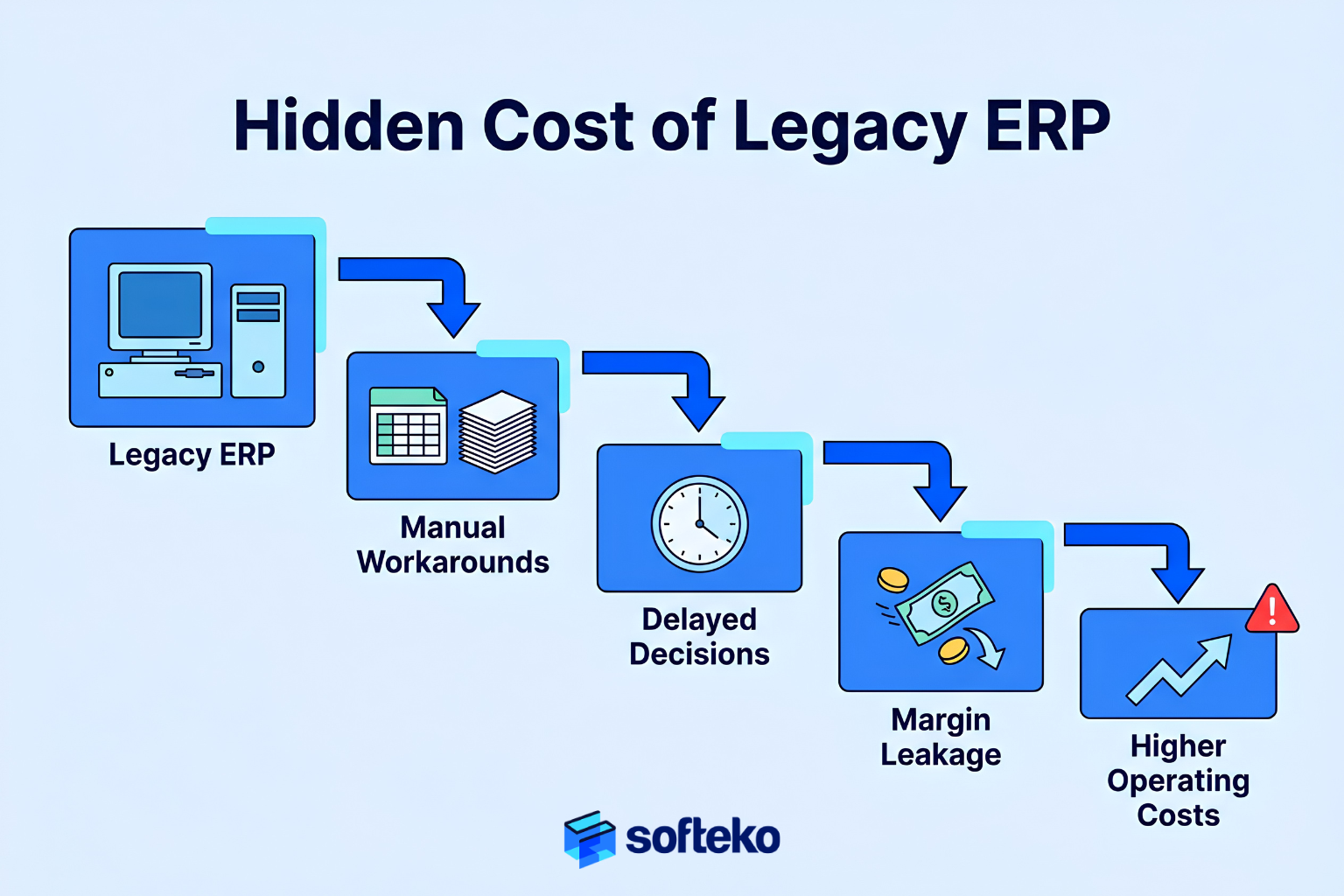
The cost of an ERP system is often discussed in terms of software licenses, implementation fees, and annual support contracts. These expenses are easy to measure because they appear in financial reports. However, the larger costs are usually hidden inside your daily operations.
In fact, a legacy ERP may continue processing transactions without major technical issues, but every manual workaround, duplicate data entry, delayed report, and custom integration adds operational overhead. Individually these inefficiencies seem manageable. Across hundreds of employees and thousands of transactions each month, they become a significant cost of doing business.
Independent research quantifies this pattern clearly. Only 26–27% of employees actively use legacy ERP systems, meaning you may be paying for 100% of licenses while receiving 26% of the operational value.[3] Additionally, 60% of traditional ERP users report they cannot access real-time data due to integration limitations,[4] which forces your Sales, Warehouse, and Finance teams to make decisions on stale information.
In practice, for your trading business, maintaining an older ERP often means maintaining the processes built around it. Your employees create spreadsheets because standard reports cannot answer operational questions. Sales teams exchange information through email because customer updates are difficult to share. Warehouse staff reconcile inventory manually because systems update too slowly. Finance exports data into separate tools to prepare management reports.
The ERP is still running, but your business increasingly operates outside the ERP.
Why This Hidden Cost Compounds Every Year
Notably, research from APQC consistently shows that standardised, integrated business processes improve operational performance by reducing process variation, shortening cycle times, and improving data quality. The benefit does not come from automation alone. It comes from replacing fragmented processes with consistent operational controls.
Specifically, for trading businesses, these controls affect nearly every department:
- Procurement needs accurate supplier prices before confirming quotations
- Warehouse teams need real-time inventory before committing stock
- Finance needs current customer exposure before approving additional credit
- Management needs reliable profitability before accepting low-margin deals
Consequently, when each department works from different information, decisions become slower and less reliable.
A well-designed trading workflow shows how these controls work together. Before a quotation is approved, Procurement validates supplier pricing, Finance reviews credit exposure, Logistics confirms shipment feasibility, and commercial management verifies margins through a structured Pre-Sales Review workflow. Instead of relying on emails between departments, the operational control becomes part of the business process itself.
Importantly, the financial impact extends beyond employee productivity. Delayed purchasing decisions can increase procurement costs. Incorrect inventory visibility can create emergency purchases. Manual landed cost calculations can distort product profitability. Slow reporting delays management decisions that affect pricing, replenishment, and cash flow.
These costs rarely appear as “ERP expenses,” but they directly influence your margins. Legacyleap’s analysis of Deloitte and Gartner data indicates that legacy system maintenance costs compound at 10–15% per year after warranty expiration, and organisations relying heavily on legacy systems spend 75–85% of their IT budget maintaining what already exists — leaving only 15–25% for improvement.[10]
Business Example
Consider an importer that purchases industrial chemicals from multiple suppliers across Europe and Asia. Each shipment includes:
- Supplier invoices
- Ocean freight
- Customs duties
- Port handling charges
- Inland transportation
- Storage fees
- Currency fluctuations
If these costs are calculated manually after products arrive, your Sales team may continue quoting customers using outdated profitability assumptions. A product that appeared profitable during quotation could already be below your minimum margin before delivery.
The issue is not accounting accuracy. It is delayed operational visibility.
A modern ERP establishes a workflow where Procurement, Logistics, Finance, and Sales contribute cost information throughout the purchasing process instead of after it. Your business makes pricing decisions using current operational data rather than historical estimates. This principle is reflected in mature trading workflows, where landed costs, supplier pricing, freight estimates, approval thresholds, and margin validation are incorporated into the commercial process before orders progress to execution.
Why Businesses Continue Using Legacy ERP Despite the Costs
However, if maintaining a legacy ERP creates so many operational challenges, why do businesses keep using it? The answer is rarely technical. It is usually organisational.
In practice, replacing an ERP system affects every department. Sales, procurement, warehouse operations, finance, and management all depend on it every day. Even when everyone agrees the current system has limitations, replacing it feels like a major business risk. As a result, many organisations postpone the decision for years.
Firstly, the first reason is familiarity. Your employees know how the current system works. They understand its limitations and have developed routines to work around them. From your management’s perspective, those workarounds seem less risky than introducing a completely new platform. Unfortunately, familiarity should not be confused with efficiency. When employees spend years building spreadsheets, creating manual reports, or maintaining separate databases, those activities become accepted as “the way we work.” Your organisation gradually stops questioning whether the underlying process is still appropriate.
Secondly, another reason is previous investment. Many traditional ERP implementations required significant spending on software licenses, infrastructure, consulting, and custom development. After investing substantial resources, leadership often feels pressure to maximise that investment, even when the system no longer supports business objectives.
Economists describe this behaviour as the sunk cost effect. Past spending cannot be recovered, yet it continues to influence future decisions. From an operational perspective, however, the relevant question is different: which ERP will support the business over the next five to ten years — not which ERP justified investments made ten years ago?
There is also concern about implementation disruption. Trading companies cannot pause operations while replacing core business systems. Customer orders, warehouse activities, procurement, invoicing, and shipments must continue without interruption. These concerns are valid; furthermore, a poorly planned ERP implementation can disrupt operations.
However, implementation methodology has evolved significantly. Modern ERP projects typically use phased deployments, pilot testing, parallel data validation, user training, and incremental rollout strategies to reduce operational risk. Rather than replacing every process simultaneously, businesses often modernise one functional area at a time while maintaining business continuity.
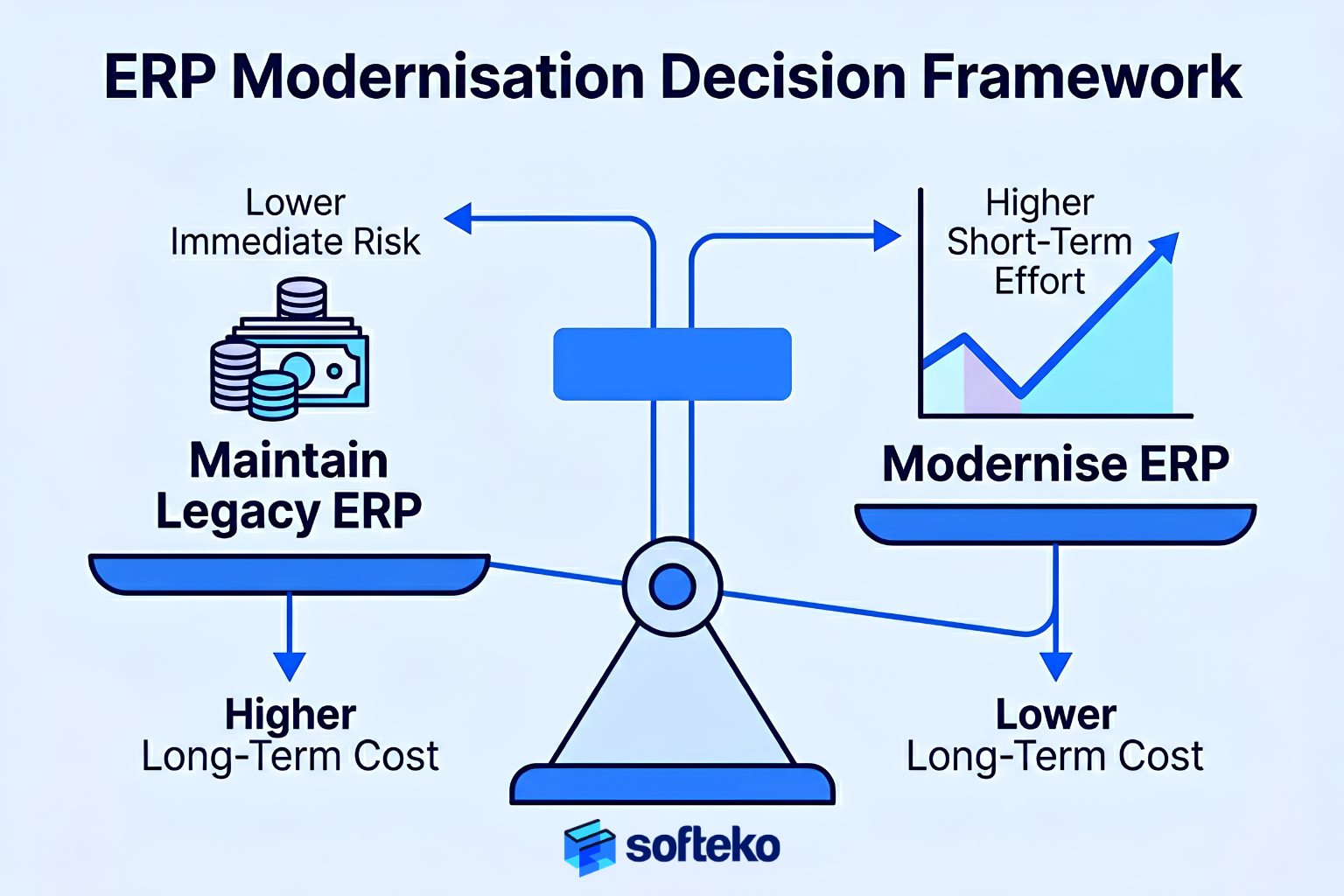
The decision therefore becomes a balance between short-term implementation effort and long-term operational capability. Businesses that delay modernisation avoid today’s project risks but continue paying tomorrow’s operational costs every single day.
Difference Between Modern ERP and Traditional ERP
The biggest difference between traditional ERP and modern ERP is not the technology — it is the business philosophy behind the technology. Traditional ERP systems were designed to standardise stable business processes within large organisations. Modern ERP platforms are designed to help businesses adapt quickly as markets, operations, and customer requirements change.
Many ERP comparisons begin with cloud deployment, mobile applications, or user interfaces. Those differences are visible during a software demonstration, but they rarely determine whether an ERP will support your business five years from now. A more useful comparison starts with a different question: how easily can the ERP adapt when your business changes?
For your trading business, change is constant. Suppliers change pricing. Customers request different payment terms. Governments introduce new compliance requirements. Warehouses open in new locations. Product lines expand. Shipping routes change. Acquisitions introduce new legal entities.
Your ERP should help the business absorb these changes without rebuilding its core processes every few years. That is where modern ERP and traditional ERP begin to differ.
Traditional ERP Was Built for Stability
Notably, traditional ERP systems emerged at a time when enterprise operations were relatively predictable. Large manufacturers, multinational corporations, and government organisations typically followed standardised processes that changed gradually over many years. Their priority was consistency across thousands of employees rather than rapid business adaptation.
As a result, traditional ERP implementations usually followed this pattern:
Business processes → Custom development → Deployment → Long-term maintenance
During implementation, consultants spent months documenting existing processes, identifying exceptions, and developing custom functionality to replicate how the organisation already worked. The implementation itself became a major capital project. Once deployed, organisations often avoided making process changes because every modification required additional development, testing, and deployment.
In fairness, this approach made sense for organisations whose operating model remained relatively stable. For many large enterprises, stability was more valuable than flexibility. Even today, some industries continue to benefit from this philosophy. Organisations with highly standardised operations, strict regulatory requirements, or extensive legacy integrations may prioritise long-term process consistency over rapid operational change. That is why traditional ERP systems continue to play an important role in certain environments.
However, the challenge arises when growing trading businesses adopt the same implementation philosophy. Trading companies operate in markets where supplier relationships, pricing, logistics, inventory strategies, and customer expectations evolve continuously. If adapting a workflow requires months of development, your business may respond more slowly than the market demands.
Modern ERP Is Built for Business Agility
Modern ERP platforms approach the same problem differently. Instead of assuming business processes remain unchanged, they assume that organisations will continue improving those processes as they grow.
Rather than encouraging extensive customisation during implementation, modern ERP platforms emphasise configurable business rules, standardised workflows, modular functionality, and incremental improvement. The implementation philosophy becomes:
Standard business process → Configuration → Adoption → Continuous optimisation
Importantly, this does not eliminate customisation entirely. Every business has unique operational requirements. However, customisation becomes the exception rather than the default.
For your trading business, this distinction has practical consequences. Suppose your management decides to introduce a new approval policy: any quotation below a minimum gross margin now requires commercial approval before being sent to customers. In a heavily customised legacy ERP, implementing this rule may require software development, testing, deployment, and regression validation. In many modern ERP platforms, the same requirement can often be configured using approval rules, workflow settings, or role-based permissions.
The operational outcome is the same. The implementation effort is very different.
Additionally, the philosophy also extends to expansion. As your trading business opens new warehouses, enters additional countries, or creates new business entities, the ERP should support organisational growth without requiring a complete redesign of existing processes. This is particularly relevant for importers, exporters, distributors, and multi-company trading organisations where operational structures evolve over time.
The objective is not simply faster implementation. It is preserving your business’s ability to improve continuously after implementation.
Research validates this direction. Independent analysis of modular vs monolithic architectures shows modular ERP delivers 93% greater scaling flexibility, 3× faster module deployment, and requires 50% less customisation time compared to monolithic systems, where 80% of changes still need vendor involvement.[6] Gartner projects that by 2027, roughly 75% of businesses will begin phasing out monolithic ERP systems in favour of modular architectures.[7] And AI is no longer a future add-on — SAP reported that half of all ERP deals closed in Q4 2024 included AI-powered features.[17]
Compare Traditional ERP and Modern ERP Across Key Business Areas
The following comparison focuses on operational outcomes rather than software features.
| Evaluation area | Traditional ERP | Modern ERP |
|---|---|---|
| Implementation approach | Extensive process analysis followed by significant customisation | Configuration-first implementation with selective customisation |
| Business process changes | Often require development work | Frequently handled through configuration and workflow rules |
| Upgrade strategy | Customisations may complicate upgrades | Standardised architecture generally simplifies upgrades |
| Integration approach | Often depends on custom interfaces | Typically supports standardised APIs and connectors |
| User experience | Functional but may reflect older interface design | Designed for broader business adoption across departments |
| Scalability | Scales well but may require additional customisation | Designed to support continuous business expansion through modular capabilities |
| Reporting | Frequently relies on custom reports | Greater emphasis on configurable dashboards and real-time visibility |
| Long-term ownership | Costs often increase as customisations accumulate | Lower customisation requirements can reduce long-term maintenance effort |
The purpose of this comparison is not to suggest that one approach is universally superior. Instead, it highlights a key evaluation principle:
The ERP implementation approach often has a greater impact on long-term ownership than the initial software selection.
A system that perfectly matches today’s workflows but becomes expensive to modify tomorrow may limit your future growth. Conversely, a platform that allows business processes to evolve with less technical effort can support continuous operational improvement over many years.
Visual Opportunity: Traditional ERP vs Modern ERP comparison matrix using the categories above.
Why ERP Architecture Affects Scalability, Upgrades, and Business Agility
Notably, architecture is one of the least discussed topics during ERP evaluations because it is largely invisible to business users. Yet it influences almost every aspect of long-term ownership. Architecture determines how different parts of the ERP communicate, how new functionality is introduced, how integrations are maintained, and how upgrades are performed.
In practice, you rarely need to understand technical design in detail. However, you do need to understand its operational consequences.
For example, consider a trading company that expands from one country to four countries over five years. New legal entities require additional tax rules. Finance needs consolidated reporting. Warehouse operations become multi-location. Procurement manages suppliers across several regions. Management wants profitability by company, region, product line, and customer segment. These are business requirements — not technical ones. The ERP architecture determines whether these requirements can be supported through configuration or require significant redevelopment.
Similarly, the same applies to upgrades. Additionally, every ERP platform evolves. Security improvements, regulatory updates, performance enhancements, and new capabilities are released regularly. If previous customisations are deeply embedded within the system, each upgrade becomes more expensive because every customisation must be validated and potentially rewritten.
Over time, organisations may postpone upgrades altogether. The result is an ERP that becomes increasingly difficult to support, integrate, and secure. Modern ERP platforms generally seek to reduce this risk by separating standard functionality from customer-specific configurations wherever possible. This does not eliminate implementation effort. Instead, it reduces the technical debt that accumulates as your business grows.
For trading businesses planning international expansion, additional warehouses, or more complex supply chains, architecture is not simply an IT consideration. It is a long-term business decision.
Implementation Insight
One pattern appears repeatedly in ERP modernisation projects. Businesses rarely replace their ERP because it cannot process transactions. Rather, they replace it because modifying existing workflows has become slower than adapting the business itself. When your organisation changes faster than the ERP can change, the ERP gradually shifts from being an operational control system to becoming an operational constraint. That is often the clearest signal that it is time to evaluate a different approach.
Compare Traditional ERP and Modern ERP in Daily Trading Operations
The differences between traditional ERP and modern ERP become most visible in daily operations. Every quotation, purchase order, inventory movement, shipment, and financial transaction depends on how easily your departments can share information, follow standardised workflows, and make timely decisions.
An ERP system should not simply record completed transactions. It should help every department make better decisions before those transactions happen. For trading businesses, that means providing visibility across procurement, inventory, logistics, finance, and sales while enforcing consistent operational controls.
Independent research indicates that businesses adopting modern ERP achieve around 22% improvement in business process efficiency through smoother collaboration and faster data sharing across departments.[16] The following comparisons focus on business processes rather than software features.
Inventory and Warehouse Management
Notably, inventory is one of the largest working capital investments for most trading businesses. For example, too much inventory ties up cash. Too little inventory creates stockouts, delayed deliveries, and lost sales. Managing this balance becomes increasingly difficult as you expand into multiple warehouses, countries, or distribution centres.
In many legacy ERP environments, inventory visibility is available — but not always in real time. Your Warehouse Supervisor may rely on periodic updates or manual reconciliation to confirm stock levels. Inventory transfers between locations may require separate processes. Executives often receive inventory reports after operational decisions have already been made.
As warehouse operations become more complex, your employees frequently build spreadsheets to answer questions such as:
- Which warehouse has available stock?
- Which shipment will arrive first?
- Which products are approaching expiry?
- Which inventory is already committed to customer orders?
When these answers exist outside the ERP, inventory planning becomes slower and less reliable.
Modern ERP platforms approach inventory differently. Rather than treating inventory as a warehouse function alone, they connect inventory with procurement, sales, logistics, and finance. When a customer order is confirmed, inventory availability updates immediately. When Procurement creates a purchase order, expected incoming quantities become visible. Your Warehouse team receives goods, inventory, valuation, and purchasing records update together. This creates a single operational view rather than separate departmental records.
A well-designed Supply Chain workflow follows this principle. Product availability, warehouse locations, Goods Receipt Notes (GRN), shipment execution, FEFO allocation, warehouse movements, and delivery records are connected through one continuous operational process instead of isolated warehouse activities.
Business Example
A distributor operates warehouses in Dubai, Riyadh, and Muscat. A customer in Bahrain requests immediate delivery. Instead of calling each warehouse individually, your Sales team should immediately know:
- Available inventory by warehouse
- Incoming shipments already in transit
- Reserved quantities
- Expected replenishment dates
- Alternative fulfilment locations
The ERP is not making the decision. It is providing the operational visibility required to make the right decision quickly.
Procurement and Supplier Management
Importantly, procurement decisions affect much more than purchasing costs. They influence inventory availability, customer delivery dates, cash flow, supplier relationships, and ultimately gross margin.
In many traditional ERP implementations, procurement follows a sequential process. Sales confirms an order. Procurement creates a purchase order. Logistics arranges shipment. Finance reviews invoices later. While functional, this approach often delays operational visibility. For example, supplier lead times, freight estimates, and purchasing costs may not become visible until procurement activities have already started.
Modern ERP platforms encourage Procurement to become part of the commercial decision rather than a downstream activity. Before quotations are approved, Procurement can contribute supplier pricing, minimum order quantities, expected lead times, and sourcing constraints. This enables your Sales team to quote customers using current procurement information instead of historical assumptions.
A mature commercial workflow reflects exactly this operational model. Before quotations progress, Procurement validates supplier pricing, Logistics confirms shipment feasibility, and Finance reviews commercial risk through a structured Pre-Sales Review process. Purchase Orders are then generated from approved commercial documents while preserving margin controls and approval workflows. This reduces one of the most common causes of operational rework: promising customers something Procurement cannot deliver.
Sales and Customer Order Processing
Notably, sales performance depends on more than issuing quotations quickly. It depends on issuing accurate quotations that your business can deliver profitably.
Even today, many trading companies still rely on emails, spreadsheets, and shared folders to coordinate customer inquiries, quotation revisions, and internal approvals. As sales volumes increase, these manual processes create several operational risks:
- Different quotation versions being sent to customers
- Orders based on expired pricing
- Margin approvals occurring through email
- Purchase Orders that no longer match approved quotations
- Delayed responses because departments cannot see workflow status
The problem is rarely the Sales team. It is the absence of standardised workflow governance.
A modern ERP establishes operational checkpoints throughout the sales cycle. Instead of relying on memory, your business defines mandatory controls. For example:
- Customer onboarding before trading begins
- Credit validation before quotation approval
- Margin approval below predefined thresholds
- Purchase Order validation against approved quotations
- Shipment execution only after commercial requirements are complete
A well-designed Sales SRS demonstrates how these controls work together. Customer onboarding follows a Sales → Finance → Management approval sequence. Quotations observe a seven-day SLA with automated escalations. Customer Purchase Orders are validated against approved quotations, and procurement cannot proceed until payment or commercial conditions have been satisfied.
The ERP is not replacing management decisions. It is ensuring those decisions happen consistently.
Finance, Multi-Currency, and Consolidated Reporting
In practice, your Finance team rarely struggles because transactions are missing. Rather, they struggle because business information arrives too late. By the time month-end reports are complete, operational decisions have already been made.
For trading businesses operating across multiple countries, this challenge becomes even greater. Finance must consolidate:
- Multiple currencies
- Multiple legal entities
- Different tax jurisdictions
- Intercompany transactions
- Inventory valuation
- Outstanding customer exposure
- Supplier liabilities
Consequently, if this information requires manual reconciliation between separate systems, your management receives historical reports instead of operational insight.
Modern ERP platforms aim to reduce this delay by connecting commercial, procurement, inventory, logistics, and accounting processes within a common operational database. When inventory moves, financial valuation updates and when invoices are generated, customer exposure changes. When supplier costs increase, profitability calculations reflect current information. This enables Finance to move beyond transaction recording toward operational decision support.
For your management, the benefit is simple. Instead of asking “What happened last month?” they can ask “What is happening today?”
Landed Cost and Profit Visibility
For many importers and distributors, the purchase price represents only a portion of the actual product cost. Additional expenses often include ocean freight, inland transport, insurance, customs duties, port charges, warehousing, inspection fees, packaging, and currency differences.
If these costs are allocated manually after products are sold, your reported profitability may differ significantly from actual profitability. This is why landed cost visibility is a critical operational control rather than simply an accounting calculation.
A mature trading ERP implementation addresses this by incorporating supplier pricing, freight, customs, storage charges, and standardised loss factors into landed cost calculations before commercial decisions are finalised. Margin approvals are based on expected operational costs rather than supplier price alone.
The operational benefit is immediate. Your Sales team quotes customers using more accurate cost assumptions. Procurement negotiates with full cost visibility. Management evaluates product profitability before committing resources. This reduces margin leakage throughout the order lifecycle.
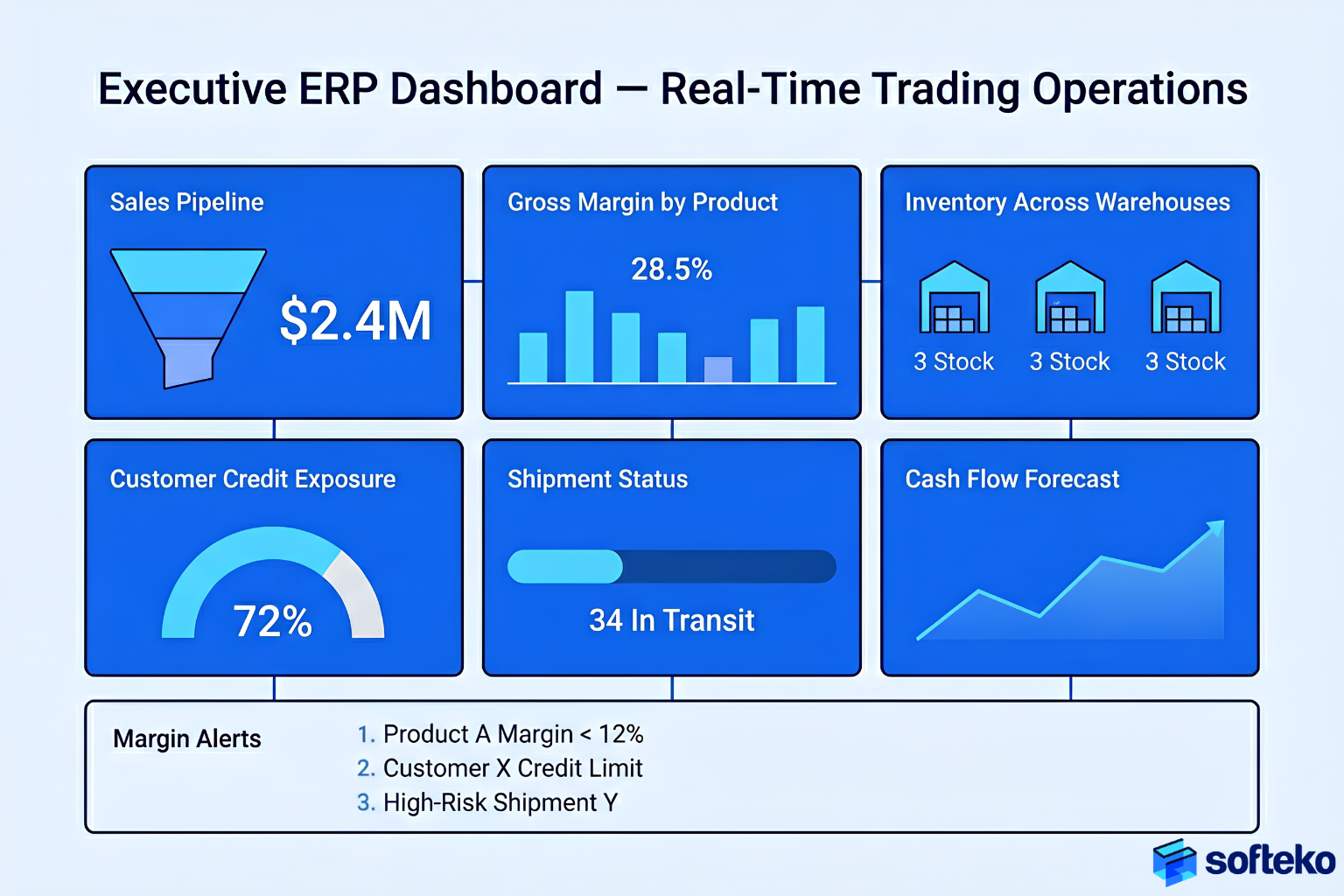
Management Dashboards and Decision-Making
Importantly, your senior management does not need more reports. They need better visibility. The most valuable ERP dashboards answer operational questions before problems become expensive.
For a trading business, executives typically want visibility into:
- Sales pipeline
- Gross margin by product
- Inventory across warehouses
- Customer credit exposure
- Shipment status
- Supplier delivery performance
- Cash flow forecasts
- Outstanding collections
In fact, traditional ERP systems often provide these reports, but they may require custom development, manual consolidation, or scheduled reporting. Modern ERP platforms increasingly emphasise configurable dashboards that combine operational information from multiple departments into a single management view.
This changes how your leadership makes decisions. Instead of waiting for departmental updates, management can identify exceptions earlier, prioritise corrective actions, and monitor operational performance continuously. That visibility does not replace experience. Rather, it allows experienced managers to act before operational issues become financial problems.
Key Takeaway
Comparing ERP systems based on daily workflows reveals a more meaningful difference than comparing feature lists. A traditional ERP and a modern ERP may both support purchasing, inventory, finance, and sales. The real question is: how easily can those departments work together using the same operational information?
For growing trading businesses, that ability often determines whether the ERP becomes a long-term operational control system — or simply another system your employees work around.
How to Calculate the Total Cost of Owning an ERP System
Direct answer: The total cost of owning an ERP system extends far beyond software licensing. Implementation, customisation, infrastructure, training, support, upgrades, integrations, and ongoing maintenance often represent a much larger investment over the life of the system.
Notably, this is one of the most common mistakes businesses make during ERP selection. They compare software prices. They should be comparing five-year ownership costs. A lower software price does not automatically result in a lower total investment. Likewise, a higher implementation cost is not necessarily more expensive if it reduces operational costs, simplifies upgrades, and lowers maintenance over time.
The objective is not to buy the cheapest ERP. Rather, it is to own the most sustainable ERP. For trading businesses, where operational requirements continue evolving, understanding Total Cost of Ownership (TCO) is often more important than comparing software licenses.
Deloitte’s 2024 research confirms more than 90% of CFOs rank ERP evaluation among their top five digital finance priorities, and industry benchmarks indicate implementation typically represents 40–60% of the total ERP investment — not the license price.[15]
Software License Cost Is Only One Part of the Investment
Typically, software vendors usually present licensing costs first because they are easy to compare. You naturally ask questions such as:
- How much does the ERP cost?
- Is there a monthly subscription?
- Is the license perpetual?
- How many users are included?
These questions are important. However, they are also incomplete. Software licensing typically represents only one component of ERP ownership. The larger investment often includes:
- Business process analysis
- Implementation consulting
- Data migration
- System configuration
- Custom development
- Integration with third-party applications
- User training
- Change management
- Testing
- Annual maintenance
- Future upgrades
- Ongoing technical support
Some of these costs occur only once. Others continue throughout the life of the ERP.
For example, a trading company implementing inventory management across four warehouses may spend relatively little on software compared to the effort required to clean inventory master data, standardise warehouse processes, train users, and validate stock balances before go-live. Those activities create business value. Ignoring them during ERP budgeting creates unrealistic expectations.
This is why experienced implementation partners begin with business processes before discussing software pricing. They understand that successful ERP projects are operational improvement initiatives — not software installations.
The Hidden Cost of Customization
Customisation is often presented as a competitive advantage: “We can customise the ERP exactly how your business works.” That sounds attractive. In practice, however, extensive customisation frequently becomes one of the largest contributors to long-term ERP ownership costs.
For example, every custom workflow introduces additional development effort. Every custom report requires testing. Every custom integration must be maintained. Each software upgrade must verify that these customisations continue working correctly. Over several years, the cumulative maintenance effort can become substantial. Academic research quantifies the risk clearly: projects with more than 20% customisation are 64% more likely to experience significant delays, and extensive changes drive cost increases of 200–400%.[14]
This does not mean customisation should always be avoided. Every organisation has unique operational requirements. Some level of customisation may be justified where it supports genuine competitive advantages or regulatory requirements.
The question should always be: is this customisation improving the business — or simply reproducing an inefficient process that already exists?
This distinction is especially important for your trading company. Many manual approval steps, spreadsheet calculations, and email-based workflows developed over time because previous systems lacked flexibility. Replicating those same workarounds inside a new ERP simply transfers yesterday’s inefficiencies into tomorrow’s platform.
Implementation projects should instead evaluate whether standard business practices can replace unnecessary customisation. This philosophy is reflected throughout well-designed trading ERP implementations. Rather than customising every operational decision, the solution emphasises configurable approval workflows, standardised quotation governance, role-based responsibilities, margin controls, document management, and operational checkpoints that can evolve with the business. The result is an ERP that supports operational discipline without excessive technical complexity.
Maintenance, Upgrades, and Technical Debt
Notably, every ERP system accumulates technical debt. The difference lies in how quickly that debt grows.
Technical debt refers to the additional effort required to maintain software because of previous design decisions, customisations, outdated integrations, or unsupported technology. Unlike financial debt, it does not appear on a balance sheet. Rather, it appears in implementation timelines. A simple workflow change that once required a few hours may later require several weeks because multiple custom components must be reviewed before anything can change.
The same challenge appears during upgrades. ERP vendors regularly release security improvements, performance enhancements, regulatory updates, bug fixes, and new business capabilities. Your organisation benefits only if it can adopt these updates. In heavily customised environments, upgrades often become complex projects because every modification must be validated against the new software version.
Some organisations postpone upgrades for years to avoid this effort. Eventually they face a difficult decision: continue operating unsupported software, or undertake a costly modernisation project. Legacy maintenance costs also escalate on their own — 10–15% annually after warranty expiration, according to Gartner and Deloitte data compiled by Legacyleap, with 42% of developer time consumed by maintaining existing systems rather than delivering new capabilities.[10]
Modern ERP platforms generally attempt to reduce this technical debt by separating standard functionality from business-specific configuration wherever possible. For growing trading businesses, this provides an important operational advantage. Instead of continuously maintaining software, your internal teams can focus on improving purchasing, inventory, customer service, warehouse performance, and financial controls.
Calculate the Five-Year Total Cost of Ownership
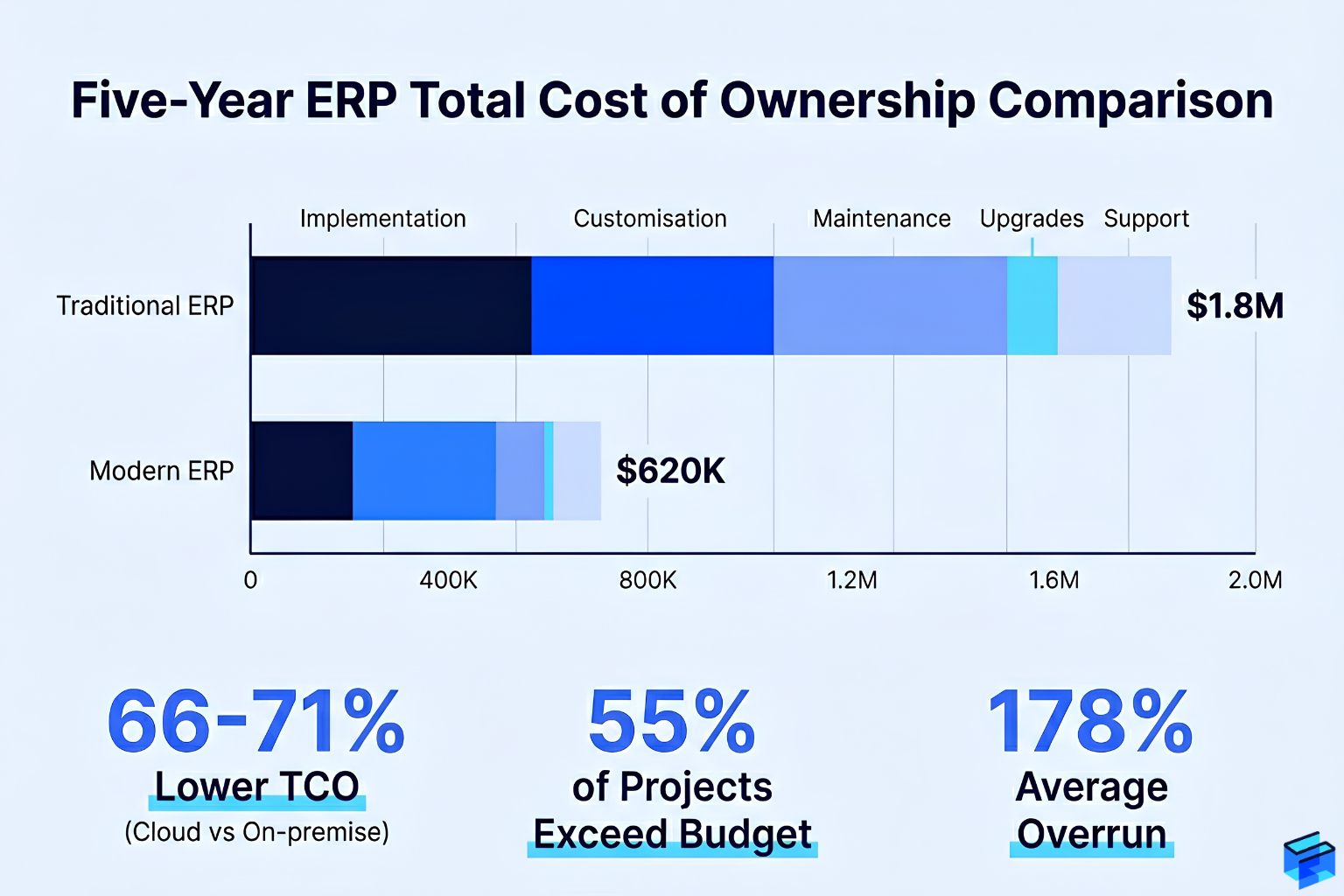
Looking only at implementation costs provides an incomplete picture. A more realistic evaluation considers the entire ownership period.
The following framework illustrates the categories businesses should compare during ERP evaluation.
| Cost category | Traditional ERP | Modern ERP |
|---|---|---|
| Software licensing | Initial license or subscription | Initial subscription or license |
| Implementation | High due to customisation | Moderate, configuration-focused |
| Infrastructure | Often significant for on-premise deployments | Often reduced with cloud deployment |
| Custom development | Frequently extensive | Typically lower |
| User training | Initial and ongoing | Initial and ongoing |
| Annual maintenance | Vendor support plus customisation maintenance | Vendor support and configuration updates |
| Upgrade projects | Often larger because of customisation | Generally less complex |
| Integration maintenance | May require custom development | Often supported through standard APIs |
| Operational improvements | Slower to introduce | Easier to implement over time |
The exact costs vary by organisation. However, the comparison illustrates an important principle. The ERP with the lowest implementation cost is not always the least expensive to own. Likewise, the ERP with the highest software subscription may still deliver a lower five-year ownership cost if maintenance, upgrades, and operational improvements require less effort.
Independent 10-year TCO analysis of cloud vs on-premise ERP indicates cloud typically delivers a 66–71% lower total cost of ownership.[8] Meanwhile, industry data shows 55% of ERP projects exceed their original budget, with an average overrun of 178% — usually driven by scope creep and customisation.[9]
When Modern ERP Becomes the Lower-Cost Option
Importantly, modern ERP platforms are not automatically less expensive. Rather, they become more economical under specific business conditions. For example:
- Your business expects to expand into additional countries
- New warehouses will be added over time
- Product lines continue growing
- Business processes change regularly
- Management expects frequent reporting improvements
- Integrations with external applications will increase
Under these conditions, adaptability becomes financially valuable. Every future workflow change that can be handled through configuration rather than software redevelopment reduces future ownership costs.
This is one reason many growing distributors, wholesalers, and import-export businesses are re-evaluating ERP investment strategies. They are not replacing traditional ERP because the software has stopped functioning. Rather, they are replacing it because maintaining operational flexibility has become increasingly expensive.
From a financial perspective, your ERP should be viewed as a long-term business asset. Like a warehouse or distribution network, its value should be measured by the operational capability it enables — not simply by its purchase price.
Implementation Insight
Organisations that achieve the strongest ERP return on investment rarely optimise for the lowest implementation budget. Rather, they optimise for the lowest lifetime operational cost. That usually leads to different decisions regarding customisation, implementation methodology, user adoption, and long-term governance.
Internal Link Opportunity: This discussion naturally connects to your upcoming cluster articles on ERP Cost, ERP Implementation, and ERP Implementation Mistakes, where readers can explore budgeting, project planning, and common implementation risks in greater detail.
Why Businesses Delay Replacing Legacy ERP Systems
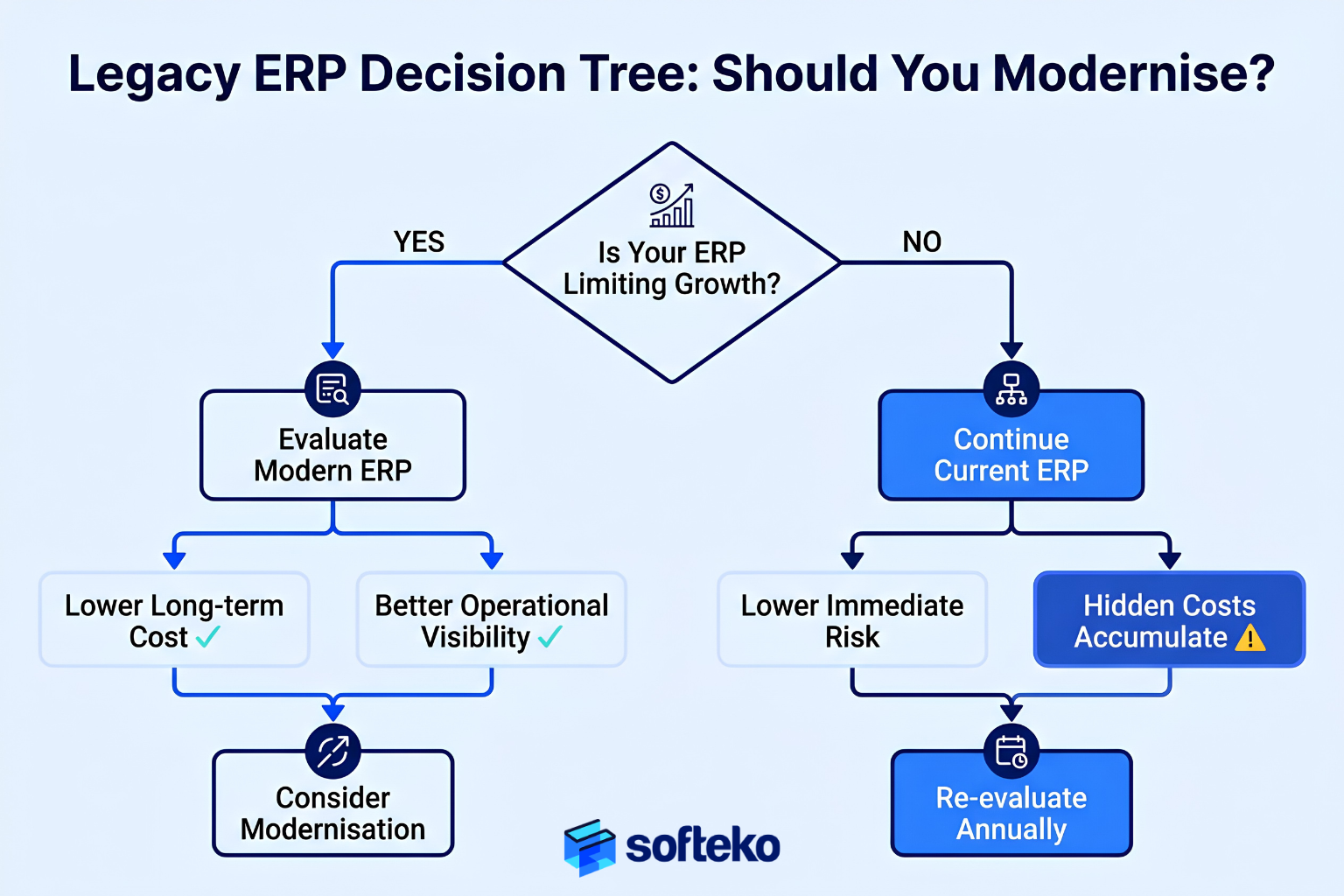
Most businesses do not delay replacing a legacy ERP because they believe it is the best system available. They delay because the perceived risks of change feel greater than the visible costs of staying the same.
In fairness, this is an understandable reaction. An ERP system supports nearly every core business function. Customer orders, procurement, inventory, warehousing, finance, shipping, compliance, and reporting all depend on it. Replacing such a critical platform naturally raises concerns about disruption.
However, focusing only on implementation risk often causes you to overlook another risk: the operational cost of doing nothing.
Every year a legacy ERP remains unchanged, your business typically spends more time maintaining workarounds, supporting outdated processes, and compensating for limited visibility. The ERP continues processing transactions. Meanwhile, the business gradually becomes less efficient.
This section examines the most common reasons organisations postpone ERP modernisation and how your business leaders can evaluate those concerns objectively.
The Sunk Cost Trap
Notably, one of the strongest reasons companies continue using legacy ERP systems has nothing to do with technology. It is psychology.
Many organisations have invested heavily in their existing ERP. That investment may include:
- Software licenses
- Custom development
- Consulting services
- Internal IT resources
- User training
- Hardware infrastructure
- Years of operational knowledge
After spending millions of dollars — or even hundreds of thousands — it becomes difficult to consider replacing the system. Your leadership naturally asks: “We’ve already invested so much. Shouldn’t we continue using it?”
From an accounting perspective, this question makes sense. From a business perspective, however, it can become dangerous. Economists refer to this behaviour as the sunk cost fallacy. Money already spent cannot be recovered. Future decisions should therefore be based on future value rather than historical investment.
The better question is: will this ERP support the business we expect to become over the next five years? If the answer is no, previous investment should not determine future strategy.
Business Example
A wholesale distributor implemented a traditional ERP twelve years ago. Since then, the company has expanded from one warehouse to six. International sourcing has increased. The number of products has tripled. Management now wants real-time profitability by warehouse and customer segment.
Technically, the existing ERP can still process orders. Operationally, however, it requires dozens of spreadsheets and manual reconciliations every month. Replacing the ERP feels expensive. Continuing to operate inefficiently becomes even more expensive.
The investment decision should compare those future costs — not yesterday’s implementation budget.
“Our Employees Already Know This System”
In practice, this is one of the most common arguments against ERP replacement. Your experienced employees understand every screen. They know every shortcut. Which reports are unreliable. They know which spreadsheets must be updated. They even know which manual checks compensate for missing system controls.
From your organisation’s perspective, this knowledge feels valuable. In reality, however, it often signals that important business processes exist outside the ERP. When critical operational knowledge lives only in experienced employees, several risks emerge:
- New employees require extensive training
- Business continuity depends on key individuals
- Processes vary between departments
- Errors increase when experienced staff leave
An effective ERP should reduce dependence on individual memory by embedding operational controls into standardised workflows. For example, a well-designed trading ERP does not rely on employees remembering every approval step. Instead, quotation approvals, customer onboarding, credit validation, purchase order verification, and shipment progression follow defined workflows with mandatory checkpoints and role-based responsibilities. The process itself becomes standardised rather than dependent on individual experience.
That distinction is important. The objective of ERP is not to replace experienced employees. Rather, it is to ensure that your organisation’s best operating practices become repeatable across the entire business.
Fear of Migration and Business Disruption
Understandably, ERP migration is a major business initiative. Concern about disruption is justified. Your trading company cannot simply stop operations while implementing a new platform. Customer orders continue arriving. Containers continue moving. Purchase orders continue being issued. Invoices continue being generated.
The challenge is maintaining business continuity while modernising operational systems. Fortunately, ERP implementation methodologies have changed considerably over the last decade. Instead of replacing every department simultaneously, many organisations now adopt phased implementation strategies. A typical approach may include:
- Clean and validate master data
- Configure core business processes
- Train key users
- Pilot selected departments
- Run parallel validation where appropriate
- Deploy remaining business functions in controlled stages
This approach reduces operational risk while allowing your employees to adapt gradually. Implementation success therefore depends less on the ERP platform itself and more on project planning, executive sponsorship, user adoption, and implementation expertise.
A poorly managed implementation can disrupt any ERP project. A well-managed implementation can significantly reduce that risk. The Hershey and Lidl case studies (later in this article) illustrate exactly what happens when businesses ignore these principles.
Concerns About Data Loss
Similarly, data migration is another major concern during ERP replacement. Business owners often worry about losing:
- Customer history
- Supplier records
- Product master data
- Inventory balances
- Financial transactions
- Historical quotations
- Purchase orders
- Shipment documentation
These concerns are valid. Poor-quality data migration can affect business operations long after implementation. However, migration should not be viewed as simply moving information from one system to another. Rather, it should be viewed as an opportunity to improve data quality.
Many legacy ERP environments contain duplicate customer records, obsolete suppliers, inactive inventory items, incorrect product attributes, inconsistent units of measure, outdated pricing, and incomplete documentation. Migrating poor-quality data simply transfers existing problems into the new ERP.
Experienced implementation teams therefore spend considerable effort preparing data before migration begins. That preparation often delivers operational improvements even before the new ERP goes live.
Implementation Insight
Successful ERP projects rarely migrate everything. Rather, they migrate what the business actually needs, while archiving obsolete information according to business and regulatory requirements. This reduces implementation complexity and improves long-term data quality.
The Operational Cost of Delaying ERP Modernization
Notably, every postponed ERP project has an opportunity cost. Unlike implementation expenses, these costs rarely appear in budgets. Rather, they appear as operational inefficiencies. Examples include:
- Sales teams waiting for approval emails
- Procurement negotiating with outdated supplier information
- Warehouse staff reconciling inventory manually
- Finance preparing reports outside the ERP
- Management making decisions using last month’s data
Each activity consumes employee time. Delays affect customer responsiveness. Each manual process increases operational risk. Individually, these costs appear manageable. Collectively, however, they influence profitability, customer satisfaction, and business scalability.
The longer you postpone modernisation, the more these hidden costs accumulate. That does not mean every business should replace its ERP immediately. Rather, it means that maintaining a legacy ERP should be an active strategic decision — not simply the default option because change feels difficult.
Key Takeaway
Organisations rarely replace legacy ERP because the software stops working. Rather, they replace it because the business evolves faster than the system supporting it. When your employees spend more time working around the ERP than working through it, modernisation becomes less of a technology project and more of an operational improvement initiative.
The decision should therefore be based on future business capability — not past software investment.
Avoid Common Mistakes When Comparing ERP Systems
Most ERP selection mistakes happen long before software demonstrations begin. Businesses often compare products instead of comparing business requirements. As a result, they select a system that performs well during presentations but creates operational challenges after implementation.
In reality, ERP projects are rarely unsuccessful because the software lacks features. Rather, they struggle because the evaluation process focuses on the wrong questions.
For example, two ERP systems may both support inventory management, purchasing, accounting, and sales. Yet one may require extensive customisation to support your approval processes, while the other can be configured using standard workflows. On paper, both systems satisfy the requirements. In practice, however, their long-term ownership experience can be very different.
An effective ERP evaluation should therefore begin with your operational model rather than the vendor’s product brochure. The following mistakes appear repeatedly in ERP selection projects across trading businesses.
What the Hershey, Lidl, and GiFi Failures Prove
Three well-documented ERP failures show what happens when process discipline is ignored:
- Hershey Foods, 1999. Hershey compressed a 48-month SAP + Siebel + Manugistics implementation into 30 months and went live during peak Halloween season. The result: $150 million in lost sales, a 19% profit drop, and an 8% stock-price fall in one day.[11] The 2002 re-implementation succeeded only because Hershey slowed down, tested thoroughly, and provided adequate training.
- Lidl, 2011–2018. Lidl spent €500 million over seven years on SAP before abandoning the project entirely.[12] Root cause: process misalignment — Lidl valued inventory at purchase price while SAP used retail price. Instead of adapting its process, Lidl attempted heavy customisation. Executive turnover, weak change management, and over-reliance on external consultants compounded the failure.
- GiFi, 2023. The French retail chain’s SAP migration caused empty shelves, delivery errors, and mis-synchronised stock. Sales dropped 9% (€117 million), net profit turned to loss, and the company required emergency government-backed restructuring.[13]
Each case reinforces the same lesson: software quality does not survive process misalignment.
Don’t Compare Features Before Business Processes
Notably, a long feature checklist creates the impression of a thorough evaluation. In reality, however, it often creates confusion.
Most mature ERP platforms already include similar functional capabilities: inventory management, procurement, sales, accounting, CRM, and reporting. These features answer what the ERP can do. They do not explain how your business will actually operate.
A better evaluation starts with operational workflows. Ask questions such as:
- How does a customer inquiry become a confirmed order?
- How are supplier quotations evaluated?
- Who approves low-margin transactions?
- How are landed costs calculated?
- What happens when inventory is unavailable?
- How are customer credit limits enforced?
- How does Finance receive operational information before invoicing?
Only after these workflows are documented should software capabilities be compared. This process-first approach also reduces unnecessary customisation. Many businesses discover that standard ERP workflows already support industry best practices. Implementation becomes simpler because your business improves its processes instead of reproducing historical workarounds.
A well-designed trading ERP implementation illustrates this philosophy well. Rather than treating Sales, Procurement, Logistics, Warehouse, and Finance as independent departments, the solution defines an end-to-end commercial workflow where each department contributes at specific operational checkpoints. The ERP enforces those checkpoints through standardised approval rules instead of relying on email coordination.
Business Framework
Current Process → Identify Operational Risks → Define Required Controls → Evaluate ERP Workflow → Select ERP
Notice what is missing. There is no step called “Compare Features.” Features support processes. They should never define them.
Don’t Choose ERP Based Only on Price
Of course, every ERP project has a budget. That budget matters. However, selecting an ERP solely because it has the lowest purchase price often creates much higher ownership costs later. A lower-cost implementation may involve more manual work, higher customisation, limited reporting, greater maintenance effort, and more expensive future upgrades. Likewise, a higher initial investment may reduce operational costs for many years.
Business leaders should therefore compare value, not simply price. Useful evaluation questions include:
- How much manual work will this ERP eliminate?
- Will managers receive faster operational visibility?
- Can future business changes be handled without major redevelopment?
- How much internal IT support will the system require?
- What is the expected five-year ownership cost?
These questions produce a much more accurate financial comparison than software pricing alone.
Don’t Ignore the Implementation Partner
In practice, many ERP evaluations focus almost entirely on the software. The implementation partner receives far less attention. This is often a costly mistake.
An ERP platform provides capabilities. The implementation partner determines how those capabilities are translated into operational workflows. A strong implementation partner spends more time understanding your business than demonstrating software. They ask questions about procurement approvals, inventory movements, credit controls, warehouse operations, margin governance, financial reporting, and operational bottlenecks. They challenge inefficient processes instead of simply reproducing them.
For example, in one trading ERP implementation, considerable effort was invested in documenting business processes before configuring the system. Separate Business Requirements Documents (BRDs) and Software Requirements Specifications (SRSs) were prepared for Sales, Supply Chain, Finance, Operations, and HR to ensure that operational controls — not software screens — defined the implementation.
That approach illustrates an important implementation lesson. The quality of process design often has a greater influence on project success than the ERP software itself. When evaluating vendors, assess both the ERP platform and the implementation methodology. Both determine long-term outcomes.
Don’t Over-Customize the System
Importantly, customisation should solve genuine business requirements. It should not preserve inefficient habits.
Many organisations request custom development because “this is how we’ve always done it.” That may not be the best reason. Before requesting customisation, ask:
- Does this process create competitive advantage?
- Is it required by regulation?
- Does it improve customer service?
- Can the same objective be achieved using standard workflows?
If the answer is no, customisation may simply increase future ownership costs. Modern ERP implementations generally follow a simple principle: configure first; customise only where configuration no longer supports the business requirement.
This philosophy reduces technical debt, simplifies upgrades, and improves long-term maintainability. It also encourages organisations to adopt proven operational practices rather than recreating outdated procedures.
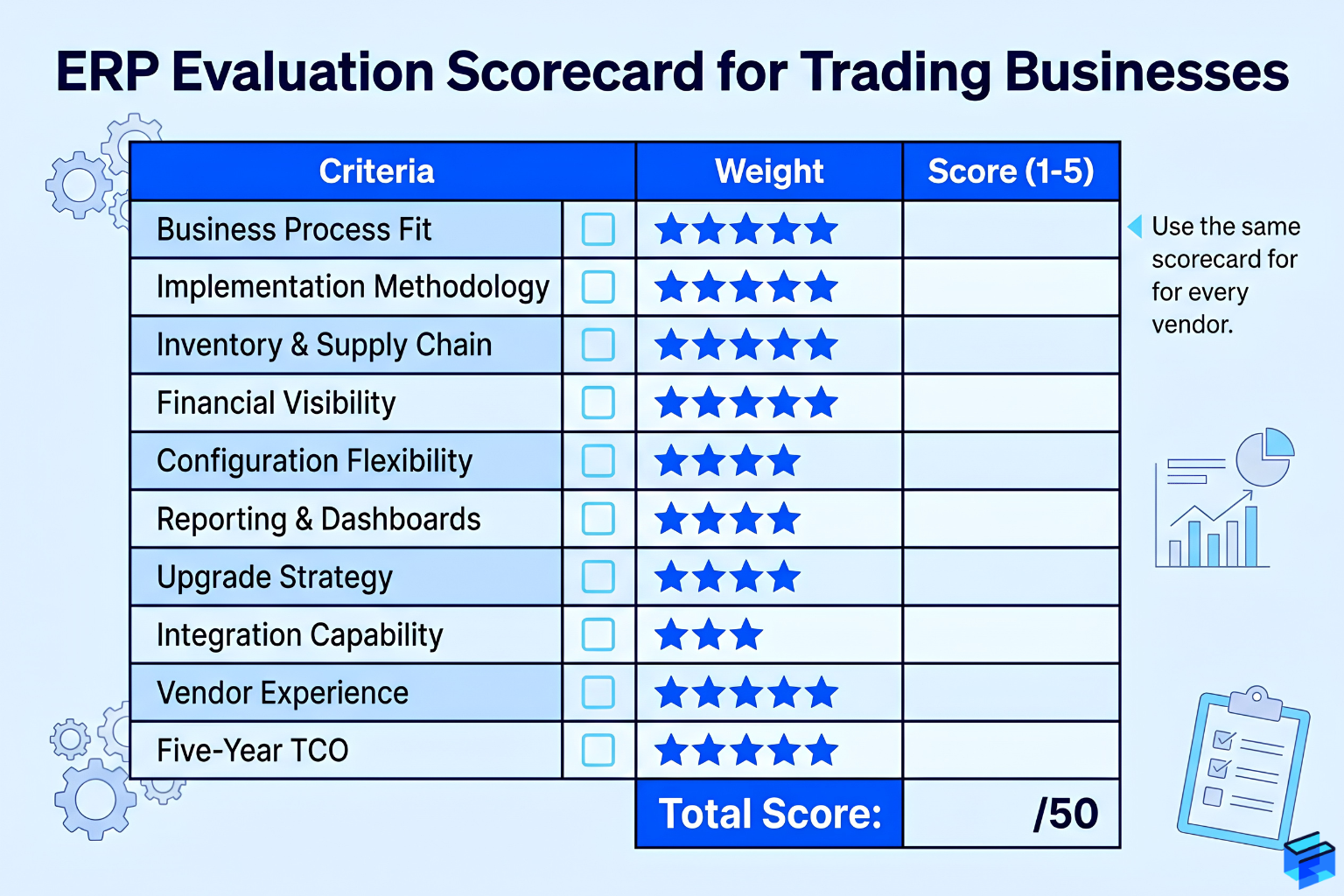
Use an ERP Evaluation Scorecard
Certainly, software demonstrations are useful. However, they should not determine the final decision. Instead, evaluate every ERP using the same business criteria.
ERP Evaluation Scorecard
| Evaluation area | Questions to ask | Weight |
|---|---|---|
| Business Process Fit | Does the ERP support your actual trading workflows? | ⭐⭐⭐⭐⭐ |
| Implementation Methodology | Is the implementation process structured and practical? | ⭐⭐⭐⭐⭐ |
| Inventory & Supply Chain | Can it support multi-warehouse, procurement, and logistics operations? | ⭐⭐⭐⭐⭐ |
| Financial Visibility | Does it provide real-time profitability and cash flow insights? | ⭐⭐⭐⭐⭐ |
| Configuration Flexibility | Can workflows change without extensive redevelopment? | ⭐⭐⭐⭐ |
| Reporting & Dashboards | Can management monitor operations without manual reporting? | ⭐⭐⭐⭐ |
| Upgrade Strategy | Will future upgrades remain manageable? | ⭐⭐⭐⭐ |
| Integration Capability | Can the ERP connect with existing business applications? | ⭐⭐⭐ |
| Vendor & Partner Experience | Do they understand trading operations? | ⭐⭐⭐⭐⭐ |
| Five-Year Total Cost of Ownership | Is the ERP financially sustainable? | ⭐⭐⭐⭐⭐ |
Rather than asking “Which ERP has the most features?” ask “Which ERP gives our business the strongest operational foundation for the next decade?” That question produces far better implementation decisions.
Key Takeaway
In fact, successful ERP projects begin long before implementation. They begin with a disciplined evaluation process. Businesses that focus on workflows, operational controls, implementation methodology, and long-term ownership consistently make stronger ERP decisions than those that compare software demonstrations alone.
Choosing an ERP is not about buying technology. Rather, it is about selecting the operating model that will support your business as it grows.
Use a Practical Framework to Evaluate ERP Software
The best way to evaluate an ERP system is to measure how well it supports your business processes over the next five to ten years — not how impressive it looks during a software demonstration.
By this point, you have seen that ERP selection is about much more than features, licensing, or deployment models. A successful ERP should help your business standardise operations, improve decision-making, reduce manual coordination, support future growth, and lower long-term ownership costs.
To evaluate ERP systems objectively, use the following framework. Rather than asking vendors to explain what their software can do, ask them to demonstrate how your business would actually operate inside their ERP. That shift changes the entire evaluation process.
Evaluate Business Fit Before Software Fit
Every ERP vendor can demonstrate purchasing, inventory, accounting, and sales. The more important question is whether those functions support your operating model.
Begin by documenting your current business workflows. For a trading business, that normally includes:
- Customer inquiry
- Quotation approval
- Customer Purchase Order
- Procurement
- Supplier Purchase Order
- Shipment execution
- Warehouse operations
- Delivery
- Invoicing
- Collection
Then identify where delays, duplicate work, or manual coordination occur. For example:
| Current business issue | Operational risk | ERP control to evaluate |
|---|---|---|
| Quotations require multiple email approvals | Slow customer response | Workflow approvals |
| Procurement cannot see confirmed demand | Purchasing delays | Shared demand visibility |
| Inventory reports are outdated | Incorrect stock commitments | Real-time inventory |
| Customer credit reviewed manually | Financial risk | Credit approval workflow |
| Management waits until month-end for profitability | Slow decision-making | Live operational dashboards |
Notice what this framework evaluates. Not software features. Business outcomes. If an ERP cannot support these operational controls without excessive customisation, it may not be the right long-term fit.
Assess Scalability for Future Growth
Many ERP projects fail because they are designed for today’s business rather than tomorrow’s. During evaluation, ask yourself: if our business doubles over the next five years, will this ERP still support us without major redevelopment?
Growth may involve new warehouses, additional legal entities, more countries, higher transaction volumes, additional product lines, larger procurement teams, more approval layers, and new reporting requirements. Your ERP should accommodate this growth without forcing another major implementation project.
A well-designed trading ERP demonstrates this forward-looking approach. Its operational model supports multi-company trading, multiple warehouse types, intercompany transactions, international procurement, multi-currency operations, and end-to-end shipment visibility as part of a single business process rather than separate implementations.
When evaluating scalability, ask vendors to demonstrate: adding another warehouse, creating another company, supporting another country, introducing another approval level, and expanding reporting across all entities. If these activities require extensive redevelopment, scalability may become an issue later.
Compare Flexibility and Configuration Options
Every business evolves. Your ERP should evolve with it. Ask vendors to demonstrate changes such as adding another approval stage, creating new pricing rules, changing customer credit policies, introducing a new document approval process, adding another product category, or creating another sales territory.
Then ask an important follow-up question: can these changes be handled through configuration, or do they require software development?
This distinction has significant long-term implications. Configuration generally allows business administrators to adapt operational workflows. Custom development usually requires technical resources, testing, deployment, and future maintenance. Neither approach is inherently wrong. However, organisations expecting frequent operational change should understand the long-term implications before implementation begins.
Measure Reporting and Operational Visibility
One of the primary reasons organisations invest in ERP is better visibility. Unfortunately, many evaluations stop after confirming that reports exist. Instead, evaluate how decisions are supported.
Ask vendors to demonstrate dashboards that answer questions such as:
Inventory: Which warehouse has available stock? Which products require replenishment? Which inventory has been reserved?
Sales: Which quotations are waiting for approval? Which customers have exceeded credit limits? Which orders are delayed?
Procurement: Which suppliers consistently miss delivery dates? Which purchase orders remain outstanding?
Finance: What is today’s customer exposure? Which shipments have not yet been invoiced? Which products generate the highest gross margin?
Management: Which customers are most profitable? Where are operational bottlenecks developing? Which KPIs require immediate attention?
The objective is not more reports. Rather, it is faster operational decisions.
Review Upgrade Strategy and Long-Term Support
ERP selection should never end at implementation. Eventually your business will need software updates, security improvements, regulatory changes, performance enhancements, and additional functionality.
Ask vendors:
- How often are major releases published?
- How are upgrades performed?
- What happens to customisations during upgrades?
- How much downtime is normally required?
- Which activities require redevelopment?
These questions often reveal more about long-term ownership than implementation discussions. An ERP should improve continuously without forcing you into repeated large-scale redevelopment projects.
Evaluate Total Cost of Ownership
Finally, bring every evaluation category together. Instead of comparing software prices, compare business ownership. Consider:
| Evaluation category | Questions business leaders should ask |
|---|---|
| Implementation | How long will implementation take? |
| Operations | Will departments work together more effectively? |
| Customisation | How much future development should we expect? |
| Reporting | Will management receive better visibility? |
| Training | How easily can employees adopt the system? |
| Scalability | Will the ERP support future expansion? |
| Maintenance | What ongoing effort will ownership require? |
| Upgrade Path | Can we stay current without major disruption? |
| Implementation Partner | Do they understand trading operations? |
| Five-Year Value | Will this ERP still support our strategy in five years? |
Looking at all these areas together provides a far more reliable basis for decision-making than comparing software demonstrations.
ERP Evaluation Framework
The entire evaluation process can be summarised using a simple framework:
Business Strategy → Business Processes → Operational Risks → Required Controls → ERP Workflow Fit → Implementation Method → Long-Term Ownership → Final ERP Selection
Notice where software appears — near the end. That is intentional. Your business should first understand how it wants to operate, then evaluate which ERP best supports that operating model.
Why Odoo Represents a Modern ERP Approach
Odoo represents a modern ERP approach because it emphasises standardised business processes, configurable workflows, modular deployment, and continuous improvement rather than extensive customisation during implementation. For many growing trading businesses, this aligns well with the operational requirements discussed throughout this article.
This is the first time we have mentioned Odoo in detail. That is intentional. An ERP should never be selected simply because it is popular or widely recommended. It should be selected because it supports the operational model your business needs.
By now, we have established an evaluation framework based on business process fit, operational controls, scalability, flexibility, reporting visibility, long-term ownership, and total cost of ownership. The next step is to evaluate where Odoo fits within that framework. Rather than comparing marketing claims, we’ll compare operational capabilities.
How Odoo Supports Trading Business Workflows
In practice, trading businesses rarely operate as independent departments. Sales decisions influence procurement. Procurement affects inventory. Inventory determines delivery commitments. Logistics impacts customer satisfaction. Finance needs visibility across every stage.
An ERP should connect these workflows without requiring your employees to manually transfer information between departments. Odoo is designed around this connected business process. Instead of treating Sales, Inventory, Purchase, Accounting, and Logistics as isolated applications, they share a common operational database. Information entered once becomes available throughout the business according to user roles and workflow permissions.
For example, consider a typical trading workflow:
Customer inquiry → Quotation → Customer Purchase Order → Supplier Purchase Order → Shipment → Warehouse Receipt → Customer Delivery → Invoice → Payment
Rather than recreating information at each stage, the workflow progresses through connected business documents. This approach closely matches the operational model used in mature trading ERP implementations. Customer inquiries progress through structured commercial review, Procurement validates supplier pricing, Finance reviews commercial risk, warehouse operations receive confirmed demand, and shipment execution follows approved purchasing decisions. Every department contributes to a single operational workflow instead of maintaining separate records.
This creates several operational advantages. Instead of asking “Has Procurement received this order?” your employees can immediately see workflow status. Or calling Finance to verify customer credit, the commercial team works within approved business rules. Instead of updating multiple spreadsheets, departments work from the same operational information. For growing trading businesses, this shared visibility often reduces delays more effectively than adding additional staff.
Why Odoo Requires Less Customization
Notably, one of the reasons Odoo is frequently considered a modern ERP platform is its implementation philosophy. The objective is generally to configure standard business workflows before introducing custom development.
For example, many operational requirements can be configured through standard capabilities such as approval workflows, user roles and permissions, multi-company management, multi-warehouse operations, document routing, automated activities, business rules, dashboards, and reporting.
This approach supports an important implementation principle: business processes should become more standardised during ERP implementation — not more complicated.
A well-designed trading ERP implementation demonstrates this philosophy throughout. Rather than developing custom functionality for every approval, the solution relies on structured workflow controls. Examples include customer onboarding approval (Sales → Finance → Management), quotation SLA monitoring, margin approval thresholds, Purchase Order validation, credit control, shipment progression, supplier approval workflows, document management, and role-based visibility. These are business controls first. The ERP simply enforces them consistently.
That distinction reduces unnecessary development while improving governance. Customisation still has an important place. Your trading business may require industry-specific workflows, regulatory reporting, or specialised integrations that cannot be achieved through configuration alone. In those situations, carefully designed customisation creates business value. The objective is to customise only where the business gains a measurable operational advantage.
How Odoo Simplifies Future Upgrades
In fact, one of the largest long-term costs in many ERP environments is maintaining custom software during upgrades. Every ERP evolves. Security updates, regulatory changes, performance improvements, and new functionality are released regularly. The challenge is adopting those improvements without rebuilding previous customisations.
Odoo addresses this challenge by encouraging organisations to remain as close as possible to standard business workflows. When implementation emphasises configuration instead of modifying core application logic, future upgrades generally become more predictable and less disruptive.
That does not eliminate upgrade planning. Your business should still test critical workflows, validate integrations, review custom developments, and train users on new functionality. However, reducing unnecessary customisation generally reduces upgrade complexity over time.
For trading businesses that expect continued growth, this becomes a significant operational advantage. Instead of investing heavily in maintaining software, your internal teams can continue improving warehouse operations, procurement performance, inventory planning, customer service, and financial reporting.
When Odoo Is the Right Choice
Realistically, no ERP platform is ideal for every organisation. However, Odoo aligns particularly well with businesses that value operational flexibility and continuous improvement. It is often a strong fit when your trading business wants to:
- Standardise operations across departments
- Connect Sales, Procurement, Inventory, Logistics, and Finance
- Improve operational visibility
- Support multiple warehouses or companies
- Reduce dependence on spreadsheets
- Introduce structured approval workflows
- Expand gradually without redesigning the ERP
It is also well suited for organisations that prefer phased implementation. Instead of deploying every module simultaneously, your business can often implement functions in stages as operational maturity increases. This allows you to prioritise the areas generating the greatest business value first.
When Another ERP May Be a Better Fit
In fairness, an objective ERP evaluation should also recognise where another platform may be more appropriate. For example, a traditional enterprise ERP may remain the better choice when your organisation:
- Has highly specialised manufacturing processes requiring deep industry functionality
- Operates in industries with unique regulatory requirements supported by dedicated ERP vendors
- Has already invested significantly in enterprise-wide platforms that integrate thousands of users globally
- Requires capabilities that depend on a specific vendor ecosystem already adopted across the organisation
Similarly, businesses with minimal operational complexity may not require a comprehensive ERP implementation immediately. Improving business processes should always take priority over implementing unnecessary technology.
The goal is not to choose Odoo. Rather, the goal is to choose the ERP that best supports your operating model, growth strategy, and long-term ownership objectives. That is the same evaluation framework we established at the beginning of this guide.
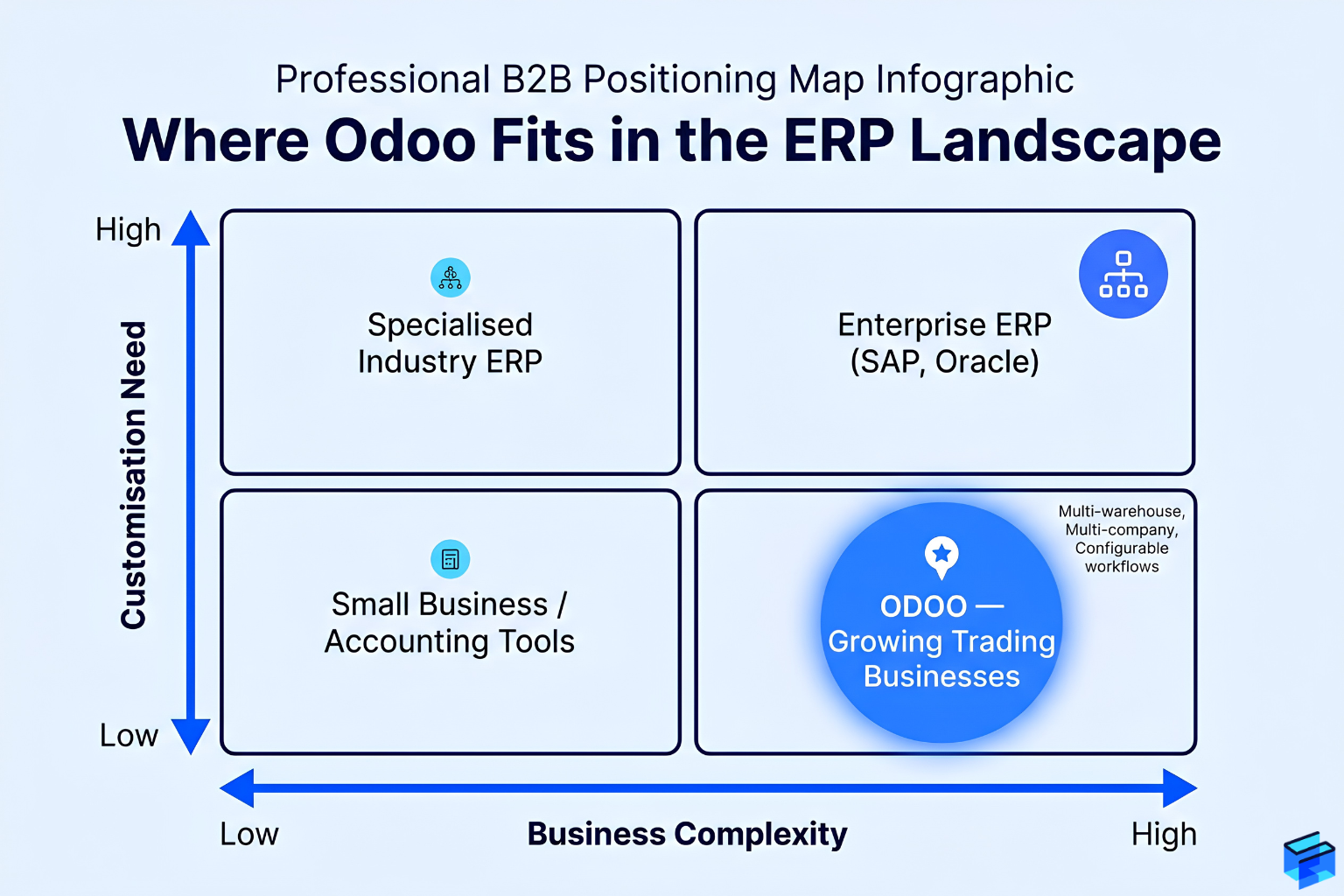
Key Takeaway
Odoo represents a modern ERP approach because it emphasises connected business processes, configurable workflows, modular implementation, and continuous improvement. For many wholesalers, distributors, importers, exporters, and multi-warehouse trading businesses, those characteristics align well with the operational challenges discussed throughout this article.
However, the decision should never begin with Odoo — or any ERP vendor. It should begin with a clear understanding of how your business operates today, how it plans to grow tomorrow, and which ERP philosophy best supports that journey.
Choose the ERP That Best Supports Your Long-Term Business Strategy
By the time your trading business begins evaluating ERP systems, the discussion often revolves around software. Which vendor has more features? Which ERP has the better interface or which proposal is less expensive?
Those questions matter. However, they simply should not come first. The businesses that achieve the greatest return from ERP implementation usually make one important shift. They stop asking “Which ERP is the best?” and start asking “Which ERP will help our business operate better over the next ten years?”
That change in perspective leads to better decisions because ERP selection becomes a business strategy discussion rather than a software purchasing exercise.
Focus on Operational Fit Instead of Brand Reputation
Notably, well-known ERP brands often dominate shortlists. Brand recognition creates confidence. However, operational fit creates business value.
A globally recognised ERP platform may still require extensive customisation to support your approval processes, warehouse operations, procurement model, or reporting requirements. Meanwhile, another platform with less market visibility may align much more closely with how your business actually operates. That is why software demonstrations should never replace operational evaluation.
Before selecting any ERP, confirm that it supports the workflows that create value inside your business. For a trading company, these typically include customer inquiry management, quotation governance, procurement approvals, multi-warehouse inventory control, shipment execution, landed cost management, credit control, multi-company reporting, and executive dashboards.
The objective is not to select the ERP with the longest feature list. Rather, it is to select the ERP that supports these operational controls with the least complexity.
Think Beyond Initial Implementation Cost
In practice, ERP projects are often evaluated using implementation budgets. Implementation is important. Ownership, however, is more important.
A business planning to use an ERP for the next eight or ten years should evaluate future upgrade effort, maintenance requirements, user adoption, operational improvements, business flexibility, reporting capability, and scalability. These factors determine the real return on investment. A slightly higher implementation budget that reduces years of manual work, minimises customisation, and simplifies future expansion often produces a stronger business outcome than selecting the lowest-cost proposal.
ERP should therefore be evaluated as a long-term operational investment rather than a short-term technology purchase.
Build an ERP That Can Grow With Your Business
As you scale, growth introduces complexity. Your ERP should absorb that complexity instead of creating more of it. As your business expands, the ERP should continue supporting new product categories, additional warehouses, more suppliers, new countries, additional legal entities, higher transaction volumes, more sophisticated reporting, and additional approval structures.
You rarely know exactly what your operations will look like five years from now. However, you do know that change is inevitable. Choosing an ERP that adapts through configuration, standardised workflows, and modular expansion generally provides greater long-term flexibility than one that depends on repeated redevelopment. The implementation should therefore establish a foundation that supports continuous operational improvement rather than simply solving today’s challenges.
Next Steps Before Making Your Final Decision
Before signing an ERP contract, pause and review your evaluation objectively. Ask your project team the following questions.
Executive Decision Checklist
- ☐ Have we documented our core business processes before evaluating software?
- ☐ Have we identified our biggest operational bottlenecks?
- ☐ Have we evaluated ERP workflows rather than feature lists?
- ☐ Have we compared five-year ownership costs instead of implementation costs alone?
- ☐ Have we assessed the implementation partner’s experience with trading businesses?
- ☐ Have we minimised unnecessary customisation?
- ☐ Have we considered future expansion into additional warehouses, companies, or countries?
- ☐ Have we confirmed how upgrades will be managed?
- ☐ Have we involved Sales, Procurement, Warehouse, Finance, and Management in the evaluation?
If several of these questions remain unanswered, the evaluation process may not yet be complete. Spending additional time before selecting an ERP is almost always less expensive than correcting the wrong decision after implementation.
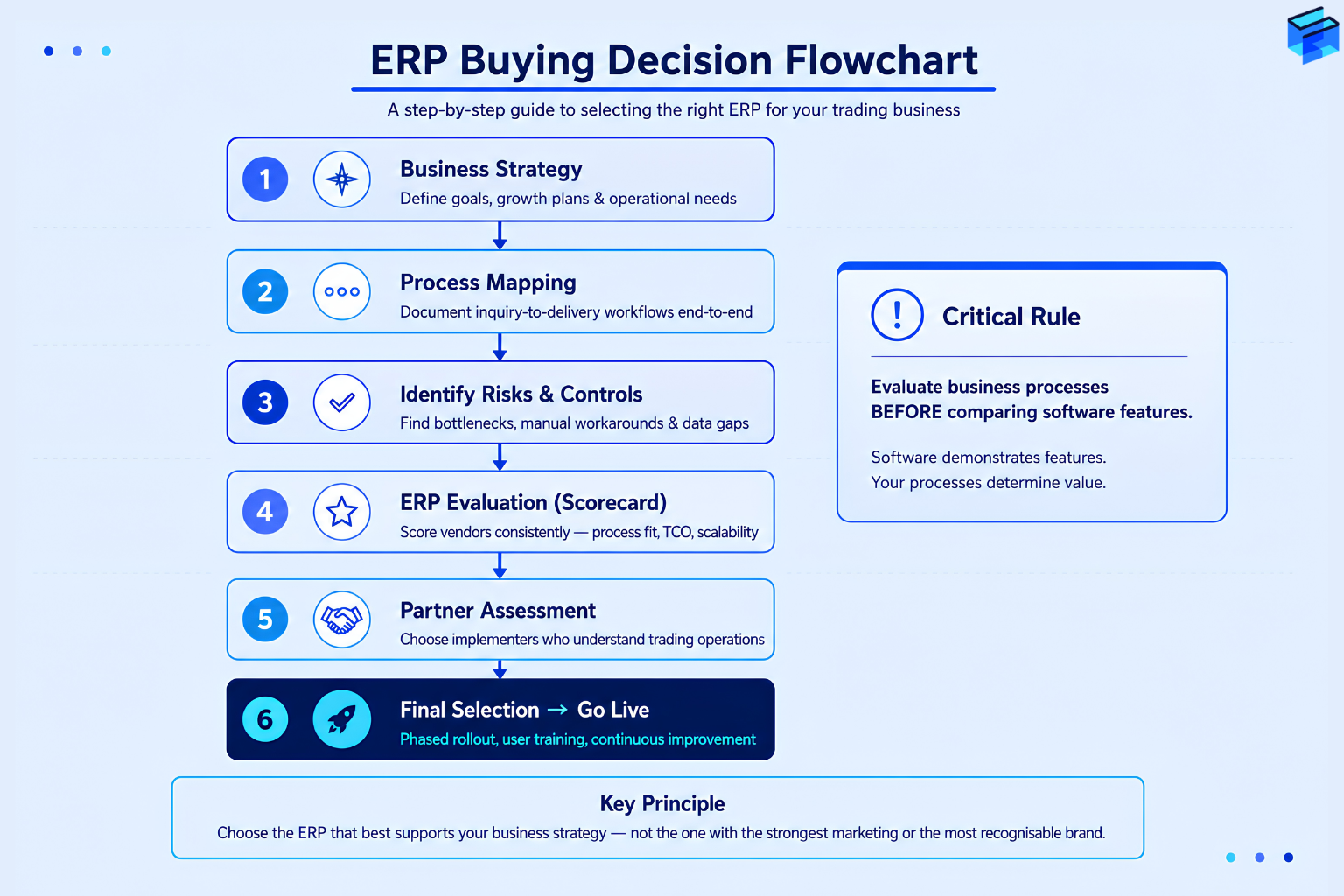
Conclusion
Choosing an ERP is one of the few business decisions that affects almost every department at the same time. Sales depends on it to manage customer relationships and quotations. Procurement relies on it to purchase efficiently. Warehouse teams use it to control inventory. Finance depends on it for visibility and governance. Management uses it to make strategic decisions.
That is why ERP selection should never begin with software demonstrations or feature comparisons. It should begin with a clear understanding of how your business operates today and how you expect it to operate tomorrow.
Throughout this guide, we compared modern ERP and traditional ERP from an operational perspective rather than a technical one. The goal was not to prove that one approach is universally superior. Rather, it was to provide a practical framework for evaluating ERP systems based on business process fit, operational controls, scalability, long-term flexibility, total cost of ownership, and implementation quality.
For many growing trading businesses, modern ERP platforms such as Odoo align well with these evaluation criteria because they emphasise standardised workflows, configuration over excessive customisation, connected operations, and continuous improvement. For other organisations — particularly those with highly specialised enterprise requirements — a traditional ERP platform may remain the better strategic choice.
The important lesson is this: choose the ERP that best supports your business strategy — not the one with the strongest marketing message or the most recognisable brand.
A well-selected ERP becomes more than a business application. It becomes the operational foundation that supports better decisions, stronger governance, improved visibility, and sustainable growth for years to come.
At Softeko, we help trading businesses design a process-first ERP evaluation and implement Odoo ERP as a connected operating system across sales, procurement, inventory, warehouse, logistics, and finance.
Frequently Asked Questions
What is the difference between modern ERP and traditional ERP?
Traditional ERP systems were primarily designed to standardise stable business processes within large organisations. Modern ERP platforms are designed to support continuous business improvement through configurable workflows, modular deployment, and easier adaptation as operational requirements change. The biggest difference is not the technology itself but the implementation philosophy and long-term flexibility.
Is Odoo considered a modern ERP?
Yes. Odoo is generally considered a modern ERP platform because it emphasises modular implementation, connected business processes, configurable workflows, and regular product updates. For many trading businesses, this approach supports growth without requiring extensive customisation for every operational change.
When should a company replace a legacy ERP system?
Your business should evaluate replacing its legacy ERP when operational workarounds begin increasing. Common indicators include heavy spreadsheet use, slow reporting, duplicate data entry, difficult upgrades, limited visibility across departments, and increasing customisation costs. The decision should be based on future business requirements rather than the age of the software alone.
Is cloud ERP always better than traditional ERP?
Not necessarily. Cloud deployment offers advantages such as easier infrastructure management and faster access to updates, but deployment method alone does not determine ERP success. Business process fit, implementation quality, operational controls, and long-term ownership are usually more important than whether the ERP is deployed on-premise or in the cloud. However, market direction is clear — cloud already accounts for 70% of ERP spend and grows 7× faster than on-premise.[2]
How do I compare ERP systems objectively?
Start by documenting your business processes instead of comparing software features. Evaluate how each ERP supports operational workflows, approval controls, reporting visibility, scalability, configuration flexibility, upgrade strategy, total cost of ownership, and implementation methodology. Using the same evaluation framework for every vendor makes comparisons much more reliable.
What is the total cost of owning an ERP system?
Total Cost of Ownership (TCO) includes much more than software licensing. Your business should also consider implementation, configuration, customisation, data migration, training, annual maintenance, support, upgrades, integration maintenance, and internal operational effort. Evaluating five-year ownership costs usually provides a much more accurate investment comparison than implementation pricing alone. Independent 10-year analysis suggests cloud ERP delivers a 66–71% lower TCO than on-premise alternatives.[8]
Can I migrate from a traditional ERP to Odoo?
Yes. Many organisations successfully migrate from traditional ERP systems to Odoo through phased implementation projects. Success depends on business process redesign, data preparation, user training, testing, and change management rather than software migration alone. A structured migration plan helps reduce operational disruption while improving long-term data quality.
Which ERP is best for a growing trading business?
There is no single ERP that is best for every trading business. The right ERP depends on factors such as business size, operational complexity, industry requirements, international operations, implementation goals, and long-term growth strategy. For many wholesalers, distributors, importers, and exporters, platforms that provide strong operational integration, configurable workflows, and lower long-term ownership costs often offer the greatest value.
References
- Gartner — Latest Enterprise Resource Planning (ERP) Insights — https://www.gartner.com/en/information-technology/topics/enterprise-resource-planning
- Cargoson / Gartner / Statista — How Big is the ERP Market? — https://www.cargoson.com/en/blog/how-big-is-the-erp-market
- Net at Work — The Five Hallmarks of Modern ERP — https://www.netatwork.com/blog/the-five-hallmarks-of-modern-erp/
- Cudio — Postmodern ERP Systems vs Traditional ERP Systems — https://www.cudio.com/blog/postmodern-erp-systems-vs-traditional-erp-systems
- SAP / IDC — 5 Warning Signs of a Growing Business That’s Outgrown Its Legacy ERP — https://news.sap.com/sea/2021/08/5-warning-signs-of-a-growing-business-thats-outgrown-its-legacy-erp/
- Axolt — Modular ERP vs Monolithic ERP: Why Architecture Matters — https://axolt.com/modular-erp-vs-monolithic-erp/
- VE3 Global — Shift from Monolithic ERP Systems to Modular, API-First ERP — https://ve3.global/blog/composable-erp-shift-from-monolithic-erp-systems-to-modular-api-first-erp
- Bizowie — ERP TCO Comparison: Cloud vs On-Premise Over 10 Years — https://bizowie.com/erp-tco-comparison-cloud-vs-on-premise-over-10-years
- Gitnux — ERP Implementation Failure Statistics — https://gitnux.org/erp-implementation-failure-statistics/
- Legacyleap — The True Cost of Maintaining Legacy Systems — https://www.legacyleap.ai/blog/cost-of-maintaining-legacy-systems/
- Kopis USA — ERP Implementation Failure at Hershey Foods Corporation — https://kopisusa.com/wp-content/uploads/ERP_Implementation_Failure_Hershey_Foods.pdf
- Panorama Consulting — The Lidl SAP ERP System Project Failure Case Study — https://www.panorama-consulting.com/lidl-erp-failure/
- MeltingSpot — Lidl’s €500M SAP Failure: An ERP Case Study and Lessons Learned — https://meltingspot.io/en/blog/lidl-sap-failure-an-erp-case-study-and-lessons-learned
- IJCA / Mhaskey — Identifying and Mitigating Risks in ERP Customizations — https://ijcaonline.org/archives/volume187/number22/mhaskey-2025-ijca-925366.pdf
- Deloitte via DualEntry — ERP Evaluation Template — https://www.dualentry.com/templates/erp-evaluation
- Omniful — Modern vs Traditional ERP Systems: Best for Supply Chain & Logistics — https://www.omniful.ai/blog/modern-vs-traditional-erp-supply-chain-logistics
- Mordor Intelligence — Cloud ERP Market Size and Share Report — https://www.mordorintelligence.com/industry-reports/cloud-erp-market