

Overview
Your trading business did not grow into complexity overnight. It grew one customer, one warehouse, one supplier, and one shipment at a time. Typically, somewhere along that path — usually when a second warehouse opens, or a new country enters the picture, or Finance stops trusting the inventory report — leadership starts asking a bigger question. Not “Can we keep going with spreadsheets?” but “What will it cost to run this business properly?”
That is when the ERP discussion begins.
Almost immediately, however, it turns into the wrong discussion. Business owners open browser tabs, compare Odoo pricing pages, and land on subscription numbers per user per month. Then they multiply by headcount, add a partner fee, and assume that is the budget.
That number is almost never the real number.
Why License Cost Is Not the Total ERP Cost
In reality, an ERP is not software you install. It is the operating system your Sales, Procurement, Warehouse, Logistics, and Finance teams will use every day. The Odoo ERP cost for a trading business is therefore not a licence price. It is the complete investment required to move your business from disconnected spreadsheets to a controlled operating model — including implementation, data migration, integrations, training, change management, and long-term support.
In practice, this guide explains what actually drives that investment. You will see why two trading businesses of similar revenue can receive quotes that differ by a factor of five, which costs are one-time versus recurring, which costs stay hidden until go-live, and how to build a realistic budget that survives contact with reality. Independent research is used throughout — from Gartner, McKinsey, Prosci, Panorama Consulting, and Nucleus Research — because ERP budgeting deserves evidence, not sales estimates.
Ultimately, by the end you should be able to answer the harder question your leadership team actually needs to answer: what investment is required to successfully change how your trading business operates?
Why ERP Costs More Than Software Licenses
In practice, the first mistake trading businesses make is treating an ERP quotation like a software purchase. Software purchases have a price tag. ERP investments have a budget structure.
For example, consider what happens when you buy accounting software. You pay a subscription, install it, enter last year’s opening balances, and continue working. The cost is knowable in advance because the software is not changing how your business operates. It is only recording what your business already does.
In contrast, an ERP does the opposite. It reshapes how orders move through your business, replaces email approvals with workflows, replaces separate customer databases with one master, and replaces month-end reconciliation with daily reporting. As a result, because it changes how your business operates, most of the cost lies in the change itself — not the licence.
Notably, independent research supports this clearly. Gartner-sourced industry analysis shows that between 55% and 75% of ERP projects fail to meet their original objectives, and Panorama Consulting’s 2026 ERP Report puts the average cost overrun at 178% — meaning most projects cost nearly three times the original estimate.[1][2] Importantly, almost none of that overrun is caused by the software vendor raising the licence fee. It is caused by underestimating everything else.
License Price Is Only 20–30% of Total ERP Investment
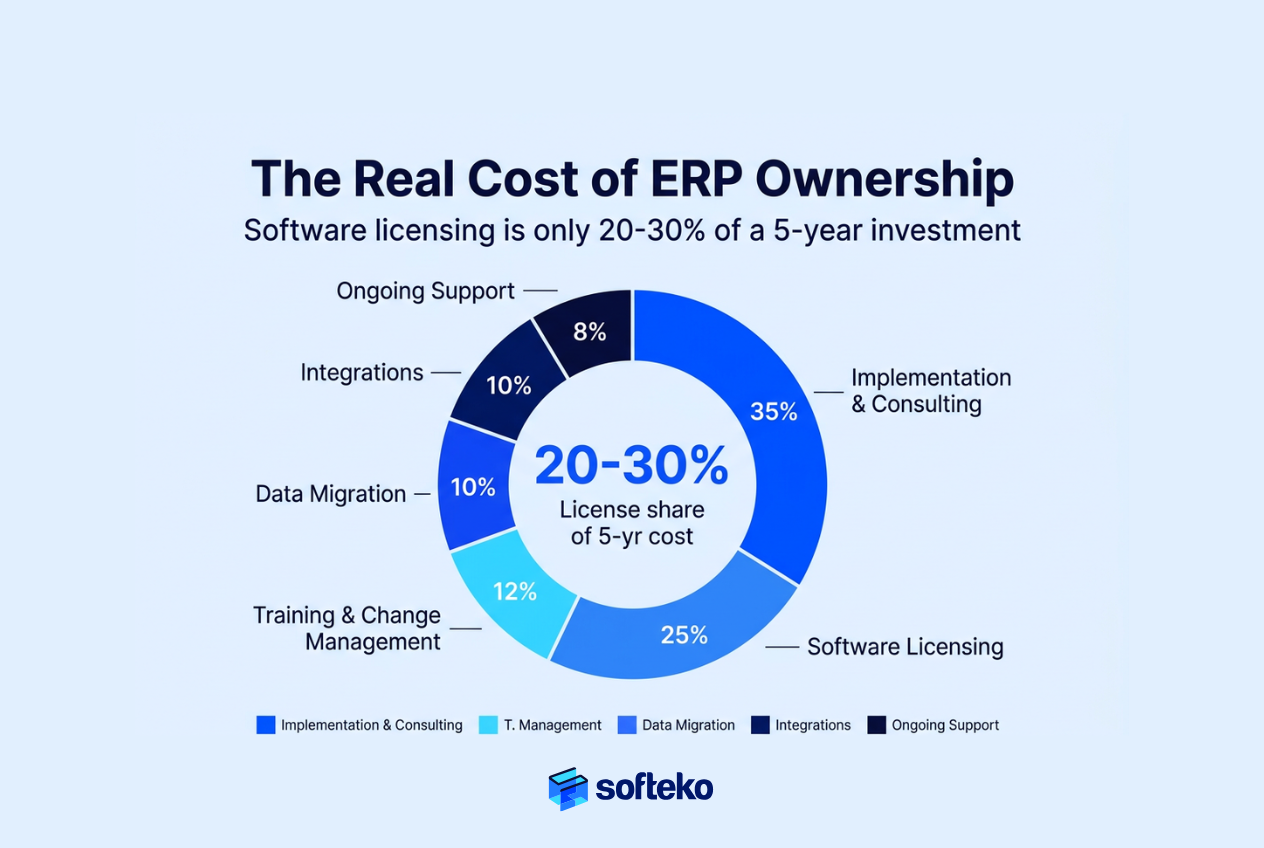
For most trading business Odoo implementations, the software subscription represents only 20–30% of total five-year ownership cost.[1] The remaining 70–80% goes to implementation consulting, data migration, integrations, training, change management, and ongoing support.
Consequently, this ratio matters because it explains why a lower licence quote does not always mean a lower project. A partner offering a low licence discount but requiring 45% customisation will almost always cost more over five years than a partner recommending a slightly higher licence with 10% customisation and configured workflows.
In short, the takeaway is simple. Compare five-year ownership. Not licence prices.
What Increases Odoo ERP Implementation Cost
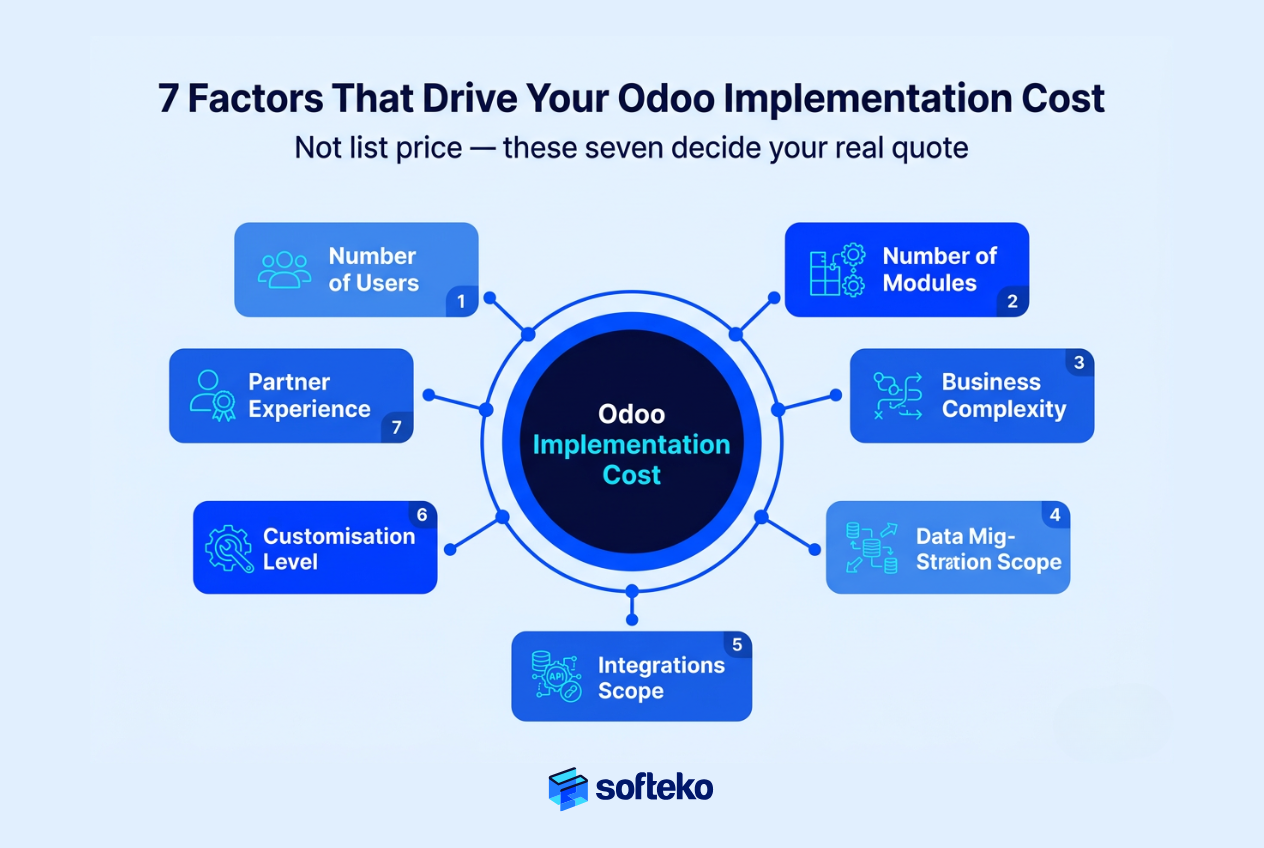
First, before you can budget for Odoo, you need to understand what makes one quote larger than another. Trading business quotes are driven by seven factors, not by list price.
1. Daily ERP Users Increase License Costs
Odoo licenses per user. However, the more important number for cost planning is daily users — the employees who will actually create quotations, receive inventory, post journal entries, or approve purchases. Read-only executive access is usually cheaper than transactional access.
For a trading business, a rule of thumb: count everyone in Sales, Procurement, Warehouse Supervisors, Delivery coordinators, Finance, and department heads. Casual users (visitors, occasional dashboard viewers) can often use portal access or Studio dashboards without full licenses.
2. More Odoo Modules Increase Implementation Costs
Odoo’s modular architecture means you pay for the applications you use. A trading business typically starts with Sales, Purchase, Inventory, Accounting, and CRM. Advanced modules — WMS, Landed Costs, Multi-Company, Manufacturing (if used for kitting or repackaging), Documents, Approvals — add both licence cost and implementation cost.
Importantly, the right question is not “Which modules can we activate?” but “Which modules are required to operate on day one?” Everything else can be added later without redoing the core implementation.
3. Business Complexity Increases ERP Costs
Notably, complexity multiplies cost faster than headcount. A trading business with one warehouse, one legal entity, one currency, and 500 SKUs will spend far less than a company with three warehouses, two legal entities, three currencies, and 12,000 SKUs — even at similar revenue.
Complexity drivers include number of warehouses, number of legal entities, number of currencies, number of Incoterms and shipping routes, number of product categories, number of pricing rules, and depth of approval hierarchy.
4. Data Migration Often Costs More Than Expected
In practice, data migration is the single most underestimated cost in ERP projects. Trading businesses typically underestimate it because they assume “we’ll just export from the old system and import into Odoo.” In practice, most of the effort is not moving the data. It is cleaning the data before it moves.
Gartner has documented that 83% of data migration projects fail or exceed their budgets.[4] Specifically, the reasons are consistent — duplicate customers, inconsistent product codes, obsolete suppliers, mismatched units of measure, and inventory balances that never matched physical stock in the first place.
5. System Integrations Increase ERP Costs
Additionally, every integration adds cost. A trading business often needs to connect Odoo to bank accounts (for payment reconciliation), e-invoicing platforms (ZATCA in Saudi, FTA in the UAE), shipping providers (DHL, Aramex, freight forwarders), customs portals, and possibly a legacy CRM or e-commerce site.
In general, standard connectors cost less. Custom API integrations cost more. Complex real-time integrations with legacy systems cost the most.
6. Customizations Can Significantly Increase ERP Costs
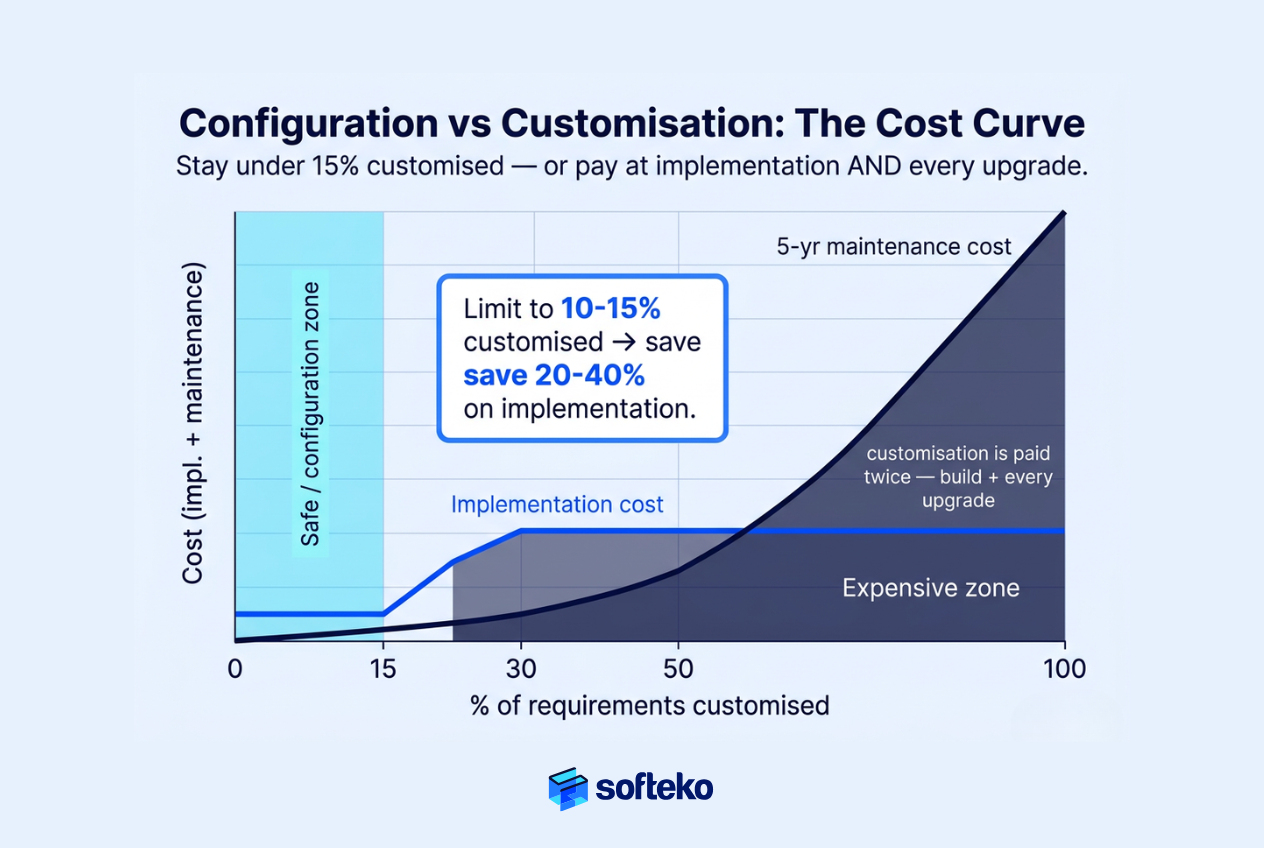
Notably, customisation is the fastest way to inflate an ERP budget. Trading businesses often ask for Odoo to “work exactly like our old system.” That request is expensive twice — once during implementation, then again at every upgrade.
Independent research shows that limiting customisation to 10–15% of requirements can save 20–40% of implementation cost.[4] The best partners push back on customisation requests and ask: “Can this be configured instead? Is our existing process actually better than Odoo’s standard workflow?”
7. Your Implementation Partner Affects Project Cost
In practice, two Odoo partners can quote the same scope and deliver radically different outcomes. Experienced trading-industry partners typically charge more per hour but complete projects faster, avoid rework, and produce configurations that survive upgrades. Cheaper partners with limited trading experience often deliver a technically functional Odoo that does not actually support your trading workflow — which becomes a rescue project six months later.
The Complete Cost Breakdown Beyond the License Fee
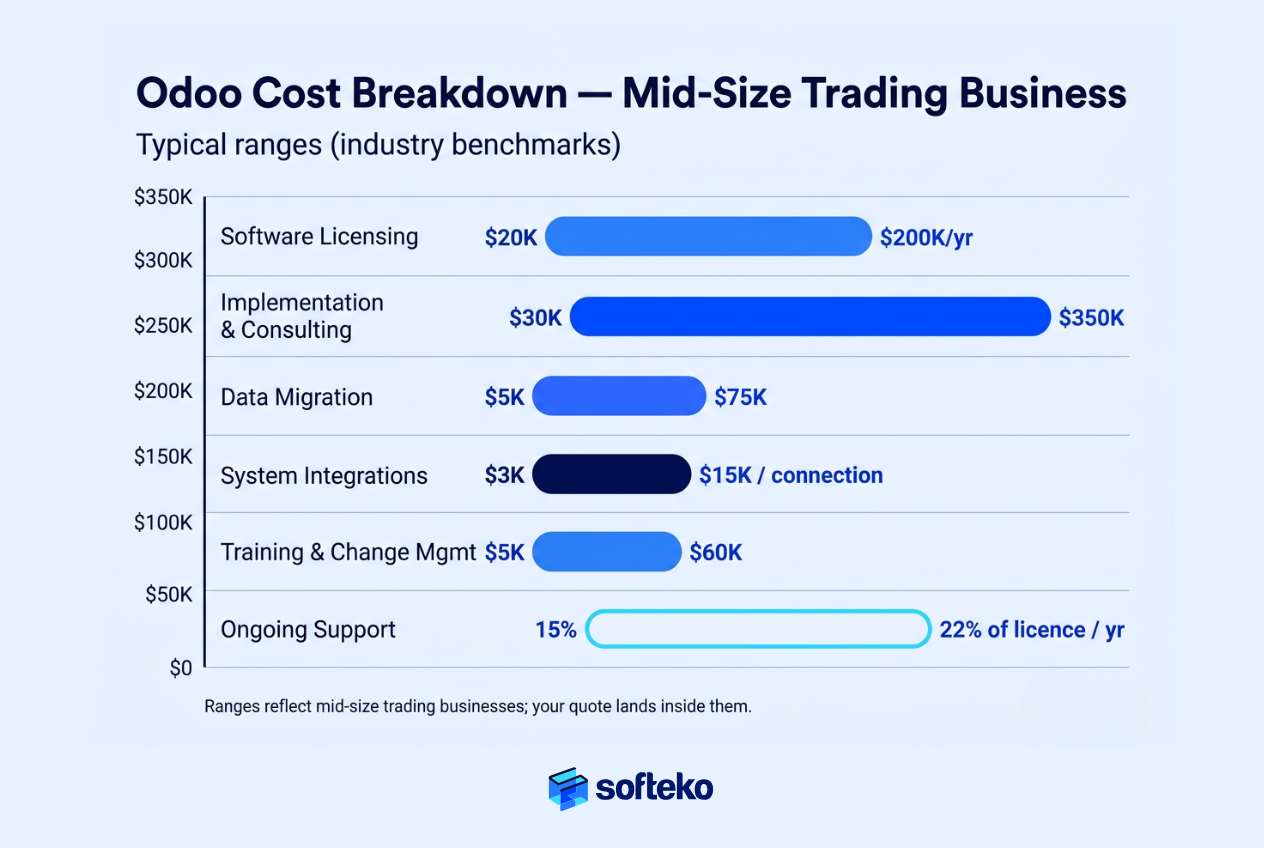
Typically, a realistic Odoo budget for a trading business includes six categories. The ranges below reflect industry benchmarks for mid-size trading businesses. Your actual quote will land somewhere inside them.
| Cost category | Typical range | Notes |
|---|---|---|
| Software licensing | $20,000–$200,000/year | Depends on user count and modules |
| Implementation & consulting | $30,000–$350,000 | Usually 40–60% of total first-year investment |
| Data migration | $5,000–$75,000 | Depends on data quality and legacy system count |
| System integrations | $3,000–$15,000 per connection | More for real-time or custom APIs |
| Training & change management | $5,000–$60,000 | Frequently underfunded |
| Ongoing maintenance & support | 15–22% of licence yearly | Recurring — plan for year 2 and beyond |
Software Licensing Is the Easiest Line to Estimate
In practice, Odoo’s licence cost is straightforward. Pick your edition (Community, Enterprise, or Odoo Online), count your users, select your modules, and the number is calculable. Odoo Enterprise typically runs at a per-user monthly rate that scales linearly with headcount.
Nevertheless, the licence quote alone tells you almost nothing about your total investment. Notably, trading businesses with the same user count often have wildly different implementation and integration costs because their operational complexity differs.
Implementation Services Usually Cost the Most
Typically, implementation consulting typically consumes 40–60% of total first-year ERP investment.[4] This covers process discovery, workflow design, configuration, testing, user acceptance, and go-live support. Specifically, for a trading business it also includes designing your quotation approval workflow, procurement approval matrix, landed cost calculation rules, multi-warehouse inventory movements, and financial reporting structure.
Partner hourly rates in most markets run $150–$350 per hour.[4] The number of hours depends entirely on the seven drivers above — not on your industry, and not on your revenue.
Data Migration Costs More Than You Expect
For a trading business with several years of history, expect to migrate customer master, supplier master, product master, opening inventory balances, open sales orders, open purchase orders, outstanding receivables, and outstanding payables. In practice, historical financial transactions are usually best archived in the legacy system, not migrated.
Ranges typically run $5,000–$75,000+.[4] The lower end is a small trading business with clean data and one legacy accounting package. The upper end is a multi-country distributor with several legacy systems and dirty master data.
Integrations Have a Per-Connection Cost
Standard Odoo connectors (bank feeds, basic payment gateways, common shipping providers) cost less to implement. In contrast, custom API integrations with legacy systems — a proprietary WMS, an old CRM, a custom customs portal — run $10,000–$50,000+ per integration.[4]
Notably, the practical rule: every integration is a permanent maintenance cost. Every future upgrade of either system must be tested against the integration. Trading businesses should minimise integrations to what genuinely delivers operational value.
Training and Change Management Is Where Projects Save Money and Lose ROI
In practice, training is consistently underfunded. Independent research shows training costs frequently exceed initial estimates by 45%, and the average employee ERP usage rate sits at only 26% — meaning that in most implementations, three-quarters of the workforce never fully adopt the system.[3]
As a result, for a trading business this shows up as Warehouse teams continuing to keep parallel stock sheets, Sales Executives keeping customer notes in personal spreadsheets, and Finance reconciling ERP reports back to Excel every month-end. The ERP is technically live, but operationally the business is still running on the old model.
Maintenance and Support Continue After Go-Live
Typically, ongoing support, subscription renewals, and periodic upgrades typically add 15–22% of the annual licence value each year.[4] Consequently, over five years this is where the “software subscription looked cheap” argument breaks down. A $30,000 annual licence carries roughly $4,500–$6,600 in annual support, plus periodic upgrade projects.
Importantly, build these into your year 2, 3, and 4 budgets from the start. Businesses that treat them as surprises overspend later.
Why Odoo ERP Quotes Differ Between Trading Businesses
In practice, business owners routinely compare Odoo quotes from different partners and cannot understand why one is $50,000 and another is $250,000. Notably, the answer is almost always scope — not partner greed.
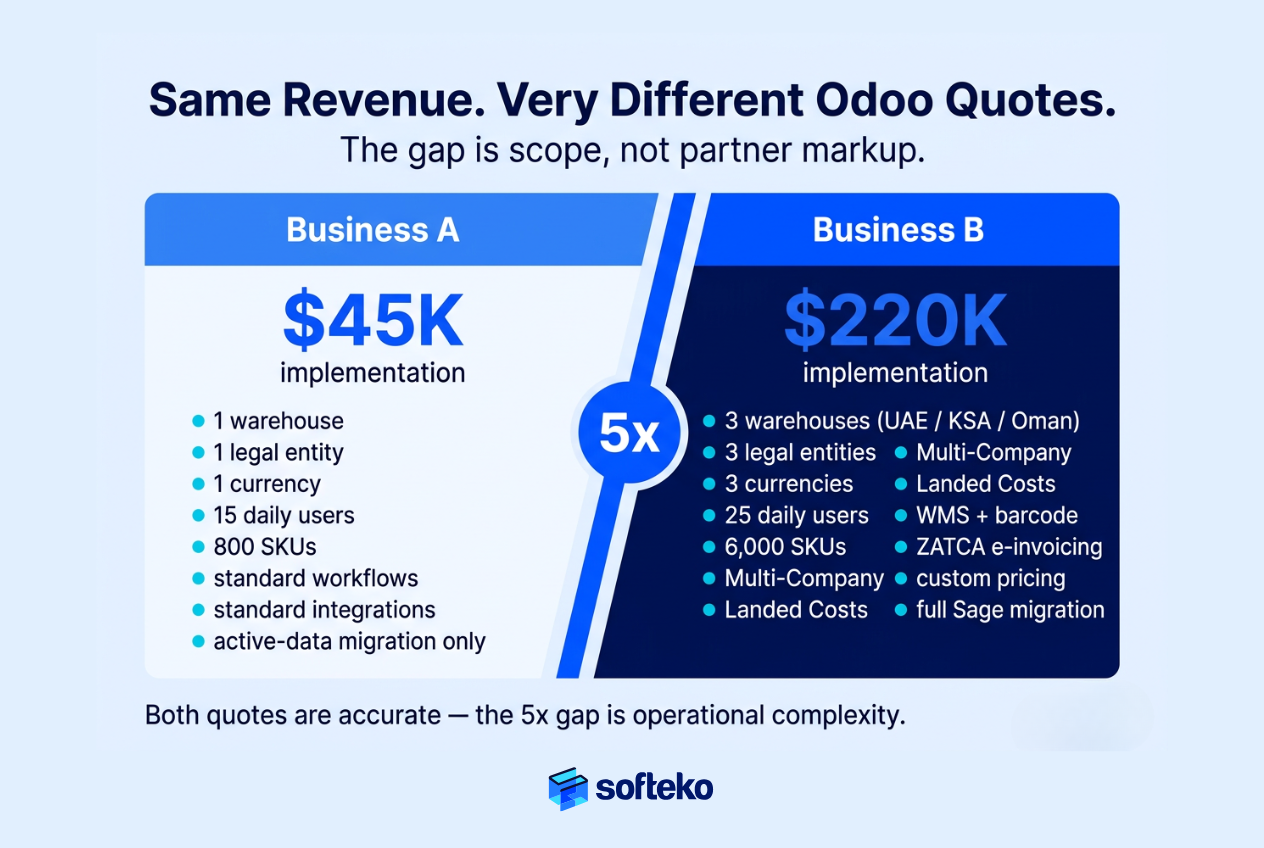
Consider two mid-size distributors, each with roughly $10M in annual revenue.
Business A operates one warehouse, one legal entity, one currency, 15 daily users, and 800 SKUs. Their Odoo scope covers Sales, Purchase, Inventory, and Accounting. They accept Odoo’s standard workflows, migrate only active customers and current inventory, and use standard bank and payment integrations. Their partner quotes $45,000 for implementation plus subscription.
Business B operates three warehouses across UAE, Saudi Arabia, and Oman. They have three legal entities, three currencies, 25 daily users, 6,000 SKUs, and a legacy Sage system with 12 years of transaction history. Their scope adds Multi-Company, Landed Costs, WMS with barcode scanning, ZATCA e-invoicing integration, custom pricing rules for corporate accounts, and full data migration from Sage. Their partner quotes $220,000 for implementation plus subscription.
In fact, both quotes are accurate. Both businesses need what they scoped. Rather, the five-fold difference is not the partner’s markup — it is the operational complexity gap.
Every Business Requirement Increases Project Scope
First, when comparing quotes do not ask “Why is yours more expensive?” Ask “What is included that the other partner did not include?” You will usually find one of the following differences:
- Different user counts
- Different module set at go-live
- Different assumptions about data cleansing
- Different integration scope (basic vs custom)
- Different customisation percentage
- Different training hours
- Different post-go-live hypercare duration
In practice, a partner offering to implement Odoo for half the price of another is often quoting a smaller scope, not a better deal. What you save at implementation, you frequently pay later in rework, workarounds, and low user adoption.
Good Project Governance Prevents Budget Problems
Notably, Prosci research shows human factors matter roughly 6× more than technical factors in ERP success, and organisations that integrate change management with project management see about half of their projects meet or exceed objectives.[5] Partners who quote higher usually build change management into the plan. Partners who quote lower often leave it out entirely — which is where projects fail.
Consequently, when comparing quotes always ask whether change management, training design, and post-go-live hypercare are separately scoped or omitted.
The Hidden ERP Costs Most Trading Businesses Miss
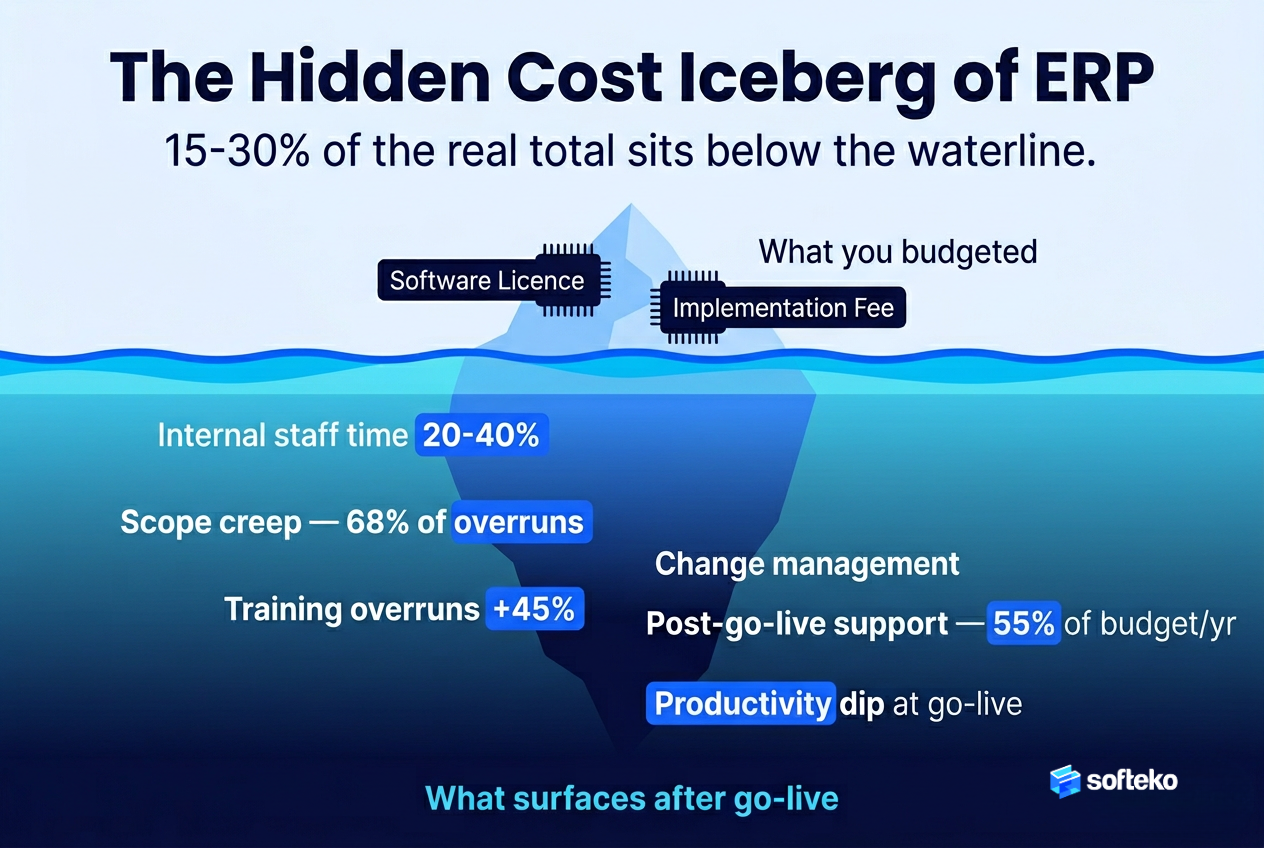
In practice, even a well-structured budget usually misses several categories that only become visible after go-live. Together, these hidden costs typically add 15–30% to the real total.[4] Notably, trading businesses that plan for them survive their go-live. Businesses that do not, run into cash flow surprises exactly when they can least afford them.
Your Internal Staff Time Has a Real Cost
Typically, every ERP project consumes senior time from your Sales Manager, Procurement Manager, Warehouse Supervisor, Finance Controller, and Managing Director. Independent estimates suggest subject-matter experts contribute 20–40% of their time during implementation, representing an opportunity cost of roughly $30,000–$80,000 for a mid-market trading business.[4]
Importantly, this time never appears on your partner’s invoice. It appears as reduced operational capacity during the project. Trading businesses that plan for it either backfill key roles temporarily or accept a controlled reduction in commercial activity during the implementation window.
Scope Changes Increase ERP Costs
Notably, scope creep is not a single decision. It is a series of small ones. For example, during configuration workshops someone requests an additional approval level. During testing, another department asks for a custom report. Before go-live, Sales adds a new customer field.
In isolation, each request seems minor. Cumulatively, scope creep drives 68% of ERP budget overruns, with an average cost impact of 40% per project.[3] Rather, the fix is not saying no to every request. It is having a formal change-control process where every scope change has an owner, a cost estimate, and an approval threshold.
Training Always Costs More Than You Think
Typically, training overruns average 45% above the initial estimate.[3] Specifically, the reasons are consistent — turnover during implementation means re-training new joiners, initial training sessions do not cover exception scenarios, and department managers need more hands-on time than a partner’s standard package includes.
Instead, build training as a line item — not a percentage of implementation — and budget for repeat sessions during hypercare.
Support Costs Continue After Go-Live
In practice, year 2 usually costs more than businesses expect. Independent research indicates annual maintenance can consume around 55% of the original implementation budget in year 2 and beyond, driven by upgrade projects, support subscriptions, additional user licences, and customisation maintenance.[3] Notably, for heavily customised implementations this figure runs higher. For clean, configuration-first implementations, it runs lower.
Productivity Usually Drops After Go-Live
In fact, every ERP go-live includes a temporary productivity dip. Warehouse fulfilment slows for the first two weeks as staff learn barcode workflows. Sales quotations take longer during the first month as the approval workflow is used properly for the first time. Finance close takes longer at the first month-end after go-live.
Importantly, none of these are failures. They are expected. Nevertheless, they represent lost revenue capacity that never appears on a budget line. A conservative planning assumption is 2–4 weeks of 20–30% reduced operational throughput in Warehouse, Sales, and Finance immediately after go-live.
How to Build a Realistic Odoo ERP Budget
In practice, a structured budget prevents both under-quoting and over-quoting. Use the framework below.
Step 1 — Assess Your Business Readiness First
McKinsey’s 7-S framework (Strategy, Structure, Systems, Style, Staff, Skills, Shared Values) is widely applied to ERP readiness assessment.[9] For a trading business, evaluate:
- Are business objectives clear and agreed at leadership level?
- Are core workflows documented?
- Is master data cleanable within the project window?
- Are department process owners available?
- Is executive sponsorship confirmed with budget authority?
Importantly, every “No” answer either delays the project or expands its scope. Answering these before requesting quotes gives you a defensible starting position.
Step 2 — Map Your Requirements Before Requesting Quotes
Use a standardised process framework to describe your workflows. The APQC Process Classification Framework offers over 1,000 standardised business processes across categories including customer management, procurement, inventory, order fulfilment, and financial management.[10] Mapping your current workflows against this baseline gives partners a much clearer picture of scope than a general “we need Odoo for our trading business.”
Consequently, the clearer your requirements document, the more comparable the quotes.
Step 3 — Build a Line-Item Budget
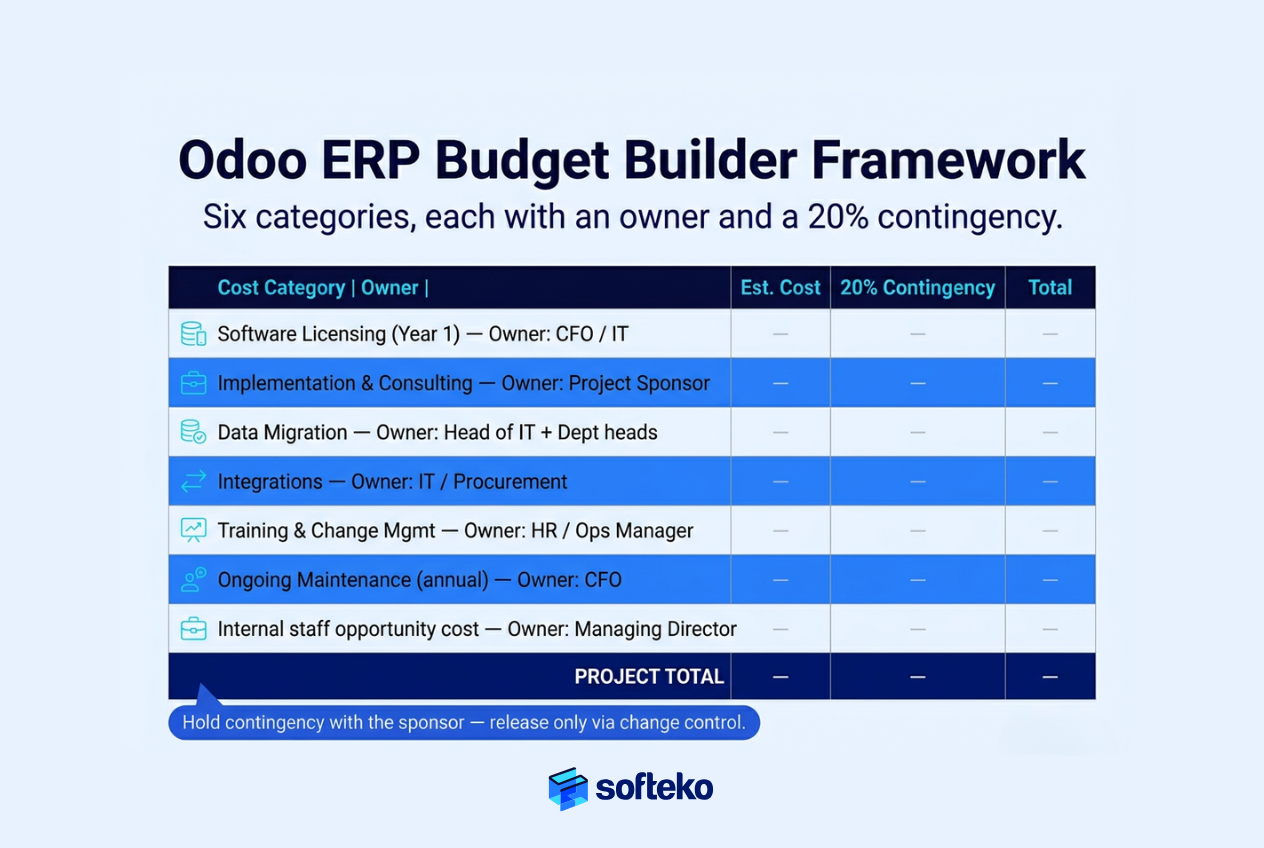
Then, break your budget into the six categories from earlier and assign an owner, an estimated range, and a contingency reserve.
| Category | Owner | Estimated cost | 20% contingency | Total |
|---|---|---|---|---|
| Software licensing (Year 1) | CFO / IT | |||
| Implementation & consulting | Project Sponsor | |||
| Data migration | Head of IT + Dept heads | |||
| Integrations | IT / Procurement | |||
| Training & change management | HR / Ops Manager | |||
| Ongoing maintenance (annual) | CFO | |||
| Internal staff opportunity cost | Managing Director |
Step 4 — Add a 20% Contingency Reserve
Industry practice suggests most trading businesses underestimate ERP implementation costs by 30–50%. A 20% contingency buffer is not pessimism — it is statistical prudence.[4] Contingency should be held by the project sponsor and released only through formal change control, not automatically added to every request.
Step 5 — Model Five-Year Ownership, Not Just Year One
Initially, a licence subscription looks affordable in year one. Add five years of maintenance, upgrades, additional user licences as your team grows, and integration maintenance — and the picture changes. Consequently, model five years so your executive team is comparing apples to apples.
The Cost of Delaying ERP Implementation
Typically, the ERP decision is often framed as “how much will it cost?” That is only half the question. The other half is “how much is it costing us not to have one?”
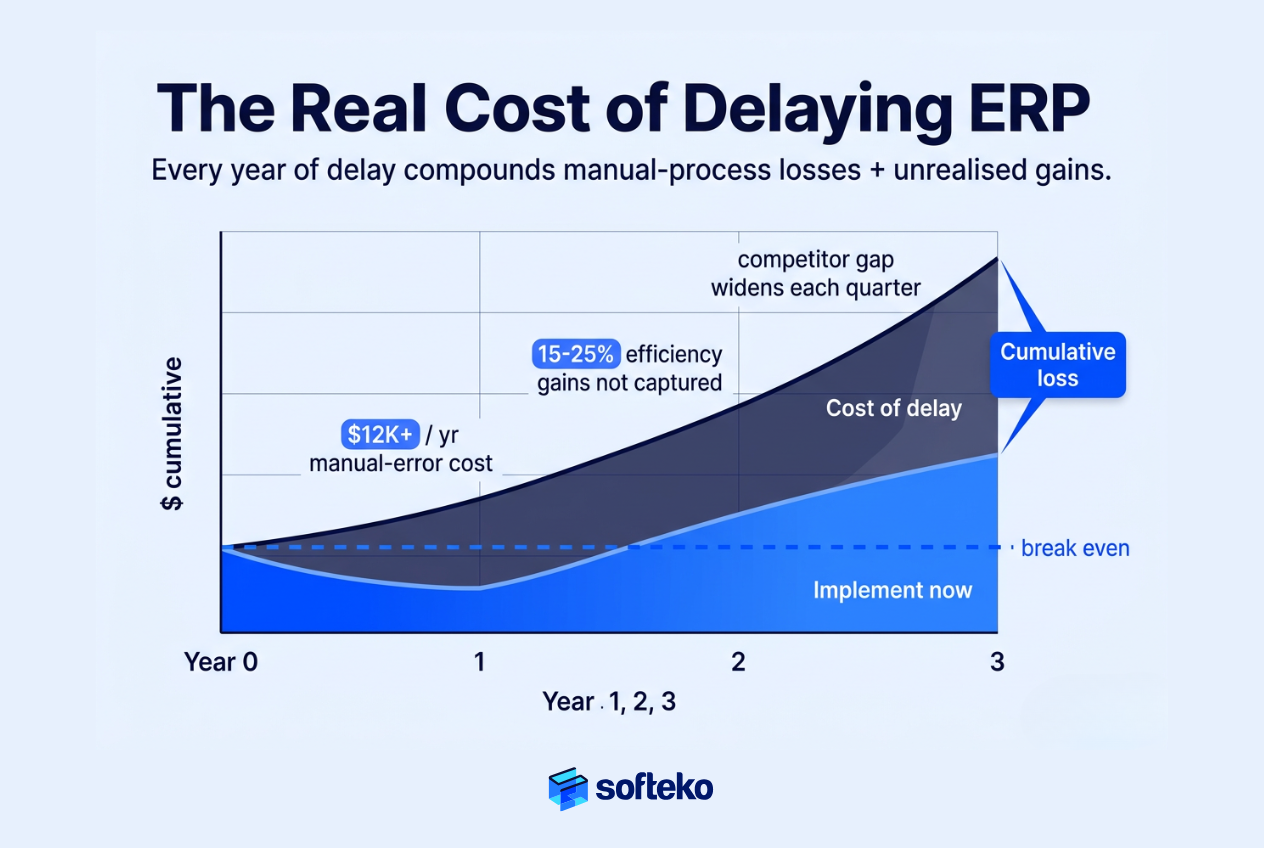
In reality, manual processes are not free. Independent research indicates small trading businesses lose $12,000+ annually to error corrections from manual processes, with 27% of manual data entries containing mistakes.[8] Notably, for a mid-size distributor the true cost is significantly higher because inventory errors compound into stockouts, emergency purchases at premium prices, and delivery delays that damage customer relationships.
In fact, automation delivers measurable gains. Cloud-based operational tools yield 15–25% efficiency gains within six months of adoption.[8] Every month of delay is a month of gains not captured.
The “We’ll Wait Another Year” Trap
In practice, trading businesses often postpone ERP implementation because the budget feels large and the disruption feels risky. However, that reasoning ignores two things.
First, the cost of manual processes continues every month you delay — visible as spreadsheet errors, unbilled shipments, missed reorder points, and month-end reconciliation days.
Second, the productivity gap between your business and competitors who have implemented ERP widens with each quarter. In competitive trading markets, this shows up as slower quotations, lower margins, and eroded customer trust.
Independent ROI Research Reframes the Decision
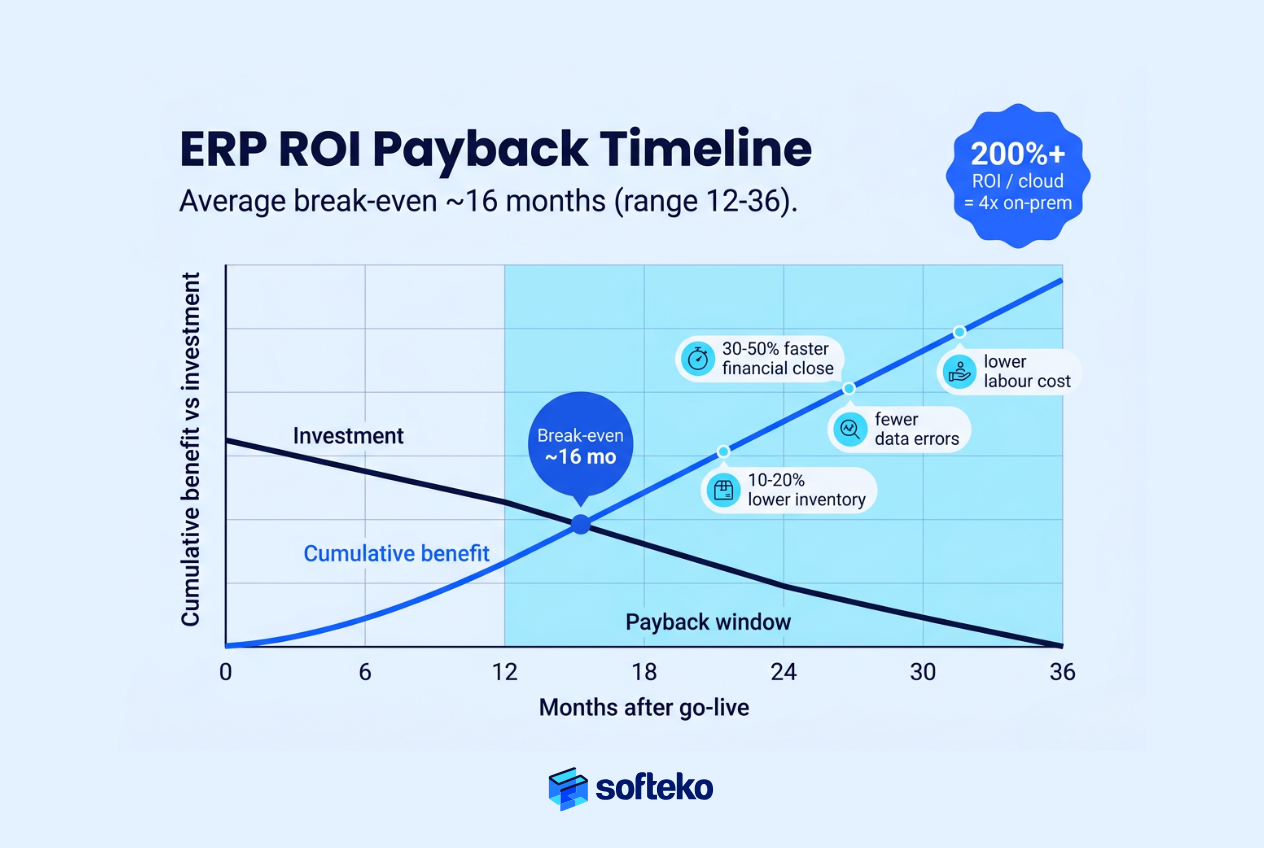
Notably, Nucleus Research reports 16-month average payback and over 200% ROI for ERP implementations, with cloud ERP delivering roughly 4× the ROI of on-premises deployments.[7] Similarly, Forrester’s Total Economic Impact studies for mid-market implementations report similar payback windows.
In practice, for a trading business that ROI comes from measurable operational improvements: 30–50% faster financial close, 10–20% reduction in inventory holding, lower labour cost from workflow automation, and fewer margin losses from data errors.[11] Consequently, delay pushes these gains one quarter, one year, or several years into the future.
Ultimately, the financial framing then becomes: is delaying implementation actually saving money, or is it deferring returns while continuing to pay the cost of manual operations?
How to Measure Your Odoo ERP Return on Investment
Notably, return on an ERP investment is not a single number. It is a set of measurable operational improvements that compound over time.
Measure KPIs That Show ERP Success
First, set targets before implementation begins so you can measure improvement objectively. For a trading business, useful KPIs include:
- Inventory accuracy — target 98%+ within 90 days of go-live
- Order processing time — target 50% reduction within 60 days
- Quotation cycle time — target 40% reduction within 60 days
- Days Sales Outstanding (DSO) — target 15–20% improvement within 6 months
- Financial close time — target 40–60% reduction within 90 days
- User adoption rate — target 90%+ active use within 90 days
Importantly, if you cannot measure these before implementation, ROI after implementation becomes untraceable.
Change Management Increases ERP ROI
Notably, McKinsey research shows organisations with effective change management achieve 143% of expected ROI. Organisations with little or no change management achieve only 35% of expected ROI.[6] That is nearly a 4× multiplier — earned entirely by preparing employees for change rather than assuming they will figure it out.
In practice, for a trading business this is the strongest ROI-based argument for investing in training and change management rather than trimming those line items to reduce quoted cost.
The Real Question Is Not Cost — It Is Value Realisation
Notably, the most successful ERP implementations are not those with the lowest cost. They are those that translate every cost category into measurable business outcomes. For example, a partner who costs 30% more but delivers 90% user adoption and 45% faster quotation cycles delivers vastly more value than a partner who costs less and leaves you with an ERP that half the business ignores.
How Odoo Reduces Long-Term ERP Costs
Consequently, once you understand what drives ERP cost, Odoo’s specific advantages for trading businesses become clearer.
Odoo Lets You Expand Your ERP in Stages
In practice, Odoo’s design lets trading businesses start with a core set of applications — Sales, Purchase, Inventory, Accounting, CRM — and add more later without redoing the base implementation. A trading business can implement WMS with barcode scanning in year 2, add Multi-Company in year 3, and introduce advanced reporting in year 4, spreading investment as the business scales.
Notably, this is fundamentally different from monolithic ERPs that require you to commit to full-suite functionality upfront.
Use Configuration Before Customization
In practice, Odoo’s extensive configuration capabilities allow most trading business requirements to be met without custom development. Independent analysis indicates that limiting customisation to 10–15% of requirements can save 20–40% of implementation cost — and reduces ongoing upgrade costs even more dramatically over five years.[4]
Consequently, the practical rule for trading businesses: before requesting a customisation, always ask “Can this be configured instead? Is our current process actually better than Odoo’s standard workflow, or is it just familiar?”
Upgrade Path Protects Long-Term Investment
Notably, Odoo publishes annual major releases with a clear upgrade path. In practice, businesses that stay close to standard functionality can upgrade with modest effort. Businesses with heavy customisation face progressively larger upgrade projects — which is why the customisation discipline discussed above pays off for years.
One Platform for Trading Workflows
Specifically, for a trading business having Sales, Procurement, Inventory, Warehouse, Logistics, and Finance on the same platform removes the integration overhead that inflates cost in multi-vendor ERP environments. Customer information exists once. Product master exists once. Inventory movements update Accounting automatically. This is where Odoo’s cost profile differs from ERP stacks that require multiple systems stitched together.
Importantly, the Odoo cost advantage is only realised when the implementation respects these principles. A heavily customised Odoo implementation loses many of them.
Choose an ERP Based on Long-Term Business Value
Notably, an Odoo implementation is not a software purchase. It is a business investment that decides how your trading operation runs for the next several years.
In practice, the businesses that treat it as a purchase — comparing licence prices, choosing the lowest partner quote, cutting training and change management to reduce the number — consistently end up spending more. They pay in scope creep, in productivity dips that never fully recover, in low user adoption, and in a Warehouse team that keeps a parallel spreadsheet three years after go-live.
In contrast, the businesses that treat it as an investment — mapping their requirements before requesting quotes, comparing five-year ownership rather than year-one cost, funding change management as a first-class line item, and budgeting a real contingency — consistently see the payback that independent research promises. Not because they spent more, but because they spent smarter.
Ultimately, the correct question is not “How much does Odoo cost?” The correct question is “What investment does our trading business need to make to run itself properly for the next five years?”
Consequently, once you answer that question honestly, comparing quotes becomes much easier. Notably, the right partner is not the cheapest one. It is the one whose quote reflects the complete cost of successful change — and whose approach gives your business the operational discipline to earn the return.
At Softeko, we help trading businesses build honest ERP budgets and implement Odoo ERP with the governance, scope discipline, and change management that protect long-term ROI.
FAQ: Odoo ERP Cost for Trading Businesses
How much does Odoo cost for a small trading business?
A small trading business (one warehouse, 5–15 daily users, one currency, straightforward workflows) typically invests $25,000–$75,000 in year one for Odoo. This includes subscription, implementation, basic data migration, and initial training. Ongoing annual cost usually runs $10,000–$25,000 for licence renewal, support, and periodic improvements.
How much does Odoo cost for a mid-size trading business?
Mid-size trading businesses (2–3 warehouses, 20–40 daily users, multi-currency, several product lines) typically invest $100,000–$300,000 in year one. Data migration complexity, integrations with e-invoicing platforms, and multi-company configuration are the main drivers of variation. Ongoing annual cost usually runs $40,000–$80,000.
Is Odoo cheaper than SAP or NetSuite for trading businesses?
For most mid-market trading businesses, yes — often significantly. Odoo’s per-user licence is lower, implementation timelines are shorter, and configuration reduces custom-development cost. However, the price gap narrows sharply when trading businesses heavily customise Odoo. The long-term cost advantage exists because of Odoo’s configuration-first design — not because of licence pricing alone.
What is the biggest hidden cost in an Odoo implementation?
Internal staff time. Senior employees typically contribute 20–40% of their time during implementation, representing an opportunity cost of $30,000–$80,000 for a mid-market trading business that never appears on any vendor invoice.[4] Scope creep, training overruns, and post-go-live support are the next largest hidden costs.
How long does it take to see ROI from Odoo?
Independent research shows average ERP payback of 12–36 months across industries, with 16 months being typical for cloud implementations.[7] For trading businesses, the ROI comes primarily from inventory reduction, faster order-to-cash cycles, lower labour cost, and reduced data errors. Realising this ROI requires user adoption above 90% — which depends on change management, not on the software.
Should we choose Odoo Community or Enterprise?
Odoo Community is the free open-source edition. Odoo Enterprise adds features (multi-company, advanced accounting, mobile apps, dedicated support) and a subscription cost. For most trading businesses with multi-warehouse, multi-currency, or multi-company needs, Enterprise is the more sensible choice — Community typically ends up costing more once you factor in third-party modules, self-support, and integration effort. Small single-entity trading businesses can sometimes start with Community.
How much should we budget for change management?
Aim for 10–20% of total implementation cost for change management and training combined. This is the single highest-ROI line item in the budget — McKinsey research shows effective change management delivers roughly 4× the ROI of poor change management.[6] Trading businesses that cut this line item to reduce quoted cost consistently regret it within six months of go-live.
What contingency should we build into our ERP budget?
20% is a widely used industry benchmark.[4] Contingency should be controlled by the project sponsor and released only through a formal change-control process. Adding contingency does not mean the money will be spent — it means the project has a buffer against the scope discoveries that appear during implementation.
References
- Gartner — Latest Enterprise Resource Planning (ERP) Insights — https://www.gartner.com/en/information-technology/topics/enterprise-resource-planning
- Panorama Consulting Group — 2026 ERP Report — https://www.panorama-consulting.com/panorama-consulting-group-releases-latest-study-of-erp-implementation-outcomes-across-the-globe/
- Gitnux — ERP Implementation Failure Statistics 2026 — https://gitnux.org/erp-implementation-failure-statistics/
- ERP Research — ERP Implementation Cost Breakdown 2026 — https://www.erpresearch.com/en-us/erp-implementation-cost-breakdown
- Prosci — Why Do ERP Implementations Fail? — https://www.prosci.com/blog/why-do-erp-implementations-fail
- McKinsey via MyHub — Digital Transformation Statistics — https://www.myhubintranet.com/digital-transformation-statistics/
- Nucleus Research / Rand Group — What is the Average ROI of an ERP Implementation? — https://www.randgroup.com/insights/services/solution-implementation/what-is-the-average-roi-of-an-erp-implementation/
- BizHealth — Hidden Costs of Manual Processes — https://bizhealth.ai/blog/hidden-costs-manual-processes
- NetSuite — ERP Readiness Assessment (McKinsey 7-S applied) — https://www.netsuite.com/portal/resource/articles/erp/erp-readiness.shtml
- APQC — Process Classification Framework — https://www.apqc.org/process-frameworks
- Rand Group — ERP Implementation Timeline: How Long an ERP Implementation Takes and What to Expect — https://www.randgroup.com/insights/services/solution-implementation/erp-implementation-timeline-how-long-an-erp-implementation-takes-and-what-to-expect/