


Key takeaways
- Packaging manufacturers make a new product for almost every customer. An ERP has to handle a technical specification, artwork and a multi-step production route for each job, not just a product list.
- Odoo 19 covers a lot of this as standard: CRM, sales, purchasing, lot-tracked inventory, bills of materials with operations, work centres, quality checks, maintenance and accounting.
- The parts that usually need building are packaging-specific: a technical requirement form, a feasibility check against machine limits, a costing calculator, and production orders that link every process of one job.
- For Sahl Pack, a Saudi flexible packaging manufacturer, we planned roughly 60% standard Odoo, 30% configuration and 10% development. Development is kept for logic that standard Odoo does not have.
Overview
If you run a folding carton plant, a label converter, a flexible packaging line or a commercial print shop, you have probably asked whether a general ERP can handle your work, or whether you need packaging-specific software.
This guide answers that for Odoo 19. It is based on the requirements we documented for Sahl Pack (Modern Sahl Industries), a Saudi company moving from trading packaging it sourced from China to manufacturing its own pouches, roll stock and labels. The project started in May 2026 and is being delivered in phases. This article describes the agreed design, not results from a live system.
What makes packaging different from general manufacturing
Most manufacturing ERPs assume a catalogue of standard products. Packaging works differently:
- Every job has a specification. Bag type, dimensions, gusset, up to four film layers with their micron thickness, colours, finishes, zippers and valves.
- Feasibility comes before price. A job has to fit the machines: web width, repeat size, gusset limits on the pouching machine.
- Artwork sits on the critical path. Design files go through prepress, an outside plate maker, colour proofs and customer approval before anything is printed.
- Production is a chain of processes. A laminated pouch can go through printing, one or two lamination passes, slitting and pouching, with semi-finished stock between each step.
- Materials are bought one way and used another. Film is bought by the kilogram but costed and consumed by the metre or square metre.
- Repeat orders matter. The same design comes back, so plates, approved artwork and codes must be easy to find.
A useful ERP has to carry all of this from enquiry to invoice without re-keying it into spreadsheets. Each of these has its own guide: the technical requirement form and feasibility check, artwork and plate approvals, multi-process production and item codes and lots for film. Industry terms are explained in our printing and packaging glossary.

What Odoo 19 covers as standard
| Need | Odoo 19 feature | What it does |
|---|---|---|
| Leads and opportunities | CRM | Pipeline, activities and follow-ups |
| Quotations and orders | Sales | Quotes, sales orders, customer approval |
| Buying film, ink and adhesive | Purchase | RFQs and purchase orders with expected dates per line |
| Material traceability | Inventory with lots | Track each roll or batch by lot. FIFO is the default removal strategy [1] |
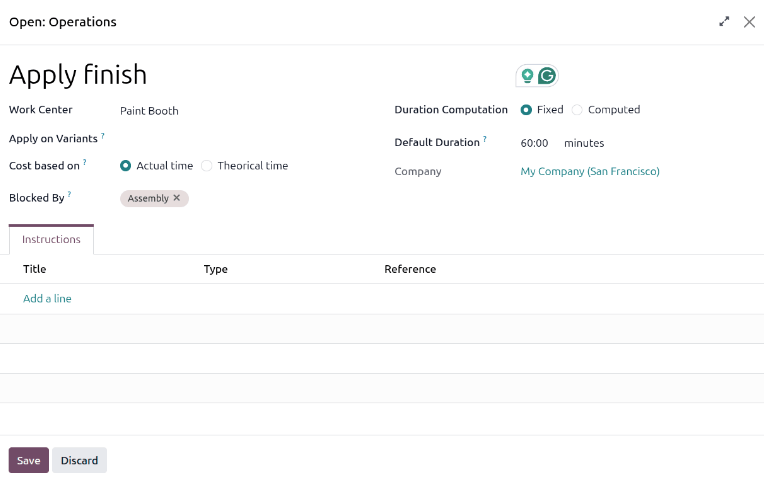
| Production routing | Manufacturing: bills of materials with operations | A BoM lists components and the operations, each at a work centre [2] |
| Process sequence | Work order dependencies | One operation can be blocked until an earlier one finishes [3] |
| Machine set-up and cost | Work centres | Setup time, cleanup time and cost per hour per work centre [4] |
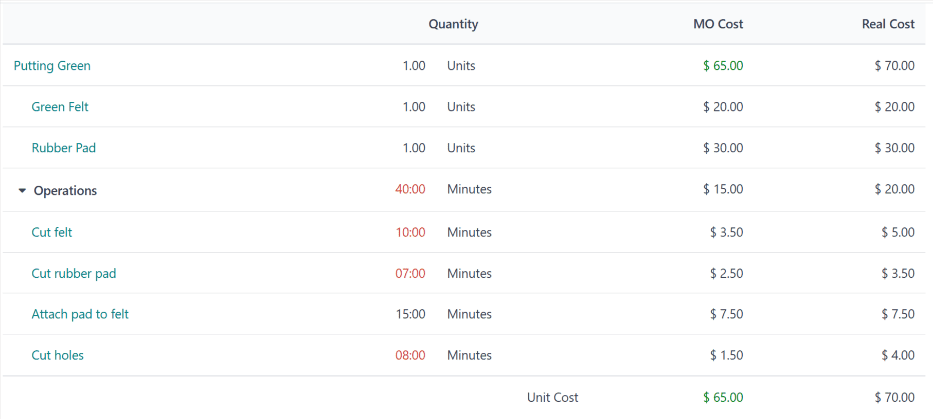
| Planned vs actual job cost | Manufacturing order costs | Shows the expected MO cost and the real cost once work starts [5] |
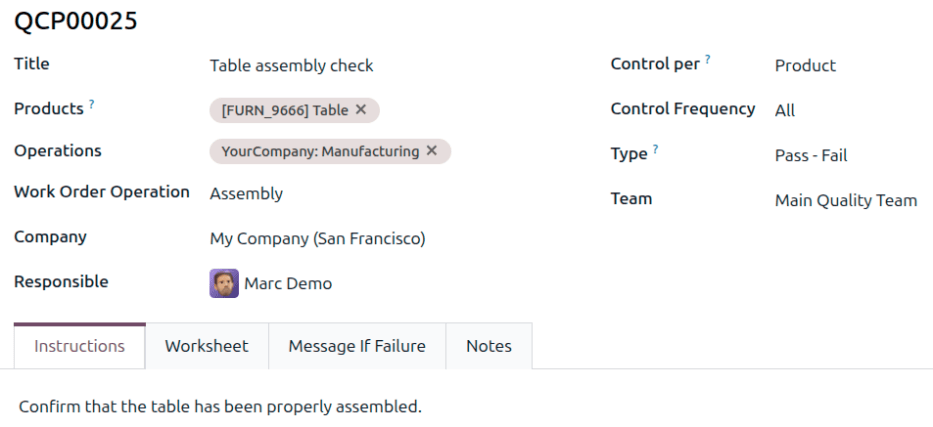
| Inspections | Quality control points | Checks on receipts or work orders, including measurements within a tolerance [6] |
| Machine downtime | Maintenance | A maintenance request can block a work centre while it is being serviced [7] |
| Artwork tasks | Project | Tasks and stages for each artwork job |
| Saudi VAT and e-invoicing | Saudi Arabia localisation | ZATCA Phase 1 QR codes and Phase 2 integration [8] |
How Odoo models a packaging job
In Odoo 19, a converted product such as a laminated pouch is a product with a bill of materials (BoM). The BoM lists the components and the operations, and each operation runs on a work centre [2].
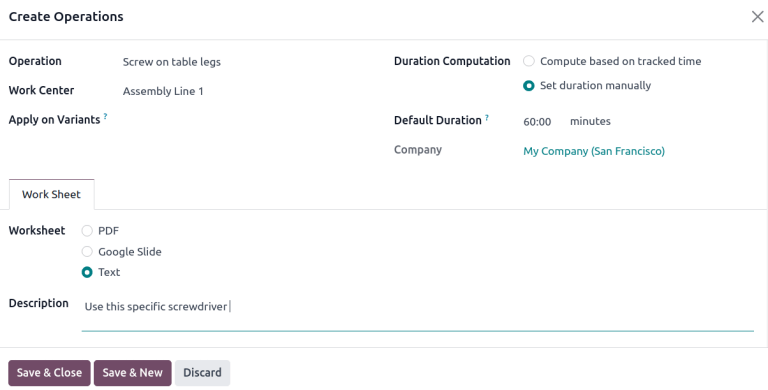
An illustrative BoM for a three-layer stand-up pouch:
| Line | Item | Notes |
|---|---|---|
| Component | PET film, 12 micron | Printed layer, consumed by area |
| Component | Aluminium foil, 7 micron | Barrier layer |
| Component | PE film, 80 micron | Sealant layer |
| Component | Ink, adhesive, zipper | Consumed per job |
| Operation 1 | Printing | Work centre: printing press |
| Operation 2 | Lamination (two passes) | Work centre: laminator, blocked until printing ends |
| Operation 3 | Slitting | Work centre: slitter |
| Operation 4 | Pouching | Work centre: pouch machine |
Each work centre carries its setup time, cleanup time and cost per hour [4]. That is what lets Odoo calculate a job’s expected cost and compare it with the real cost once work starts [5].
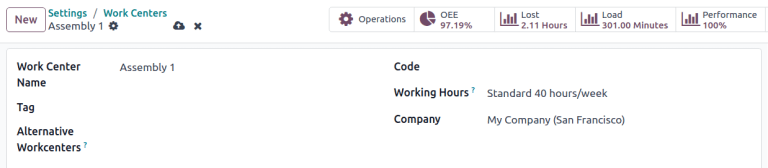
Operations can depend on each other, so lamination cannot start before printing is finished [3]. For a single-site plant, this covers much of the routing. What standard Odoo does not do is link several manufacturing orders for one customer job into a single printable document, which is why Sahl Pack’s linked process order is planned as development.
Once production starts, the manufacturing order overview shows expected and real cost side by side.
Quality checks can be attached to receipts or to operations, for example a thickness or bond-strength measurement within a tolerance after lamination [6].
If you want to see your own hardest job modelled this way, we can map it with you.
What usually needs configuration or development
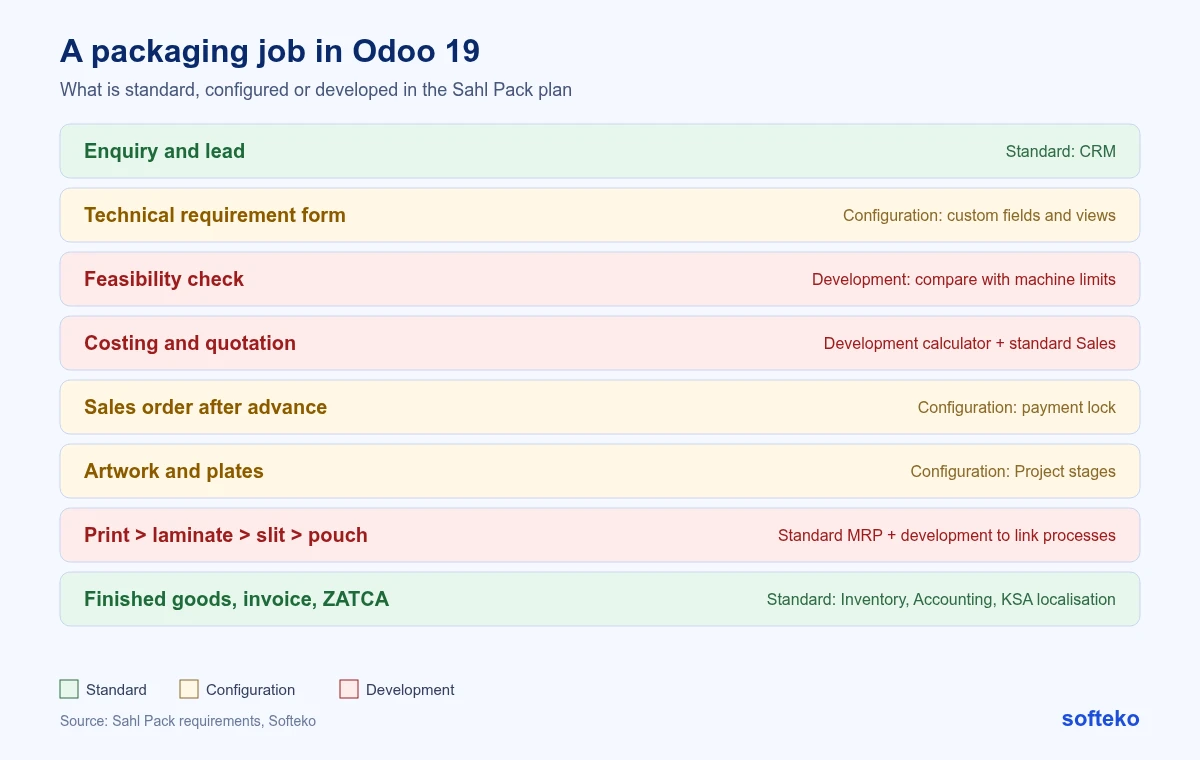
This is where packaging projects differ. The table shows how we classified the main Sahl Pack requirements. Where development is needed, it is built as Odoo customisation on top of the standard apps.
| Requirement | Why standard Odoo is not enough | Approach |
|---|---|---|
| Technical requirement form | Bag type changes the fields you need. Up to four layers, each with material and micron | Configuration (custom fields and views) |
| Feasibility check | Has to compare the specification with machine and pouching limits | Development |
| Costing calculator | Converts kg to m², picks the next available film width, adds setup time and lamination passes, and hides internal costs from sales | Development |
| Design and job numbering | A design number (GDN) for each approved design and a job code with a child code for each process | Configuration |
| Advance payment lock | Artwork and production cannot start until finance confirms the advance | Configuration, possibly light development |
| Linked process orders | One master production order with a page for each process, printed as one document | Development (likely) |
| Plate life tracking | Count impressions on each plate and flag replacement | Development, after a fit check against Maintenance |
The rule we followed: use standard Odoo where it does the job, configure where a field or approval step is enough, and develop only where no standard feature exists. Every customisation has to be maintained through future Odoo upgrades, so a small development share keeps the system easier to upgrade.
Odoo vs SAP, Oracle and others: how to compare fairly
Comparisons online often quote licence prices or savings without a source. Your own numbers matter more. Compare vendors on the same scope:
- Fit. Take your three hardest workflows, for example costing a three-layer pouch, a repeat order with a design change, and a job that goes through two lamination passes. Ask each vendor to show them, not describe them.
- Licences. Odoo publishes its pricing. Multi-company, Studio and external API access need the Custom plan [9]. Ask other vendors for a written quote for the same users and apps.
- Implementation. Ask what is standard, what is configured and what is developed, as in the table above.
- Upkeep. Ask who maintains custom code through upgrades, and at what cost.
- Local compliance. If you sell in Saudi Arabia, check ZATCA Phase 2 support. Odoo provides it in the Saudi localisation [8].
Large ERPs can handle very complex groups. A single plant with one to a few production lines usually needs strong job flow and costing more than group-level features. For how licence and implementation costs build up, see what drives Odoo cost.
Questions to ask before choosing any ERP
- Can it hold a full technical specification for each design and copy it for a similar design?
- Can it check feasibility before a quote is sent?
- Can sales quote without seeing machine rates and margins?
- Can it track artwork stages with an outside plate maker?
- Can it link every process of one job, with semi-finished stock between steps?
- Can it compare the quoted cost with the actual cost of each job?
- Can it stop production of what is already in finished goods stock?
FAQ
Is Odoo suitable for flexible packaging manufacturers?
Yes, for the core business: sales, purchasing, lot-tracked inventory, manufacturing, quality, maintenance and accounting. Packaging-specific logic, such as feasibility checks and film costing, usually needs configuration or development. Saudi e-invoicing is covered separately in ZATCA e-invoicing in Odoo.
Does Odoo have a packaging estimating module?
Not as a dedicated app. Odoo calculates manufacturing order costs from the BoM components, operation times and work centre hourly costs [5]. A quote-stage calculator for film width, kg-to-m² conversion and wastage has to be built. See our article on costing a flexible packaging quote.
Do I need a print MIS as well as an ERP?
It depends on how much of your estimating and scheduling a single system can handle. We compare the options in our article on print MIS vs ERP.
How long does an implementation take?
It depends on scope and how quickly decisions are made. Sahl Pack started in May 2026 and is being delivered module by module, starting with enquiry to sales order. We describe the mapping stage in how we mapped Sahl Pack’s workflow.
Start with your hardest workflow
Pick the job that causes the most rework today and map it from enquiry to invoice. We can show you which parts Odoo 19 handles as standard and which would need building. Read more about our Odoo implementation service.
References
[1] Odoo, Removal strategies, Odoo 19.0 documentation. https://www.odoo.com/documentation/19.0/applications/inventory_and_mrp/inventory/shipping_receiving/removal_strategies.html
[2] Odoo, Bill of materials, Odoo 19.0 documentation. https://www.odoo.com/documentation/19.0/applications/inventory_and_mrp/manufacturing/basic_setup/bill_configuration.html
[3] Odoo, Work order dependencies, Odoo 19.0 documentation. https://www.odoo.com/documentation/19.0/applications/inventory_and_mrp/manufacturing/advanced_configuration/work_order_dependencies.html
[4] Odoo, Work centers, Odoo 19.0 documentation. https://www.odoo.com/documentation/19.0/applications/inventory_and_mrp/manufacturing/advanced_configuration/using_work_centers.html
[5] Odoo, Manufacturing order costs, Odoo 19.0 documentation. https://www.odoo.com/documentation/19.0/applications/inventory_and_mrp/manufacturing/basic_setup/mo_costs.html
[6] Odoo, Quality control points, Odoo 19.0 documentation. https://www.odoo.com/documentation/19.0/applications/inventory_and_mrp/quality/quality_management/quality_control_points.html
[7] Odoo, Maintenance requests, Odoo 19.0 documentation. https://www.odoo.com/documentation/19.0/applications/inventory_and_mrp/maintenance/maintenance_requests.html
[8] Odoo, Saudi Arabia fiscal localization, Odoo 19.0 documentation. https://www.odoo.com/documentation/19.0/applications/finance/fiscal_localizations/saudi_arabia.html
[9] Odoo, Pricing. https://www.odoo.com/pricing
[10] Screenshots: Odoo S.A., Odoo 19.0 documentation (Manufacturing, Quality), licensed under CC BY-SA 4.0 (https://creativecommons.org/licenses/by-sa/4.0/). https://www.odoo.com/documentation/19.0/