


Employee request management is the process trading businesses use to give employees the resources, approvals, access, and accommodation they need to perform work. Every hour those requests stay pending is an hour paid but not produced — a laptop request delays a Sales Executive’s customer visits, an accommodation request delays a Warehouse Supervisor’s start date, an ERP access request delays a Procurement Officer’s first purchase order. When request handling is standardised across the employee lifecycle, it creates work readiness — the state in which an employee can start producing from day one. The relationship is a chain:
Employee Request → Work Readiness → Trading Productivity
Break the first link and the second collapses. Once the second collapses, the trading workflow inherits the delay — warehouse capacity, customer visits, purchase orders, and shipment coordination all suffer at the same time. This article shows how ERP protects that chain across HR, Administration, Procurement, IT, Finance, and Operations.
Key takeaways
- Only 12% of employees say their company does a great job with onboarding, and only 29% of new hires feel prepared and supported to excel in their role.[1] For a trading business, that gap shows up as delayed customer visits, unmanned warehouse shifts, and stalled purchase orders.
- Knowledge workers spend about 28% of the workweek on email and nearly 20% searching for internal information or tracking down colleagues — the exact behaviour that turns “small” employee request delays into a continuous productivity leak.[2]
- In trading businesses, one delayed request rarely stays isolated. For example, a Warehouse Supervisor without safety equipment delays inbound receiving; an Import Coordinator without ERP access delays shipping documents; a Sales Executive without a company SIM delays customer confirmations.
- The fix is not more approval layers. Instead, it is one controlled workflow that captures every request, routes approvals automatically, allocates the right resource, and tracks the request until the employee is ready to work.
- ERP protects trading productivity by converting scattered emails, WhatsApp messages, and spreadsheets into one request record with owner, deadline, status, and audit trail — from submission to work readiness.
What Employee Request Management Means in a Trading Business
Employee request management is the process of handling every request an employee makes to perform their job or access company resources. Unlike customer-facing workflows, these requests happen inside the business. However, they have a direct effect on operational performance. The objective is not simply to approve requests quickly. Rather, it is to make sure employees receive what they need to work without unnecessary interruption.
In trading businesses, employee requests involve far more than annual leave forms. For example, Warehouse Supervisors need safety equipment, forklift access, and handheld scanners before receiving containers. Sales Executives need laptops, company SIMs, CRM access, and customer price-list permissions before visiting clients. Import Coordinators need travel approvals, accommodation, and DHL account setup before managing overseas suppliers. Consequently, each request depends on multiple departments working together — which makes coordination as important as approval.
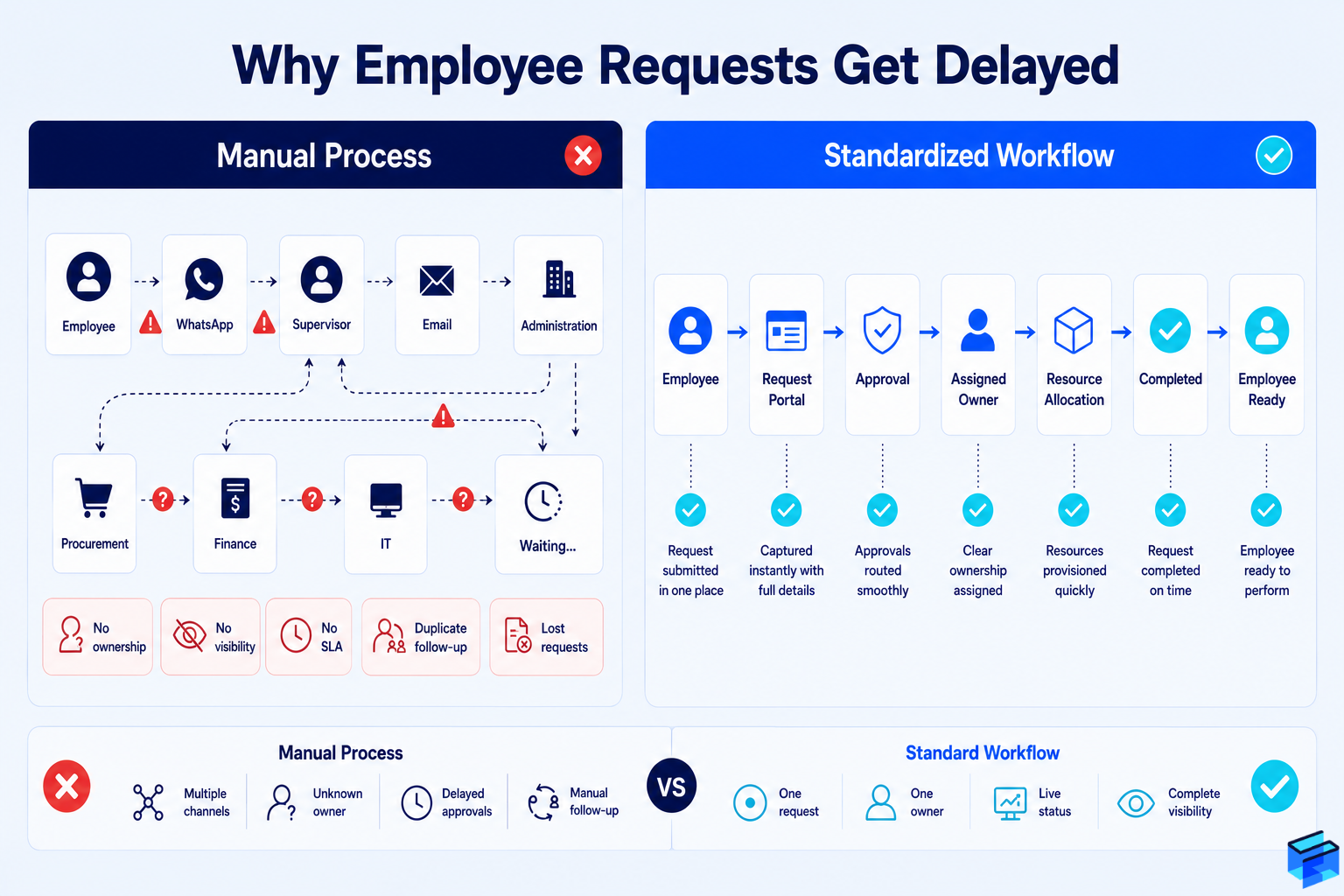
Without a structured process, these requests move through emails, WhatsApp, spreadsheets, and verbal conversations. As a result, an employee may believe a request has been approved while Administration is still waiting for Procurement to purchase the equipment. Meanwhile, HR may assume accommodation has been assigned even though Facilities has not confirmed room availability. Every disconnected handoff increases waiting time and reduces accountability.
CIPD’s research on induction reinforces this point: employees need the knowledge and support to perform their role — not just a signed offer letter — and structured induction directly affects turnover, absenteeism, and employer brand.[3]
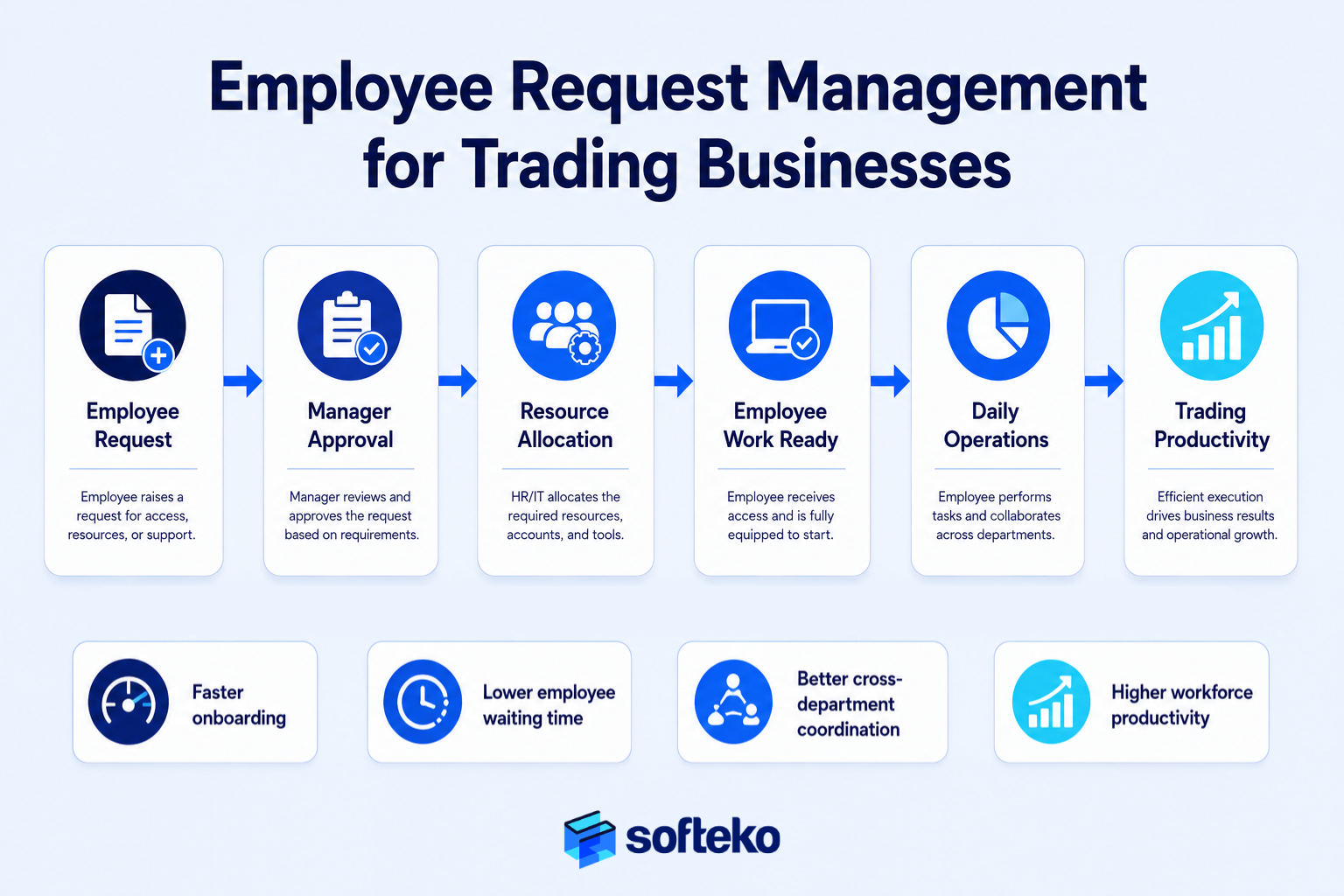
Effective employee request management creates one operational workflow from the moment an employee identifies a need until that need is fulfilled. Every request follows the same lifecycle:
Employee Need → Request → Approval → Resource Allocation → Confirmation → Work Ready
Because every stage has an owner, managers see which requests are waiting, departments know when action is required, and employees stop chasing updates. Instead of reacting to delays, the trading business manages requests through visibility, ownership, and standardised process.
Which Employee Requests Affect Daily Operations
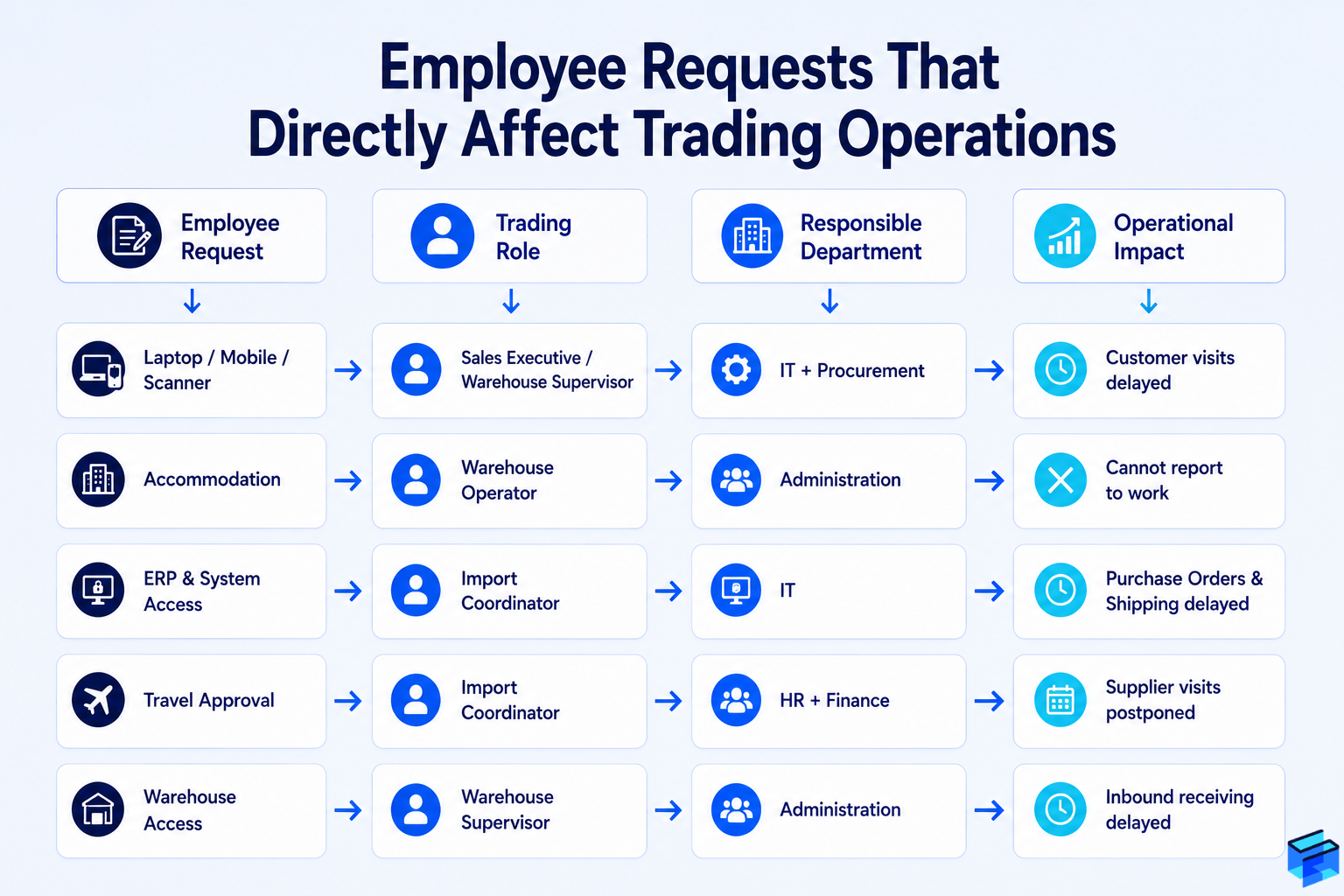
Not every employee request has the same operational impact. Some improve convenience; others determine whether an employee can perform the role at all. In trading businesses, delays usually occur around the resources, approvals, and services employees need before they can contribute to daily operations. Below is where those requests hit trading operations.
| Request category | Trading roles affected | What breaks when delayed |
|---|---|---|
| Company assets (laptop, mobile, SIM, scanner) | Sales Executive, Warehouse Supervisor, Import Coordinator | Customer visits paused, inbound receiving idle, documentation delayed |
| Accommodation and room allocation | Warehouse Operator, Delivery Driver, expat Sales Executive | Employee cannot report to work on the joining date |
| Manager approval (travel, overtime, vehicle) | Import Coordinator, Warehouse Supervisor, Delivery Driver | Supplier visits postponed, peak-shipment overtime not covered, delivery routing changes |
| System and building access (ERP, warehouse gate, DHL, banking) | Procurement Officer, Customs Clearance Officer, Finance Officer | No purchase order raised, no customs declaration lodged, no supplier payment released |
Requests for Laptops, Phones, and Company Equipment
A new Sales Executive cannot meet customers effectively without a laptop, company SIM, email account, and CRM access. Similarly, a Warehouse Operator needs a handheld scanner, safety equipment, or a company SIM before starting daily tasks.
Many trading businesses still manage these requests through emails or WhatsApp. HR informs Administration about the new employee, Administration contacts Procurement, Procurement orders the equipment, and IT waits until the device arrives before configuring user access. Without a shared workflow, every handoff introduces another opportunity for delay.
Leading trading businesses treat asset requests as part of employee readiness rather than as isolated procurement activities. Specifically, the request is tracked from submission to allocation, ownership changes are recorded, employees acknowledge receipt digitally, and the asset remains linked to the employee for the full lifecycle.
Requests for Staff Accommodation and Room Changes
Accommodation requests are common in trading businesses employing Warehouse Operators, Delivery Drivers, field technicians, or expat staff across multiple locations. The request is rarely limited to assigning a room. Administration must confirm availability, inspect facilities, allocate beds, record amenities, and update occupancy records.
If the accommodation process is delayed, employees cannot relocate, report to work, or complete onboarding on schedule. As a result, a structured workflow prevents rooms from being assigned twice, helps Administration monitor occupancy, and gives management visibility into available capacity instead of a manual spreadsheet.
Requests That Need Manager Approval
Many operational requests cannot proceed without approval because they involve company spending, policy compliance, or operational risk. Examples include:
- Business travel for an Import Coordinator visiting suppliers
- Overtime approval for Warehouse Supervisors during peak deliveries
- Temporary vehicle allocation for a field Sales Executive
- Emergency purchases required for urgent customer orders
When approvals depend on email or WhatsApp, employees spend more time asking for updates than completing work. Meanwhile, managers struggle to identify which requests need immediate attention because pending approvals are scattered across different channels. Standardised approval workflows reduce these delays by defining who approves each request, the order of approvals, escalation rules, and expected response times.
Requests for System and Building Access
Employees cannot begin productive work until they receive the correct physical and digital access. For example, a Procurement Officer needs access to supplier records, purchase approvals, and document repositories. A Warehouse Supervisor needs entry to restricted storage areas and permission to use the WMS. A Finance Officer needs controlled access to payment records without seeing unrelated HR data.
These requests are frequently overlooked because access is managed by different teams. HR confirms employment, Administration issues ID cards, IT configures user permissions, and Security activates building access. If any step is missed, the employee remains unable to perform their responsibilities even after officially joining the company.
Why Employee Requests Stay Pending
Employee requests rarely become delayed because people refuse to help. Instead, most delays happen because the process itself lacks structure. Requests move between departments without clear ownership, approvals wait in inboxes, and employees have no visibility into what happens after submission. Consequently, the longer a request remains unresolved, the more people become involved — and what began as a simple request gradually becomes an operational bottleneck.
Requests Are Shared Through Calls and Chats
Many trading businesses still rely on emails, phone calls, WhatsApp, or verbal conversations to manage employee requests. Consider a Warehouse Operator who needs a replacement handheld scanner. The Operator informs the Warehouse Supervisor through WhatsApp. The Supervisor calls Administration. Administration emails Procurement to check availability. Procurement asks Finance to approve the purchase because no spare devices remain.
Each department has part of the conversation. However, no department owns the complete process. If someone goes on leave or forgets to respond, the request simply stops moving. Days later, everyone remembers the conversation differently, making it difficult to determine where the delay occurred.
Nobody Knows Who Should Act Next
Ownership is one of the biggest reasons employee requests stay open. Imagine a new Import Coordinator joining the company. Before the first working day, the employee needs a laptop, company email, ERP access, an office workstation, and a mobile SIM.
- HR believes Administration is preparing the equipment.
- Administration assumes IT is configuring user accounts.
- IT is waiting for Procurement to deliver the laptop.
- Procurement has not received an approved purchase request.
Everyone is involved. Nobody owns the next action. Without clearly assigned responsibility, requests move only when someone notices the delay. Meanwhile, managers spend time chasing updates instead of managing operations, and the employee remains unable to perform productive work.
Departments Work Separately Instead of Together
Employee requests rarely belong to one department. In fact, a single request often passes through HR, Administration, Procurement, IT, Finance, and Operations before it is completed. For instance, a business travel request from an Import Coordinator may involve:
- The line manager approving the business need
- HR confirming travel eligibility
- Administration arranging tickets and accommodation
- Finance approving the budget
- Operations coordinating customer or supplier schedules
When each department maintains separate spreadsheets or communication channels, employees must repeatedly provide the same information. Moreover, departments only see the portion they manage. Instead of one connected workflow, the trading business operates as several disconnected processes — and as the business expands across warehouses or countries, these handoffs multiply.
Managers Cannot See Pending Requests
One of the biggest operational risks is the lack of visibility. Managers often learn requests exist only after employees begin asking why nothing has happened. Without centralised tracking, important questions become difficult to answer:
- Which requests have been waiting the longest?
- Which department causes the most delays?
- How many employees are waiting for assets?
- Which approvals are overdue?
- Which requests affect onboarding this week?
Because this information is unavailable, managers respond to problems only after employees complain or deadlines are missed. In contrast, high-performing trading businesses treat every request as a shared workflow record showing its status, owner, pending approvals, and expected completion date.
How Employee Request Delays Reduce Productivity
Employee request delays are often treated as minor administrative issues because each request looks small on its own. A laptop arrives two days late. A building access card takes another day. An accommodation request waits for approval until next week.
However, the real cost is not the individual delay. It is the cumulative loss of productive work across the business. When employees cannot access the people, systems, equipment, or facilities they need, operational capacity declines even though the workforce is present. Consequently, the trading business continues paying salaries while receiving only a fraction of the expected output.
New Employees Wait Before They Can Start Working
Hiring a new employee does not immediately increase productivity. That happens only when the employee is fully prepared to perform the assigned role. For example, a Warehouse Supervisor joining a distribution centre may need a company ID card, warehouse access, safety equipment, ERP credentials, handheld scanners, and standard operating procedures. If these requirements are completed over several days instead of before the joining date, the employee spends the first week waiting rather than contributing.
The delay also affects existing employees. Team members pause their own work to answer questions, lend equipment, or complete tasks the new employee cannot yet perform. As a result, the onboarding process temporarily reduces operational capacity rather than increasing it. This is exactly why SHRM data shows only 12% of employees say their company does a great job with onboarding, and only 29% of new hires feel prepared to excel.[1] Leading trading businesses respond by measuring time-to-productivity, not just employee joining dates.
Employees Spend Time Waiting Instead of Working
Employee request delays do not only affect new hires. Existing employees submit requests every day to continue their work without interruption. For example:
- A Sales Executive waiting for a replacement laptop postpones customer meetings.
- A Delivery Supervisor without vehicle approval delays shipment planning.
- A Warehouse Operator waiting for safety equipment cannot enter restricted work areas.
None of these employees are absent. They are available. However, they cannot perform the work they were hired to do. Furthermore, these waiting periods often stay invisible because they are spread across different departments — one employee loses an hour, another loses half a day, and across hundreds of employees over a year, those hours become a significant operational cost.
HR and Admin Teams Spend More Time Following Up
When requests are not tracked properly, employees naturally start asking for updates. Consequently, HR receives calls asking whether accommodation has been assigned. Administration receives emails requesting status on company assets. Procurement is asked whether equipment has been purchased. Managers spend time identifying who owns each request instead of making operational decisions.
McKinsey estimates knowledge workers spend about 28% of the workweek managing email and nearly 20% searching for internal information or tracking down colleagues.[2] For a trading business, that is exactly the pattern employee request chasing produces — the request itself takes minutes; the follow-up consumes far more time than the actual task. As request volumes grow, administrative teams become occupied with answering questions instead of completing requests, creating a cycle where delays generate even more delays.
Small Delays Spread Across Multiple Departments
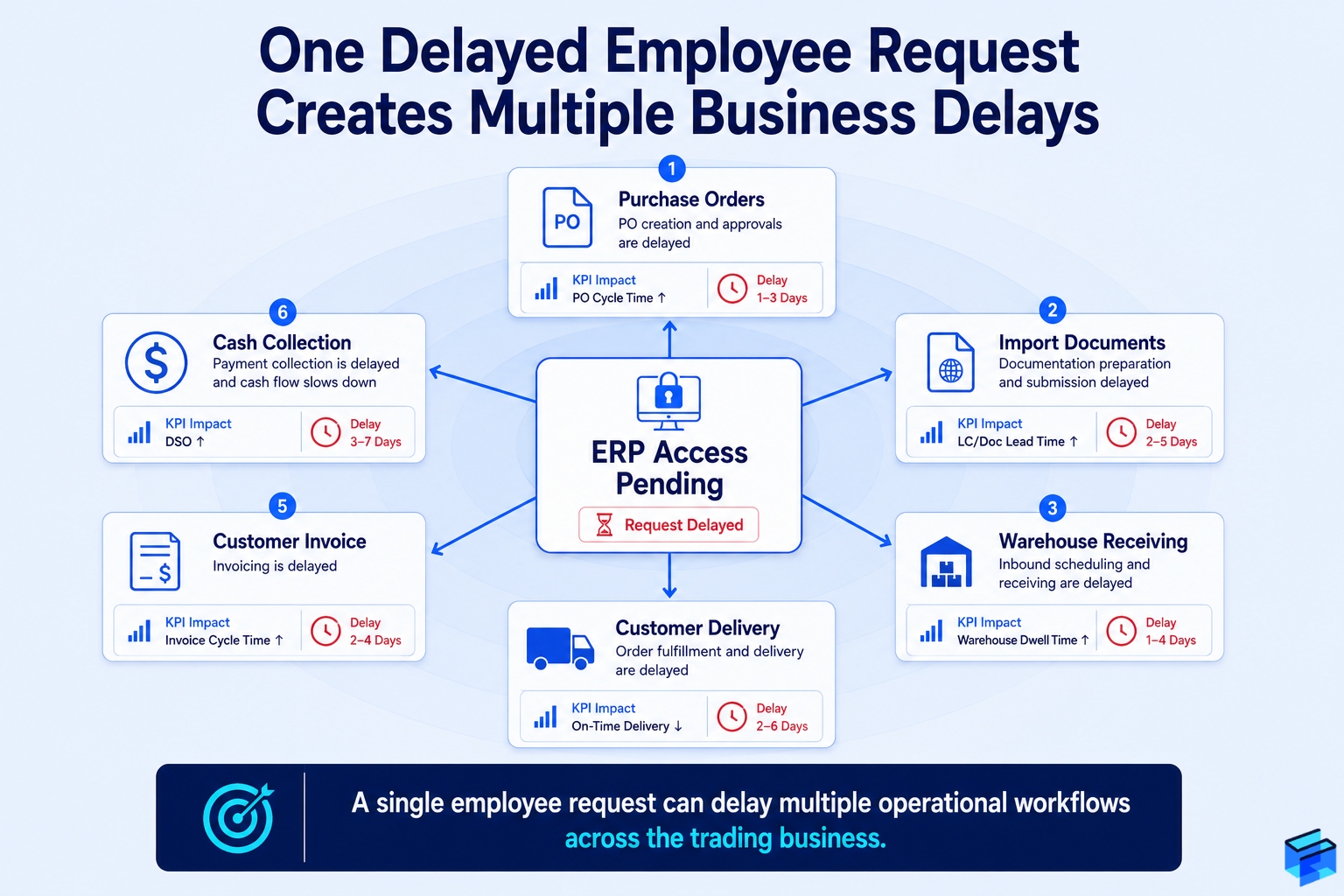
One delayed request rarely affects only one employee. In trading businesses, work is highly interconnected — a delay in one department creates waiting time somewhere else. For example, an Import Coordinator cannot release shipping documents because system access is still pending. Consequently, customs clearance waits for the documents. Warehouse receiving schedules change because shipment arrival is delayed. Customer delivery dates move. Finance invoices the customer later than planned.
The original problem was a simple employee request. However, the business consequence affects multiple operational processes. This ripple effect is why successful trading businesses treat employee request management as an operational control rather than an administrative service.
How ERP Tracks Employee Requests from Start to Finish
Employee request management does not improve simply because requests become digital. If the underlying process remains unclear, replacing paper forms with online forms only moves the same problems onto a computer. Therefore, leading trading businesses first define a standard workflow — who submits each request, who approves it, who provides the resource, and how completion is confirmed. ERP then supports that workflow by recording every action, assigning responsibility, and providing visibility from submission to completion.
Capture Every Employee Request in One Place
The first control is creating a single entry point for every employee request. Whether an employee needs a company laptop, warehouse access, accommodation, business travel approval, or replacement safety equipment, every request should begin in the same system instead of scattered channels. Specifically, a centralised request process delivers:
- A unique reference number for every request
- Complete information submitted the first time
- Supporting documents attached to the request
- Easier identification of duplicate requests
- One place for managers to review all outstanding requests
For example, instead of informing the Warehouse Supervisor verbally about replacement safety boots and hoping the message reaches Administration, the Warehouse Operator submits a request that becomes visible to everyone involved from that moment on.
Send Requests to the Right Approver Automatically
Approvals should follow business rules, not personal relationships. Without defined approval workflows, employees send requests directly to whichever manager responds fastest. As a result, decisions become inconsistent, approval bottlenecks form whenever managers are unavailable, and company policies are enforced unevenly.
A standardised workflow routes requests automatically based on factors such as request type, department, employee role, location, request value, and company policy. For instance, a replacement office chair may need only Administration approval. A new laptop, however, may require approvals from the department manager, Administration, and Finance because company assets and budget are involved.
Track Every Pending Request in Real Time
One of the biggest improvements comes from visibility. Instead of wondering whether someone has received a request, employees and managers see exactly where it stands. Each request moves through clearly defined stages:
Submitted → Under Review → Approved → Resource Assigned → Completed
Every status change records who completed the action, when it happened, what decision was made, and which step is next. Consequently, managers stop asking “has anyone looked at this request?” and start asking “why is this stage taking longer than target?”
Notify Teams Before Requests Become Delayed
Most employee requests do not become overdue overnight. Rather, delays develop because nobody realises a request has been waiting for several days. For example, a new Sales Executive may still be waiting for CRM access three days before customer visits are scheduled — and by the time someone notices, the onboarding plan has already slipped.
Leading trading businesses reduce these situations by using automated reminders and escalation. If a request remains untouched beyond its expected response time:
- The assigned owner receives a reminder
- Managers are notified about overdue approvals
- Escalations trigger automatically when deadlines are missed
- Priority requests appear on operational dashboards
Measure Request Performance with Dashboards
Employee request management should be measured like any other operational process. Without performance data, management cannot tell whether request handling is improving or simply generating more administrative work. A centralised ERP workflow allows managers to monitor:
- Which requests remain open the longest
- Which departments create the most delays
- How quickly approvals are completed
- How many employees are waiting for essential resources
- Which request types occur most frequently
How ERP Manages Different Employee Requests
A standardised workflow should handle routine activities as effectively as exceptional ones. For trading businesses, that means connecting HR, Administration, Procurement, IT, Operations, and Finance through one coordinated process instead of several disconnected ones.
Assign and Return Company Assets
Company assets move continuously through an employee’s lifecycle. A new Sales Executive receives a laptop, mobile, and SIM. A Warehouse Supervisor is issued a handheld scanner and safety equipment. When employees transfer departments or leave, those assets must be returned, inspected, and reassigned.
Without a structured process, trading businesses lose track of company property. Assets remain recorded against former employees, duplicate purchases rise because existing equipment cannot be located, and IT or Administration spend time investigating missing devices. A centralised workflow records every stage — employee submits request, manager approves, Administration or Procurement allocates equipment, employee confirms receipt, HR updates the record. When employment ends, the same workflow ensures assets are returned before final clearance.
Allocate Rooms and Track Occupancy
Trading businesses operating across multiple warehouses, project sites, or countries accommodate Warehouse Operators, Delivery Drivers, technicians, and expat staff. Each accommodation request affects occupancy, maintenance, transportation, and readiness. For example, a warehouse expansion requiring twenty additional operators cannot start on time if accommodation planning begins only after employees arrive.
A standardised workflow allows Administration to assign available rooms based on capacity, track current occupancy, record check-in and check-out dates, monitor room availability before recruiting additional staff, and schedule maintenance when a room becomes vacant. Consequently, accommodation becomes part of workforce planning rather than a last-minute activity.
Approve System and Facility Access
Employees cannot contribute effectively without appropriate access. A Procurement Officer needs supplier portals, purchase approval rights, and document repositories. A Warehouse Operator needs access to restricted storage zones and the WMS. A Finance Officer needs payment authorisation while remaining restricted from confidential HR information.
Granting excessive access creates compliance risk. However, granting insufficient access stops employees from performing their jobs. A structured approval workflow balances both objectives by ensuring employees receive only the permissions their role requires. Additionally, when an employee changes roles or leaves, the same workflow removes unnecessary access promptly, closing the compliance and security exposure.
Manage Everyday HR and Admin Requests
Not every employee request involves assets or system access. Employees regularly submit requests for business travel, transport, visa or work permit documentation, medical reimbursements, uniform replacements, visitor passes, office maintenance, and official certificates or letters. Although these requests differ in purpose, they share the same operational requirements — a standardised submission process, defined approval rules, a responsible owner, a clear completion status, and a permanent record.
Furthermore, using one consistent workflow across all request types reduces administrative complexity. Employees no longer need to decide which department manages a specific request because the system routes it automatically.
Which KPIs Show Whether Employee Requests Are Improving
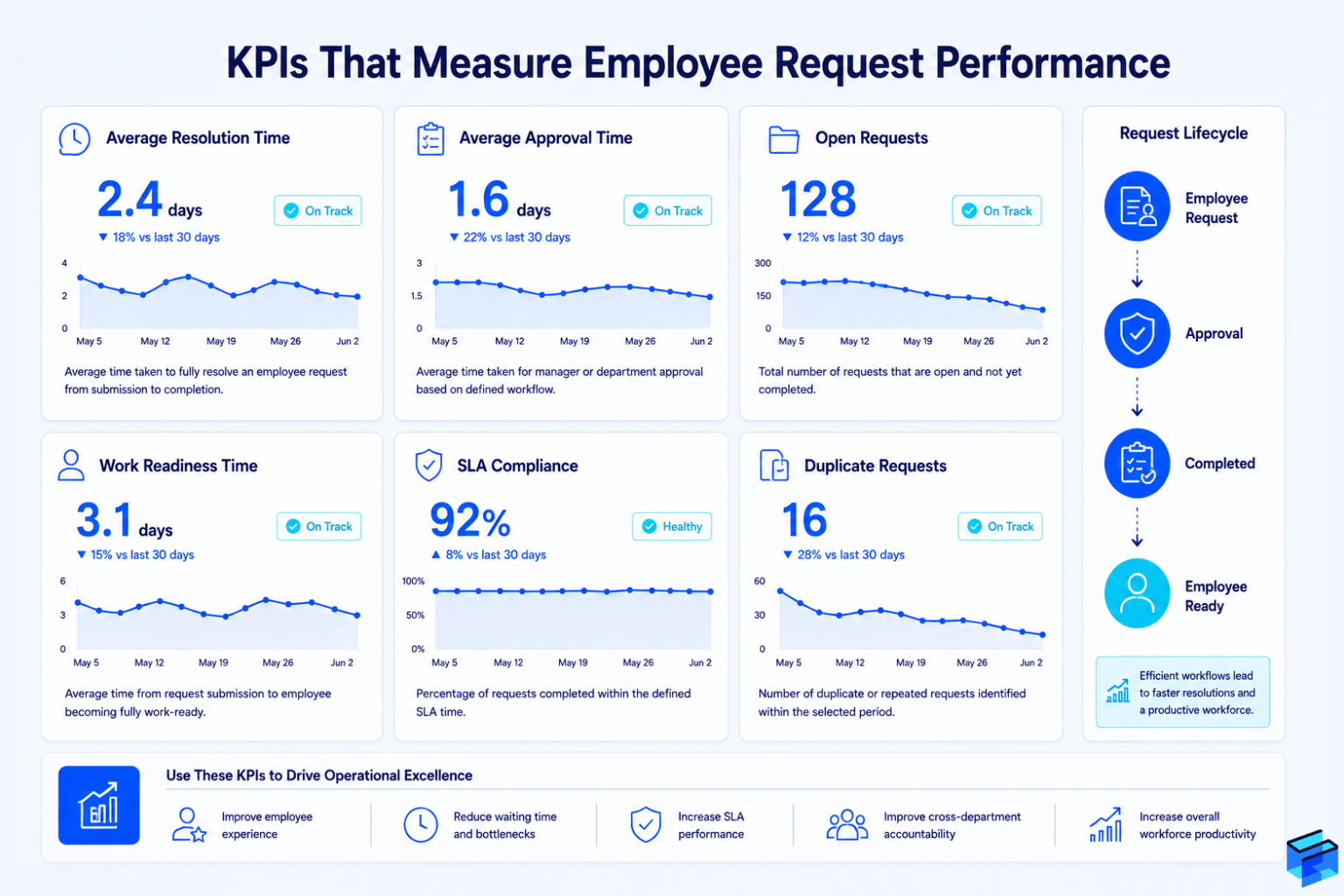
Employee request management should be measured the same way trading businesses measure inventory accuracy, supplier OTIF, or order fulfilment. If requests are not measured, delays remain hidden until employees complain or operations slow down. The purpose of tracking KPIs is not to monitor administrative activity. Instead, it is to understand whether employees are receiving what they need quickly enough to perform productive work.
| # | KPI | What it reveals |
|---|---|---|
| 1 | Average time to complete a request | Total lifecycle efficiency — highlights where in the chain time is being lost |
| 2 | Number of open requests | Backlog and capacity pressure by department |
| 3 | Average approval time | Separates slow decision-making from slow execution |
| 4 | Average time employees wait before they can work | Direct business-impact measure — time-to-productivity |
| 5 | SLA compliance rate | % of requests completed within target |
| 6 | Duplicate request rate | Signal that employees cannot see status and are re-submitting |
Average Time to Complete a Request
The first KPI measures how long a request takes from submission to closure. Notably, this reflects the whole process rather than a single department. For example, if a laptop request takes nine days, management should not immediately assume Procurement is responsible. The delay may have occurred because approvals took three days, Procurement ordered the device two days later, and IT needed another two days to configure it. Measuring the full lifecycle identifies where time is actually lost.
Number of Open Requests
A growing backlog often signals a capacity problem or an inefficient workflow. For instance, if Administration receives fifty accommodation requests but completes thirty each week, the backlog keeps growing regardless of how hard the team works. Monitoring open requests reveals which departments carry the largest backlog, which request types stay open longest, and whether pending requests are increasing month over month.
Average Approval Time
Completing a request depends on how quickly decisions are made. A request may sit inactive for days simply because an approval has not been reviewed. Tracking approval time separately from total completion time distinguishes two different operational problems — slow decision-making versus slow execution — and each requires a different fix.
Average Time Employees Wait Before They Can Work
This is the most valuable workforce readiness metric because it measures business impact rather than administrative activity. Specifically, it captures how long an employee waits before receiving everything required to perform their responsibilities. For example, a new Warehouse Supervisor becomes operational only after receiving ID card, warehouse access, safety equipment, ERP login, handheld scanner, and workstation. Reducing this waiting time increases workforce productivity without hiring additional employees.
How to Improve Employee Request Management Step by Step
Improving employee request management does not begin with implementing new software. Rather, it begins with understanding how requests move through the business today. In fact, many organisations discover that delays are caused by unclear responsibilities, inconsistent approval rules, or disconnected communication — not a lack of technology. Leading trading businesses simplify the process first and then use ERP to enforce it consistently, which reduces implementation risk and speeds up adoption.
This approach also aligns with ISO 9001’s process-management principles: define the process, assign ownership, measure performance, and improve continuously.[4]
List Every Employee Request Your Business Handles
The first step is identifying every request employees submit throughout their employment. Notably, many businesses focus only on common HR requests while overlooking operational requests managed by Administration, Procurement, IT, Facilities, and Operations. Start by creating a complete inventory:
- Company asset requests (laptop, mobile, SIM, scanner)
- Accommodation and room-change requests
- System and building access
- Business travel
- Vehicle allocation
- Safety equipment
- Uniforms and PPE
- Employee certificates and official letters
- Office maintenance
- Visitor passes
For each request, document who submits it, which department processes it, who approves it, what documents are required, and what marks it complete. This exercise often reveals duplicate processes, unnecessary approval layers, and requests that depend entirely on verbal communication.
Define Who Owns Each Request
Every request should have a clearly identified owner at every stage. Ownership does not mean completing every task personally. Instead, it means being responsible for ensuring the request moves to the next step without unnecessary delay. Consider a replacement laptop request:
- Employee submits the request
- Department manager confirms the business need
- Administration verifies company policy
- Procurement arranges the purchase if required
- IT prepares the device
- Administration issues the laptop
Each stage has a different owner, but responsibility is always visible. Without defined ownership, requests remain idle because everyone assumes another department is acting.
Use the Same Approval Process Across Departments
Approval rules should be consistent enough that employees know what to expect regardless of the request type. In many organisations, similar requests follow completely different approval paths depending on the department involved — one team requires two approvals for a laptop request, another requires four. These inconsistencies create confusion and increase processing time. Standardising workflows helps trading businesses apply company policies consistently, reduce unnecessary approval levels, clarify approval authority, simplify employee training, and improve auditability.
However, not every request needs the same number of approvals. The objective is to base approval requirements on business risk rather than departmental habit.
Review Request Performance Every Month
Employee request management should improve continuously rather than only when problems become visible. Monthly operational reviews help management identify trends before they affect workforce productivity. Useful review questions include:
- Which request types generate the most delays?
- Which departments consistently exceed target completion times?
- Are approval bottlenecks increasing?
- Which locations receive the highest number of requests?
- Which requests could be automated or simplified?
For example, if managers notice that most delayed requests involve new employee onboarding, they may discover that laptops are ordered only after employees join the company. Changing the process so equipment is prepared before the joining date can significantly reduce onboarding delays without increasing headcount or administrative effort.
How Odoo Connects Employee Requests, Approvals, Assets, and HR
Managing employee requests becomes increasingly difficult as a trading business grows. More employees, multiple warehouses, and branch offices mean every request passes through several departments before completion. If each department maintains its own records and communication channels, delays become unavoidable. An effective ERP does not replace departments.
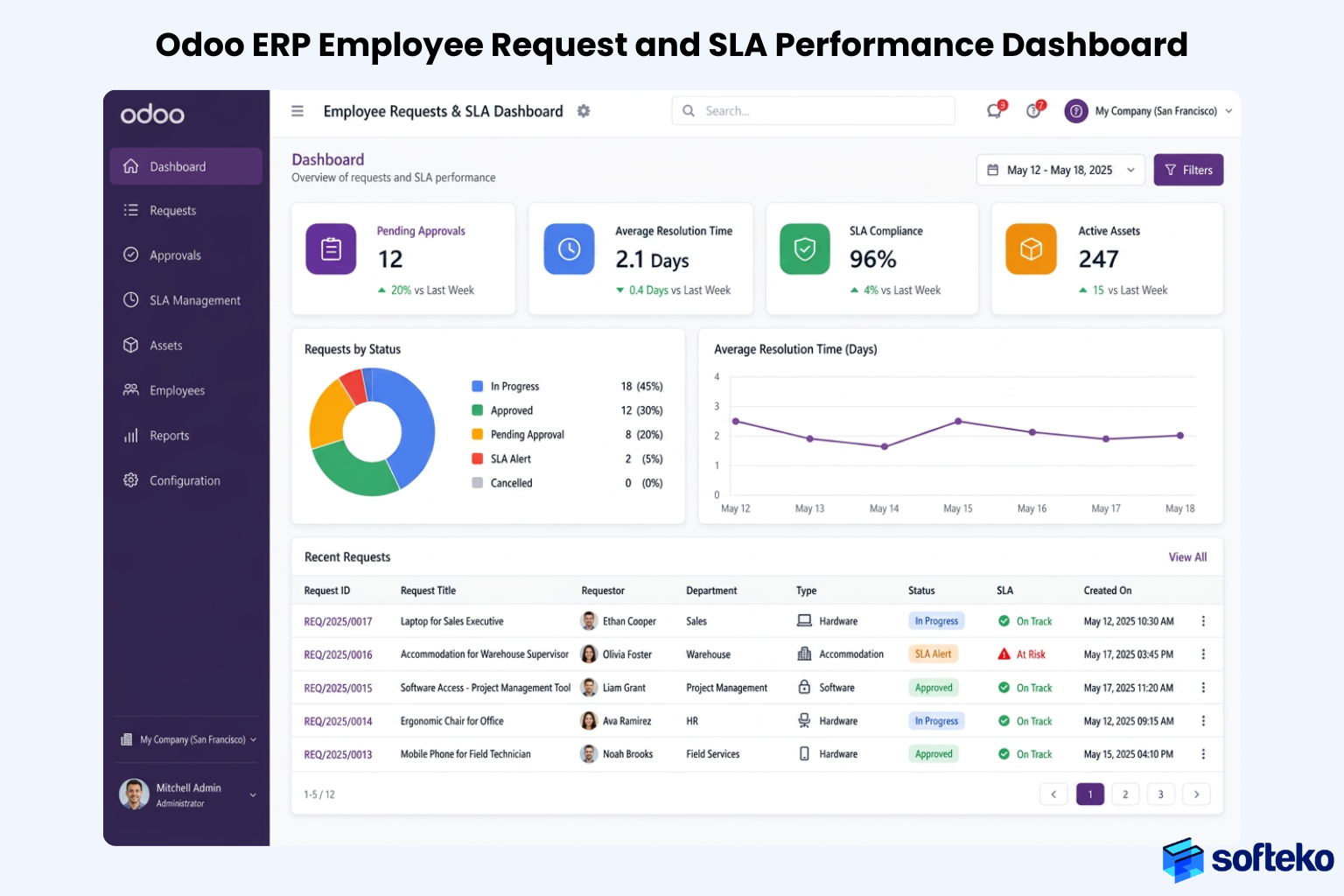
Instead, it connects them through one controlled workflow with clear ownership, complete visibility, and a permanent audit trail.
Below, the Odoo controls are grouped into three layers: the intake layer (how requests enter the system), the workflow layer (how work moves across departments), and the oversight layer (how managers see status and reduce waiting time).
The intake layer: capture every request in one place
First, the intake layer converts scattered emails and WhatsApp messages into structured records.
| Control | What it does | Trading impact |
|---|---|---|
| Employee self-service portal | One entry point for every request with mandatory fields, category selection, and file attachments | No more “I sent it to WhatsApp” — every request enters the same pipeline |
| Employee master record | Request auto-links to employee, department, manager, location, joining date | Routing decisions no longer depend on the requester remembering the org chart |
| Onboarding plans by role | Pre-defined request bundles for Warehouse Supervisor, Sales Executive, Procurement Officer, Import Coordinator | Common requests are pre-approved and pre-staged before the joining date |
| Attached documents | Justification, supporting quotes, ID copies, approvals stored on the request itself | Removes the “email chain of attachments” that spreads across four inboxes |
Consequently, the request is complete at the moment of submission — not after three rounds of follow-up.
The workflow layer: route, approve, allocate, confirm
Next, the workflow layer moves the request across departments without manual chase-emails.
| Control | What it does | Trading impact |
|---|---|---|
| Rule-based approval routing | Automatic assignment to the correct approver by request type, department, value, or location | Manager consistency across UAE, KSA, Bahrain warehouses |
| Ownership handoff at each stage | Responsibility transfers automatically as the request moves; every handoff is recorded | HR → Admin → Procurement → IT → Operations without a single “who has this?” email |
| SLA and escalation | Target response and resolution times per category, with escalation when missed | Warehouse peak-shipment overtime approvals never sit unactioned before the shift starts |
| Equipment and asset records | Laptop, mobile, SIM, scanner, fuel card linked to employee profile at allocation | Every asset is traceable to a person for the full lifecycle |
| Access-rights configuration | ERP roles applied based on department and role template | Procurement Officer starts raising POs on day one; Finance Officer sees payments without HR data |
As a result, each stage becomes a task with an owner and a deadline, rather than a spreadsheet row waiting to be noticed.
The oversight layer: dashboards, closure, and improvement
Finally, the oversight layer gives managers the forward view they already trust for OTIF and DSO.
| Control | What it does | Trading impact |
|---|---|---|
| Real-time dashboards | Open requests, aging, SLA breaches, backlog by department, category, location | Managers see delays before employees escalate |
| Confirmed closure | Request closes only after employee/manager confirms receipt and usability | Prevents “issued but not working” false completions |
| Reporting by trend | Volume by category, delay by owner, aging by department, request-to-productivity time | Continuous improvement based on data, not anecdote |
| Audit trail on every action | User ID and timestamp on every status change | Governance evidence produced by the system, not assembled later |
Notably, these are not features in isolation. Rather, each one implements a control the trading business already relies on somewhere else — SLA windows are the request-management equivalent of the 7-day quotation SLA, ownership handoff is the workforce equivalent of the payment-readiness gate on Supplier PO issuance, and dashboards report request performance the same way they report supplier OTIF.
FAQ
What is employee request management in a trading business?
It is the process of receiving, approving, fulfilling, and tracking every request an employee makes to perform their job — including assets, accommodation, access, approvals, travel, and administrative services. Notably, in trading businesses these requests cross HR, Administration, Procurement, IT, Finance, and Operations, which is why they need one shared workflow rather than several disconnected ones.
Why do employee requests get delayed?
Because the process itself lacks structure. Requests move through emails, WhatsApp, and spreadsheets with unclear ownership and no visibility. As a result, no single person owns closure, and delays are only discovered when the employee finally escalates.
How do request delays affect trading productivity?
Directly. A Sales Executive without a company laptop postpones customer visits. An Import Coordinator without ERP access delays shipping documents. A Warehouse Supervisor without safety equipment cannot receive inbound containers. Because trading operations are interconnected, one delayed request rarely stays isolated — the delay spreads across procurement, warehouse, delivery, and finance.
What is “time-to-productivity” and why does it matter?
Time-to-productivity is the time between an employee’s joining date and the moment they can perform useful work. Consequently, it is a more meaningful metric than headcount because a hired employee is not a productive employee — productivity begins only when every required request has been fulfilled.
Which KPIs should we measure?
At minimum: average time to complete a request, number of open requests, average approval time, average employee waiting time before work-ready, SLA compliance rate, and duplicate request rate. Together, these six KPIs distinguish administrative activity from actual productivity impact.
How can ERP automate employee request workflows?
ERP captures every request in one place, routes approvals automatically, tracks status in real time, escalates overdue actions, and reports on performance. However, ERP does not create governance by itself — the trading business must first define categories, owners, approval rules, and SLA targets. ERP then enforces them.
Where should we start if we are still on WhatsApp and spreadsheets today?
Start with the two request categories that most often delay work: new-employee onboarding (laptop, ERP access, accommodation, ID card) and asset replacement (equipment failure that stops daily tasks). Together, these two workflows cover the largest source of employee waiting time in most trading businesses.
Does Odoo replace HR, IT, or Administration?
No. Rather, Odoo gives HR, IT, Administration, Procurement, and Operations one shared workflow so they can each execute their part without re-typing information, chasing status, or losing requests between inboxes.
Turn Employee Requests Into a Trading Productivity Control
If your trading business is still managing employee requests through WhatsApp, email chains, and separate spreadsheets, hidden waiting time is almost certainly building inside daily operations. The cost shows up as delayed onboarding, unmanned warehouse shifts, postponed customer visits, and administrative teams occupied with follow-up instead of completing work.
At Softeko, we help trading businesses implement Odoo ERP so employee requests move through one controlled workflow — from submission and approval to asset allocation, access configuration, and confirmed work-readiness. Furthermore, we connect HR, Administration, Procurement, IT, Finance, and Operations into a single record with owner, deadline, status, and audit trail.
Ultimately, the objective is not more software. Rather, it is reducing the time between an employee’s joining date and the moment they can produce — which is where employee request management starts contributing directly to trading productivity.
References
- SHRM — Onboarding Definition and Overview — https://www.shrm.org/topics-tools/topics/onboarding
- McKinsey Global Institute — The Social Economy — https://www.mckinsey.com/industries/technology-media-and-telecommunications/our-insights/the-social-economy
- CIPD — Induction Factsheet — https://www.cipd.org/uk/knowledge/factsheets/induction-factsheet/
- ISO — ISO 9001:2015 Quality Management Systems — https://www.iso.org/standard/62085.html