


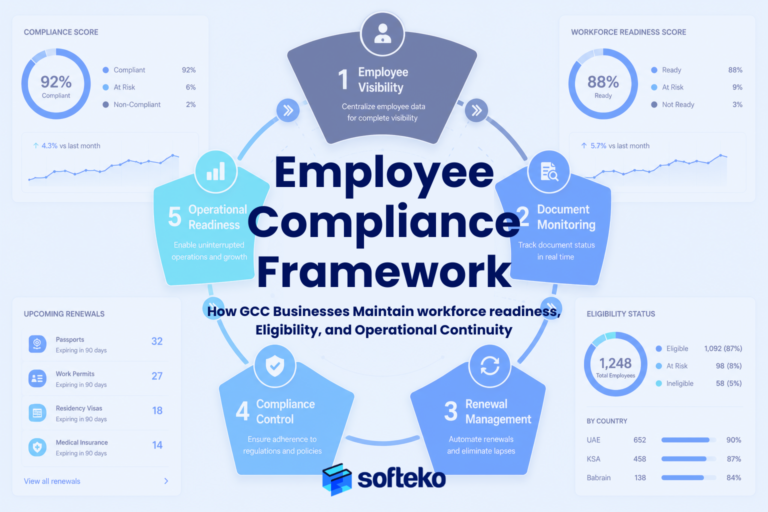
Employee compliance ensures that every employee remains legally eligible to perform their role — valid visa, current work permit, signed contract, WPS registration, and country-specific labour authorisations. When that compliance is maintained across every operational role, it creates workforce readiness — the ability of a trading business to keep sales, procurement, warehousing, customs clearance, and customer deliveries running without interruption. The relationship is a chain:
Employee Compliance → Workforce Readiness → Trading Continuity
Break the first link and the second collapses. Once the second collapses, the trading workflow stalls at whichever stage lost coverage — customs, warehouse, delivery, or invoicing. This article shows how ERP protects that chain across UAE, Saudi Arabia, and Bahrain.
Key takeaways
- Every trading operation depends on people before it depends on inventory. If the right people are not legally available to work, procurement slows, warehouses lose capacity, deliveries are delayed, and customer orders suffer.
- Workforce readiness is a trading operations control, not an HR administrative task. It sits alongside credit control, inventory accuracy, and landed cost as one of the operational controls that protect trading continuity.
- Trading businesses managing risk through fragmented spreadsheets and manual reminders are 60% more likely to experience operational failures.[1]
- GCC trading operations depend on jurisdiction-specific compliance — UAE Emiratisation and WPS violations can trigger AED 20,000 per employee, Saudi Qiwa violations up to SAR 250,000 (~US$66,590) for serious cases, and Bahrain LMRA penalties of BHD 500–2,000 per employee — and each violation removes a role from the trading workflow while the penalty is being resolved.
- When one role (Import Coordinator, Warehouse Supervisor, Customs Clearance Officer) becomes unavailable through a compliance failure, colleagues absorb the workload — and shortages make remaining staff 61% more likely to report burnout.[2]
- The fix isn’t more spreadsheets or more HR administrators. It’s continuous visibility into role eligibility, compliance status, and upcoming document expiries — enforced through the same ERP that runs sales, procurement, and warehouse operations.
Every Trading Process Depends on Operational Controls
A trading business runs on a chain of dependent stages. From the moment a customer enquiry lands to the moment cash is collected, each stage passes the workflow to the next only if a specific control is satisfied.
The standard trading operations flow looks like this:
| Stage | What happens | The operational control |
|---|---|---|
| RFQ | Sales captures the customer enquiry in CRM | Enquiry log with mandatory fields |
| PSR | Pre-Sales Review checks stock, pricing, credit | Stock, lead time, credit eligibility signoff |
| Quotation / PFI | Landed cost + margin calculated, offer sent | 7-day quotation SLA, dual approval |
| Customer PO | PO verified against approved quotation | Hard block on Product/Packaging/Incoterm mismatch |
| Payment arrangement | LC, advance, partial, or open credit confirmed | Finance confirms “okay to go” |
| Supplier PO | Procurement issues PO to supplier | Payment readiness gate |
| Shipment booking | Procurement books cargo, Logistics tracks | Supplier PI acknowledgement |
| Documentation & clearance | BL, COO, COA, CI, PL uploaded and cleared | Central document repository |
| Delivery & GDC | Goods delivered, weighbridge report, customer sign-off | Signed GDC, weighbridge upload |
| Invoicing & closure | Final CI issued, payment reminders start | 25-day + credit-period reminder rule |
Every stage has a control. Every control depends on a person executing it — a Sales Executive, an Operations Manager, a Procurement Officer, an Import Coordinator, a Customs Clearance Officer, a Warehouse Supervisor, a Weighbridge Operator, a Delivery Driver, a Finance Officer. Remove any one of them and the corresponding control stops working.
Workforce Readiness Is One of Those Operational Controls
Trading businesses already accept that inventory needs controls, finance needs controls, and sales needs controls. Workforce readiness sits in the same category — and most trading businesses have never treated it that way.
| Domain | The operational control |
|---|---|
| Inventory | Cycle counts, ABC classification, 99% accuracy targets |
| Finance | Credit limits, aging reports, DSO tracking |
| Sales | Quotation SLA, PSR discipline, PO verification |
| Procurement | Landed cost, supplier delivery assessment scoring, OTIF tracking |
| Workforce | Role eligibility, document validity, renewal cadence |
Missing this last row is what causes the “we thought we had cover” surprise. A trading business tracks its inventory accuracy to two decimal places, its collection efficiency to the day, and its landed cost to the fourth cent — then discovers on a Tuesday morning that the Customs Clearance Officer’s work permit expired the previous Friday, and that no shipment can be released from the port until it is reissued.
That’s a workforce readiness failure. It shows up as an inventory failure (goods not received), a finance failure (invoice can’t post), and a sales failure (customer commitment missed). But the root cause was a control that nobody was watching.
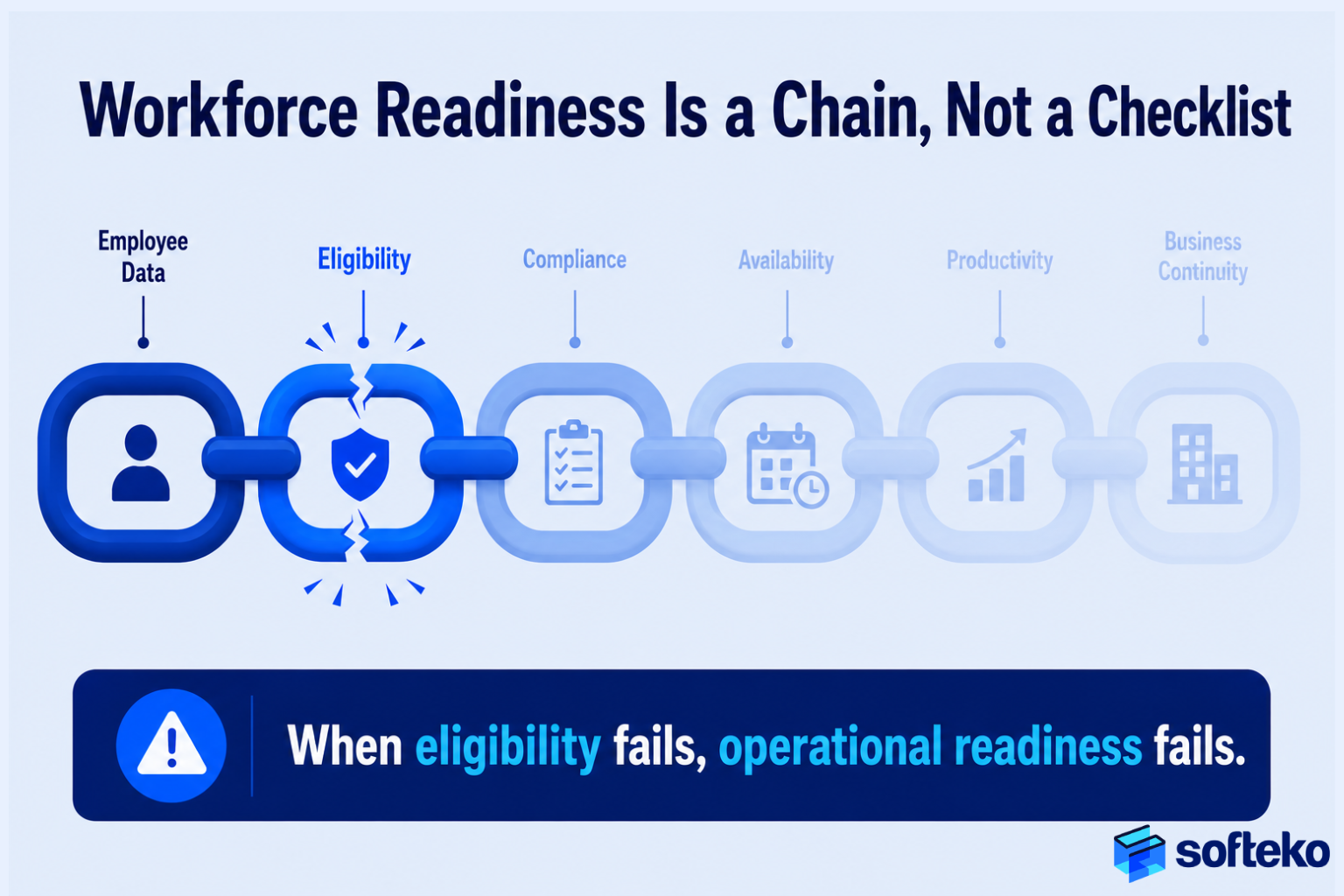
Where Workforce Readiness Breaks Inside Trading Operations
The same expired-document event has a different operational shape depending on which trading function it hits. Here is where readiness failures translate into trading disruption.
| Trading function | Role at risk | What breaks when readiness fails |
|---|---|---|
| Sales / Commercial | Sales Executive, Commercial Head | Quotation SLA (7 calendar days) missed, RFQ lost after 30 days of inactivity, PSR approvals stall |
| Procurement | Procurement Officer, Purchase Manager | Supplier PO not issued after payment readiness, PI acknowledgement delayed, shipment booking window missed |
| Import / Documentation | Import Coordinator, Documentation Officer | BL, COO, COA, CI, PL upload delayed; freight forwarder chase-emails multiply; documents move outside the central repository |
| Customs & clearance | Customs Clearance Officer, Broker Liaison | Goods held at port, container demurrage builds day by day, RAK / Duty exemption approvals cannot be lodged |
| Warehouse | Warehouse Supervisor, Forklift Operator, Weighbridge Operator | Inbound receiving idle, bulk-to-bag conversion (with 0.4% loss factor) stops, weighbridge report missing for local deliveries |
| Inventory control | Inventory Controller | Stock not reserved against confirmed Sales Orders, cycle counts postponed, accuracy KPI drifts |
| Delivery | Delivery Driver, 3PL Liaison | GDC not obtained on the delivery day, customer sign-off delayed, ISO nonconformity risk |
| Finance | Finance Officer, AR Controller | Final CI not posted, 25-day payment reminder not issued, 60+10 commission rule breaks |
Notice the pattern: a single expired document doesn’t just remove a role — it removes an operational control somewhere in the trading workflow, and the workflow keeps demanding that control regardless.
How One Compliance Failure Spreads Across the Trading Workflow
Compliance failures rarely stay inside HR. Once a role goes offline, the trading workflow absorbs the shock stage by stage.
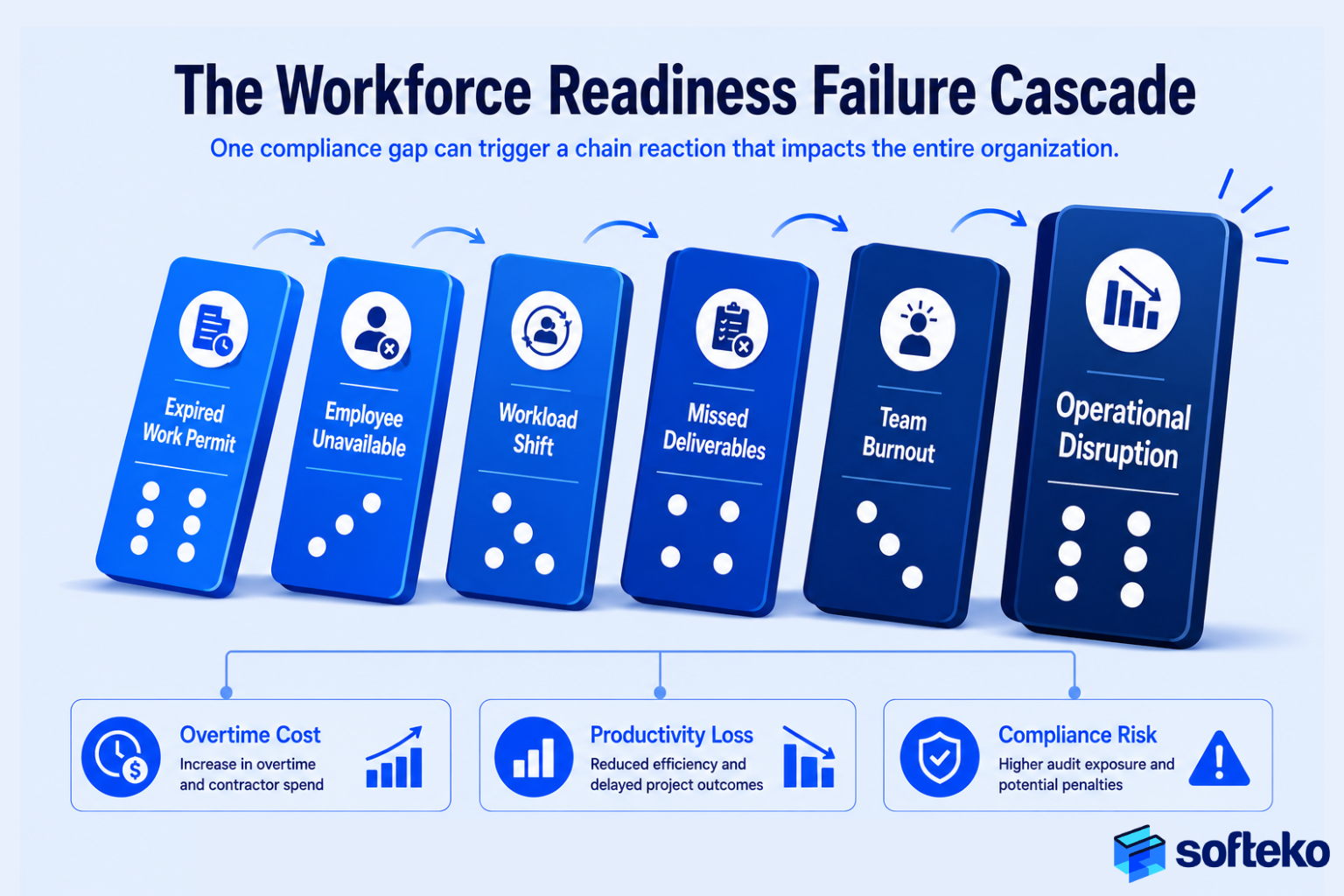
Take a single realistic scenario: an Import Coordinator’s work permit lapses on a Sunday. Nobody notices until Wednesday morning when the container arrives at port.
| Hour | What happens | Which trading control breaks |
|---|---|---|
| T + 0 | Container lands; Import Coordinator cannot legally sign for release | Documentation stage frozen |
| T + 8 hrs | Customs clearance paperwork not lodged | RAK / Duty exemption workflow stalls |
| T + 24 hrs | Container starts accruing demurrage | Landed cost inflates outside quoted margin |
| T + 48 hrs | Warehouse Supervisor’s inbound slot passes empty | Warehouse productivity drops; Forklift Operator idle |
| T + 72 hrs | Sales Order cannot be allocated against stock | Customer delivery date at risk |
| T + 5 days | Delivery Driver route re-planned; GDC not obtained | ISO nonconformity report filed |
| T + 7 days | Final Commercial Invoice cannot be issued | 25-day payment reminder clock does not start |
| T + 30 days | Collection cycle stretches | Cash flow gap widens; the 60+10 commission rule breaks for the Sales Executive on the deal |
One expired permit. Eight stages disrupted. And the burnout compounds: the Warehouse Supervisor picks up the Import Coordinator’s chase-emails, the Documentation Officer covers customs correspondence, the Finance Officer answers customer escalations. Shortages make the remaining team 61% more likely to report burnout,[2] which pushes error rates up on the next customer PO already in the queue.
A compliance failure is a trading failure with a delayed timestamp.
Why Workforce Readiness Gets Harder as Trading Businesses Grow
A trading business with one warehouse, one country, and 30 employees tracks compliance in a shared spreadsheet. The same spreadsheet does not survive expansion.
Three growth vectors compound the readiness problem:
1. Multiple warehouses and branches. Each warehouse has a Warehouse Supervisor, Forklift Operators, Weighbridge Operators, Inventory Controllers, and Delivery Drivers. Each role has its own document lifecycle. Multiply by five warehouses and the tracking surface increases five-fold.
2. Multiple GCC jurisdictions. A trading business operating in the UAE, Saudi Arabia, and Bahrain runs three parallel compliance regimes. Emirates ID renewal in the UAE does not follow the same cadence as Iqama renewal in KSA, which does not match CPR renewal in Bahrain. Probation lasts 3 months in Bahrain and 6 months in UAE/KSA. End-of-Service Benefits are calculated differently in each. The employer bears full recruitment and permit fees in KSA; UAE law prohibits withholding a worker’s official documents.
3. Function-specific document sets. A Sales Executive needs contract, visa, work permit, ID. A Delivery Driver adds a valid driving licence. A Forklift Operator adds a mandatory equipment certificate. A Customs Clearance Officer adds a customs broker authorisation. Each function layers additional expiry dates onto the same person.
Cross-border workforce management increases compliance complexity by about 3×.[3]
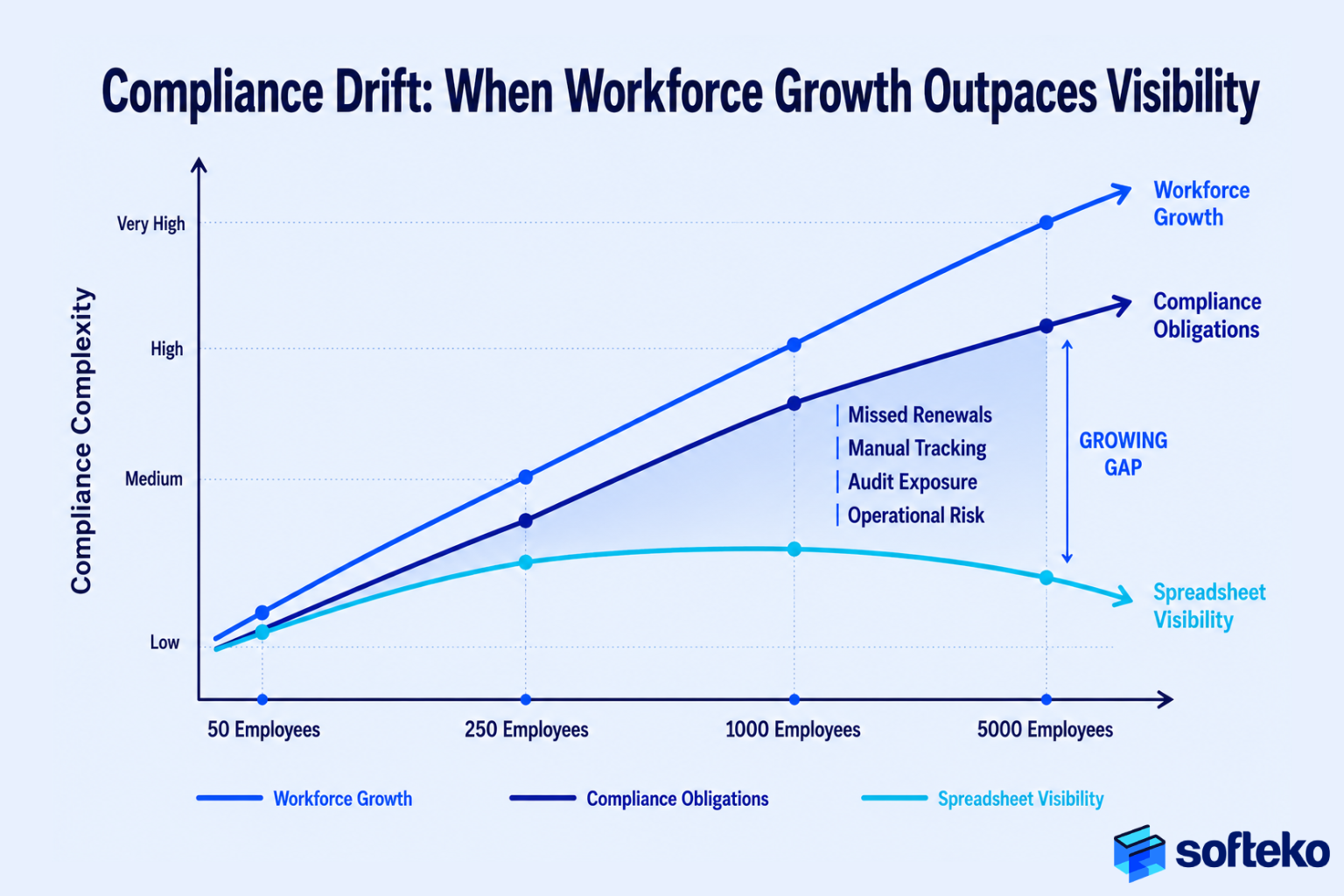
For a trading business, the same multiplier applies not to headcount but to role coverage — the number of operational stages that must remain executable across every country every day.
Why Manual Workforce Tracking Stops Working
Trading businesses do not abandon spreadsheets because they run out of columns. They abandon them because the spreadsheet answers the wrong question.
A spreadsheet tells you when a document expires. Trading operations need to know:
- Which trading function loses coverage if this document lapses next month?
- Which warehouse or country carries the highest exposure across the next 90 days?
- Which upcoming shipments depend on a role whose eligibility is about to change?
- Which Procurement Officer, Import Coordinator, or Delivery Driver has a renewal in progress right now, and who owns the next action?
A spreadsheet cannot answer any of those. It stores dates; it does not evaluate risk. The moment a trading business runs more than one workflow in more than one country with more than one specialist, the spreadsheet becomes a source of false confidence.
Automation reduces manual data-entry errors by approximately 80%.[4] That number matters because workforce readiness depends on accuracy — an alert generated from an incorrect visa expiry date is worse than no alert, because it moves the trading business from unaware to misinformed.
Manual tracking also fails on the human side. A tracker maintained by a single HR administrator survives only until that administrator takes leave, changes roles, or resigns. When the tracker leaves with them, so does workforce readiness — and the trading workflow inherits the risk with no warning.
The 6-Stage Workforce Readiness Model for Trading Operations
Workforce readiness is not one activity. It is a chain of six controls, each dependent on the one before it. When the chain holds, trading operations run. When any link breaks, the workflow stalls downstream.
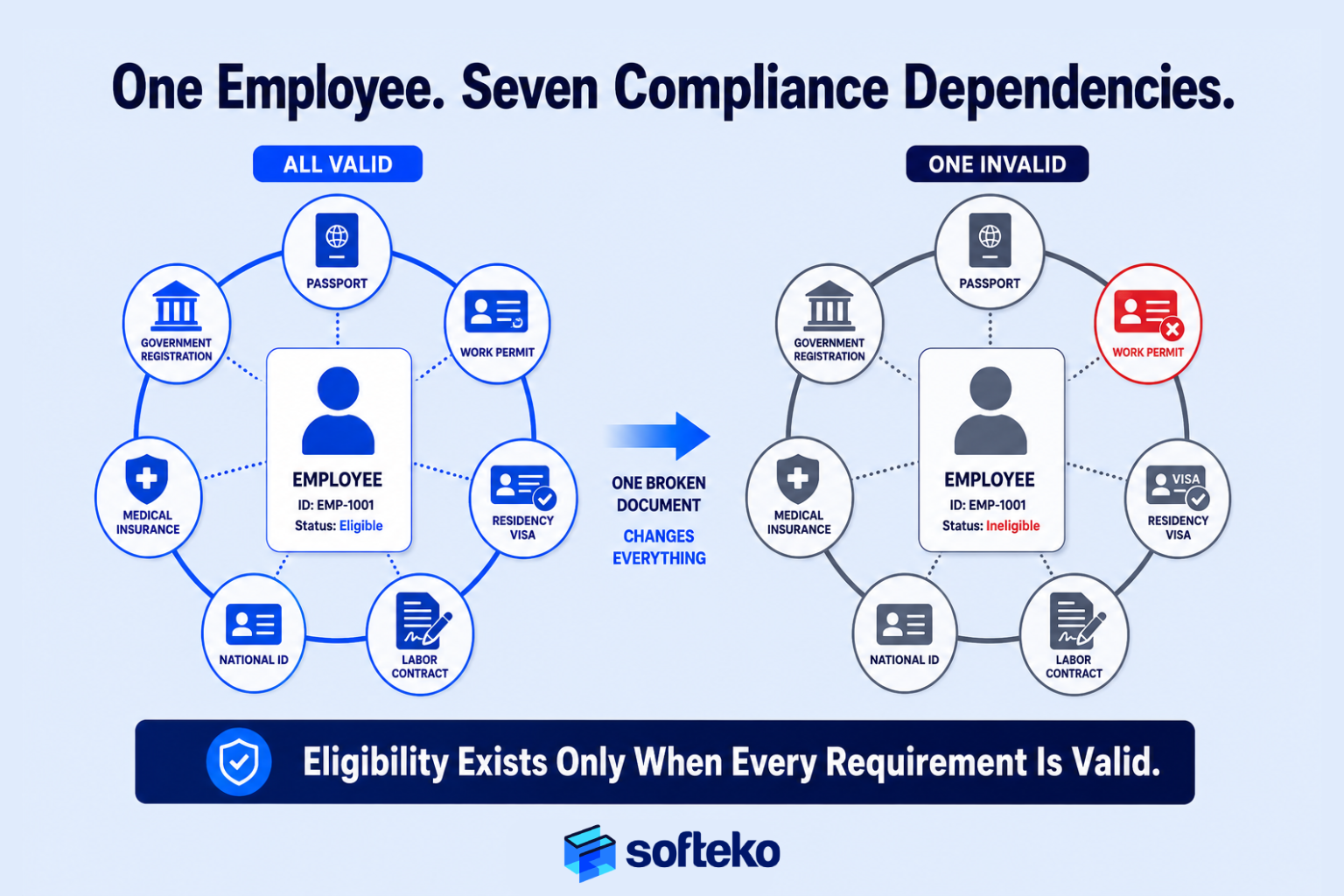
| # | Stage | The question it answers | What it enables for trading |
|---|---|---|---|
| 1 | Operational Role | Which trading role does this person fill? | Coverage of a defined trading control (e.g., Customs Clearance) |
| 2 | Eligibility | Are the person’s documents valid and complete? | Contract, visa, work permit, national ID, licences current |
| 3 | Compliance | Do all obligations to authorities remain satisfied? | WPS, Emiratisation, Saudisation, LMRA registration up to date |
| 4 | Availability | Is the person physically able to work this week? | No visa hold, no permit gap, no exit permission pending |
| 5 | Operational Control | Is the workflow monitored so gaps are caught in time? | 90/60/30-day alerts owned by named stakeholders |
| 6 | Trading Continuity | Do trading operations run without workforce disruption? | RFQs answered, POs issued, shipments cleared, invoices posted |
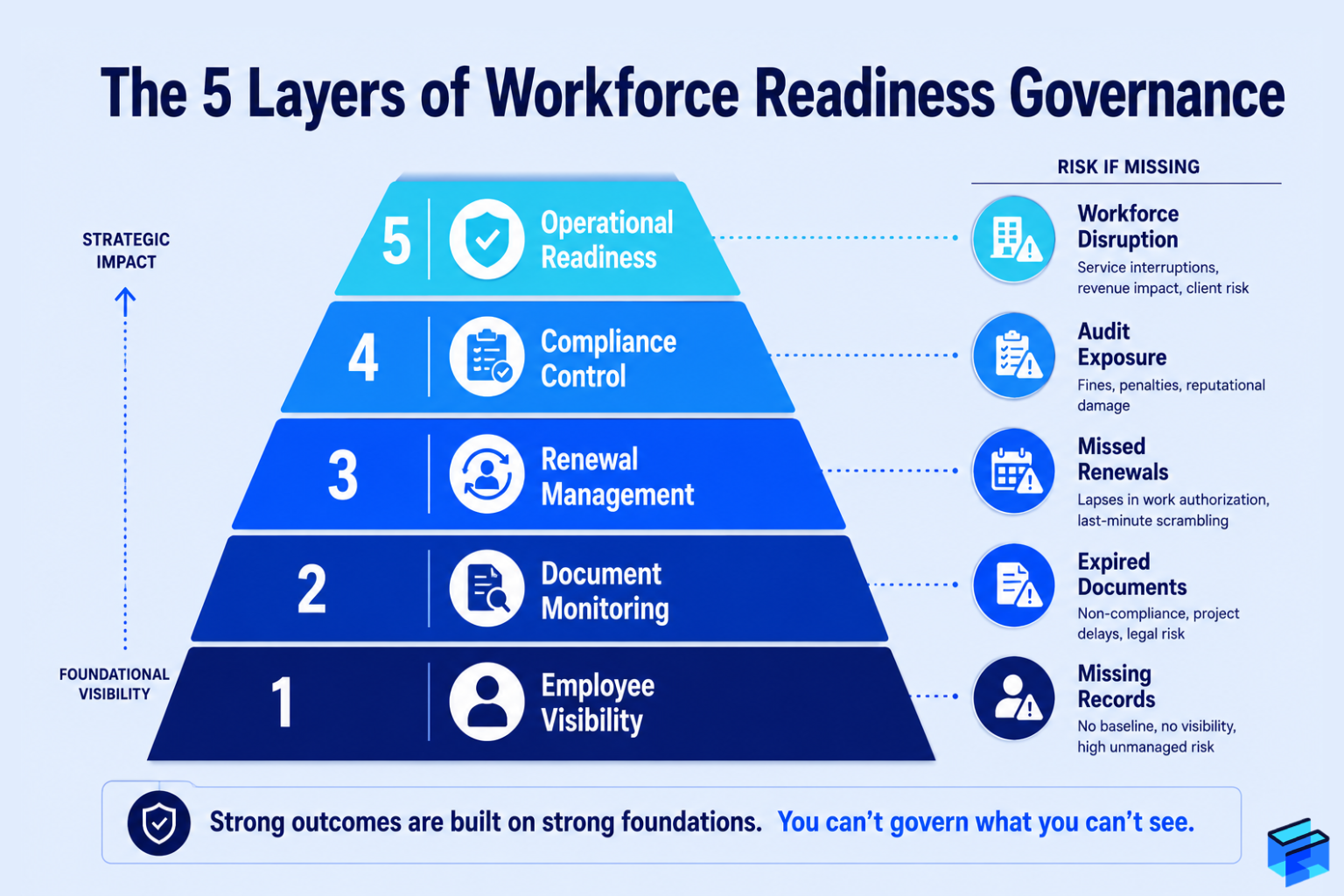
Stages 1–4 describe the person. Stage 5 is what an ERP adds. Stage 6 is what the trading business feels in its cash cycle. Most trading businesses invest heavily in Stages 1 and 2 (hiring and onboarding), audit Stages 3 and 4 once a year, and skip Stage 5 entirely — which is why disruption arrives without warning.
Audit Readiness Does Not Guarantee Trading Readiness
Passing an audit proves the past. Running trading operations tomorrow requires proving the future. Trading businesses that mistake one for the other build a dangerous blind spot.
| Audit readiness | Trading readiness |
|---|---|
| Focuses on evidence | Focuses on continuity |
| “Can we prove roles were compliant last quarter?” | “Will every trading stage have coverage next quarter?” |
| Historical orientation | Forward orientation |
| Records, documents, audit trails | Expiry windows, renewal workflows, escalation rules |
| Periodic exercise triggered by external request | Continuous discipline that runs alongside sales and procurement |
| Centralised records cut audit completion time by ~50%.[5] | Prevents shipments, deliveries, and collections from being disrupted before disruption occurs |
The gap between the two is where trading businesses lose money silently. A Sales Executive’s contract, an Import Coordinator’s work permit, and a Warehouse Supervisor’s residency visa may all be compliant today. That fact is worth nothing if any of them expires inside the next 60 days without a renewal already underway.
Managing Workforce Readiness Across UAE, KSA, and Bahrain
A trading business operating across the GCC runs three regulatory regimes in parallel. Each authority defines the compliance obligation. Each defines the penalty. The trading workflow feels the impact whichever country the failure occurs in.
| Country | Primary regulator | Trading-relevant obligation | Reported penalty range |
|---|---|---|---|
| UAE | MOHRE (Ministry of Human Resources & Emiratisation) | Emiratisation targets, WPS (Wage Protection System) compliance, work permit validity, prohibition on withholding worker documents | Up to AED 20,000 per employee (Emiratisation); AED 200 per employee after 60-day permit-renewal grace period |
| Saudi Arabia (KSA) | MoHRSD via Qiwa platform | Digital contract notarisation, Saudisation (Nitaqat), employer-borne Iqama and work-permit fees | Up to SAR 250,000 (~US$66,590) for serious violations |
| Bahrain | LMRA (Labour Market Regulatory Authority) | Labor registration, wage protection, CPR renewal | BHD 500–2,000 per employee for non-compliance |
Penalty figures cited from industry-aggregator data. Verify current rates with each authority’s official channels (MOHRE, Qiwa, LMRA) before relying on these for compliance planning.
The 90/60/30-day alert cadence is the same across all three:
| Window | Purpose | Trading action |
|---|---|---|
| 90 days out | Planning | HR notifies role owner, documents gathered, agency coordination begins |
| 60 days out | Execution | Application lodged, biometric or medical appointments booked |
| 30 days out | Escalation | Line manager and Operations Manager alerted; contingency coverage identified for the affected trading role |
A trading business running this cadence across UAE, KSA, and Bahrain does not need to memorise each labour law. It needs one visibility layer that applies the correct rules per country and surfaces the exposure in one dashboard.
How ERP Protects Workforce Readiness in Trading Businesses
The trading business already has an ERP for sales, procurement, warehouse, and finance. Workforce readiness belongs in the same system — because that is where the trading workflow lives. When document validity and role eligibility sit inside the ERP, the workflow itself can enforce readiness.
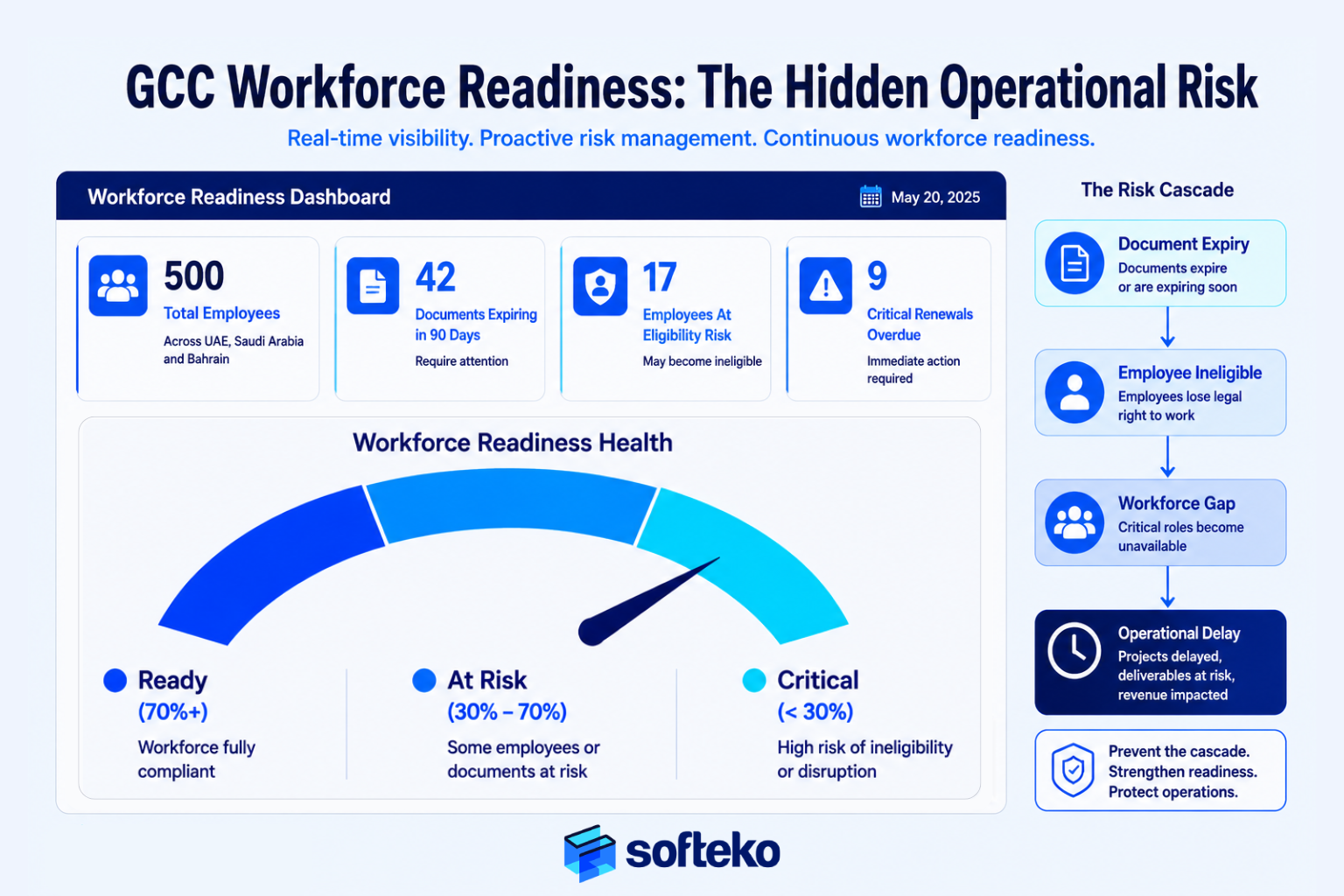
| Manual tracking | ERP-driven readiness |
|---|---|
| Stores expiry dates in a spreadsheet | Continuously evaluates exposure across every trading role |
| Requires an HR administrator to check the file | Escalates upcoming failures to the role owner and Operations Manager |
| Each warehouse or country office holds its own tracker | One source of truth across UAE, KSA, Bahrain |
| Manual reminders sent by email | Tiered automated alerts at 90/60/30 days, daily in the last 30 |
| Renewals depend on a single person’s memory | Renewals are tracked workflows with ownership and audit trail |
| Compliance status known when audited | Readiness surfaced as a live KPI on the same dashboards as OTIF and DSO |
Independent ROI analysis of ERP reports compliance administrative burden falling by around 40% and overall ROI exceeding 200% with ~6-month payback.[6] For a trading business the structural benefit matters more than the number: as headcount and country coverage grow, visibility scales automatically while administrative capacity does not need to grow in step.
How Odoo Implements Workforce Readiness Controls
Odoo already runs the trading workflow — CRM for RFQs, Sales for quotations, Purchase for supplier POs, Inventory for warehouse, and Accounting for invoicing. Therefore, workforce readiness runs in the same platform, using the same access rules, dashboards, and audit logs.
Below, the ten Odoo controls are grouped into three layers: the data layer (what is stored), the workflow layer (how renewals move), and the oversight layer (how the trading business sees status).
The data layer: employee records and documents
First, the data layer captures every fact the readiness system depends on.
| Control | What it does | Trading impact |
|---|---|---|
| Employee master record | One unified profile per role with contract, visa, permit, passport, national ID, licences | Every trading role links to a single readiness view |
| Central document repository | Digital copies with metadata (issue date, expiry, authority) | Removes reliance on shared drives and email chains |
| Document version control | Auto-versioning of every updated document | Full history without duplicate files |
| Country-specific compliance records | Applies UAE / KSA / Bahrain rules automatically (Emirates ID, Iqama, CPR, WPS, Saudisation, LMRA registration) | Multi-country trading operations managed from one system |
In short, once the data layer is clean, the workflow and oversight layers can run on top of it.
The workflow layer: alerts, approvals, and ownership
Next, the workflow layer turns stored data into scheduled action.
| Control | What it does | Trading impact |
|---|---|---|
| Expiry monitoring | Continuous evaluation of validity against renewal cadence | Import Coordinator, Warehouse Supervisor, Delivery Driver documents surfaced before expiry |
| 90/60/30-day alerts + daily in final 30 | Tiered notifications with escalation | Matches the same cadence used for contract renewals (120-day weekly alert, 90-day performance review, 2-month renewal letter) |
| Approval workflows | Line Manager → HR → HR/Admin Manager for renewals | Same approval discipline used for supplier PO approval and PFI signoff |
| Role-based notifications | Alerts routed to role owner, line manager, Operations Manager | Trading disruption prevented at the workflow layer, not just the HR layer |
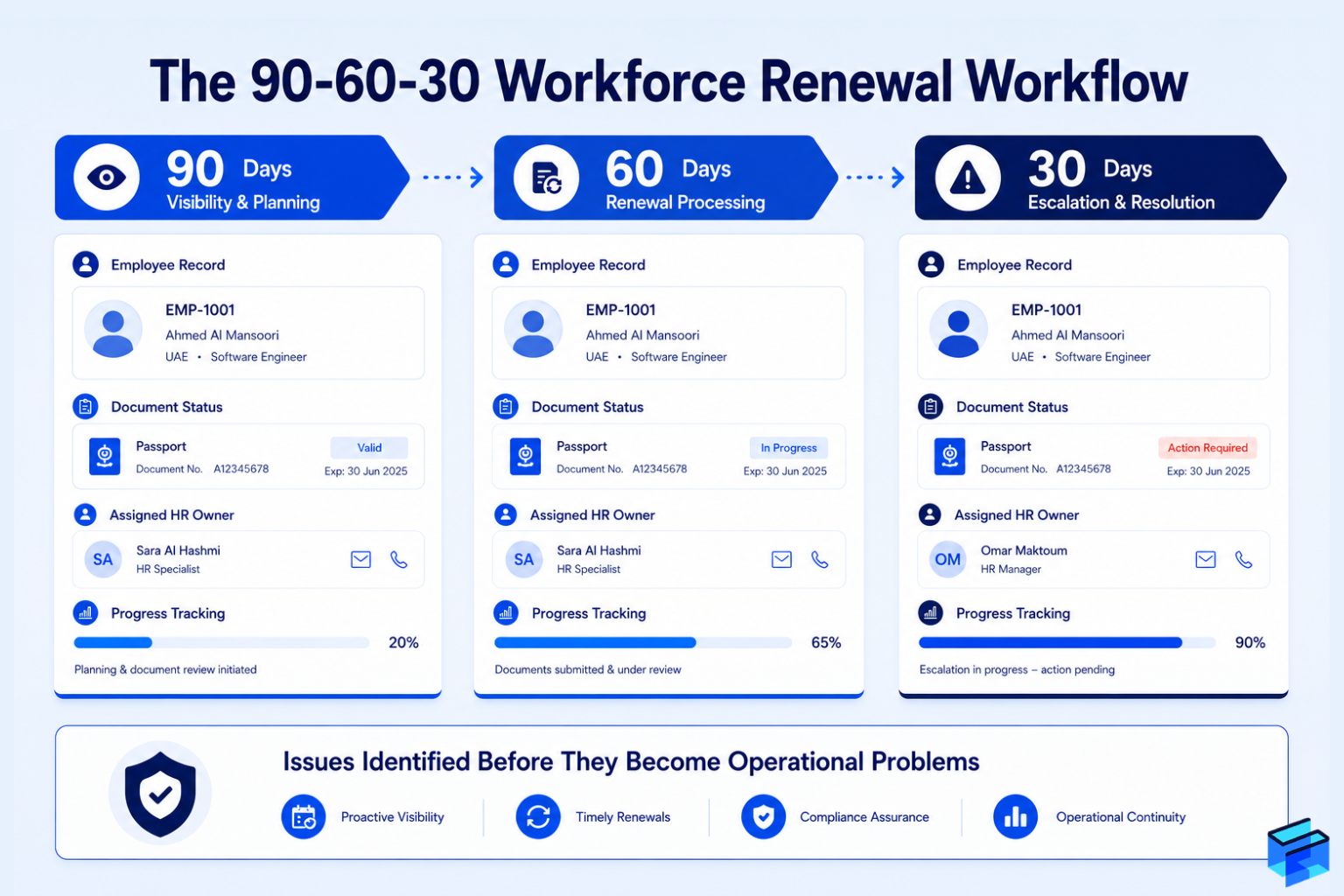
Consequently, each expiry becomes a task with an owner and a deadline, rather than a spreadsheet row waiting to be noticed.
The oversight layer: dashboards and audit trail
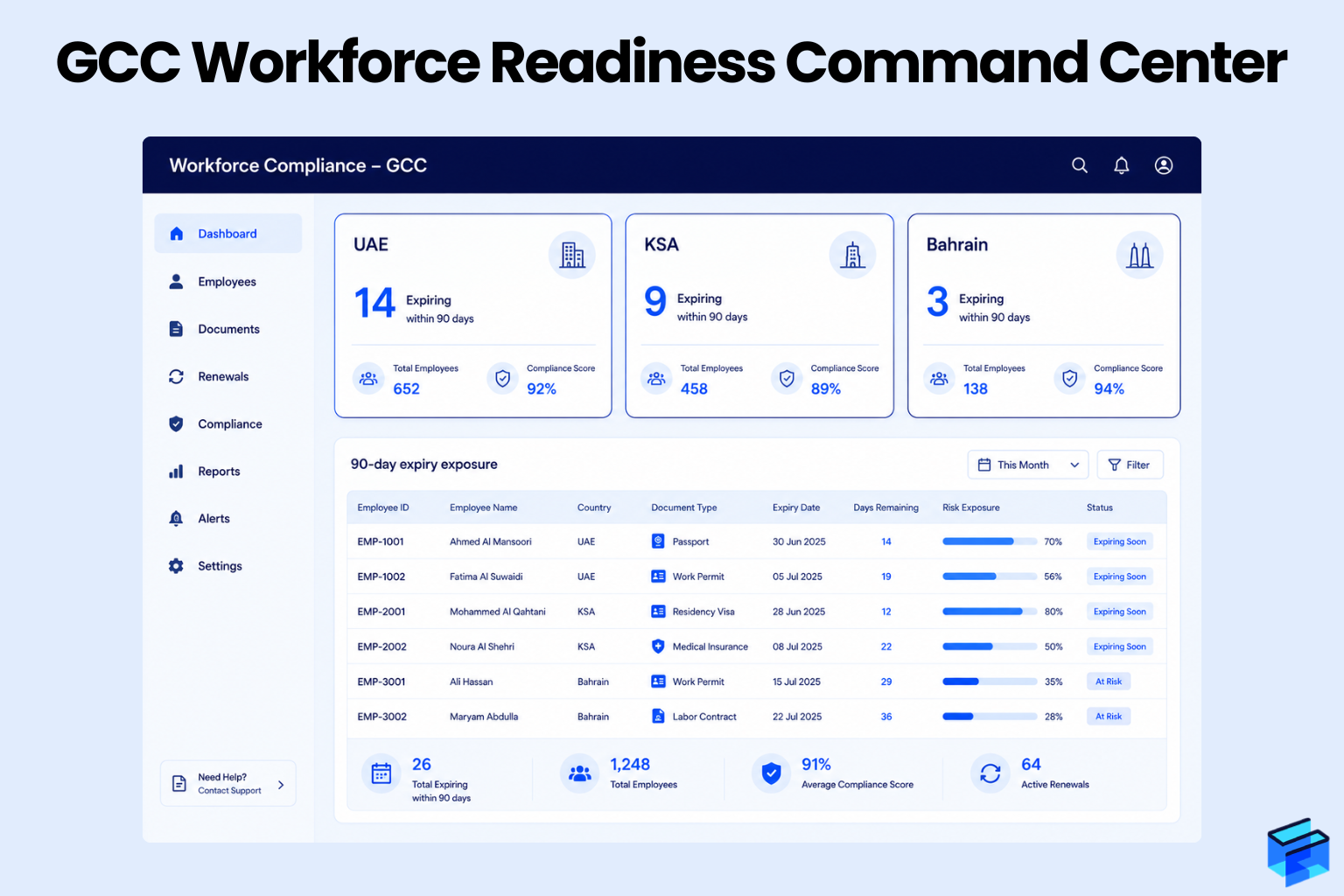
Finally, the oversight layer gives leadership the same forward view they already trust for supplier OTIF and DSO.
| Control | What it does | Trading impact |
|---|---|---|
| Dashboard visibility | Live view of headcount, expiries in next 90 days, country exposure, department readiness | Same dashboard grammar as OTIF, DSO, margin variance |
| Audit trail | User ID and timestamp on every view or change to sensitive HR data | Meets the audit-readiness requirement without a separate exercise |
Importantly, these are not features in isolation. Instead, each one implements an operational control the trading business already relies on — expiry monitoring is workforce cycle counting, tiered alerts are the workforce equivalent of the 25-day + credit-period payment reminder rule, and dashboards report readiness the same way they report supplier OTIF.
Workforce Readiness Checklist for Trading Businesses
Use this checklist across the trading business. Rate each item from 0 (no visibility) to 4 (full visibility and automation). Maximum: 60 points across 15 controls.
Visibility across trading roles
| # | Question | Score (0–4) |
|---|---|---|
| V1 | Can the Operations Manager see which trading roles have documents expiring in the next 90 days? | |
| V2 | Can readiness be viewed across Sales, Procurement, Import, Warehouse, and Delivery in one place? | |
| V3 | Can exposure be broken down by country (UAE, KSA, Bahrain) and by warehouse? |
Monitoring the trading workflow
| # | Question | Score (0–4) |
|---|---|---|
| M1 | Are visa, permit, passport, and contract expiries monitored against role coverage? | |
| M2 | Are 90/60/30-day alerts triggered automatically to the role owner? | |
| M3 | Are Delivery Driver licences and Forklift Operator certificates monitored as strictly as visas? |
Renewal ownership
| # | Question | Score (0–4) |
|---|---|---|
| R1 | Does every renewal have a named owner in HR and a named backup in the trading function? | |
| R2 | Is renewal progress tracked from initiation through final approval and upload? | |
| R3 | Are escalation rules defined when a renewal misses its 30-day window? |
Compliance across GCC jurisdictions
| # | Question | Score (0–4) |
|---|---|---|
| C1 | Can complete role-level compliance records be produced during an MOHRE, Qiwa, or LMRA audit without manual consolidation? | |
| C2 | Are UAE / KSA / Bahrain rules applied automatically to the right roles? | |
| C3 | Are WPS, Emiratisation, and Saudisation obligations tracked as live status, not annual review? |
Trading continuity
| # | Question | Score (0–4) |
|---|---|---|
| O1 | Can the Operations Manager confirm today that every trading stage has legally available coverage? | |
| O2 | Can the same confirmation be made for next quarter? | |
| O3 | Are contingency plans defined for the top 5 single-role dependencies in the trading workflow? |
How to read your total
| Total score | Maturity level | What it means for the trading business |
|---|---|---|
| 0–20 | High risk | Trading workflow exposed to sudden disruption. Compliance depends on spreadsheets and individual memory. Readiness discovered during a shipment delay, not before it. |
| 21–40 | Moderate risk | Core processes exist. Visibility fragmented across HR files and country offices. Growth into a new country or warehouse will increase disruption frequency. |
| 41–50 | Controlled | Workforce readiness treated as an operational discipline. Monitoring, renewal, and audit trails work. Gaps concentrated in cross-country visibility and role-level dashboards. |
| 51–60 | Trading-ready | Workforce readiness runs as a live operational control alongside OTIF, DSO, and margin. Disruption prevented at the workflow layer. |
One question that reveals workforce readiness
If MOHRE, Qiwa, or LMRA requested workforce evidence tomorrow, and 20 documents across Sales, Procurement, Import, Warehouse, and Delivery approached expiry inside 90 days, would the Operations Manager know about both situations immediately?
Trading-ready businesses answer yes. Every other answer is a delayed disruption in the trading workflow.
Build a Workforce Readiness System for Your Trading Business
If your trading business is still relying on spreadsheets, email reminders, and country-level HR files, workforce risks are already building weeks before they reach the shipment floor. The cost shows up as demurrage on stalled containers, missed customer delivery dates, unposted invoices, and stretched collection cycles — with the compliance penalty arriving on top.
At Softeko, we help GCC trading businesses implement Odoo ERP so workforce readiness runs on the same platform as sales, procurement, warehouse, and finance — with unified role-level visibility, automated 90/60/30 alerts, renewal workflows, and country-specific compliance records across UAE, Saudi Arabia, and Bahrain.
The objective is not software. It is turning workforce readiness into an operational control that protects every stage of the trading workflow before disruption reaches the customer.
FAQ
What is workforce readiness in a trading context?
Workforce readiness is the state of every trading role being filled by a person who is legally eligible, currently compliant, and physically available to execute the operational control that role owns — from RFQ intake through customs clearance to invoice closure.
How is workforce readiness different from HR compliance?
HR compliance measures document validity as a legal requirement. Workforce readiness measures the same documents as trading operational controls — so a lapsed Import Coordinator work permit is reported the same way a stockout is reported: as a coverage failure in a trading stage.
How is audit readiness different from trading readiness?
Audit readiness proves that trading roles were compliant last quarter. Trading readiness confirms that every stage of the workflow will have coverage next quarter. Both matter, only the second one protects cash flow.
Which trading roles fail hardest when compliance lapses?
Roles that legally sign for something. Customs Clearance Officers, Import Coordinators, Delivery Drivers, and Warehouse Supervisors on regulated equipment cannot be substituted informally — their compliance directly gates the trading stage they own.
Which GCC authorities matter for trading operations?
MOHRE in the UAE (also responsible for WPS), Qiwa in Saudi Arabia (under MoHRSD), and LMRA in Bahrain. Each manages different labour requirements with different penalty regimes; trading businesses operating in more than one country run all three regimes in parallel.
Why does cross-country trading amplify the readiness problem?
Because complexity does not grow linearly. Cross-border workforce management increases compliance complexity by approximately 3×.[3] For a trading business the multiplier applies to role coverage — the number of trading stages that must remain executable across every country every day.
Will ERP make our trading business compliant automatically?
No. ERP provides the visibility and enforcement layer. The controls have to be designed and enforced as a process first — 90/60/30 alert windows defined, renewal ownership assigned, escalation paths agreed with Operations. Implementations that succeed treat workforce readiness the same way they treat supplier OTIF: as a KPI with an owner and a dashboard.
What is the highest-impact starting point if we are still on spreadsheets?
Centralise visa, permit, and contract expiry monitoring for the 10–15 trading roles whose absence would freeze the workflow (Import Coordinator, Customs Clearance Officer, Warehouse Supervisor, Delivery Driver, Weighbridge Operator, Procurement Officer, Operations Manager, Finance Officer). One tiered alert layer across those roles prevents the largest category of trading disruption.
References
- Hyperproof — 2025 IT Compliance Benchmark Report — https://hyperproof.io/2025-it-compliance-benchmark-report/
- SHRM — 2025 State of the Workplace Research Report (PDF) — https://www.shrm.org/content/dam/en/shrm/topics-tools/research/2025-shrm-state-of-the-workplace-research-report.pdf
- Lexology — Cross-border workforce compliance complexity — https://www.lexology.com/library/detail.aspx?g=98c5334e-0a64-41ed-a359-9d9ddadb188f
- SHRM — The New Era of Workforce Planning — https://www.shrm.org/topics-tools/topics/the-new-era-of-workforce-planning
- SSRN — Centralised digital records and audit efficiency (2025) — https://papers.ssrn.com/sol3/papers.cfm?abstract_id=6563958
- Microsoft / Forrester TEI — Dynamics 365 Business Central ROI study — https://www.microsoft.com/en-us/dynamics-365/blog/business-leader/2026/03/31/enable-accelerated-growth-with-confidence-a-forrester-tei-study-projects-more-than-200-roi-over-three-years-and-six-month-payback-using-dynamics-365-business-central/