


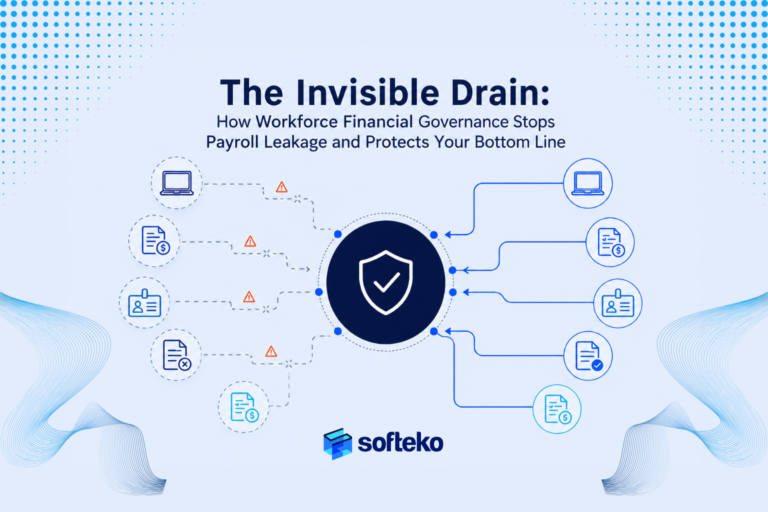
Workforce cost leakage is the quiet outflow of trading profit through unrecovered employee advances, unreturned company assets, unvalidated overtime, duplicated payroll payments, and unreconciled exit settlements. When each of those risks is controlled across the employee lifecycle, it creates workforce financial governance — the discipline that keeps every employee-related financial obligation visible, accountable, recoverable, and reconciled.
A trading business already fights for margin at three points: landed cost at import, credit control at collection, and inventory accuracy at the warehouse. However, all three gains can be quietly given back through workforce leakage. This article shows how ERP protects the trading margin at the workforce layer, across UAE, Saudi Arabia, and Bahrain.
Key takeaways
- Trading businesses lose approximately 5% of annual revenue to occupational fraud and abuse, while payroll-fraud schemes last on average 18 months before detection — with a median loss around $50,000.[1]
- Furthermore, bottom-performing payroll operations run at 12–15% error rates.[2] On a $10M annual payroll, that is a $1.2–1.5M direct hit to the trading margin.
- Without managed asset lifecycles, employee asset return rates can fall as low as 35%.[3] For a trading business, that means two out of every three laptops, mobiles, forklift certificates, fuel cards, and delivery-vehicle sets may never come back.
- Moreover, 60% of leaders identify staffing changes as the top challenge to internal controls,[4] and high-growth trading firms are 3× more likely to have material control weaknesses.[5]
- The fix isn’t more spreadsheets, more checklists, or more approval layers. Instead, it’s workforce financial governance — a structured control model that keeps every employee-related financial obligation visible, accountable, recoverable, and reconciled from onboarding to final settlement, so the trading margin actually survives to the bottom line.
Workforce Cost Leakage Reduces Trading Margins
A trading business tracks its margin through three well-known disciplines. First, landed cost captures every dollar between supplier price and warehouse receipt. Second, credit control protects the margin against slow-paying or defaulting customers. Third, inventory accuracy prevents shrinkage from silently eating profit.
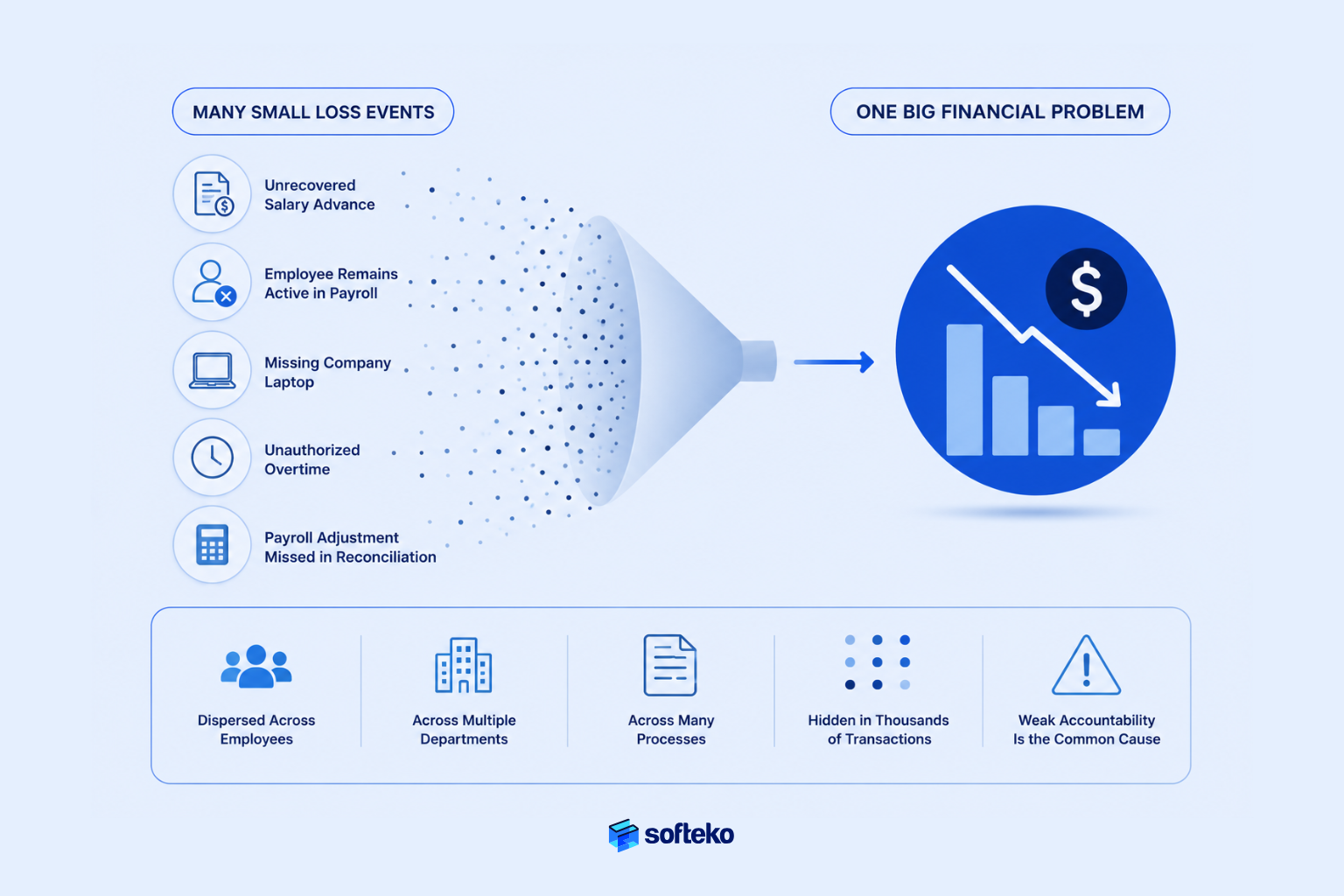
However, there is a fourth margin exposure most trading businesses do not measure: workforce cost leakage. This is the money that leaves the business through employee-related financial obligations that were never fully recovered, reconciled, or validated.
| Margin discipline | What it protects against |
|---|---|
| Landed cost | Freight, duty, storage, and clearance charges eroding purchase margin |
| Credit control | Bad debt, DSO drift, dispute deductions |
| Inventory accuracy | Shrinkage, obsolete stock, mis-picks |
| Workforce cost leakage | Unrecovered advances, unreturned assets, duplicated payroll, unreconciled exits |
For most trading businesses, workforce costs are 40–60% of operating expenses. Consequently, even a 2–4% leakage rate on that base becomes the single largest silent margin loss on the P&L — typically $1M to $5M annually for a mid-sized trading business.
The 4 Sources of Workforce Cost Leakage in Trading Businesses
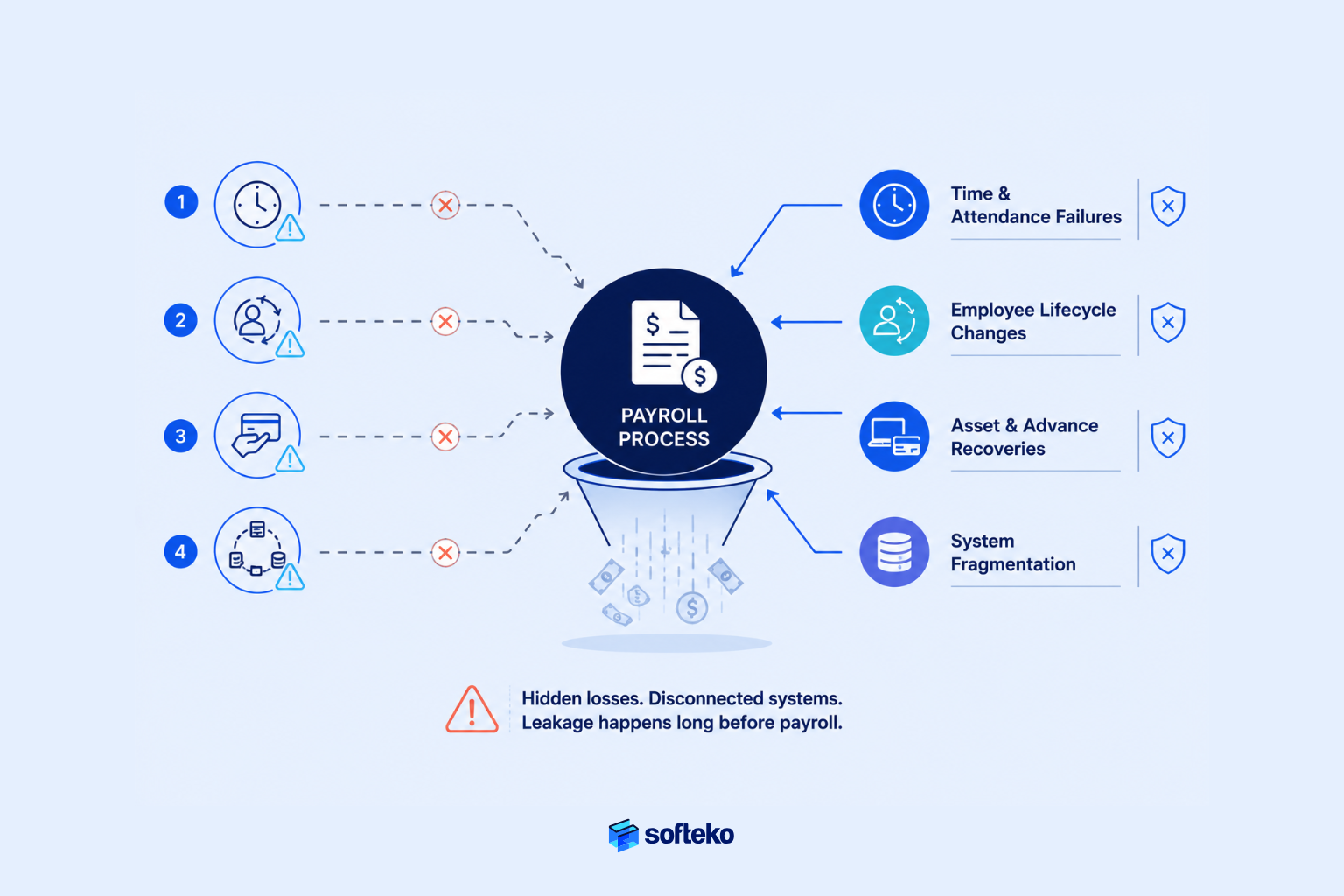
Workforce cost leakage rarely begins on payroll day. By the time an incorrect payment hits a payslip, the underlying control failure has already existed for weeks. Payroll simply processes the information it receives; therefore, if that information is incomplete, inaccurate, delayed, or disconnected, payroll converts operational mistakes into financial transactions.
| # | Source | What goes wrong in trading operations | Why it persists |
|---|---|---|---|
| 1 | Time & attendance failures | Warehouse overtime approved without validation; Delivery Driver route hours corrected manually; biometric exceptions entered after cut-off; Ramadan-adjusted hours mis-applied | Approvals replace controls — supervisor trust without objective verification |
| 2 | Employee lifecycle changes | Resignation, transfer between UAE/KSA/Bahrain entities, unpaid leave, contract change, probation exit — status changes flow between HR and Payroll by email | HR system holds the change; payroll consequences are managed elsewhere |
| 3 | Asset and advance recoveries | Forklift certificate renewal fees, fuel-card charges, accommodation deductions, salary advances, mobile phone charges, delivery-vehicle damage — each tracked in a different file | No mechanism links the recovery obligation to the final settlement |
| 4 | System fragmentation | HR system + payroll system + attendance system + accounting system + warehouse duty roster + fuel-card portal + fleet log + spreadsheets | Bottom-performer payroll operations run at 12–15% error rates from exactly this fragmentation.[2] |
Validate Every Decision Before You Approve It
If the Warehouse Manager can approve overtime without seeing biometric attendance, the day’s dispatch volume, or the pending Sales Orders that justified the overtime, the approval becomes an administrative formality rather than a governance mechanism. The same logic applies to salary advance disbursement, asset assignment, fuel-card top-ups, and exit settlement release.
Where Workforce Cost Leakage Occurs
The same governance failure looks different depending on which trading function it hits. Below is where leakage translates into direct margin loss.
| Trading function | Role at risk | How workforce cost leaks |
|---|---|---|
| Sales / Commercial | Sales Executive | 60+10 commission paid despite late collection; travel expense duplicates; unreturned laptop, mobile, SIM at exit |
| Procurement | Procurement Officer | Supplier-visit travel advances unrecovered; expense receipts uploaded twice; personal phone charges billed to company SIM |
| Import / Documentation | Import Coordinator | Overtime approved during shipment surges without objective validation; DHL / courier accounts still active after exit |
| Customs & clearance | Customs Clearance Officer | Broker certificate renewal fees advanced and never recovered; permit-related fines absorbed by employer without deduction rules |
| Warehouse | Warehouse Supervisor, Forklift Operator, Weighbridge Operator | Forklift certification fees advanced and unrecovered; asset assignments (scanners, tablets, radios) not returned; overtime for bulk-to-bag campaigns not tied to output |
| Delivery | Delivery Driver, 3PL Liaison | Company vehicle fuel-card charges not reconciled; traffic fines borne by employer without deduction; delivery route hours corrected without validation |
| Finance / Accounting | Finance Officer, AR Controller | Manual payroll adjustments processed and forgotten during reconciliation; exit settlements released before recovery deductions |
| HR / Admin | HR Administrator | Salary advances issued without recovery schedule; accommodation damage deductions missed on the final settlement |
Notably, none of these are large individually. Collectively, however, they are the difference between a healthy trading margin and a disappointed CFO at quarter-close.
How One Company Asset Creates Financial Risk
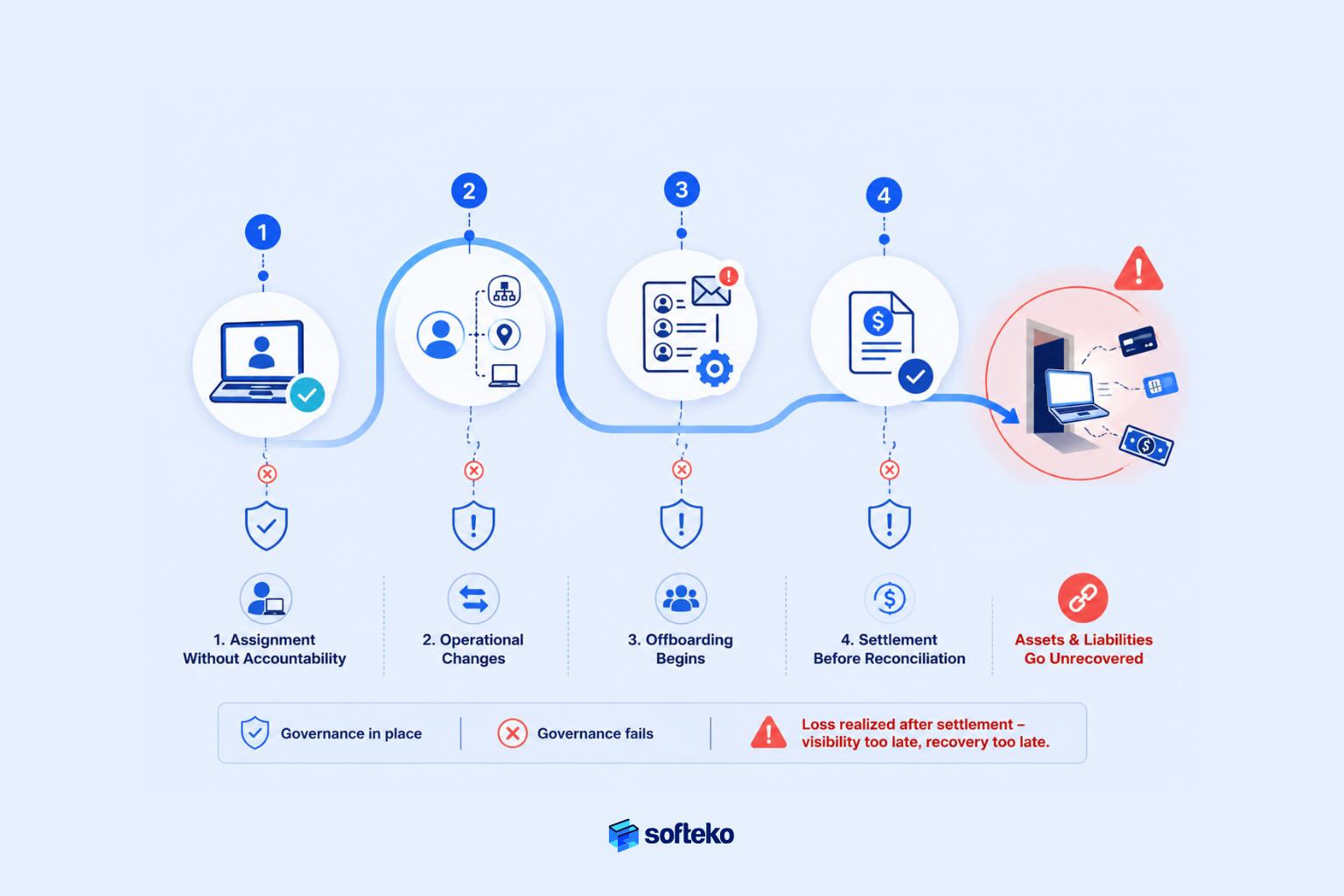
Workforce financial governance becomes easier to understand through a single asset — not a payroll transaction, just one company laptop assigned to an Import Coordinator on Day 1.
| Stage | What happens | Where governance fails |
|---|---|---|
| 1. Assignment | Import Coordinator receives laptop, mobile, SIM, DHL account, courier badge, and a Windows/Office licence | Some items recorded in IT; others in HR spreadsheets; nobody owns the master list |
| 2. Operational change | Coordinator transfers from UAE to KSA; a second laptop is issued at the new site because the first one “is on the way” | Asset records fragment across countries; the first laptop drifts off the register |
| 3. Offboarding begins | HR initiates exit; Finance prepares settlement; IT, Warehouse, Fleet, and Accommodation are all emailed for status | Departments respond independently; the settlement deadline approaches; controls weaken under time pressure |
| 4. Settlement released before reconciliation | Final EOSB and pending salary paid; employee leaves | Afterwards, IT discovers the first laptop was never returned, Fleet finds the fuel card active for two months, and HR sees an accommodation damage claim that was never deducted. The strongest recovery tool — the final paycheck — has already been used |
Research on device lifecycle management shows asset return rates fall to 35% without managed lifecycle controls.[3] The issue is not theft. Rather, it is visibility. Trading businesses cannot recover assets they cannot accurately trace back to individual employees across every country entity.
The moment an asset is assigned to an employee, it becomes a workforce financial governance issue. The laptop is capital. The fuel card is ongoing exposure. The salary advance is a recoverable liability. The Forklift Operator certificate is a renewal cost. All of them belong on one register linked to one employee record.
Why Workforce Accountability Breaks During Growth
In a small trading business, accountability runs on visibility — everyone knows everyone, and the CEO knows which Delivery Driver has the company SIM. Growth changes that reality quickly. Trading businesses scale headcount, warehouses, and country entities far faster than they scale governance.
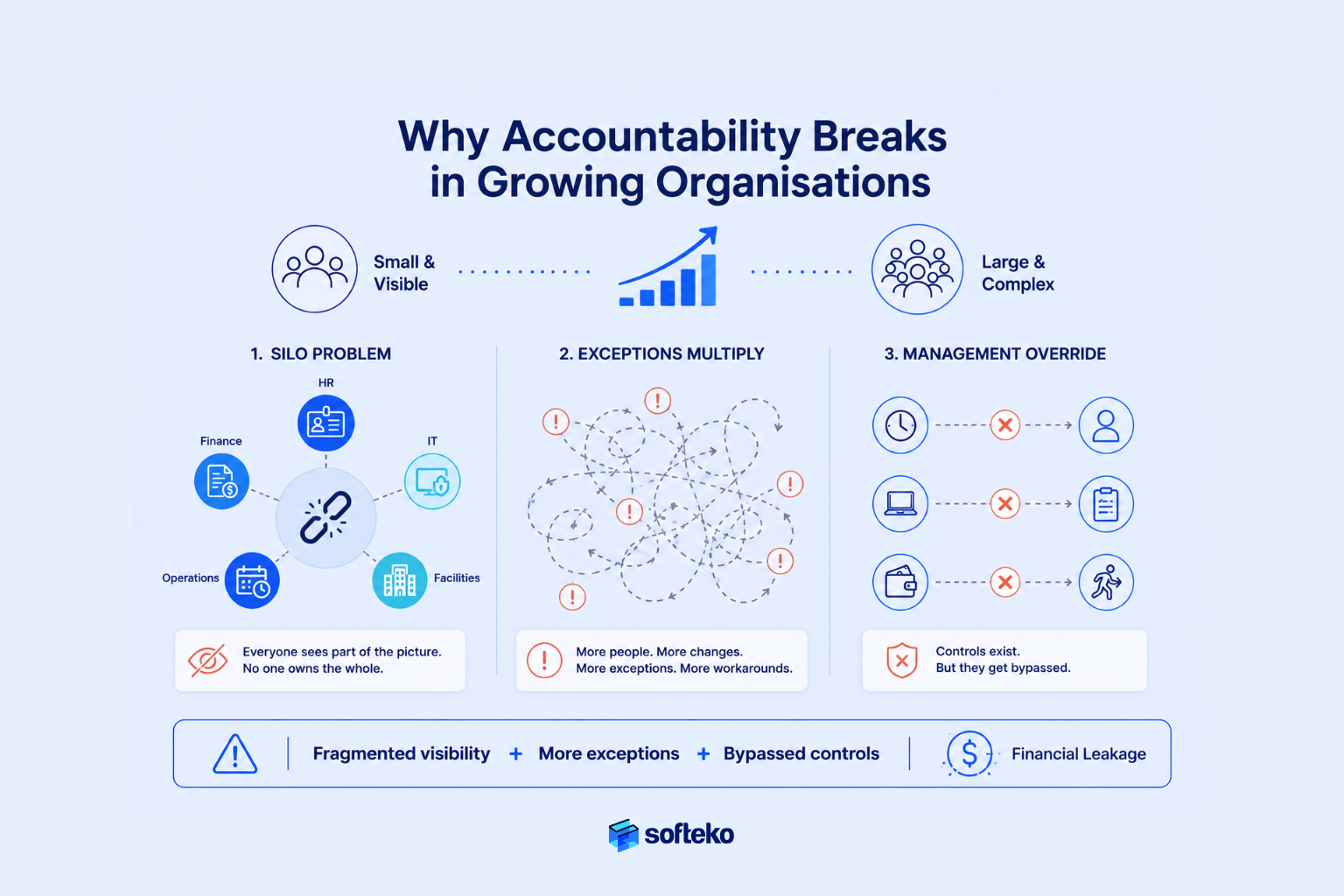
The silo problem in a trading business
| Department | What it sees | What it does not see |
|---|---|---|
| HR | Employee records, contract, probation, exit status | Fuel-card balances, vehicle damage, laptop returns |
| Finance / Payroll | Salary, allowances, advances issued | Whether the asset behind an advance was ever returned |
| IT | Laptops, mobiles, software licences | Whether the employee is still employed |
| Operations / Warehouse | Duty rosters, overtime hours | Salary impact of that overtime |
| Fleet / Logistics | Vehicles, fuel cards, traffic fines | Payroll deduction rules for personal usage |
| Facilities / Admin | Accommodation, access cards | Damage recoveries at exit |
Each department solves its immediate problem. Collectively, however, the trading business creates fragmented visibility. As a result, accountability does not break because employees make mistakes — it breaks because nobody owns the whole process end to end.
Business Growth Creates More Process Exceptions
Trading businesses design their processes around normal operations. Governance rarely fails in normal operations. Instead, it fails during exceptions: mid-cycle advances for a Sales Executive attending a KSA trade fair, emergency overtime for a bulk-to-bag campaign in the warehouse, retro payroll adjustments after a promotion, temporary UAE-to-Bahrain assignments, early resignations during peak import season, notice-period disputes, delivery-vehicle damage claims, and manual deduction requests.
As trading volume grows, exceptions become daily rather than monthly. Consequently, without structured governance, exceptions become the dominant workflow — and the trading business stops operating through systems and starts operating through workarounds.
Management Overrides Weaken Internal Controls
Most trading businesses already have policies. However, those policies get bypassed under pressure. For example, a Warehouse Manager approves weekend overtime because the shipment must clear before Ramadan hours reduce capacity. Equipment is issued to a new Forklift Operator before the assignment paperwork is signed. A final settlement releases before asset verification because the exiting Delivery Driver is refusing to hand back the vehicle without payment. The ACFE consistently identifies control overrides as a major contributor to occupational fraud.[1] The problem is not lack of policy — it is that policy gets bypassed when speed matters more than accountability.
The 6-Stage Workforce Financial Governance Model
Trading businesses that consistently protect margin manage workforce financial exposure through a structured six-stage model that spans the entire employee lifecycle. Each stage protects a specific point where the trading margin can leak.
| # | Stage | Purpose | Failure mode if missing |
|---|---|---|---|
| 1 | Assignment | Every financial obligation has a documented owner from the moment it is issued | Assets, advances, allowances issued without recovery terms recorded |
| 2 | Visibility | A single source of truth across HR, Finance, IT, Operations, Fleet, and Facilities | Each department sees its own data; nobody sees complete workforce exposure |
| 3 | Accountability | Clear ownership of outcomes (not just tasks) | Recovery fails — every department explains its role, nobody accepts ownership |
| 4 | Recovery | Recovery is automated, not memory-dependent | Recovery happens when someone remembers, not because the process demands it |
| 5 | Reconciliation | Continuous matching of workforce, payroll, asset, and financial records | Payroll ledger balances perfectly while assets are missing and advances unpaid |
| 6 | Trading Margin Protection | Governance measured as bottom-line outcome, not as HR administration | Compliance treated as paperwork; margin quietly leaks to the P&L |
RACI for workforce financial governance in a trading business
| Activity | Responsible | Accountable |
|---|---|---|
| Asset assignment (laptop, mobile, forklift key, fuel card) | IT / Warehouse Supervisor | Department Manager |
| Employee advance | Finance Officer | Finance Controller |
| Overtime validation (warehouse, delivery, import surges) | Line Supervisor | Operations Manager |
| Payroll validation | Payroll Officer | Finance Head |
| Fuel-card and vehicle reconciliation | Fleet Coordinator | Operations Manager |
| Accommodation damage recovery | Facilities / HR Administrator | HR Manager |
| Exit clearance | HR Administrator | HR Director + Finance Controller |
Responsibility performs the task. Accountability owns the outcome. Without that distinction, governance collapses into administration, and the trading margin quietly funds the difference.
Why Exit Settlements Protect Financial Control
Most trading businesses treat employee offboarding as an administrative workflow. However, from a workforce financial governance perspective, that view is dangerously incomplete.
The employee exit process is not primarily an HR activity. Rather, it is the last opportunity to recover outstanding liabilities, reconcile assigned assets, validate deductions, and close financial exposure before the relationship ends permanently. Once the final settlement is released, the trading business’s leverage drops to zero. Deloitte research found 60% of leaders identify staffing changes as the top challenge to internal controls.[4] Rushed exits consistently produce overpayments because teams are not aware of outstanding debts.
Treat Final Settlement as Financial Reconciliation
The final settlement combines outstanding salary, unpaid allowances, leave encashment, End-of-Service Benefits (EOSB) calculated per GCC jurisdiction, notice-period adjustments, salary advance recoveries, employee loan balances, asset-recovery deductions, accommodation-damage recoveries, expense reimbursements, fuel-card and vehicle liabilities, phone-bill deductions after the 3-day review window, and — for Sales Executives — the 60+10 commission rule reconciliation on any deal still inside the collection window.
Each of those lines originates from a different department. Consequently, settlement is fundamentally a reconciliation exercise across multiple ledgers, not a payroll calculation.
Apply GCC EOSB Rules Automatically
| Country | EOSB rule |
|---|---|
| Bahrain | 0.5 month’s wage per year for years 1–3; 1 month’s wage per year thereafter |
| UAE | 21 days’ wage per year for years 1–5; 30 days’ wage per year thereafter, subject to legal cap |
| KSA | 0.5 month’s wage per year for years 1–5; 1 month’s wage per year thereafter, with specific resignation rules |
A trading business operating across all three cannot afford manual calculation. Instead, the rule engine must sit inside the ERP.
Verify Four Controls Before Final Settlement
| Layer | Control | What it verifies |
|---|---|---|
| 1 | Asset verification | Laptop, mobile, SIM, DHL account, vehicle, fuel card, forklift key, access badge — all confirmed returned, on record, not by assumption |
| 2 | Financial exposure review | Outstanding advances, employee loans, accommodation balances, notice-period liabilities, unapproved expenses, pending phone deductions |
| 3 | Automated settlement calculation | EOSB by country, leave encashment, allowances, recoveries, deductions — no manual calculation, no disputes |
| 4 | Final reconciliation | HR, payroll, asset, fleet, accommodation, and accounting records must all reconcile before payment release; any mismatch becomes an exception requiring investigation |
Every employee lifecycle begins with resource allocation. Therefore, it must end with resource recovery. The final paycheck is the strongest recovery tool the trading business will ever have. Once released, recovery becomes negotiation, legal action, or write-off — and the leakage lands directly on the trading margin.
Connecting Assets, Advances, Payroll, and Recoveries in Trading Operations
Assets, advances, payroll, and recoveries are not separate processes. Rather, they are different expressions of the same financial relationship between the employee and the trading business. When one part of that relationship becomes disconnected, accountability weakens across the entire system.
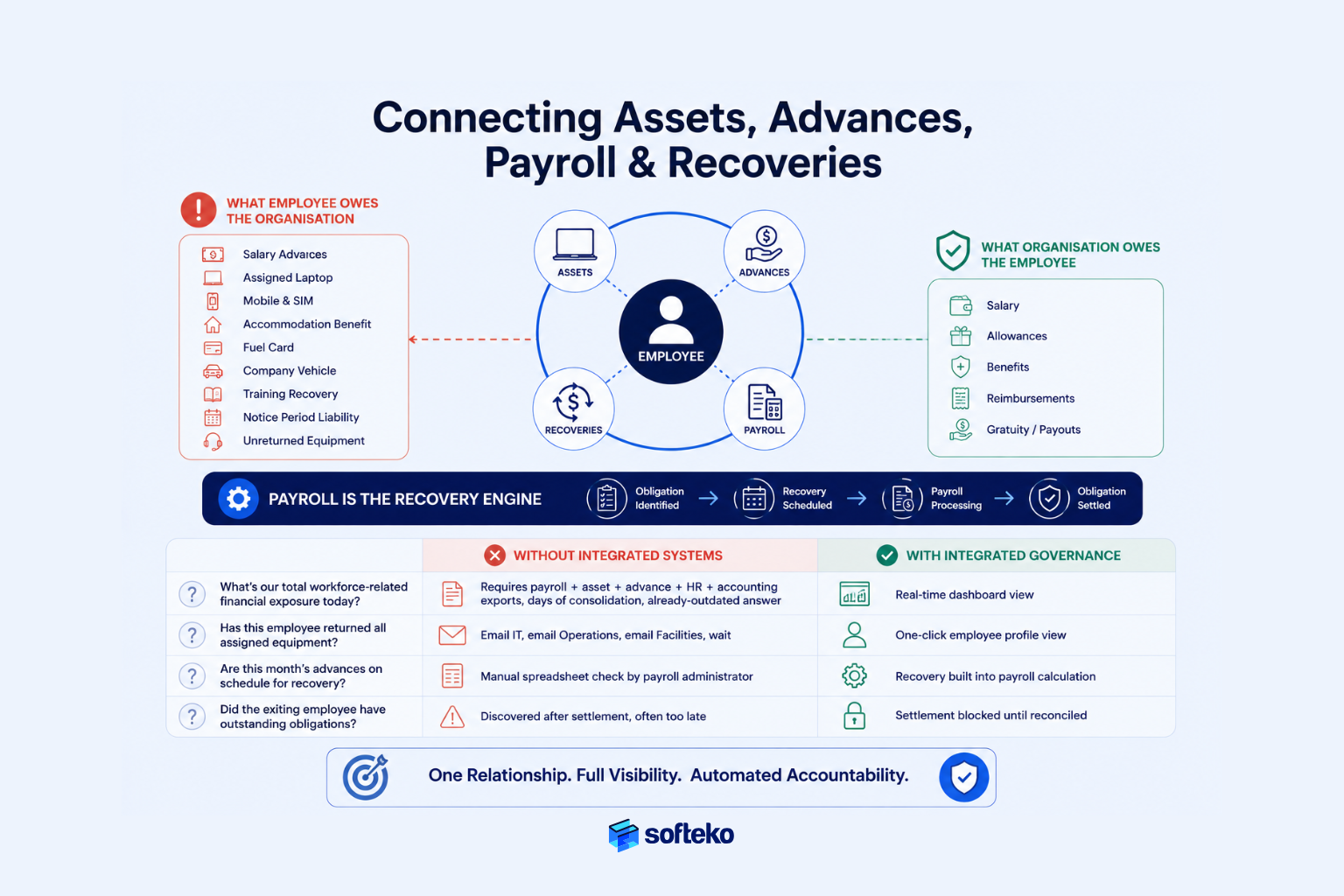
Track Every Employee’s Financial Obligation
At any moment, a trading business’s employee may hold: an outstanding salary advance, an assigned laptop and mobile, an active company SIM, an accommodation allocation, a fuel card, a company vehicle, a training-recovery obligation, a notice-period liability, and an unreturned Forklift Operator certificate paid for by the employer. Individually, the amounts look insignificant. Collectively, however, they represent substantial balance-sheet risk.
Most trading businesses maintain a very clear view of what they owe employees but a very weak view of what employees owe the trading business.
Use Payroll to Recover Every Outstanding Balance
Every workforce financial obligation eventually intersects with payroll: advances recovered through payroll, notice-period deductions through payroll, unpaid leave reflected through payroll, phone charges deducted through payroll, and settlement adjustments through payroll. Consequently, payroll is the most powerful enforcement mechanism inside workforce governance.
The principle: if an obligation exists, recovery should be mechanically connected to payroll, not manually connected. For example, once an advance is approved, the recovery schedule should already be posted. Similarly, once an asset becomes unrecoverable, the deduction rule should already exist. Once a notice-period liability is identified, the settlement logic should already run. The process should not depend on somebody remembering.
Connect Every Workforce System to Eliminate Blind Spots
| Question | Without integrated systems | With integrated governance |
|---|---|---|
| “What is our total workforce financial exposure today?” | Requires payroll + asset + advance + HR + accounting exports; days of consolidation; already-outdated answer | Real-time dashboard view |
| “Has this Delivery Driver returned the vehicle, fuel card, and mobile?” | Email Fleet, email IT, email HR, wait | One-click employee profile view |
| “Are this month’s advances on track for recovery?” | Manual spreadsheet check by a payroll administrator | Recovery built into the payroll calculation |
| “Did the exiting Sales Executive have outstanding obligations?” | Discovered after settlement, often too late | Settlement blocked until reconciled |
How ERP Enforces Workforce Governance
Trading businesses did not invest in ERP because they wanted better forms. They invested because they needed stronger controls. At its core, ERP is a governance platform. Its primary purpose is not to process transactions but to control them.
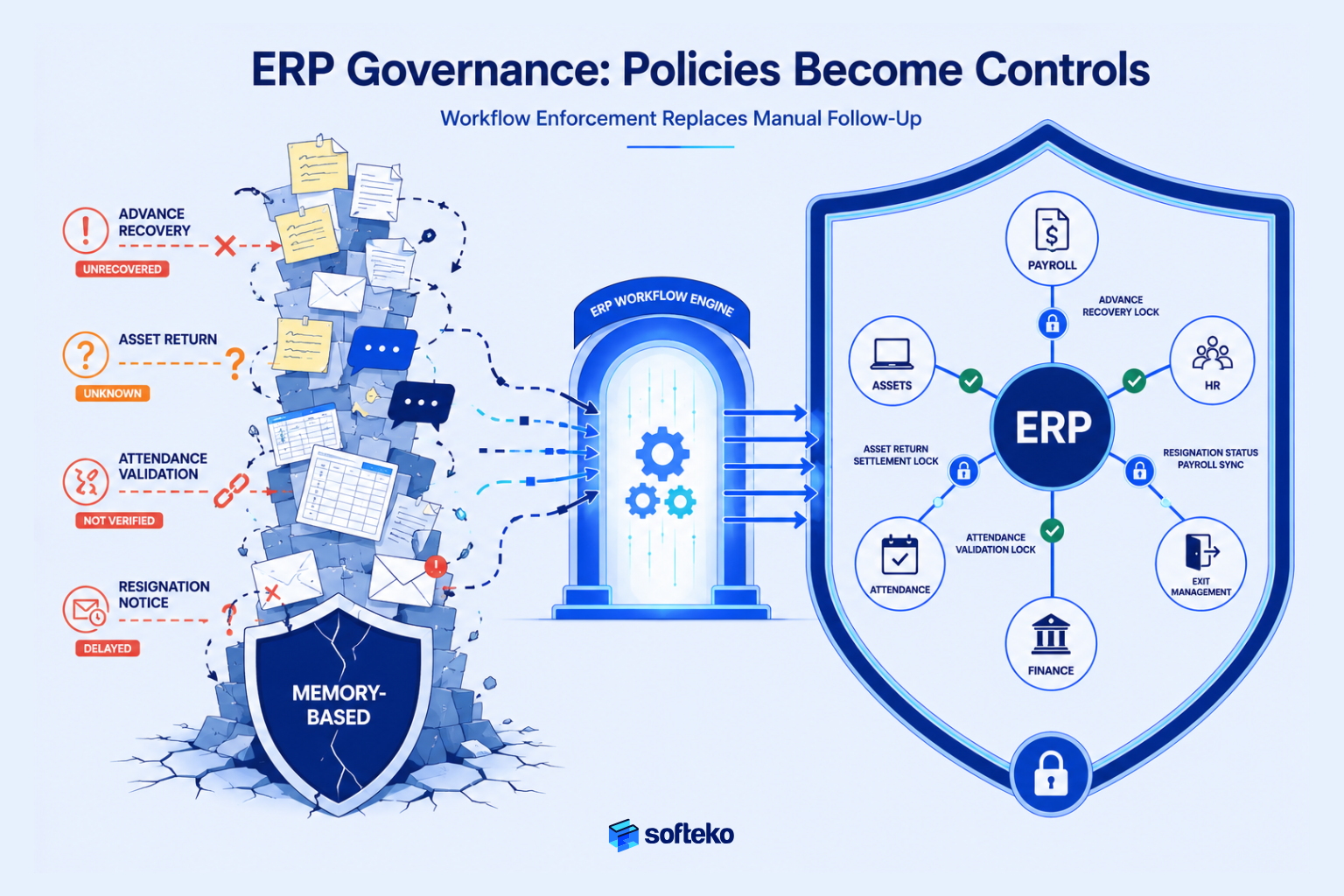
Replace Manual Follow-Up with System Controls
| Question | Memory-based model | System-based model |
|---|---|---|
| Did somebody remember to recover the advance? | Maybe | The process cannot proceed if the advance is unrecovered |
| Was the asset returned before settlement? | Hopefully | Settlement workflow blocks until verification is complete |
| Were the warehouse overtime hours validated? | Supervisor trust | Validation built into the approval workflow |
| Did the resignation reach payroll in time? | Email-dependent | HR status change automatically updates payroll status |
Peer-reviewed research in the Journal of Information Systems found ERP systems produce a 45% reduction in material control weaknesses.[6] Transactions become traceable across departments, approval paths become auditable, and data integrity improves through centralised governance.
Enforce Policies Through Automated Workflows
Policies alone do not create accountability. Enforcement does. In fact, most trading businesses already have policies requiring asset return before exit, advance recovery before settlement, approval for overtime, and payroll verification. Therefore, the problem is not policy creation. Instead, the problem is policy execution. ERP converts policies into workflows, where the process itself becomes the control.
Reconcile Workforce Records Before Payroll Runs
Traditional trading businesses reconcile at month-end. Payroll is processed, reports are generated, and finance investigates discrepancies afterwards. However, by then the transaction has already occurred and the money has already left. Modern ERP environments move reconciliation closer to the transaction itself — issues are identified before settlement, before payroll release, before approval completion. As a result, the trading business stops auditing historical problems and starts preventing future ones.
How Odoo Supports Workforce Financial Governance
Odoo already runs the trading workflow — CRM for RFQs, Sales for quotations, Purchase for supplier POs, Inventory for warehouse, Accounting for invoicing, and HR/Payroll for the workforce. Consequently, workforce financial governance runs in the same platform, on the same records, with the same audit trail.
Below, the Odoo controls are grouped into three layers: the data layer (what is stored), the workflow layer (how obligations move), and the recovery layer (how the trading margin is protected).
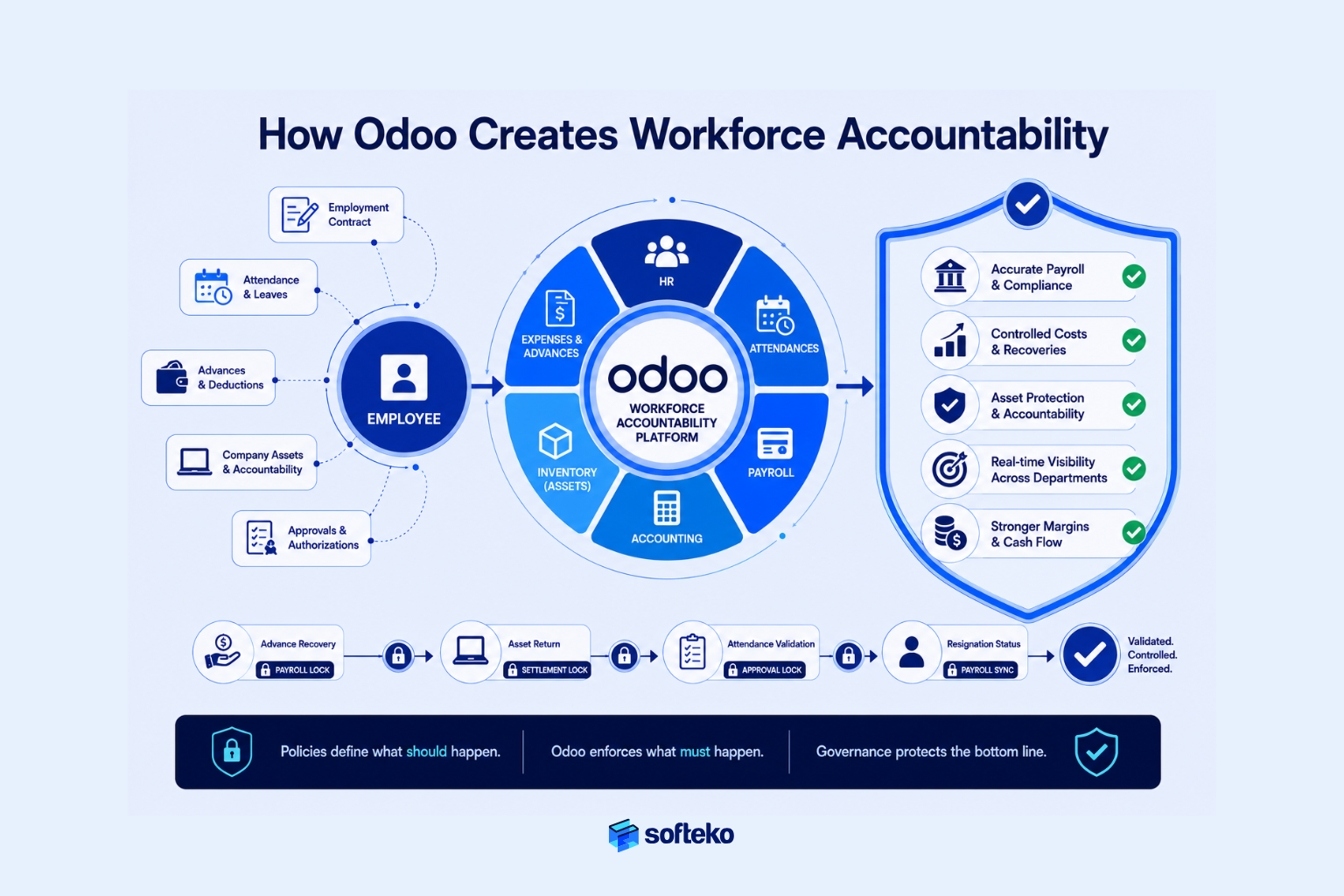
Keep Every Workforce Record in One System
First, the data layer captures every fact governance depends on. Without this, the workflow and recovery layers cannot function.
| Control | What it does | Trading impact |
|---|---|---|
| Employment contract as authoritative record | Salary, allowances, benefits, recovery rules, leave policies | Every trading role has one source of compensation truth |
| Employee asset register | Laptops, mobiles, SIMs, forklift keys, fuel cards, delivery vehicles linked to the employee profile | Assets tied to the person who holds them, not to a shared spreadsheet |
| Country-specific rule engine | UAE / KSA / Bahrain EOSB, WPS, leave, probation, contract rules applied automatically | Multi-country trading operations use one platform |
| Audit trail | User ID and timestamp on every view and change to sensitive HR or payroll data | Governance evidence produced by the system, not assembled after the fact |
Control Attendance, Advances, and Payroll Approvals
Next, the workflow layer turns stored data into scheduled, enforced action.
| Control | What it does | Trading impact |
|---|---|---|
| Attendance as financial data | Biometric and GPS attendance feed configurable salary rules and payroll inputs | Warehouse and Delivery overtime becomes measurable, not negotiable |
| Salary advance workflow | Advance approval automatically posts a recovery schedule against future payroll | Once approved, recovery cannot be forgotten |
| Multi-level payroll approvals | Finance/Payroll Owner → Finance Controller → CEO for any manual edit or salary change | Manual overrides leave a control trail |
| Automated deduction triggers | Phone charges after 3-day review, excess sick leave, unauthorised absences, unreturned company assets | Trading-margin leaks captured at the payroll layer, not written off |
Recover Workforce Costs Before Employees Leave
Finally, the recovery layer closes the loop so the trading margin actually reaches the P&L.
| Control | What it does | Trading impact |
|---|---|---|
| Mandatory exit clearance checklist | Asset returns, system access deactivation, loan settlements before final settlement is released | Asset Clearance Block prevents payment until IT, Procurement, HR sign off |
| Automated EOSB calculation | Country-specific formulas applied to last drawn basic salary | Removes manual calculation error at the largest single settlement event |
| Payroll-to-accounting posting | Payroll confirmation generates and posts journal entries automatically | Finance sees workforce exposure the same way it sees supplier and customer exposure |
| Cross-department dashboards | Live view of headcount, advances outstanding, assets assigned, exit backlog, EOSB exposure | Trading margin at the workforce layer becomes as visible as OTIF, DSO, and inventory accuracy |
Notably, these are not features in isolation. Each one implements a governance control the trading business already relies on somewhere else — advance recovery is the workforce equivalent of the 25-day + credit-period payment reminder rule, asset clearance is the workforce equivalent of the customs clearance block on shipment release, and the dashboard is the workforce equivalent of the supplier OTIF report.
PwC research links automation to a ~4× increase in productivity growth.[7] Meanwhile, the operational benefit for a trading finance team is that they flag discrepancies instantly instead of spending days on manual checks — automation turns “reactive audit” into “real-time margin protection.”
Measure Workforce Financial Governance
Most trading businesses assume their workforce controls are effective because no major incident has occurred. However, that assumption is dangerous. The absence of visible problems does not indicate the presence of strong governance. Rather, it usually indicates that leakage is happening quietly, spread across enough transactions to stay below investigation thresholds.
The point of measurement is not more reports. Instead, it is verifying that governance is actually protecting the trading margin.
| # | Metric | Formula | Strong | Moderate | High risk |
|---|---|---|---|---|---|
| 1 | First-time error-free payroll rate | (Transactions without corrections ÷ total) × 100 | >98% | 95–98% | <95% |
| 2 | Payroll error resolution cycle time | Average business days to resolve | <2 days | 2–5 days | >5 days |
| 3 | Asset recovery rate | (Assets recovered ÷ assets assigned) × 100 | >95% | 85–95% | <85% |
| 4 | Employee advance recovery rate | (Value recovered ÷ value issued) × 100 | >98% | 90–98% | <90% |
| 5 | Exit settlement compliance rate | (Settlements without post-payment exceptions ÷ total) × 100 | >95% | 85–95% | <85% |
| 6 | Workforce financial exposure visibility | Time to answer “what is our total exposure today?” | Real-time | Same day | Multi-day |
| 7 | Duplicate / erroneous payment rate | % of disbursements requiring reversal | <0.8% | 0.8–2% | >2% |
Industry analysis indicates cloud ERP reduces compliance costs by approximately 30%.[8] As a result, mid-sized GCC trading businesses can now access enterprise-grade margin-protection controls that were previously only available to the largest organisations.
Measure Workforce Financial Exposure in Seconds
If your CFO asks for total outstanding employee advances, assigned asset values, pending recoveries, and payroll liabilities across UAE, KSA, and Bahrain today — how long does it take to answer?
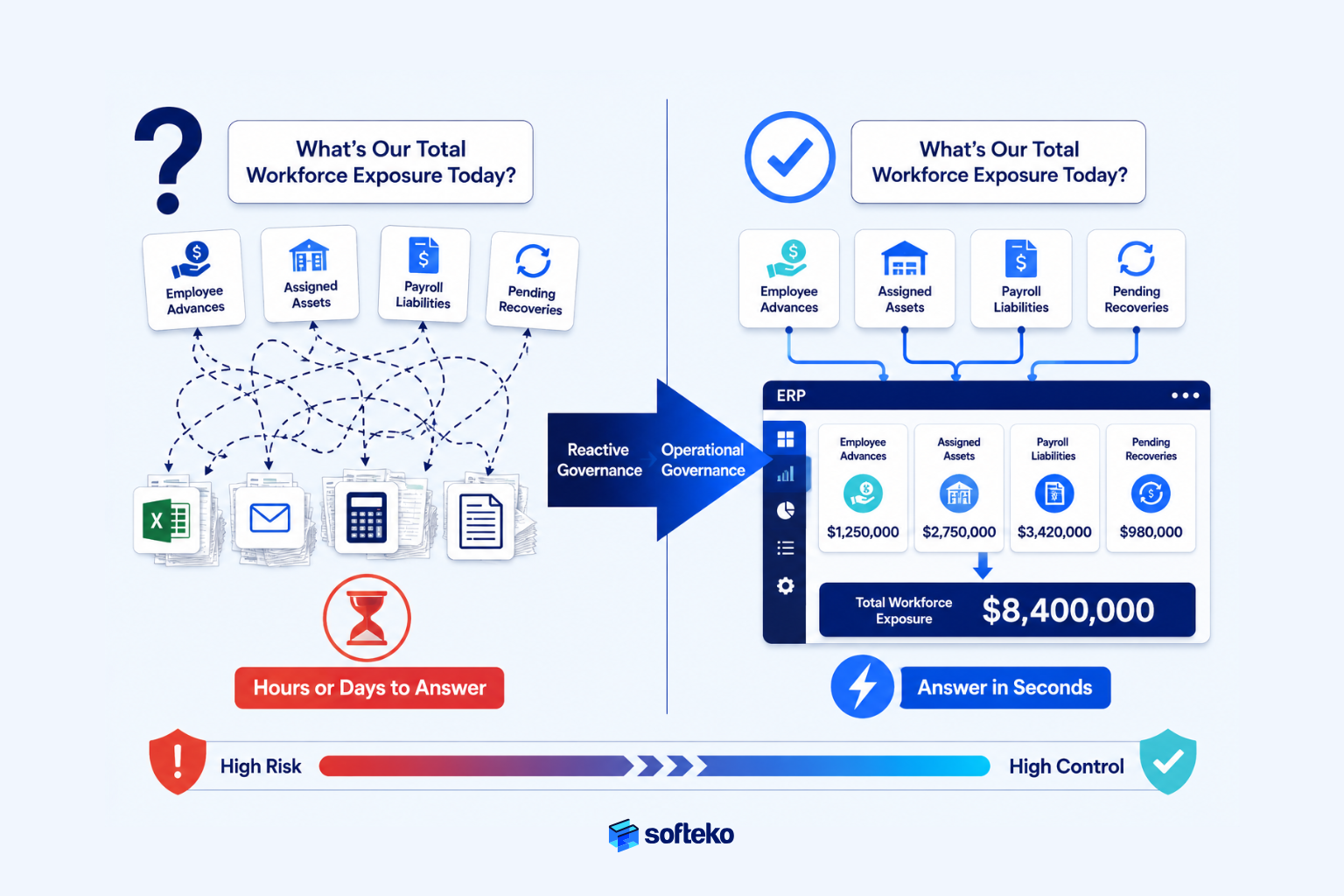
If the answer requires multiple spreadsheets and manual reconciliation, governance is reactive and the trading margin is exposed. However, if the answer appears immediately from one system, governance is operational and the margin is protected.
Protect Trading Margins with Workforce Governance
If your trading business is still managing employee advances, asset assignments, payroll recoveries, and exit settlements across spreadsheets, emails, and disconnected systems, hidden margin exposure is almost certainly building inside your workforce processes. The cost shows up everywhere — as unrecovered advances, missing laptops and forklift certificates, disputed exit settlements, payroll corrections, and an audit-prep burden that consumes weeks of finance capacity per cycle.
At Softeko, we help GCC trading businesses design and implement Odoo ERP workforce governance controls that connect HR, Payroll, Finance, Asset Management, Fleet, and Accounting into a single accountability system — reducing leakage, improving visibility, and strengthening margin protection across the entire employee lifecycle in UAE, Saudi Arabia, and Bahrain.
Ultimately, the objective is not more software. Rather, it is turning workforce management from an administrative function into a measurable trading margin protection discipline.
FAQ
What is workforce cost leakage in a trading business?
Workforce cost leakage is the silent outflow of trading margin through unrecovered salary advances, unreturned company assets, unvalidated overtime, duplicated payroll payments, and unreconciled exit settlements. Notably, it typically runs at 2–4% of total labour spend — for a mid-sized GCC trading business, that is $1M–$5M annually.
How is workforce financial governance different from HR compliance?
HR compliance protects the trading business from legal and regulatory penalties. In contrast, workforce financial governance protects the trading margin from silent leakage. Both matter; however, only governance shows up on the P&L as recovered profit.
Why don’t existing payroll systems prevent leakage?
Because payroll systems process the information they receive. If the underlying data is incomplete, inaccurate, delayed, or disconnected from HR, IT, Fleet, and Accounting, payroll simply converts operational mistakes into financial transactions. Consequently, leakage rarely originates in payroll — it originates upstream.
What is the difference between an approval and a control?
An approval depends on managerial trust. A control, however, depends on objective validation. For example, if a Warehouse Manager can approve overtime without seeing biometric attendance and dispatch volume, the approval is administrative formality. Workforce governance turns approvals into controls by requiring evidence before authorisation.
Why are asset recovery rates so low in trading businesses?
Without managed asset lifecycles, recovery rates can fall to 35%.[3] The issue is not usually theft. Rather, it is visibility. Trading businesses cannot recover assets — laptops, mobiles, fuel cards, forklift keys, vehicles — they cannot accurately trace to individual employees across multiple warehouses and country entities.
Why is offboarding called a “financial-control checkpoint” for a trading business?
Because the final paycheck is the strongest recovery tool the trading business will ever have. Before settlement, assets can be returned, advances recovered, and notice-period liabilities reconciled. After settlement, recovery becomes negotiation, legal action, or write-off — and the leakage lands directly on the trading margin.
How do UAE, KSA, and Bahrain EOSB rules affect the calculation?
Each country applies a different formula against the last drawn basic salary. Bahrain uses 0.5 month per year for years 1–3 and 1 month per year thereafter; UAE uses 21 days per year for years 1–5 and 30 days per year thereafter, subject to a legal cap; KSA uses 0.5 month per year for years 1–5 and 1 month per year thereafter, with specific resignation rules. A trading business operating across all three cannot afford manual calculation.
Will Odoo automatically prevent workforce cost leakage?
No system prevents leakage by itself. Instead, Odoo provides the mechanism — the controls have to be designed first. Specifically, the most successful implementations define the Assignment / Visibility / Accountability / Recovery / Reconciliation workflows before configuration begins. ERP enforces governance; it does not create it.
Where is the highest-impact starting point if we are still on spreadsheets?
Link salary-advance recovery directly to payroll calculation, and link asset-return verification directly to exit settlement release. Together, those two controls prevent the largest categories of workforce cost leakage with the smallest implementation footprint. Moreover, they are prerequisites for every other improvement.
References
- ACFE — 2024 Report to the Nations (PDF) — https://www.ivey.uwo.ca/media/kjljj5cy/2024-report-to-the-nations.pdf
- APQC — Payroll Key Benchmarks — https://www.apqc.org/resource-library/resource-collection/payroll-key-benchmarks
- Gartner via Unduit — Device Lifecycle Management — https://www.unduit.com/blog/gartner-device-lifecycle-management-prediction/
- Deloitte via Corporate Compliance Insights — Risks Abound, Strengthen Internal Controls — https://www.corporatecomplianceinsights.com/deloitte-risks-abound-strengthen-internal-controls/
- Deloitte — Benefits of Effective Internal Controls — https://www.deloitte.com/us/en/services/audit-assurance/blogs/accounting-finance/benefits-of-effective-internal-controls.html
- AAA / Journal of Information Systems — The Impact of Enterprise Resource Planning (ERP) — https://publications.aaahq.org/jis/article/25/1/129/1542/The-Impact-of-Enterprise-Resource-Planning-ERP
- PwC — AI Linked to a Fourfold Increase in Productivity Growth — https://www.pwc.com/gx/en/news-room/press-releases/2025/ai-linked-to-a-fourfold-increase-in-productivity-growth.html
- Gartner via SAP — Magic Quadrant for Cloud ERP Finance — https://news.sap.com/2025/10/sap-a-leader-gartner-magic-quadrant-cloud-erp-finance/