

Objective
By now, your trading business has already selected an ERP. You understand the phases, the timelines, and the budget. Only one question remains: what could go wrong, and how do we prevent it?
In practice, that question deserves an honest answer. Independent research shows between 55% and 75% of ERP projects fail to meet their original objectives, and Gartner predicts that by 2027, more than 70% of ERP initiatives will fail to fully achieve their business case goals, with 25% failing catastrophically.[2] Panorama Consulting’s 2026 report on 2,400+ implementations puts the average cost overrun at 178% — most failed projects cost nearly three times what was planned.[1][3]
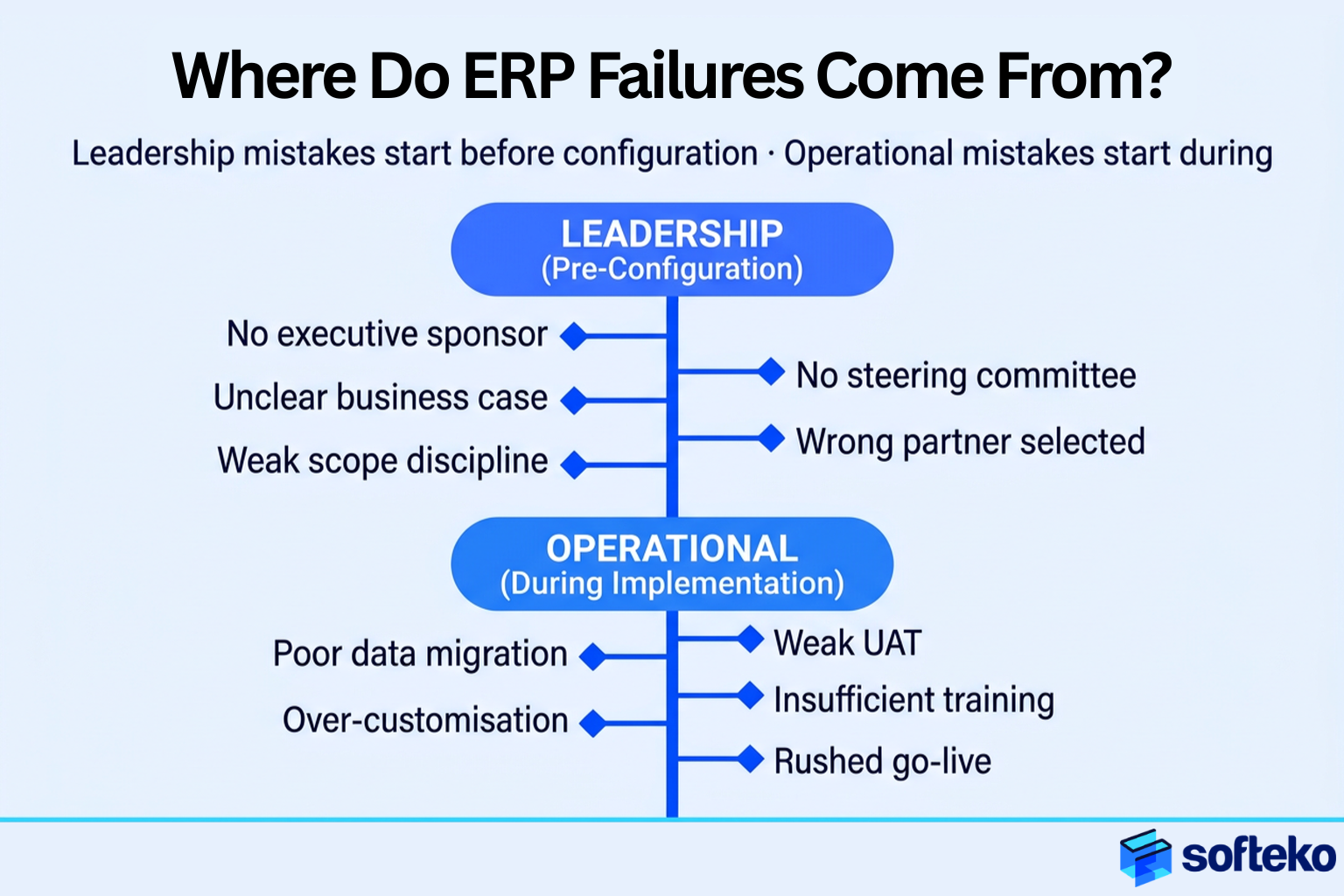
Notably, almost none of this failure is caused by the software. Panorama’s analysis ranks the top failure drivers in order: inadequate change management (42%), poor data migration (38%), inexperienced implementation teams (35%), lack of executive sponsorship (31%), insufficient training (29%), scope creep (26%), over-customisation (23%), vendor selection errors (19%).[1] Every one of those is a business decision made long before configuration begins. The good news is the same: every one of them is preventable.
In this guide, we walk you through the ERP implementation mistakes trading businesses make most often — organised by where they originate. Leadership mistakes happen before the project starts. Operational mistakes happen during configuration and data migration. People and change-management mistakes happen throughout — and cause the largest number of failures. By the end, you should have a practical framework to catch each category before it becomes an expensive lesson.
Why Most ERP Mistakes Start Before Implementation
Notably, an ERP does not create operational problems. It exposes existing ones. When leadership has not agreed on business objectives, when departments follow different processes, when master data is dirty, and when no one owns the outcome, the ERP amplifies every one of those weaknesses on go-live day.
In practice, the pattern is consistent across industries. For trading businesses specifically, the failure rate is even higher — Panorama’s 2026 report shows 73% of discrete manufacturing ERP projects fail to meet objectives, with an average budget overrun of 215%.[1] Trading businesses share the operational complexity that drives that rate: multiple warehouses, multi-currency operations, landed cost calculations, thousands of SKUs, supplier and customer master data spread across years of spreadsheets.
Importantly, the critical distinction is where mistakes originate. Most of them start with business decisions that were never made properly — not with software bugs.
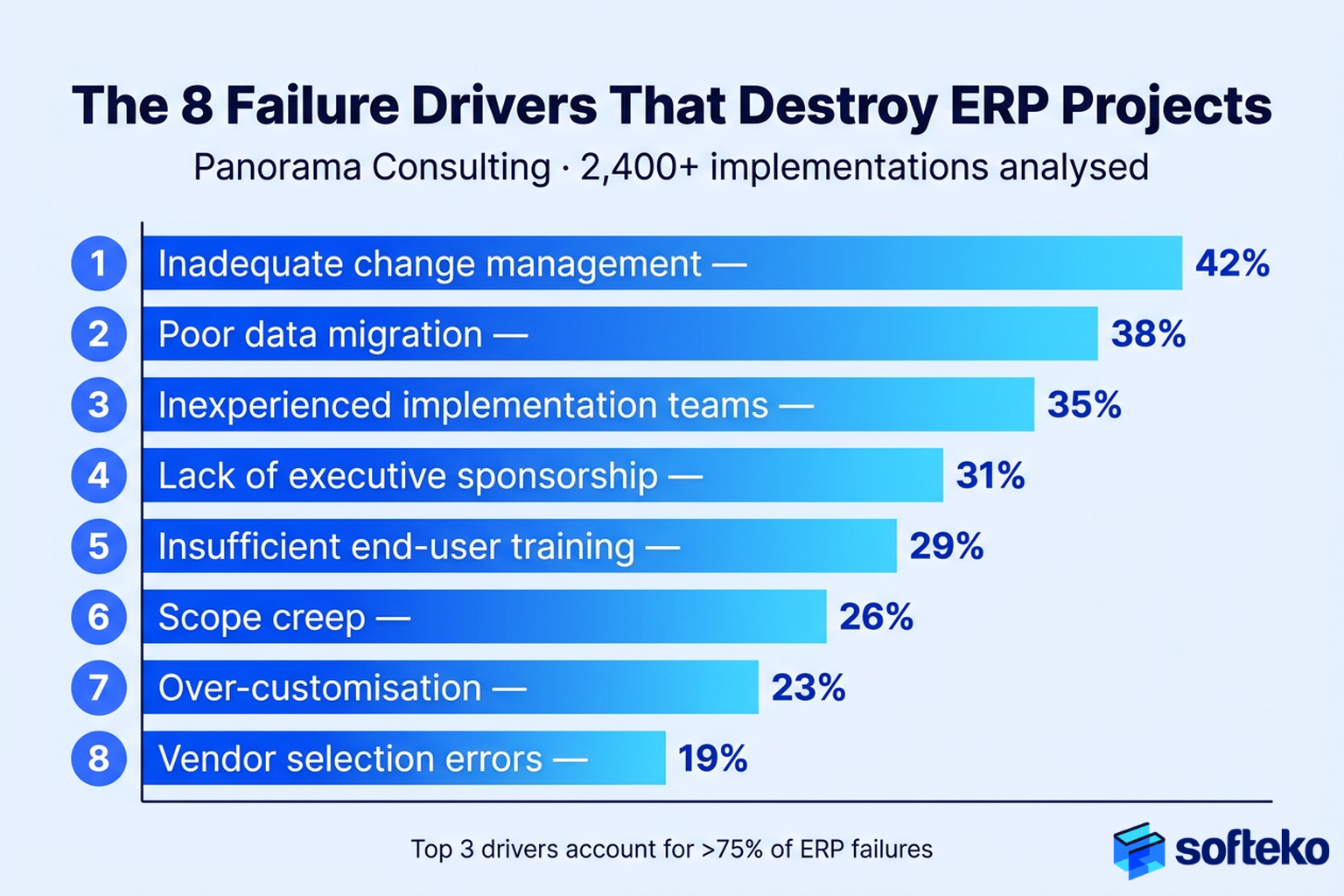
Leadership Mistakes vs. Operational Mistakes
| Where the mistake originates | Typical examples |
|---|---|
| Leadership (pre-configuration) | No executive sponsor · Unclear business case · Weak scope discipline · No steering committee · Wrong partner selected |
| Operational (during implementation) | Poor data migration · Weak testing · Over-customisation · Insufficient training · Rushed go-live |
| People & Change (throughout) | No change management plan · Weak communication · Employee resistance · Manager inconsistency · Adoption below 50% |
In our experience, every failed implementation traces back to at least one of these categories. Most trace to several. The rest of this article addresses each category with the operational controls that prevent the failure — not with abstract advice.
The 8 ERP Implementation Mistakes That Cause Most Failures
Specifically, Panorama’s analysis of 2,400+ implementations ranks the eight most common failure drivers. Together, the top three — change management, data migration, and inexperienced teams — account for more than 75% of all ERP failures.[1]
| # | Mistake | % of failures | Where it happens |
|---|---|---|---|
| 1 | Inadequate change management | 42% | Throughout |
| 2 | Poor data migration | 38% | Pre-go-live |
| 3 | Inexperienced implementation teams | 35% | Partner selection |
| 4 | Lack of executive sponsorship | 31% | Pre-configuration |
| 5 | Insufficient end-user training | 29% | Pre and post go-live |
| 6 | Scope creep | 26% | During configuration |
| 7 | Over-customisation | 23% | During configuration |
| 8 | Vendor selection errors | 19% | Pre-project |
Notably, two important things stand out.
First, only one item on this list — over-customisation — even touches the software directly. Every other driver is a business, leadership, or people failure that no ERP could resolve on its own.
Second, the top failure drivers are also the most preventable. Independent research indicates organisations completing a structured pre-implementation readiness checklist eliminate 42% of change-management-related failures and 35% of team-experience-related failures.[1] Panorama also reports that 83% of organisations with pre-implementation ROI analysis met expectations, compared to a majority who did not.[11]
In the sections that follow, this article addresses these mistakes in the order they typically appear during a trading business implementation.
Leadership Mistakes That Cause ERP Implementation Failure
In practice, every ERP project starts with leadership decisions that shape everything downstream. When those decisions are weak, no amount of good implementation work later can rescue the project.
Mistake 1 — No Executive Sponsor or Steering Committee
Lack of executive sponsorship accounts for 31% of ERP failures.[1] Typically, the pattern is consistent: the CEO or Managing Director approves the budget, then delegates everything else. Department heads make decisions in isolation. Cross-department conflicts stall. Scope changes get approved informally. Six months later, no one can explain what the project is actually delivering.
Fortunately, the fix is not complicated. Every implementation needs a named executive sponsor with real decision authority and a steering committee that meets at scheduled intervals. The sponsor removes organisational obstacles, resolves cross-department conflicts, approves scope changes, and holds departments accountable for readiness. None of this involves configuring software.
Mistake 2 — No Clear Business Case or Success Criteria
Notably, many trading businesses launch ERP projects with no measurable success criteria. “Improve operations” is not a target. “Reduce inventory holding by 15% within 6 months of go-live” is a target. “Improve financial close by 40% within 90 days” is a target. Without measurable criteria, there is no objective way to know whether the ERP is working — and no reason for the ERP to change any specific department’s behaviour.
Gartner reports 75% of ERP strategies are not strongly aligned with overall business strategy, which is why so many implementations end up delivering technology without delivering business outcomes.[2] The fix is simple: define 4–6 measurable KPIs before implementation begins. Track them from day one of hypercare.
Mistake 3 — Poor Scope Discipline
In fact, scope creep drives 26% of ERP failures on its own and contributes to 68% of budget overruns.[1][3] It rarely arrives as one big decision. It arrives as fifty small ones — an additional approval level requested during workshops, a custom report added during testing, a new customer field proposed before go-live.
Instead, the fix is a formal change control process. Every scope change gets an owner, a cost estimate, a timeline impact, and executive sign-off. This is not bureaucracy — it is the mechanism that prevents your Odoo project from becoming three Odoo projects at 178% of the original budget.
Mistake 4 — Choosing the Wrong ERP Implementation Partner
Inexperienced implementation teams are involved in 35% of ERP failures.[1] Rand Group reports that 60% of its clients arrive after a failed or subpar implementation with a previous partner, and organisations using experienced consultants report an 85% success rate.[7] The correlation is direct.
Specifically, the most common signals of the wrong partner: no trading-industry experience, no documented methodology, no named senior consultants on the proposal, no discussion of change management, no post-go-live hypercare. When comparing quotes, the cheapest partner is often the one that omits everything you cannot afford to skip.
Operational Mistakes That Cause ERP Implementation Failure
In contrast, operational mistakes happen after leadership decisions are made, during configuration and preparation. These are the mistakes that turn a well-scoped project into a stressful go-live.
Mistake 5 — Treating Data Migration as an IT Task
Notably, independent research is consistent on this one: 83% of data migration projects fail or exceed their budgets or timelines.[5] For a trading business — with years of duplicate customer records, obsolete suppliers, inconsistent SKUs, wrong units of measure, and inventory balances that never matched physical stock — the failure rate is if anything higher.
In practice, data migration is not a technical activity. It is a business governance activity that IT executes. Mr. A in Sales owns customer master accuracy. “B” in Procurement owns supplier master accuracy. “C” in Warehouse owns physical stock verification. “D” in Finance owns opening balance reconciliation. Without these owners, migration becomes a copy-paste exercise that transfers old problems into a new database.
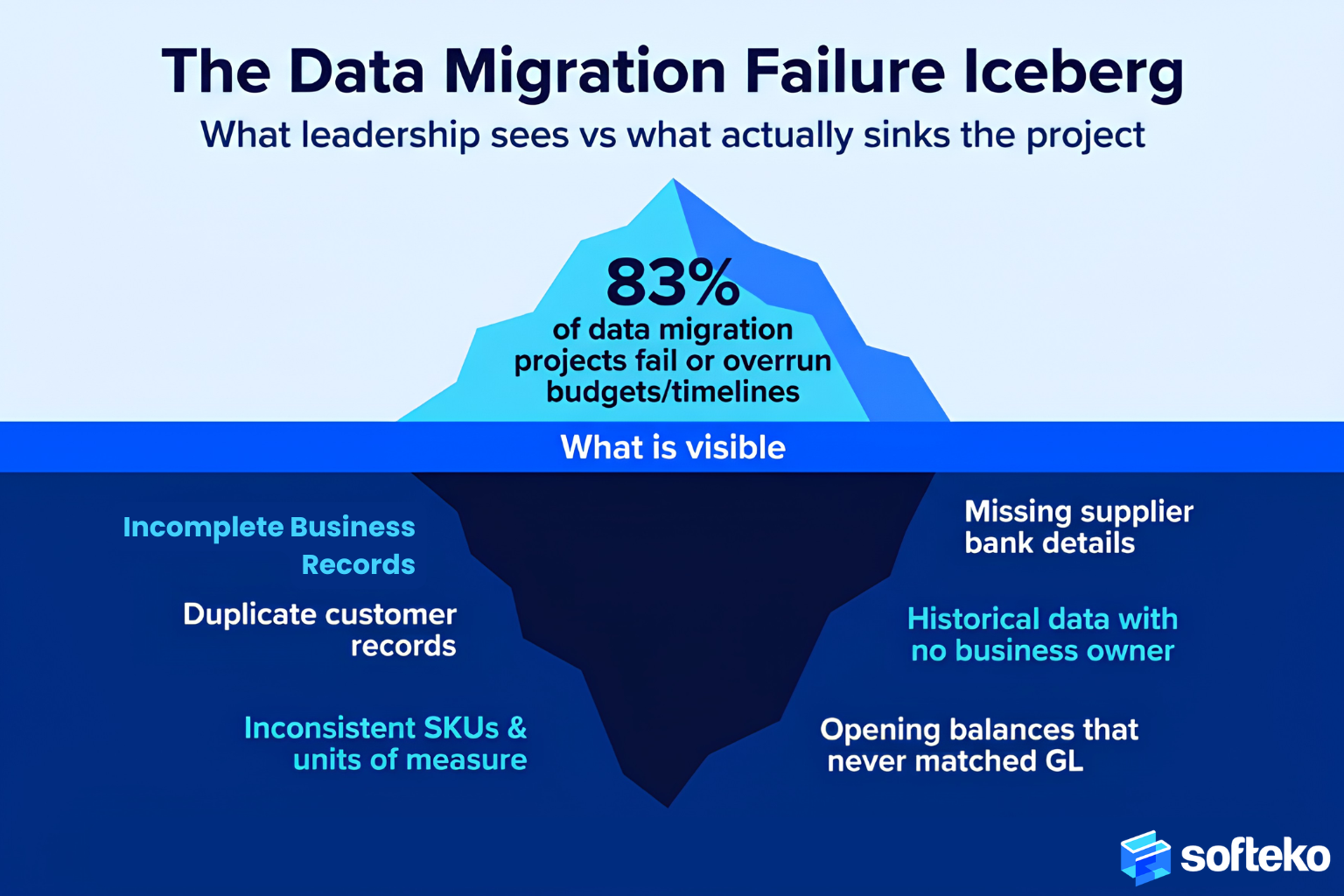
In our experience, trading businesses that migrate successfully do three things. First, they classify data — active operational data migrates, historical reference data archives, dirty data gets cleaned before migration, obsolete data is discarded. Second, they perform physical stock verification close to go-live so opening inventory reflects reality. Third, they run at least two full test migrations before production, with named business owners signing off on each dataset.
Mistake 6 — Skipping End-to-End User Acceptance Testing
Notably, testing is where projects save time and lose quality. Failed migrations spend only around 15% of project time on testing, compared to 30–40% in successful projects.[5] The gap shows up on go-live day.
Specifically, the mistake most trading businesses make is testing in silos. Sales tests quotations. Procurement tests purchase orders. Warehouse tests receipts. Everything works in isolation. What no one tests is the complete workflow: a customer inquiry becoming a quotation becoming a customer PO becoming a supplier PO becoming a shipment becoming a receipt becoming an invoice becoming a payment. If that end-to-end path breaks in production, the business breaks with it.
In practice, effective UAT follows real trading scenarios — an order revision, a partial shipment, a supplier price change, a customs delay, a customer credit override. If your ERP handles routine flows but stalls on exceptions, users will invent workarounds within a week of go-live.
Mistake 7 — Customizing the ERP Too Much
Notably, over-customisation drives 23% of ERP failures on its own, and Odoo’s official documentation is explicit on the principle: “The more you cut the amount of development, the better.”[6] Every custom workflow becomes technical debt at every future upgrade.
In fairness, the instinct behind over-customisation is understandable — trading businesses often want the ERP to “work exactly like our old system.” That request is expensive twice: once during implementation, then again at every upgrade for years afterwards. The better question during every customisation request is: “Is our current process actually better than the standard workflow, or is it just familiar?”
Specifically, trading businesses that keep customisation below roughly 10–15% of requirements typically see significantly lower implementation cost, faster testing cycles, and much simpler upgrade paths.
Mistake 8 — Going Live Before the Business Is Ready
In practice, timeline pressure kills implementations. 74% of ERP projects overrun their timeline by more than 50%, and only 16% complete on schedule.[3] Under pressure, organisations reduce testing, cut training hours, or schedule go-live during peak season. The Hershey case study — $150M in lost sales after a big-bang go-live during Halloween season with a compressed 30-month timeline instead of the planned 48 — is the textbook example of what happens when a project rushes.[8]
Importantly, a delayed go-live is almost always cheaper than a poorly prepared one. If master data is incomplete, if cross-functional testing has not passed, or if warehouse teams have not practised barcode workflows in a realistic environment, postponing go-live is the safest business decision.
Why Poor Change Management Causes More ERP Failures Than Software
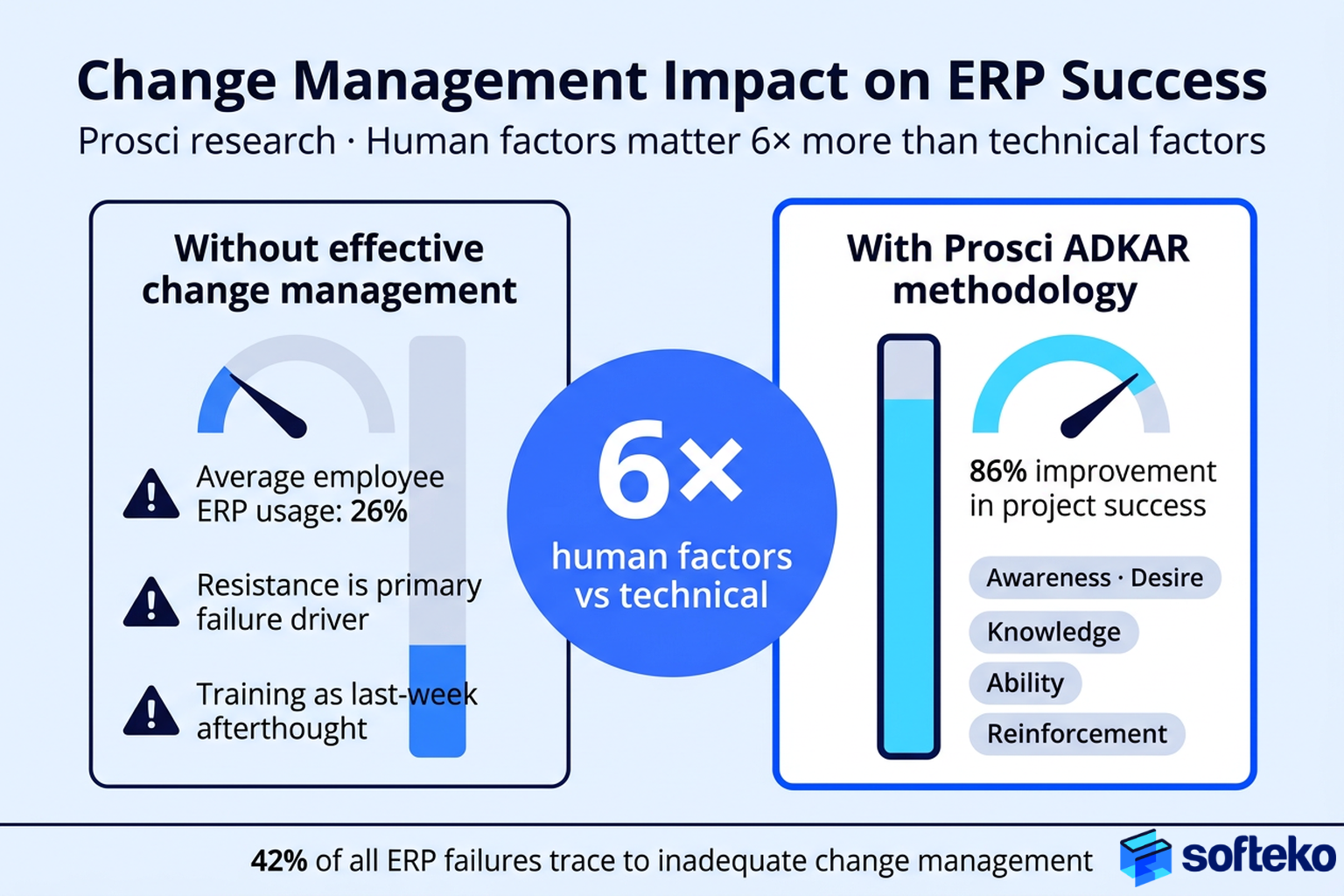
Notably, the single largest driver of ERP failure is inadequate change management — 42% of all failed implementations trace back to it.[1] Prosci’s research puts the same finding differently: human factors matter roughly 6× more than technical factors in ERP success.[4]
In practice, the reason is simple. An ERP that no one uses correctly delivers no value. Independent research indicates the average employee usage rate for ERP systems sits at only 26% — meaning that in most implementations, three-quarters of the workforce never fully adopt the system after go-live.[11] Sales teams keep customer notes in personal spreadsheets. Warehouse staff keep parallel stock sheets. Finance reconciles ERP reports back to Excel every month-end. The ERP is technically live. Operationally, the business is still running on the old model.
Mistake 9 — No Structured Change Management Plan
Notably, only 29% of organisations have effective change management strategies, and 70% cite employee resistance as the primary reason for ERP failure.[3] The pattern of failure is consistent: leadership treats change management as a training session in the last week before go-live. By then, it is too late.
In practice, effective change management starts at project kickoff. Employees need to understand why the business is changing, what will change for their daily work, and how they will be supported. Uncertainty drives resistance long before the ERP goes live.
Mistake 10 — Insufficient Training and Underinvestment in Adaptation
Notably, insufficient end-user training is responsible for 29% of ERP failures.[1] Training overruns average 45% above initial estimates, primarily because organisations underfund training in the original budget.[3]
Rather, the fix is not more training hours. It is better-designed training. Warehouse Supervisors need barcode scanning practice, not accounting screenshots. Sales Executives need to walk through quotation approval workflows using real customer scenarios, not sample data. Finance Officers need to understand how operational transactions post to the general ledger — because when they cannot trace a number back to its source, they revert to spreadsheets.
How the ADKAR Framework Improves ERP Adoption
Notably, Prosci’s ADKAR model — Awareness, Desire, Knowledge, Ability, Reinforcement — is the most widely used change management framework in ERP implementations. Organisations using structured Prosci methodology report an 86% improvement in project success.[4]
In practice, for a trading business ADKAR translates into practical stages: build Awareness of why the business is changing, Desire by showing what each department gains, Knowledge through role-based training, Ability through hands-on practice with real business scenarios, and Reinforcement through hypercare and daily manager behaviour after go-live.
Importantly, the reinforcement stage is where most implementations fail quietly. If department managers continue asking for spreadsheet updates after go-live, employees quickly conclude the ERP is optional. Leadership behaviour becomes organisational behaviour.
What Nike, Hershey, and Lidl Teach About ERP Implementation Failure
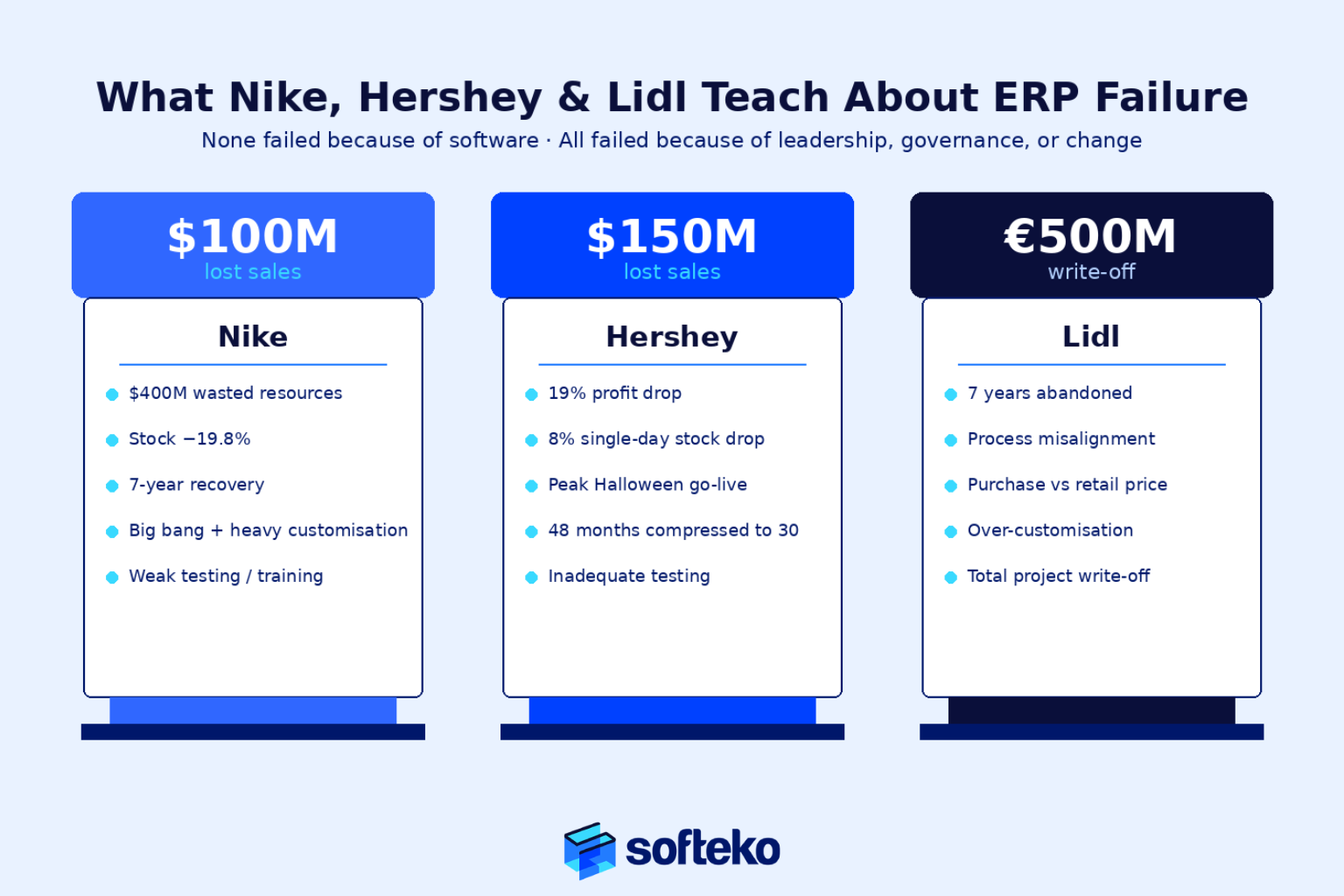
Notably, three of the most well-documented ERP failures in the last three decades trace back to the same categories of mistake. None was caused by software. All were caused by leadership, governance, or change decisions.
Nike, 2000–2001. Nike’s demand-planning ERP implementation cost the company approximately $100 million in lost sales, contributed to $400 million in wasted resources, dropped the stock 19.8%, and took seven years to fully recover from.[10] Root causes: big-bang implementation of a heavily customised system, inadequate testing, poor integration with existing systems, and insufficient user training. Nike’s post-failure recovery required 140–180 hours of training per user.
Hershey, 1999. Hershey compressed a planned 48-month SAP + Siebel + Manugistics implementation into 30 months and went live during the peak Halloween season. The result: $150 million in lost sales, a 19% profit drop, and an 8% single-day stock decline.[8] The 2002 re-implementation succeeded only because Hershey slowed down, tested thoroughly, and provided adequate training.
Lidl, 2011–2018. Lidl spent €500 million over seven years on SAP before abandoning the project entirely.[9] Root cause: fundamental process misalignment — Lidl valued inventory at purchase price while SAP used retail price. Rather than adapting the process, Lidl attempted heavy customisation. Executive turnover, weak change management, and over-reliance on external consultants compounded the failure. The write-off was total.
Ultimately, each case confirms the same lesson: software quality does not survive process misalignment, rushed timelines, or absent change management. For a trading business, these are not historical curiosities — they are the same category of mistake that appears in most present-day implementations, just at smaller scale.
The ERP Implementation Risk Reduction Framework
Notably, every risk covered in this article has an operational control that mitigates it. Trading businesses that apply these controls consistently see dramatically lower failure rates.
| Risk category | Operational control | Owner |
|---|---|---|
| No executive alignment | Named executive sponsor + steering committee with scheduled reviews | CEO / Managing Director |
| Unclear business case | 4–6 measurable KPIs defined before configuration begins | Executive Sponsor + Department Heads |
| Scope creep | Formal change control process with cost + timeline impact per request | Project Manager |
| Wrong partner | Partner scorecard evaluating trading experience, methodology, hypercare | Steering Committee |
| Poor master data | Data workstream with named business owners per dataset | Sales / Procurement / Warehouse / Finance |
| Weak testing | Cross-functional UAT following real trading scenarios | Key Users + Department Managers |
| Over-customisation | “Configure first” principle — every custom request challenged | Project Sponsor + Implementation Partner |
| Rushed go-live | Readiness gate — go-live blocked until master data, testing, training approved | Executive Sponsor |
| No change management | Prosci ADKAR plan from project kickoff, not one week before go-live | HR + Executive Sponsor |
| Low user adoption | Manager behaviour reinforcement + hypercare tracking | Department Managers |
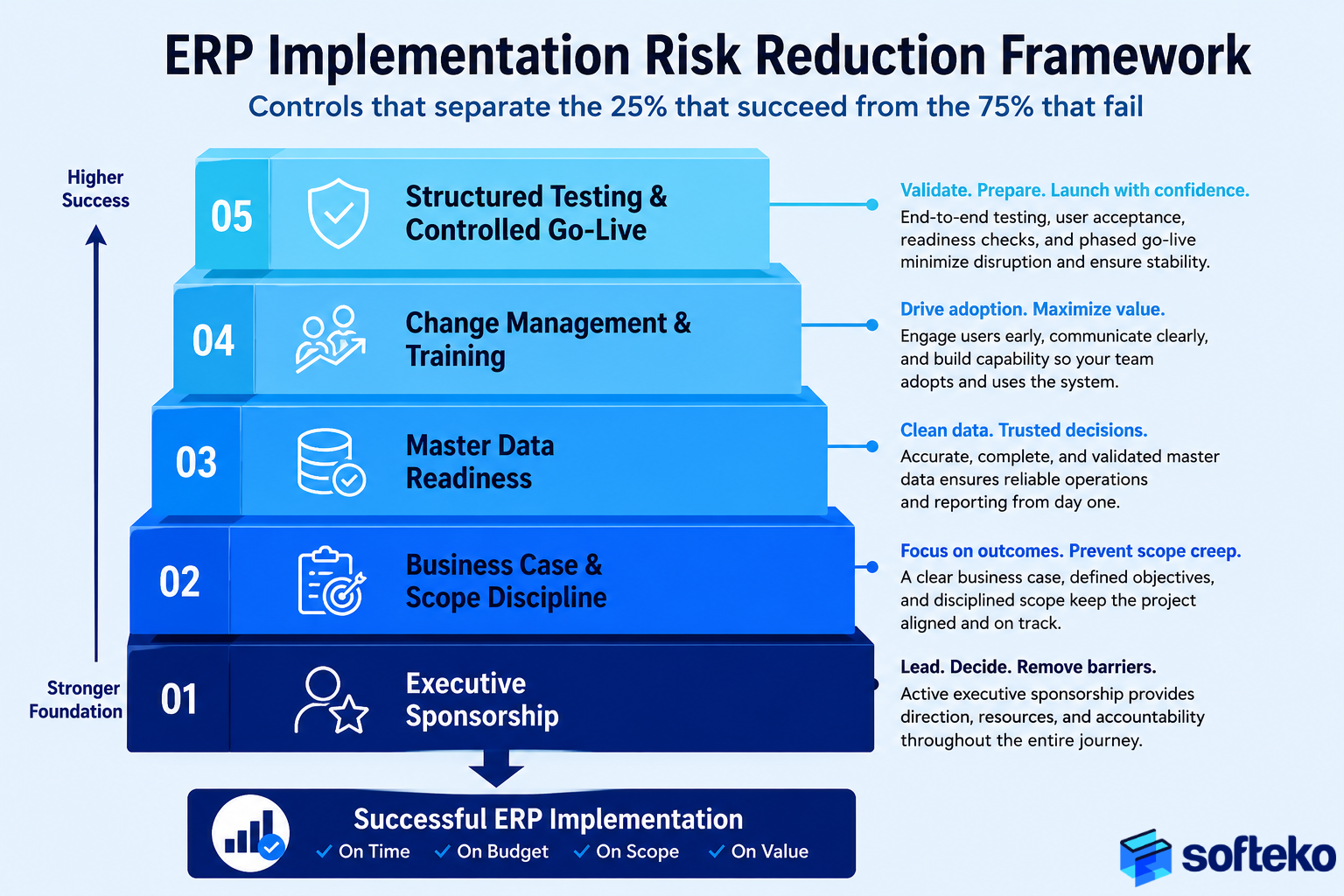
In fact, independent research shows organisations that effectively manage project risks through structured governance boost their on-time completion rates by up to 90%, and 67% see operational improvements within the first year.[11] The framework above is not theoretical — it is the operational discipline that separates the 25% of implementations that succeed from the 75% that do not.
Executive Readiness Checklist
First, before approving your ERP implementation, confirm that every category below is genuinely in place. If several answers are “no,” delaying the project is almost always cheaper than correcting the resulting problems after go-live.
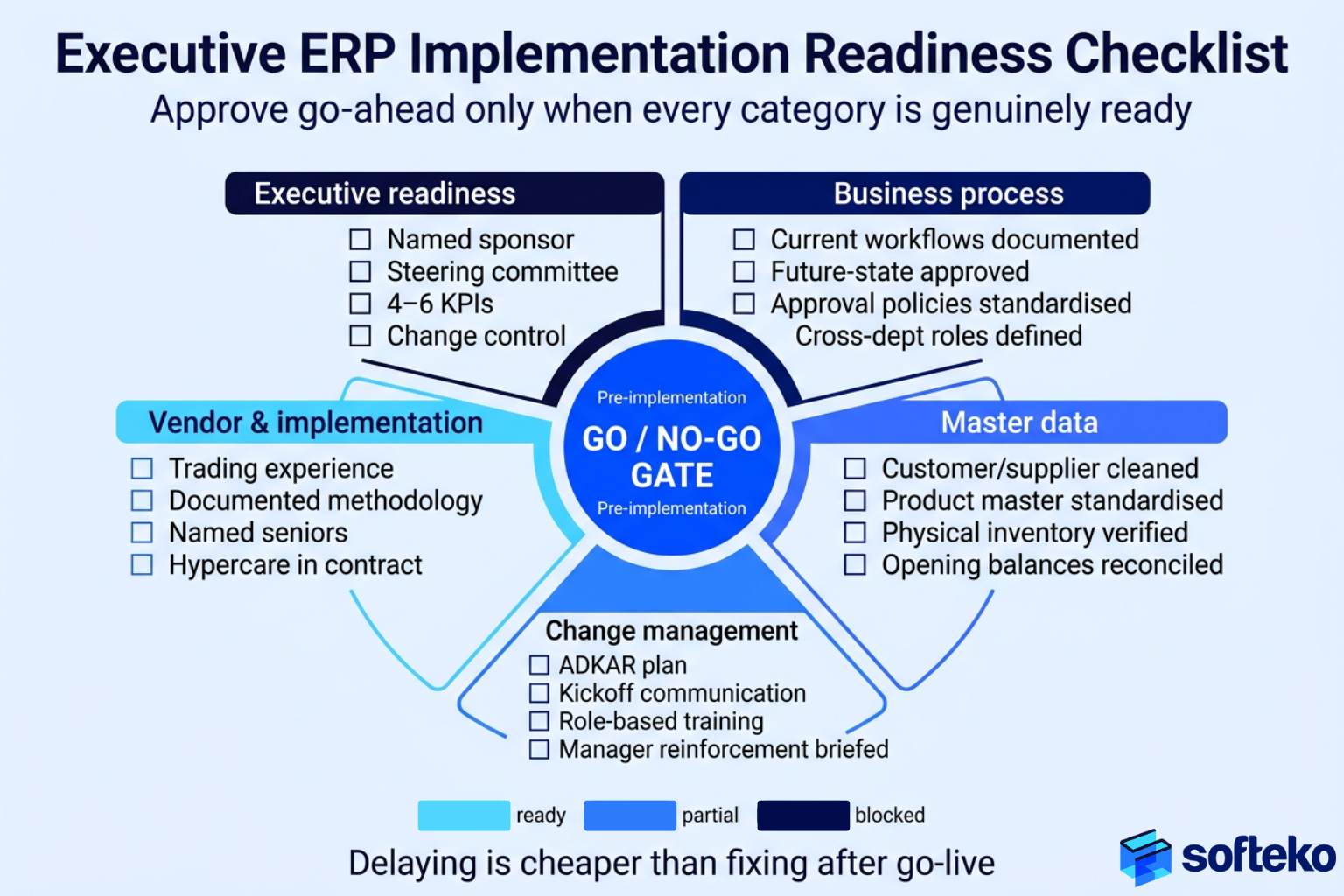
Executive readiness
- ☐ Named Executive Sponsor with decision authority
- ☐ Steering committee with scheduled reviews
- ☐ 4–6 measurable success KPIs agreed at board level
- ☐ Formal change control process for scope changes
Business process readiness
- ☐ Current workflows documented for every core process
- ☐ Future-state workflows approved by department heads
- ☐ Approval policies (credit, margin, procurement) standardised
- ☐ Cross-department responsibilities clearly defined
Master data readiness
- ☐ Customer master cleaned and deduplicated
- ☐ Supplier master validated with current banking details
- ☐ Product master standardised (SKUs, UoMs, packaging)
- ☐ Physical inventory verified close to go-live
- ☐ Opening financial balances reconciled
Change management readiness
- ☐ Change plan built on a documented framework (e.g., ADKAR)
- ☐ Communication strategy in place from project kickoff
- ☐ Role-based training designed and scheduled
- ☐ Managers briefed on post-go-live reinforcement responsibilities
Vendor & implementation readiness
- ☐ Implementation partner has trading-industry experience
- ☐ Partner methodology documented and reviewed
- ☐ Named senior consultants assigned to the project
- ☐ Post-go-live hypercare scope agreed in the contract
Key Takeaways Before You Start Your ERP Project
Notably, most ERP implementation failures are preventable — but only when your business treats implementation as an operational transformation rather than a software installation.
In practice, the pattern is consistent across the research. Panorama’s ranking of failure drivers, Gartner’s 55–75% failure rate, Prosci’s data on change management, and the well-documented Nike, Hershey, and Lidl case studies all point to the same conclusion: leadership, governance, master data discipline, and change management determine ERP success. Software rarely does.
In our experience, the businesses that avoid these mistakes do so through structured decisions, not luck. They appoint an executive sponsor who actually participates. They define measurable success criteria before configuration begins and control scope through formal change requests. Treat data migration as a business workstream with named owners. Invest in change management from project kickoff, not the week before go-live. They keep customisation below 15% of requirements. They delay go-live when readiness is incomplete.
In summary, if your trading business is preparing for implementation, do not begin by asking “How can we go faster?” Begin by asking “Which of these mistakes could apply to us — and what controls do we have in place to prevent them?” That single question reframes the project from a software installation into a business decision, which is what an ERP implementation actually is.
At Softeko, we help trading businesses run structured Odoo ERP implementations — with executive alignment, master data governance, cross-functional testing, and change management built into every phase.
Frequently Asked Questions
What is the most common ERP implementation mistake?
Inadequate change management. Independent research from Panorama Consulting shows it drives 42% of ERP failures, and Prosci research shows human factors matter 6× more than technical factors in project success.[1][4] Every other mistake — poor data migration, weak training, low user adoption — is either caused by or made worse by weak change management.
Why do so many trading businesses fail ERP implementations?
Trading businesses combine several risk factors: multi-warehouse operations, multi-currency, complex customer/supplier masters, and years of accumulated spreadsheet data. Panorama’s 2026 report shows 73% of discrete manufacturing ERP projects fail to meet objectives, and trading businesses face the same operational complexity.[1] The failure rate reflects the challenge — not the software.
How can trading businesses avoid ERP implementation failure?
Address the top three failure drivers first: change management (42%), data migration (38%), and inexperienced implementation teams (35%). Together they account for more than 75% of all failures.[1] A structured pre-implementation readiness checklist has been shown to eliminate 42% of change-management failures and 35% of team-experience failures before the project starts.
Is over-customisation really that dangerous?
Yes. Over-customisation causes 23% of ERP failures on its own, and Odoo’s own documentation is explicit: “The more you cut the amount of development, the better.”[1][6] Every custom workflow becomes technical debt at every future upgrade. Trading businesses that keep customisation below 10–15% of requirements usually see significantly lower ownership cost and simpler upgrades.
How important is executive sponsorship?
Critical. Lack of executive sponsorship drives 31% of ERP failures, and 65% of failed implementations cite lack of attention from management.[1] An ERP project without an active executive sponsor almost always drifts — scope expands, decisions stall, and departments optimise in isolation. Sponsorship is not a title on an org chart; it is scheduled participation in decisions.
Should we choose a Big Bang or phased rollout to reduce risk?
Neither is universally safer. Big Bang works for single-location businesses with standardised processes, clean data, and completed testing. Phased rollout is safer for multi-warehouse, multi-country, or multi-entity trading operations because it limits the scope of change during each go-live. The correct choice depends on your operational complexity — not on partner preference or timeline pressure.
What happens if we discover our implementation is going off track?
Stop and reassess before spending more. Rand Group reports that 60% of its clients arrive after a failed or subpar implementation elsewhere.[7] The pattern is consistent: implementations rarely recover on their own. If master data cleansing has stalled, if executive sponsorship has disappeared, or if scope changes have consumed the timeline, pausing to fix governance is almost always cheaper than pushing through.
How do we measure whether our ERP implementation succeeded?
Not by whether it went live on the planned date. By whether it delivered the KPIs agreed at project kickoff — inventory accuracy, order processing time, financial close cycle, customer OTIF, DSO, user adoption rate. Panorama recommends six KPI categories: Financial Performance, Operational Efficiency, Employee Productivity & Adoption, Business Process Improvement, Customer Experience, and Time to Value.[11] Setting explicit 30/60/90-day targets creates accountability.
References
- Panorama Consulting Group — 2026 ERP Report and Failure Statistics (2,400+ implementations analysed) — https://godlan.com/erp-implementation-failure-statistics/
- Gartner — Latest Enterprise Resource Planning (ERP) Insights — https://www.gartner.com/en/information-technology/topics/enterprise-resource-planning
- Gitnux — ERP Implementation Failure Statistics 2026 — https://gitnux.org/erp-implementation-failure-statistics/
- Prosci — ERP Change Management Research and ADKAR Case Study — https://www.prosci.com/blog/erp-change-management
- Oracle / Bloor Group — Put Your Data First or Your Migration Will Come Last — https://www.oracle.com/a/ocom/docs/middleware/data-integration/data-migration-wp.pdf
- Odoo SA — Official Implementation Methodology — https://www.odoo.com/web/content/27370198
- Rand Group / RubinBrown — What Percentage of ERP Implementations Fail? — https://www.randgroup.com/insights/services/solution-implementation/what-percentage-of-erp-implementations-fail/
- Kopis USA — ERP Implementation Failure at Hershey Foods Corporation — https://kopisusa.com/wp-content/uploads/ERP_Implementation_Failure_Hershey_Foods.pdf
- Panorama Consulting Group — The Lidl SAP ERP System Project Failure Case Study — https://www.panorama-consulting.com/lidl-erp-failure/
- Henrico Dolfing — Case Study 16: Nike’s $100 Million Supply Chain Speed Bump — https://www.henricodolfing.ch/en/case-study-16-nikes-100-million-dollar-supply-chain-speed-bump/
- Panorama Consulting Group — The ROI of ERP: How to Measure Success Beyond Go-Live — https://www.panorama-consulting.com/the-roi-of-erp-how-to-measure-success-beyond-go-live/