


Key takeaways
- Knowledge silos and fragmented information drain up to 25% of annual revenue in some organisations — and for trading businesses operating on single-digit net margins, that gap can eliminate the entire profit (HBR / Bloomfire, 2025).
- Data silos cost businesses an estimated $3.1 trillion annually in lost productivity and revenue (Forbes / SAP, 2025).
- 84% of employees report “collaboration drag” — and these teams are 37% less likely to hit revenue goals (Gartner, 2024).
- Most operational problems in trading — stock shortages, margin leakage, working-capital pressure — are not departmental failures. They are synchronization failures: departments making decisions from different versions of reality.
- The fix isn’t more meetings, more reports, or more spreadsheets. It’s a single operational reality that every department reads from — which is what ERP, properly implemented, actually delivers.
Overview
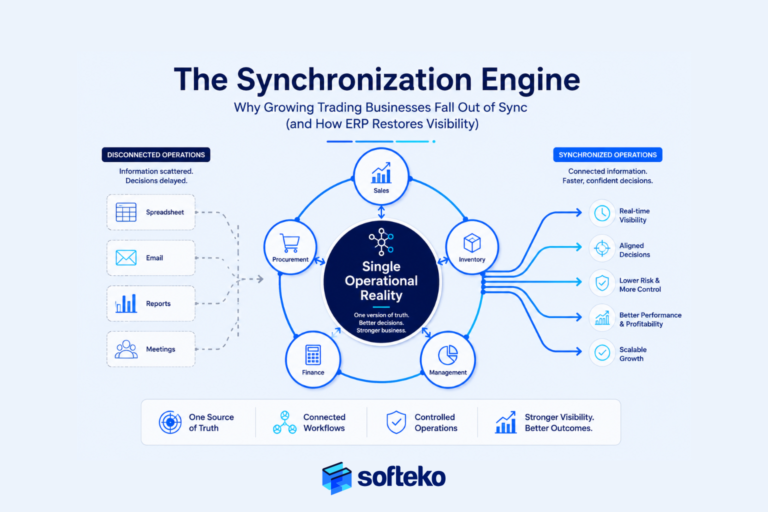
Stock shortages, margin erosion, working-capital pressure, conflicting management reports: these usually look like separate operational problems. They aren’t. They share one root cause — Sales, Procurement, Inventory, and Finance making decisions from different versions of reality.
Small trading businesses can absorb this through hallway conversations and shared spreadsheets. Growth breaks the model. Every additional customer, supplier, warehouse, and shipment increases the number of decisions that must stay synchronized — and the cost of keeping them aligned through manual communication (“synchronization debt”) compounds quietly until profitability suffers.
The fix isn’t more reports, more meetings, or more spreadsheets. It’s a single operational reality every department reads from. That’s what ERP, properly implemented as a synchronization engine rather than a software project, actually delivers.
A Customer RFQ Requires Multiple Departments
A customer sends an RFQ (Request for Quotation) for 100 metric tons (MT) of product, CIF delivery, 30-day shipment requirement, standard credit terms. From the customer’s perspective it’s a simple request. From the inside, no single department can answer it alone.
| Question the customer needs answered | Department that holds the answer |
|---|---|
| Is the product available? | Supply Chain / Inventory |
| Can suppliers meet the schedule? | Procurement |
| Does the customer have available credit? | Finance |
| Will the transaction meet margin requirements? | Finance + Sales |
| Can logistics support the timeline? | Operations |
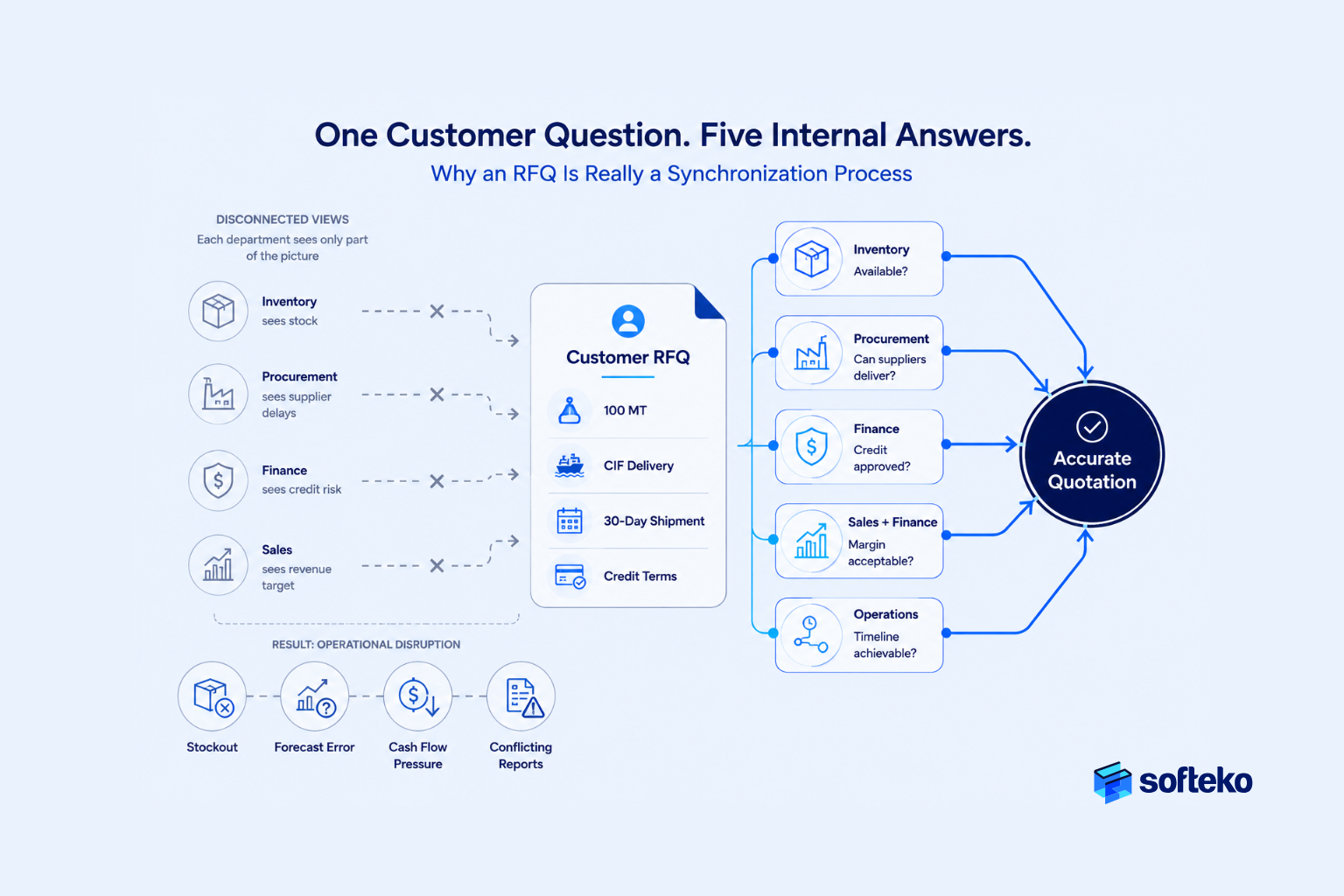
What appears to be a sales activity is actually a synchronization activity. The quotation is only as accurate as the synchronization between the departments that hold each piece of the answer.
This is where many growing trading businesses begin to struggle. The problem is rarely that departments stop performing. The problem is that they begin operating with different information, different timelines, and different priorities — Sales sees opportunity, Procurement sees supplier constraints, Warehouse sees inventory limits, Finance sees credit exposure, Management sees revenue targets.
Everyone is working. Everyone is making decisions. Yet operational problems still increase: stock shortages get more frequent, forecasts get less reliable, working capital gets harder to manage, reports start contradicting each other. Most companies assume these are separate problems. They’re not — they share one root cause.
How Growth Creates Synchronization Debt
A small trading business can operate successfully without sophisticated systems because people compensate for missing visibility. The commercial manager remembers current inventory. Procurement sits a few desks from Sales. Finance verifies customer exposure with a quick conversation. The business runs on shared physical proximity.
Growth breaks that. New markets, more suppliers, larger SKU portfolios, more warehouses, accelerating customer transactions — and information that once lived in a few hallway conversations becomes scattered across departments. Visibility breaks faster than processes do.
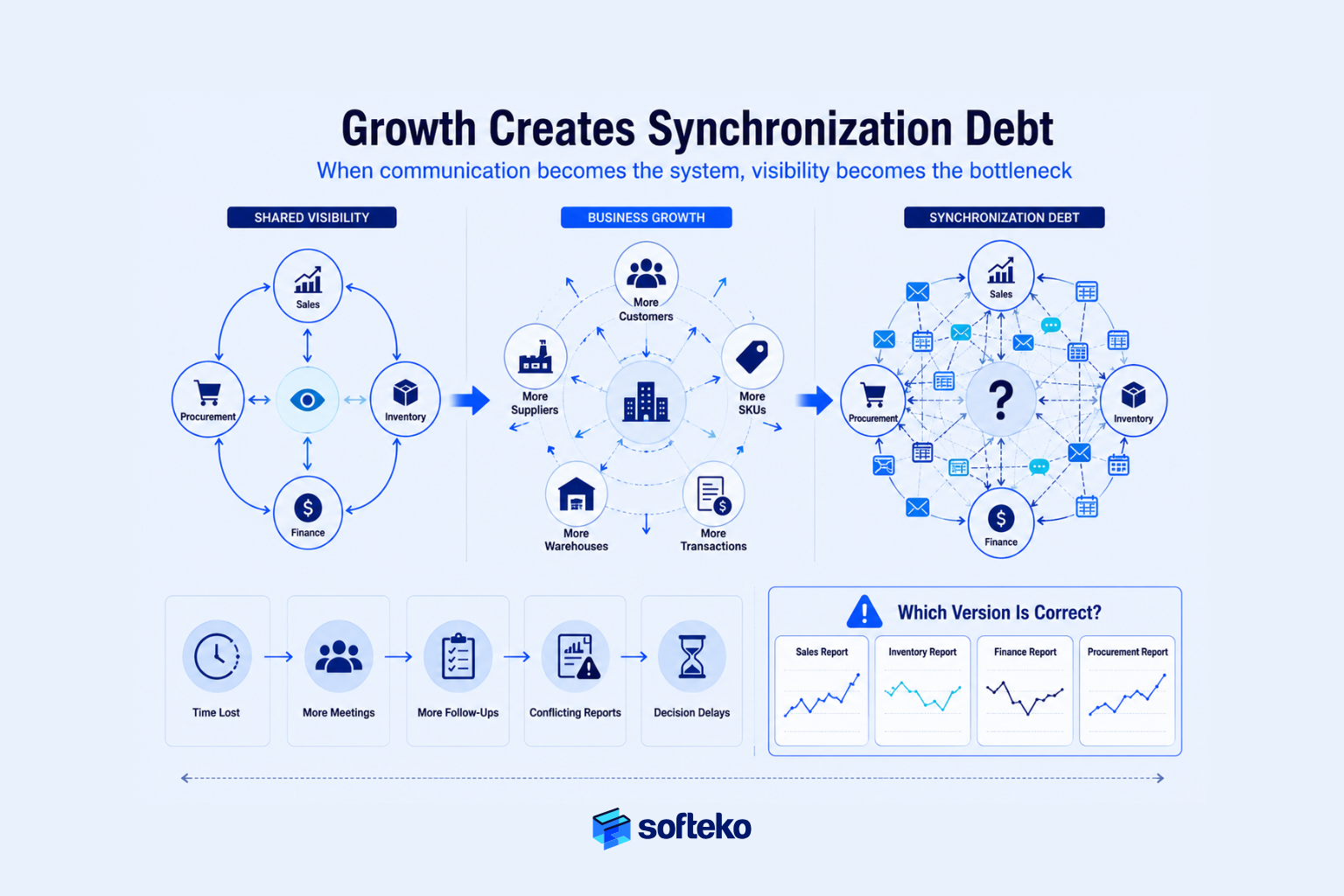
Synchronization debt is the accumulated operational cost of keeping departments aligned through manual communication instead of shared visibility.
At first the debt looks manageable: more emails, more spreadsheets, more meetings, more follow-ups. As transaction volume rises, it compounds. Employees end up spending more time synchronizing information than executing decisions. The business becomes busy, but visibility declines — and the first warning sign is conflicting reports: every department’s data is technically accurate, but management still can’t answer the simple question “what is actually happening right now?”
How One Customer RFQ Moves Through Your Business
Most synchronization failures don’t begin when goods arrive at the warehouse. They begin when a customer asks for a quote. Here’s what happens to that 100 MT inquiry inside a growing trading business:
| Step | What happens | The synchronization risk |
|---|---|---|
| 1. Sales receives RFQ | Salesperson wants to respond fast | Assumes inventory, supplier lead times, margin, and credit instead of validating |
| 2. Internal validation begins | Supply Chain, Procurement, Finance, Operations contribute info | Each works in their own spreadsheet; no shared record |
| 3. First version of reality emerges | Quotation built from validated inputs | Risk if any input is stale |
| 4. Customer issues a PO | Quantity changes from 100 MT to 150 MT | Triggers a second full validation cycle — often skipped |
| 5. Payment readiness | Customer payment, LC, or credit confirmation | Procurement often moves before this is confirmed → exposure |
| 6. Procurement & shipment | Supplier POs, freight bookings, container availability | External info changes; updates don’t propagate to internal teams |
| 7. Shipment changes | Vessel delay, port congestion, schedule revision | Sales/Finance/Management often discover this from the customer |
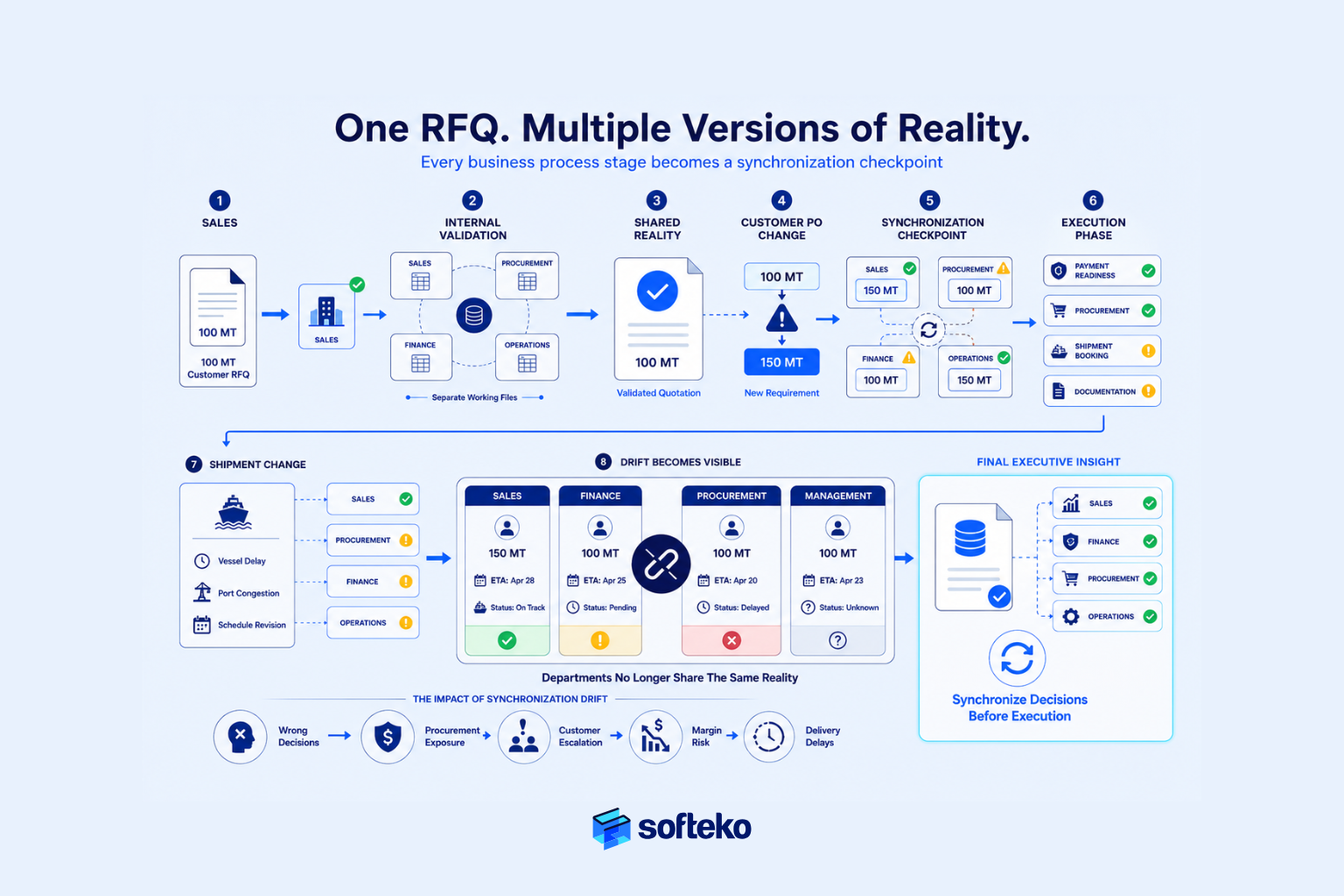
The pattern: every critical stage is a synchronization checkpoint. When it works, the transaction moves forward on a shared reality. When it fails, departments quietly drift apart — and the drift only becomes visible when something breaks downstream.
The companies that scale successfully don’t rely on better people; they synchronize decisions before execution begins. The companies that fail to synchronize early end up managing the consequences later — and those consequences are rarely small.
How Disconnected Departments Reduce Profit
Most trading businesses don’t lose money because a single department fails. They lose money because departments make decisions that are technically correct but operationally disconnected. The cost rarely appears immediately — it accumulates across dozens or hundreds of transactions until symptoms surface:
| Visible symptom | Likely upstream cause |
|---|---|
| Inventory shortages | Sales forecast change didn’t reach Procurement |
| Excess stock | Procurement bought before Sales forecast was revised |
| Emergency purchases | Late visibility into demand spike |
| Margin erosion | Quotation issued before landed-cost validation |
| Working-capital pressure | Procurement commitments outran payment readiness |
| Conflicting reports | Each department’s spreadsheet was correct on a different date |
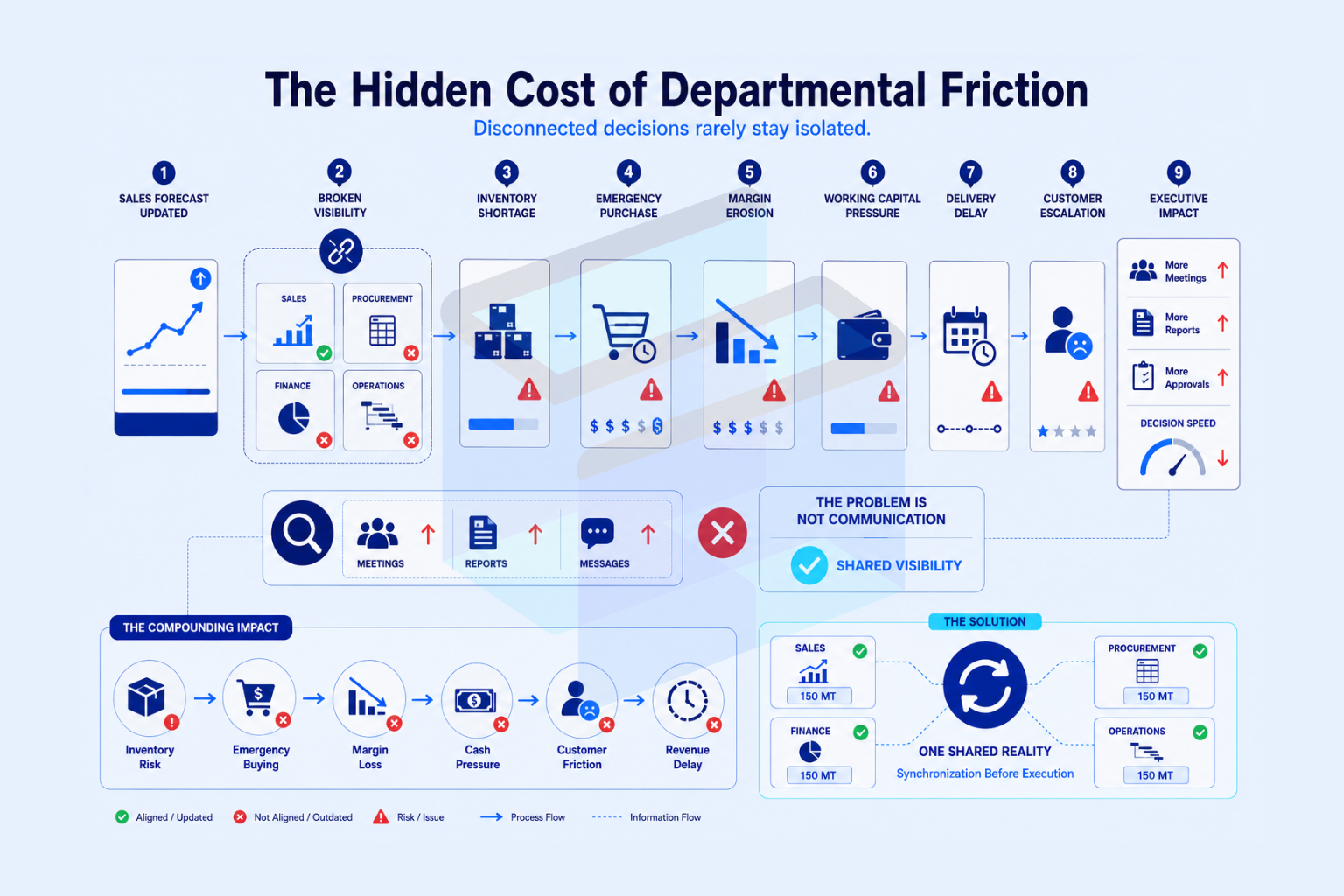
The real cost is the compounding effect: a synchronization failure rarely affects one process — it cascades. A late procurement order delays inventory arrival, delays shipment, delays revenue recognition, delays cash collection, damages customer trust. One disconnected decision creates consequences across procurement, logistics, financing, and retention costs simultaneously.
Recent supply-chain analysis puts the financial impact of disruptions and coordination failures at roughly 8% of annual revenue. For trading businesses operating on narrow margins, synchronization failure isn’t an operational inconvenience — it’s a direct profitability tax.
There’s a second cost most businesses don’t measure: management attention. When visibility declines, decision speed declines. Teams hold more meetings, request more reports, take longer to approve work. Gartner’s research found that teams experiencing collaboration drag are 37% less likely to hit revenue goals — employees aren’t underperforming, they’re coordinating instead of executing.
Most organisations try to fix this by increasing communication: more meetings, more updates, more reports, more spreadsheets. The result is information overload, not synchronization. The problem was never a lack of communication. It was a lack of shared visibility.
How Spreadsheets Create Different Versions of Business Data
When executives discuss visibility problems, spreadsheets are rarely mentioned first. By the time spreadsheets come up, the damage has already happened. The spreadsheet itself isn’t the problem — what spreadsheets force the organisation to do is the problem.
Most operational spreadsheets are reasonably accurate. The issue is timing:
| File | Updated | Department’s “current reality” |
|---|---|---|
| Sales Forecast.xlsx | 10:00 AM today | Demand confirmed this morning |
| Inventory Report.xlsx | 2:00 PM yesterday | Stock as of yesterday afternoon |
| Procurement Tracker.xlsx | 4:00 PM yesterday | Supplier commitments through yesterday |
| Cash Flow Forecast.xlsx | Tomorrow 9:00 AM | Today’s reality… tomorrow |
| Shipment Schedule.xlsx | This morning | Shipments as of overnight |
No file is wrong. The synchronization is gone — every department is now working from a different operational reality.
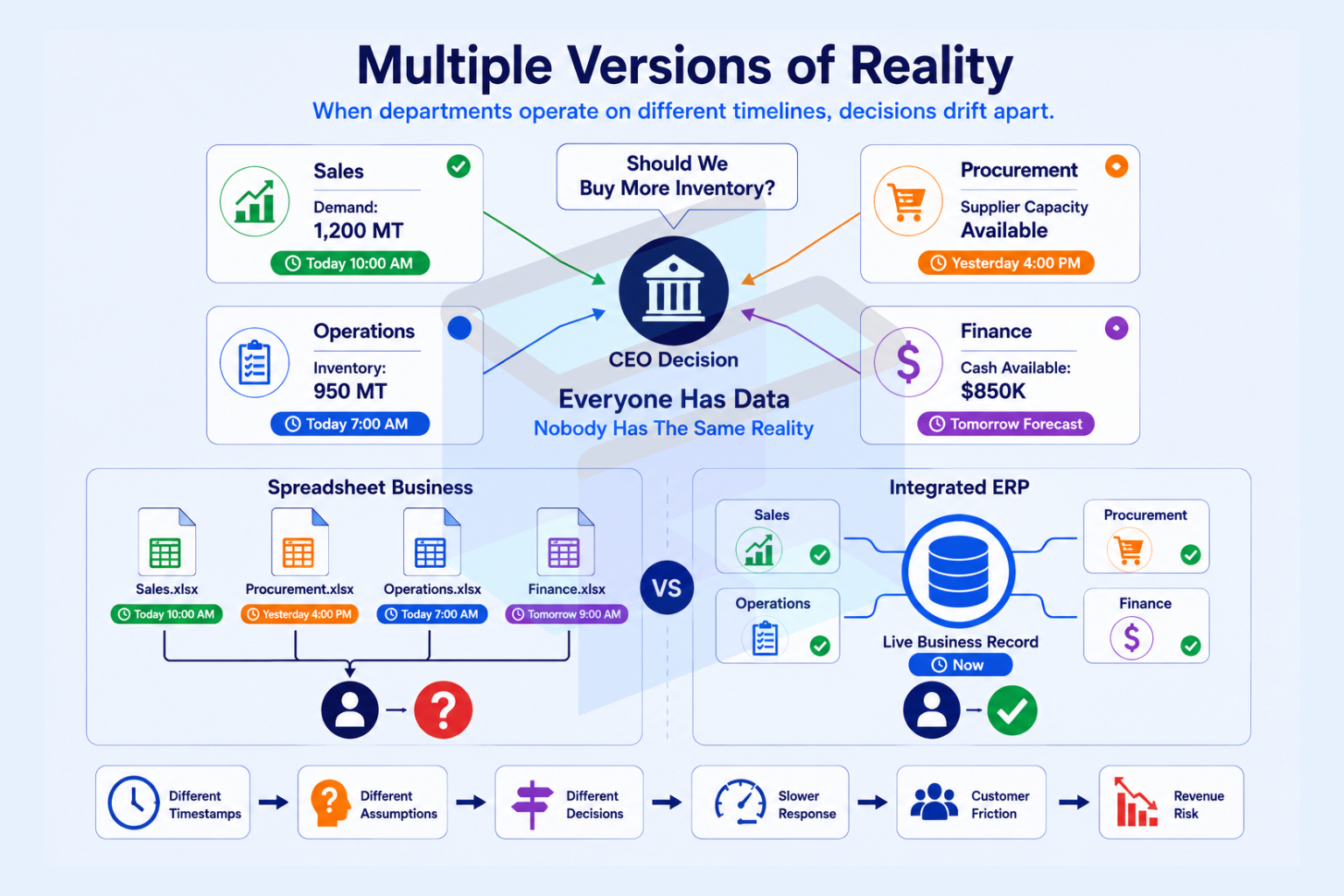
Why More Spreadsheets Create More Data Gaps
Most trading businesses begin with one spreadsheet. Growth introduces complexity, complexity introduces tracking files, and eventually departments start building their own visibility systems — Sales quotation tracker, Procurement supplier tracker, Operations shipment tracker, Finance exposure tracker. Each file exists because someone needs visibility. The irony is that every new spreadsheet increases fragmentation. The organisation generates more information while reducing shared visibility.
This is why 86% of B2B purchases stall — internal misalignments and information gaps slow deals at exactly the moment buyers expect responsiveness. The challenge isn’t producing more reports. It’s ensuring every department answers from the same source.
5 layers of Operational Synchronization
Synchronization is not a reporting problem. It is a decision-making problem. Businesses that maintain control as they scale perform well across five distinct layers — and a breakdown at any layer weakens the whole.
| # | Layer | The question it answers | Failure mode |
|---|---|---|---|
| 1 | Visibility | Can departments see the same information? | Each team works from its own report |
| 2 | Alignment | Do departments interpret information through shared objectives? | Local optimisation; global suffering |
| 3 | Coordination | When something changes, does the rest of the organisation know? | Updates depend on emails, follow-ups |
| 4 | Execution | Do operational controls get followed consistently? | Workflows bypassed under pressure |
| 5 | Decision quality | Are decisions made on current operational information? | Decisions arrive late or contradict reality |
Each layer depends on the one before it. Visibility alone doesn’t fix alignment. Alignment alone doesn’t guarantee coordination. Coordination alone doesn’t ensure execution. And without execution, decision quality stays poor. Academic research on real-time operational visibility confirms the same point: visibility is the primary driver for ERP adoption, but its real business value shows up only when it’s tied to coordinated decision-making across functions.
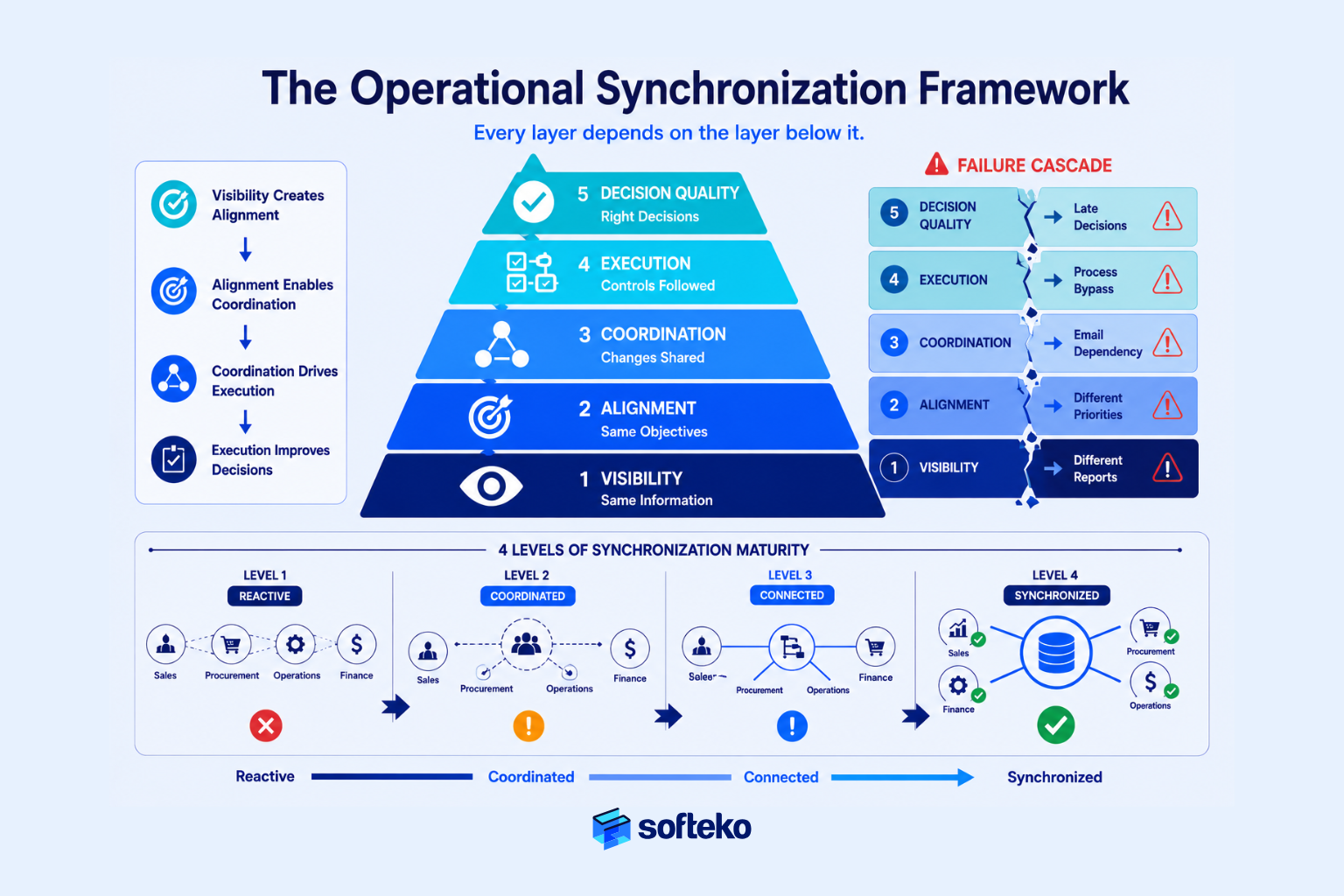
The 4 Stages of Operational Synchronization
| Level | Stage | What it looks like |
|---|---|---|
| 1 | Reactive | Departments operate independently. Spreadsheets dominate. Visibility is limited. Problems discovered after they occur. Management firefighting. |
| 2 | Coordinated | Basic reporting exists. Meetings are the primary sync mechanism. Visibility improves but stays delayed. Growth exposes weaknesses. |
| 3 | Connected | Operational information flows across departments. Transactions create visibility beyond individual teams. Manual coordination decreases. |
| 4 | Synchronized | Organisation operates as a single system. All functions work from the same reality. Visibility is immediate. Controls are embedded in workflows. Scalable growth becomes possible. |
Most growing trading businesses sit at Level 2 — coordinated but not connected — and don’t realise it until growth makes the gap visible.
Why Business Growth Increases Synchronization Problems
A synchronization issue affecting 5 transactions per week may go unnoticed. The same issue affecting 500 transactions per week becomes impossible to ignore. Growth doesn’t create synchronization problems — it exposes them.
This is especially true in modern B2B trading. Industry research shows that 56% of B2B revenue is now generated through digital channels — meaning real-time stock visibility, accurate quote feasibility, and live commitment tracking are no longer optional. A digital portal showing “in stock” while the warehouse is actually empty is a synchronization failure that becomes a customer-trust failure in seconds.
Every additional customer, supplier, warehouse, and shipment increases the number of decisions that must remain synchronized. Trading businesses face this more acutely than most because they operate across many external parties — customers, suppliers, freight forwarders, customs brokers, banks — each introducing additional information flows. Without synchronized visibility, operational complexity grows faster than the organisation’s ability to manage it.
How ERP becomes a synchronization engine
Most ERP discussions start in the wrong place — with modules. That approach explains software; it doesn’t explain why businesses implement ERP. Trading businesses don’t invest in ERP because they need more modules. They invest because operational synchronization becomes impossible to maintain manually.
The real purpose of ERP is not automation. It is synchronization. ERP creates a shared operational reality where the transaction moves the information, not people.
Manual Coordination vs ERP-Based Synchronization
| Without ERP | With integrated ERP |
|---|---|
| RFQ → Sales spreadsheet → Email to Procurement → Procurement tracker → Email to Finance → Credit validation → Operations review → Quotation | RFQ → Validation workflow on shared record → Quotation |
| Information moves through people | Information moves through the transaction |
| Each handoff = delay + risk of stale data | Update once, visible to everyone immediately |
| “Where is the latest packing list?” investigation | Latest version always on the transaction |
| Reports describe different slices of reality | Reports describe the same reality |
A recent industry study reports 95% of businesses experienced significant process improvements after adopting ERP — but the most important benefit isn’t faster transactions. It’s reporting confidence: when every department operates from the same transaction stream, reports stop contradicting each other because they already share the same source.
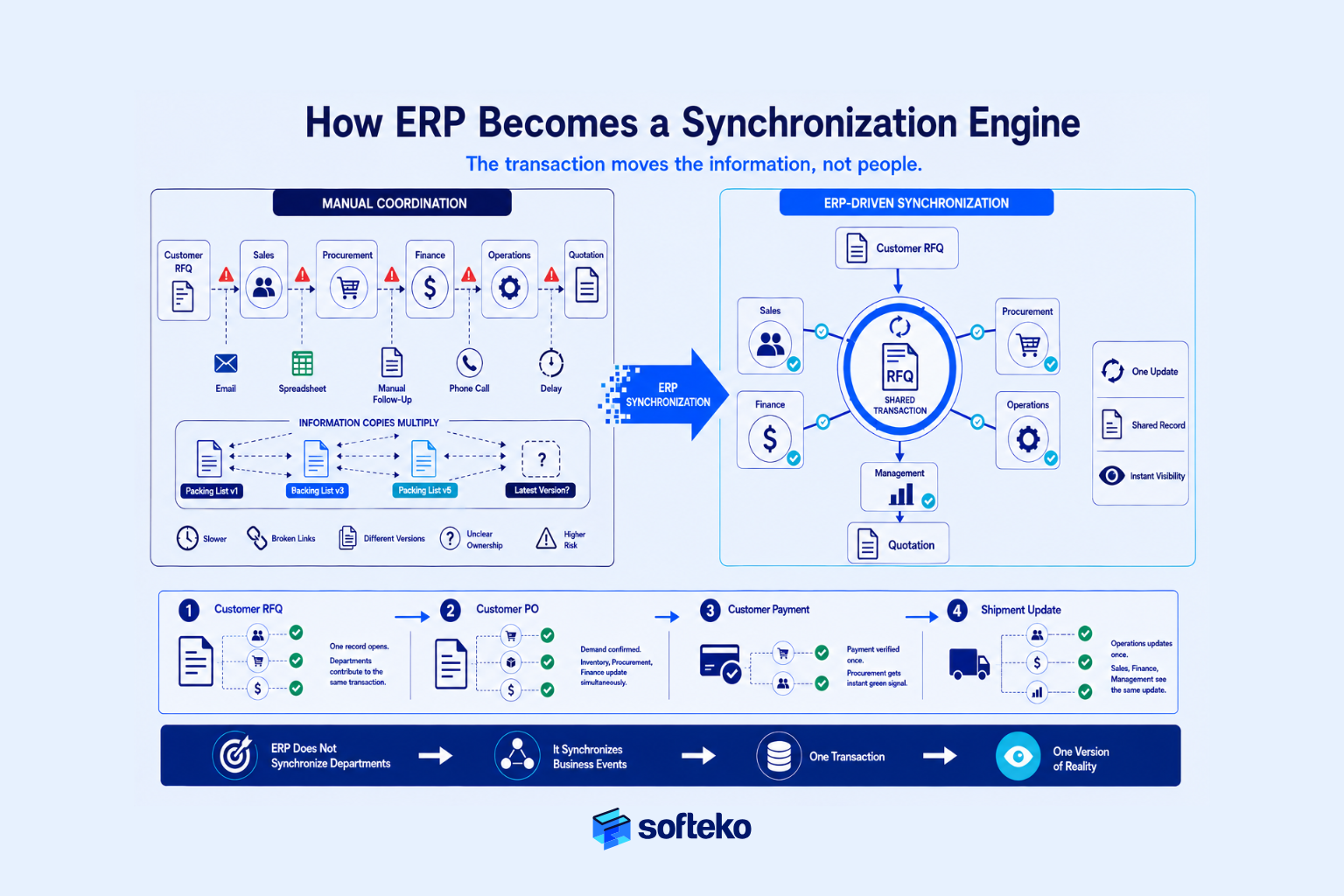
ERP Synchronizes Business Events Instead of Departments
This is a critical reframing. ERP doesn’t synchronise departments — it synchronises business events:
| Event | What becomes synchronized |
|---|---|
| Customer RFQ | Required validations begin; departments contribute to one record |
| Customer PO | Demand confirmed; inventory + procurement + financial exposure update simultaneously |
| Customer payment | Payment readiness visible; procurement can proceed confidently |
| Shipment update | Operations updates once; Sales, Finance, Management see the same change |
This is synchronization — not integration, not automation. The transaction itself becomes the carrier of operational truth.
How Odoo connects Sales, Procurement, Inventory & Finance
The Odoo value isn’t in the modules — it’s in maintaining a single operational reality as one transaction moves across functions. The connected workflow looks like:
RFQ → Validation → Quotation → Customer PO → Payment readiness → Supplier PO → Shipment → Goods Receipt → Invoice → Collection
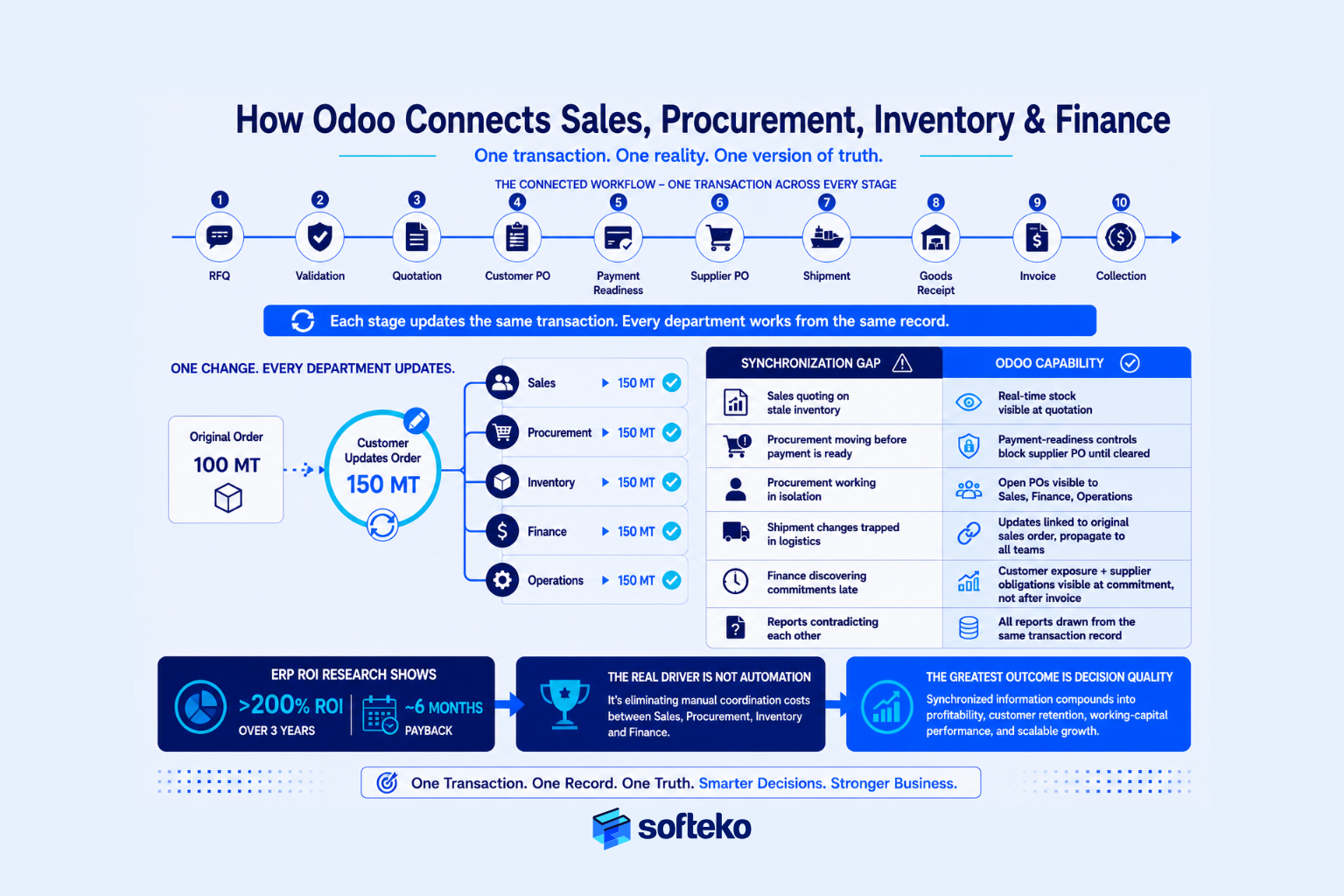
Each stage updates the same underlying transaction. Each department reads the same record. When the customer changes the order from 100 MT to 150 MT, the impact is visible to Inventory, Procurement, Finance, and Operations simultaneously — not via a chain of forwarded emails.
| Synchronization gap | Odoo capability |
|---|---|
| Sales quoting on stale inventory | Real-time stock visible at quotation |
| Procurement moving before payment is ready | Payment-readiness controls block supplier PO until cleared |
| Procurement working in isolation | Open POs visible to Sales, Finance, Operations |
| Shipment changes trapped in logistics | Updates linked to original sales order, propagate to all teams |
| Finance discovering commitments late | Customer exposure + supplier obligations visible at commitment, not after invoice |
| Reports contradicting each other | All reports drawn from the same transaction record |
When research on ERP ROI reports integrated cloud-ERP delivering >200% ROI over three years with ~6-month payback, the headline driver is rarely “automation.” It’s eliminating the manual coordination cost that previously sat between Sales, Procurement, Inventory, and Finance.
The greatest business outcome isn’t efficiency — it’s decision quality. Two companies with the same people, products, and customers will perform differently if one operates from fragmented information and the other from synchronized information. That advantage compounds over time into profitability, customer retention, working-capital performance, and growth.
Restore operational synchronization before it slows your growth
If your business relies on spreadsheets, status meetings, and manual follow-ups to stay aligned, synchronization debt is already accumulating. The cost shows up everywhere — as inventory friction, working-capital pressure, slower decisions, and reports nobody quite trusts.
At Softeko, we help trading, wholesale, distribution and import-export businesses map operational workflows, identify visibility gaps, and implement Odoo ERP as a synchronization engine across Sales, Procurement, Inventory, Logistics, Finance and Management.
The objective isn’t software. It’s a single operational reality that supports faster decisions, stronger control, and growth that doesn’t outrun visibility.
FAQ
What is operational synchronization?
The process of ensuring Sales, Procurement, Inventory, Finance, Logistics, and Management make decisions using the same information at the same time. When departments operate from different data, timelines, or assumptions, operational friction increases — synchronization creates a shared operational reality.
What is synchronization debt?
The accumulated operational cost of keeping departments aligned through manual communication (emails, phone calls, WhatsApp, spreadsheets, follow-ups) instead of shared visibility. As transaction volume grows, the debt compounds — and employees end up spending more time synchronizing information than executing decisions.
Why do departments fall out of sync as a business grows?
Growth multiplies information flows. More customers, suppliers, products, warehouses, and shipments mean more decisions that must stay aligned. When visibility systems don’t evolve at the same pace, departments rely on separate spreadsheets and start working from different versions of reality.
What is a single source of truth?
A business principle, not a database. It means when a customer order changes, every department sees the same change. When inventory changes, every team sees the same position. The technology is secondary — the principle is what matters.
What’s the difference between communication and visibility?
Communication means people exchange information. Visibility means people already have access to it. A sales rep shouldn’t need to call three departments to know whether a quotation is feasible. Eliminate communication that exists only because visibility is missing.
How is synchronization different from process automation?
Automation focuses on completing tasks automatically. Synchronization focuses on ensuring every department works from the same information. A business can automate processes and still suffer from poor synchronization if departments continue operating with disconnected data.
Why do trading businesses face this more than other industries?
Trading operates across many external parties — customers, suppliers, freight forwarders, customs brokers, banks — each introducing additional information flows. Without synchronized visibility, operational complexity grows faster than the organisation’s ability to manage it.
Will ERP automatically synchronise our business?
No. ERP provides the mechanism, but the controls have to be designed first. The most successful implementations standardise workflows, define information ownership, and establish validation checkpoints before configuration begins. ERP enforces synchronization — it doesn’t create it.