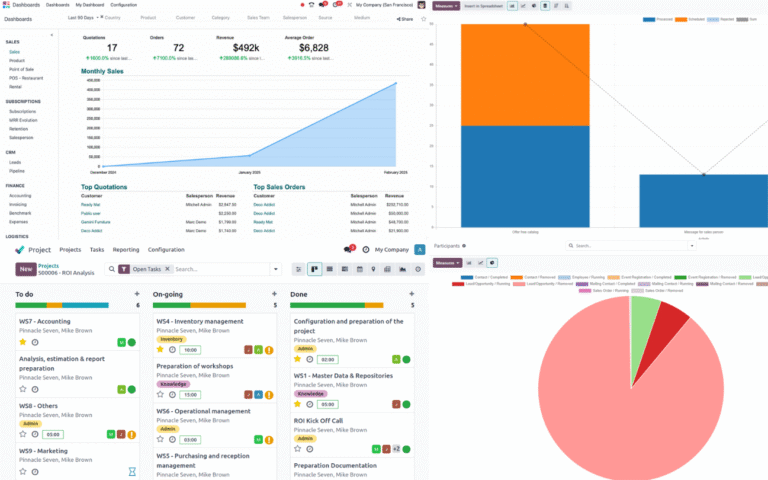
TAM Trading moved margin, credit and cash controls into Odoo.
TAM manages large chemical orders across five GCC markets, with multiple suppliers, warehouses, shipping terms and payment conditions. The new workflow puts the key checks in one place before an order moves forward.
Key controls
- 7-day quote validity
- Automatic landed-cost calculation
- Supplier PO blocked until required approval
- Commission linked to cash collected
TAM Trading at a glance
Business
Chemical trading and distribution
Markets
UAE, KSA, Oman, Qatar, Bahrain
Entities
TAM Trading, TAM Al Arabia, TAM Gulf
Products
Soda ash, sodium bicarbonate, specialty chemicals
Platform
Odoo 19 Enterprise, one multi-company database
Functions
Sales, procurement, inventory, logistics, finance, HR
Odoo apps
CRM, Sales, Purchase, Inventory, Accounting, HR
Requirements
200+ functional requirements across 5 module areas
Timeline
November 2025 to January 2026
Partner
Softeko
TAM Trading: large chemical orders with different ways to ship and pay
TAM supplies soda ash, sodium bicarbonate and specialty chemicals to food, feed, detergent, glass and packaging customers in five GCC markets. Contracts can reach 10,000 to 30,000 tons.
How it ships
Direct from supplier, through a 3PL warehouse, intercompany UAE to KSA, or local from stock.
How it is paid
Letter of credit, advance or partial payment, open credit, or local LC.
How it is priced
CFR, CIF, DDP, DDU, DAP or ex-warehouse, in several currencies, under GCC VAT rules.
What travels with it
Bill of lading, origin and analysis certificates, MSDS, halal and weight certificates, insurance.
Problems that were costing TAM time, money or control
Every deal needed a fresh cost calculation
Supplier price, freight, clearing, duty, storage and bagging loss were added by hand. On thousands of tons, a small error moves the margin.
The deal was spread across messages
Over 80% of communication ran through WhatsApp and email. The proforma, customer PO and LC draft were never kept together.
Credit position was invisible to Sales
At confirmation, Sales could not see credit limit, overdue invoices and LC status in one place.
Stock, shipments and suppliers sat apart
No single view of UAE and KSA stock, incoming cargo or supplier performance, and no common scoring method.
Finance depended on spreadsheets
Accruals and prepayments were reconciled by hand, and an invoice could be booked without a PO and receipt.
HR records followed three rule sets
Leave, probation and end-of-service rules differ across UAE, KSA and Bahrain, and expiry dates were not tracked centrally.
We started with how TAM actually worked
-
We spoke to the people doing the work
We held Q&A sessions and meetings with each department. The Finance requirements, for example, came directly from discussions with TAM's finance stakeholders.
-
TAM's existing process was the starting point
We started with TAM's RFQ-to-Payment flowchart dated 19 November 2025 and its existing forms: pre-sales review (TAM-F-004), customer feedback (TAM-F-008) and supplier assessment (TAM-F-014). The rule was simple: keep the useful parts of the current process, then add the controls it was missing.
-
We used the documents people already work with
TAM's customs declaration, delivery note and tax invoice layouts are reproduced as required. The 2025 enquiry log is migrated, keeping the historical record and the baseline for comparison.
-
Every problem was tied to a specific requirement
Each problem became a numbered requirement with a priority and status. That gives the team a clear link between the business problem and what the system is expected to do.
-
We did not guess where TAM had not decided
Where TAM had not decided a policy, it was recorded as an open decision instead of being guessed. The Finance specification alone has 25 such decisions, including late-payment interest pass-through, Free Zone input VAT recovery and payment holds during disputes.
-
The scope changed as the teams clarified their needs
Between 5 and 23 December 2025, SCM added 13 requirements, including vendor validation, document expiry alerts, MSDS version control and consignee stock. HR added recruitment, visitor and asset tracking.
Each problem, and how Odoo fixed it
Left is the pain. Middle is the fix in Odoo. Right is what the team gains.
| Problem | Solution | Benefit |
|---|---|---|
| Prices and quotes were built manually |
SalesPurchaseInventoryAccounting Adds supplier price, freight, clearing, transport, duty, storage and a fixed 0.4% loss on bulk-to-bag jobs. Sales sees only the base price. Below-target margin, quantity over 500 MT or an urgent flag routes the deal to the CEO. |
Automated cost logic on every quote. Every exception has an approver and a timestamp. |
| The full deal lived in WhatsApp and email |
CRMContacts One record from enquiry to close. RFQ, PO, proforma and LC drafts are versioned. Outlook and WhatsApp stay on the record. A customer PO that changes product, packaging or Incoterm cannot move forward as if nothing changed. |
Anyone can open a deal and see what was offered, when, and at what price. |
| Sales could not see the customer’s real credit position |
ContactsAccounting Credit limit, overdue invoices and LC status on the order screen. Grading A–D and KYC check. Order confirm warns or blocks when over limit or overdue. Sales order only after advance, LC advice or approved open credit. |
No shipment on credit that nobody approved. |
| Stock, shipments and suppliers lived in different places |
InventoryPurchase Pre-sales shows live stock and how much extra to buy. Shipments show ETD, ETA and status. Each delivery scores the supplier (TAM-F-014), so on-time-in-full is visible by supplier and route. |
Buy the shortfall, not a guess. Pick suppliers on scores, not memory. |
| Finance tracked accruals and matches in spreadsheets |
Accounting Three-way match before booking or payment. Revenue follows the Incoterm. Reverse-charge VAT posts itself. Intercompany balances clear at consolidation. |
Month-end runs from system records, not tracker files. |
| People records sat in sheets across three countries |
EmployeesTime OffAttendancePayroll UAE, KSA and Bahrain rules in one place. Probation alerts, leave accrual, visa/passport/permit expiry alerts, end-of-service by country, WPS payroll file. |
Compliance dates show up before they lapse. |
How the project was delivered
We spoke with each department and mapped TAM's existing RFQ-to-Payment process using the 19 November flowchart.
Each team's problems and workflows were mapped to the Odoo modules and features that would cover them.
TAM reviewed the requirements, added missing needs and expanded the scope where the first version did not cover the full process.
The full path from customer enquiry through fulfilment, finance and post-sale follow-up was defined, with sales rebuilt into eight clear requirement areas.
TAM's existing records, forms and process documents were moved into Odoo, and the Sales, Operations, Procurement, Logistics and Finance teams were trained.
After acceptance and go-live, TAM can measure the new process against its 2025 baseline, with the first review planned for day 90.
What TAM runs on today
Sales & Commercial
Salespeople see live stock, pricing and a customer’s credit status before they promise anything to a buyer.
Operations
Every order is checked against the real numbers of cost, margin, and capacity. Before it ever leaves the building.
Procurement
Buyers compare supplier quotes side by side, and know from past performance who actually delivers on time.
Warehouse & Logistics
Everyone can see exactly where a shipment is right now, not just where it’s supposed to be.
Finance
Nothing gets booked or paid without the paperwork behind it. The PO, the receipt, the invoice all have to match.
HR & Admin
Visa, contract and permit expiry dates show up on their own, before they turn into a compliance problem.
What changed for TAM
- Sales can't quote below the approved margin without the required approval.
- Freight, duty, storage and other landed costs are calculated with the deal instead of being worked out manually each time.
- A supplier PO cannot move forward until the customer's payment or approved credit is in place.
- A quote that sits too long gets flagged before the sales team loses track of it.
- The final invoice follows the actual delivered quantity, not just the quantity on the original order.
- Commission follows cash collection, so an order does not trigger commission before the money is collected.